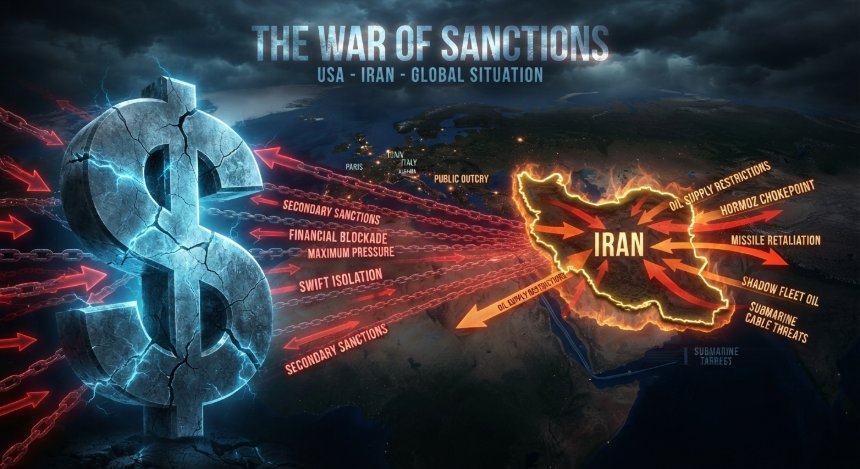

The War of Sanctions
The contemporary global architecture, drafted in the crucible of World War I and codified after World War II as a "Rules-Based Order," has historically relied on a fractured Muslim world divided by sectarianism and systemic poverty. Today, the tools used to enforce this international order have shifted away from traditional battlefields toward the highly coercive international financial system. At the heart of this modern paradigm is "The War of Sanctions," a state of permanent economic hostility primarily driven by the United States against adversaries like Iran. This geopolitical struggle has morphed from a diplomatic compliance tool into an all-out economic war, reshaping regional alignments and testing the limits of global superpower deterrence.
أَعُوذُ بِاللّٰهِ مِنَ الشَّيْطَانِ الرَّجِيمِ
بِسۡمِ ٱللهِ ٱلرَّحۡمَـٰنِ ٱلرَّحِيمِ
In the name of ALLAH, the Most Gracious, the Most Merciful
The War of Sanctions
The War of Sanctions and Hybrid Attrition: The US-Iran Standoff and the Modern Global Order
Introduction
The contemporary global architecture was largely drafted in the crucible of World War I and codified after World War II as the "Rules-Based International Order." Analysts from post-colonial and regional perspectives often argue that maintaining this specific order historically benefited from a fractured Muslim world, frequently divided along sectarian lines and burdened by systemic poverty. For decades, geopolitical maneuvers—whether driven by overt foreign interventions or covert "hidden hands"—ensured that many nations across the Middle East remained entangled in debilitating conflicts.
Today, however, the mechanisms used to police and maintain this global order have shifted dramatically. The definition of modern warfare has expanded far beyond the conventional kinetic battlefield. Today, some of the most devastating geopolitical battles are fought not with missiles, but through the international financial architecture, trade chokeholds, and asymmetric infrastructure disruptions. At the center of this paradigm is "The War of Sanctions," a state of permanent economic hostility primarily driven by the United States and its Western allies against adversaries like Iran. Designed originally as a diplomatic tool to compel behavioral change, economic sanctions have morphed into a weapon of total economic warfare, serving as the modern frontline of global alignment and resistance.
The Evolution of US-Iran Sanctions
The economic architecture of the current crisis dates back to the 1979 Islamic Revolution. Over the decades, Washington’s strategy evolved from primary sanctions—which ban American companies from trading with Iran—to highly coercive secondary sanctions. Secondary sanctions exploit the global dominance of the US dollar, forcing third-party nations and foreign corporations to choose between trading with a mid-sized economy like Iran or maintaining access to the massive US financial market.
The structural collapse of the 2015 Joint Comprehensive Plan of Action (JCPOA) nuclear deal catalyzed a "maximum pressure" doctrine. This campaign has culminated in "Operation Economic Outcast," a sweeping enforcement drive by the US Treasury aimed at the "economic asphyxiation" of the Iranian state. Notably, this model of financial containment is not unique to Iran; similar sweeping sanctions regimes were historically imposed on Iraq during the 1990s, as well as various strategic restrictions placed on Pakistan and other Muslim nations at critical geopolitical junctures, demonstrating a broader structural pattern in how global superpowers police regional actors.
The Humanitarian Tool vs. The Violence of Maximum Pressure
A central point of contention in the war of sanctions is its human cost. Proponents of the Western "maximum pressure" campaign argue that financial blockades represent a vital, non-kinetic tool to constrain state actors from acquiring nuclear capabilities or funding regional proxy networks. From this viewpoint, restricting access to international capital and energy markets is a legitimate defensive strategy to limit an adversary’s capacity to project military power.
Conversely, critics argue that the primary victims of broad-based economic warfare are not the political or military elites, but ordinary citizens. This perspective contends that sweeping financial blockades are designed to crush families, starve children, and induce societal collapse under the guise of diplomatic leverage. Human rights advocates frequently draw parallels to the 1990s sanctions on Iraq—where the massive civilian toll was infamously shrugged off by policymakers as a cost "worth it"—to argue that today’s engineered economic desperation is a brutal strategy that breaks a nation and then blames its people for not rising up in an "organic revolution." While Washington maintains that humanitarian goods are technically exempt, mass "over-compliance" by international banks fearing multi-billion dollar penalties has severed Iran from Western medical supply chains, triggering hyper-inflation and devastating human suffering.
+----------------------------------------------------------------------------------------------------+
|THE TWO FACES OF ECONOMIC WARFARE |
+----------------------------------------------------------------------------------------------------+
| PROPONENTS' VIEW (Strategic Constraint) | CRITICS' VIEW (Humanitarian Toll) |
+----------------------------------------------------------------------------------------------------+
| • Restricts state access to international capital. | • Targets the civilian population disproportionately. |
| • Starves funding for proxy networks & militaries. | • Causes hyper-inflation and critical drug shortages. |
| • Offers a non-kinetic alternative to open warfare. | • Functions as a form of collective punishment. |
+----------------------------------------------------------------------------------------------------+
The Neutralization of Regional Hegemony: The Blow to Western Basing
The paradigm shift from economic warfare to kinetic confrontation has exposed a profound vulnerability in the Western security architecture across the Middle East. For years, a vast network of US military installations distributed throughout Iran's immediate neighbors was heavily promoted as a deterrent force capable of projecting absolute dominance. However, recent escalations have dealt a critical blow to these strategic assets. Ironically, the massive bases trumpeted as regional defense hubs were systematically repurposed by Western commanders to intercept attacks and actively defend Israel, shifting their utility away from regional stabilization.
This repositioning triggered an aggressive, precise response from Tehran. In a series of retaliatory maneuvers, Iranian ballistic missiles and precision drone swarms heavily targeted installations across multiple host nations, penetrating advanced defensive shields and functionally rendering these heavily guarded bases useless for active power projection.
The systemic failure of this basing infrastructure has created immense friction among neighboring Muslim nations. Historically, several regional capitals quietly supported or rejoiced over the strict Western sanctions choking Iran, reposing absolute pride in billions of dollars worth of state-of-the-art US military hardware filling their own arsenals. Yet, the latest flashpoints have proven that these host nations cannot use their purchased American arms at all to safeguard their own sovereignty or dictate regional terms. Finding themselves caught between an unyielding Western mandate and the precision of Iranian missile capabilities, these states have watched their costly defense frameworks morph into liabilities, upending the balance of power in West Asia.
The Limits of Kinetic Interdiction and the "Hormuz Squeeze"
The limits of purely military action have shifted the conflict into a protracted game of competitive learning. Recent history has proven that conventional air weapons and targeted interdiction campaigns cannot decisively disarm Iran or dismantle its deeply entrenched regional security architecture. Having survived initial military escalations, Tehran has been emboldened to demand sweeping concessions from the West, including the unfreezing of overseas assets, the lifting of all primary and secondary sanctions, and a rebalancing of security dynamics in West Asia.
To force the United States to concede to these demands, Iran deployed a cost-imposition strategy centered on the Strait of Hormuz—a maritime corridor responsible for a fifth of the world’s petroleum trade. By threatening commercial shipping and driving international oil prices into triple digits for extended periods, Iran sought to exploit Western economic vulnerabilities, particularly ahead of crucial political milestones like US mid-term elections.
However, the strategic efficacy of this "Hormuz squeeze" remains a subject of intense debate:
• The Case for a Western Victory: Some military analysts code this phase as a defeat for Iran. They argue that the US and its allies successfully navigated the game of cat-and-mouse, securing the maritime corridors and preventing Iran from gaining permanent control over the price of crude, thereby closing the political window for Iran to coerce immediate sanctions relief.
• The Case for a Protracted Attrition: Other strategists contend the game is far from over. With oil prices hovering in triple digits for months on end, the economic toll on Western consumers remains a potent, continuous pressure point, forcing both sides into a much longer, grinding struggle of endurance.
The Expansion into Hybrid Warfare: The Submarine Cable Threat
As the traditional options of sanctions and naval skirmishes reach their strategic limits, the theater of conflict has expanded from oil tankers to global digital infrastructure. Recent warnings from the Islamic Revolutionary Guard Corps (IRGC) have put seven strategic undersea internet cables running beneath the Strait of Hormuz on the active target list.
[ GLOBAL DIGITAL TRAFFIC ]
│
┌──────────────────────────────┴──────────────────────────────┐
▼▼
[ Physical Transit: 20% of Oil ] [ Digital Transit: Subsea Data Cables ]
││
└──────────────────────────────┬──────────────────────────────┘
▼
[ STRAIT OF HORMUZ CHOKEPOINT ]
The Strait is not merely an energy artery; it is one of the world's most critical bottlenecks for submarine communications infrastructure, carrying the vast majority of internet and data traffic between the Gulf states and the wider world. Iranian officials have made it clear that in the event of an open war, these cables, alongside regional data centers and Western-linked AI facilities, will face asymmetric disruption. Cutting these digital lifelines represents a shift toward total hybrid warfare. The resulting chaos would instantly paralyze regional financial transactions, cross-border communications, and digital supply chains, demonstrating that the modern war of sanctions can no longer be contained to a single region.
Ethical Frameworks and the Geopolitical Realignment
The international response to this standoff is deeply shaped by historical and philosophical alignment. In European statecraft, particularly within Germany, intellectuals like Jürgen Habermas have long argued that defending the security of Western allies in the region is a foundational moral obligation rooted in the lessons of the 20th century. This deeply entrenched intellectual framework explains why Western coalitions often maintain a rigid, unified front regarding regional security, even when faced with significant domestic economic blowback, energy inflation, or intense ethical debates regarding the civilian costs of their policies.
However, the weaponization of the SWIFT banking system and the US dollar has inadvertently accelerated a shift away from the post-WWII unilateral order toward a multipolar financial ecosystem. To survive the Western blockade, Iran has integrated its economy into sanction-resistant networks—utilizing front companies in the UAE, expanding trade with China, establishing alternative banking portals, and leveraging digital assets.
Five Decades of Sanctions on Iran and Global Consequences
For nearly five decades, Iran has endured an exhausting blockade of unilaterally imposed US sanctions designed to cripple its state capacity, restrict its trade, and isolate its financial system. However, this long period of structural isolation has ultimately forced a shift in Iran’s defensive calculus. When pushed into a corner by decades of economic encirclement, Tehran began responding aggressively to what it frames as Western bullying, leveraging its unique geographical position to pivot from passive endurance to active cost-imposition.
By implementing restrictions on oil shipping corridors and pairing them with explicit threats to sever critical submarine internet infrastructure, Iran has demonstrated its capacity for asymmetric retaliation. The global consequences of this strategy have manifested with remarkable speed. While Iran weathered sanctions over several generations, the Western world has felt severe systemic shocks within just a few months. The resulting surge in energy prices, compounding a wider housing and cost-of-living crisis, has triggered widespread social unrest. A volatile autumn of public outcry has erupted across Europe, with massive protests, strikes, and street demonstrations breaking out in nations like France, Spain, Italy, and Albania. This sudden structural vulnerability highlights a glaring reality: in a deeply interconnected global system, a state that has been economically cast out for decades can still wield the power to rapidly disrupt the stability of the very empires that sought to isolate it.
Conclusion
The current situation demonstrates that the war of sanctions has reached a volatile equilibrium. Rather than forcing a total capitulation, decades of economic warfare have entrenched the target state's ruling elite, impoverished its civilian population, and pushed the conflict into dangerous new frontiers. As the standoff expands from the financial system and naval chokepoints into the disruption of global undersea data networks, it becomes clear that sanctions are no longer a peaceful alternative to war. They are the frontline of a highly unpredictable, interconnected global conflict that threatens both international energy security and the stability of the global digital economy.
Moreover, the war of sanctions has significantly strengthened Iran's regional ideological standing. It has fortified Tehran's narrative that US-backed regional rulers are actively working against broader Muslim interests by aligning with Western and Zionist strategic agendas. While Western policymakers may operate under intellectual frameworks akin to Jürgen Habermas's theory of state responsibility, the Islamic world operates on entirely different historical and theological imperatives. Ultimately, the protracted US-Iran economic war, coupled with the active military confrontations of this past year, has inadvertently narrowed the traditional Shia-Sunni fractures. These sectarian divides, which critics argue were meticulously cultivated by external handlers to keep the region weak, have begun to erode in the face of a shared structural adversary, fundamentally altering the geopolitical and religious alignment of the modern Middle East.
Bagasse Pulp Price Trend Q2 2026 | Price Trends, Forecast, Chart, Pric...


Online Slot Game: A total Guidebook for you to Capabilities, Game play...
Online Slot Game: A total Guidebook for you to Capabilities, Game play, along with Tricks...

How to Choose the Right Plastic Surgeon in Chicago, IL
Choosing to undergo plastic surgery is a personal decision that deserves careful thought,...
