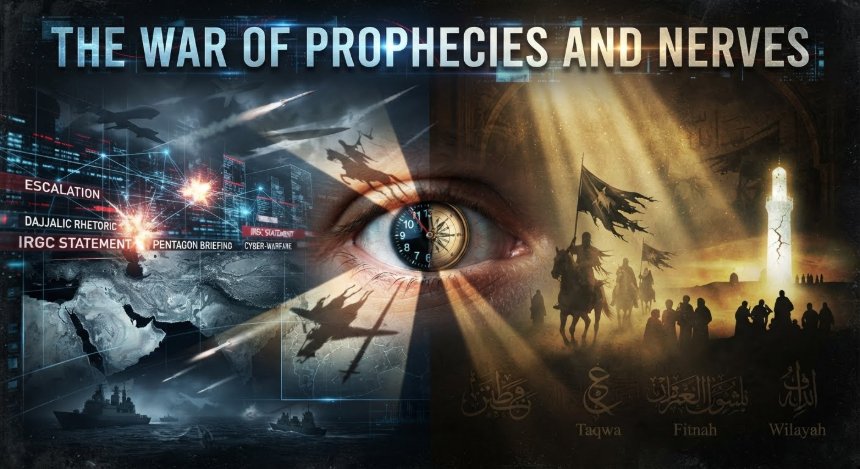

"The War of Prophecies and Nerves"
"The War of Prophecies and Nerves" represents the ultimate convergence of modern material warfare and ancient eschatological frameworks. In this high-stakes psychological landscape, global conflicts are no longer viewed merely as battles over resources or geography, but as the literal fulfillment of end-times predictions regarding Imam Mahdi and the Dajjal. By weaponizing these deep-seated spiritual convictions, modern superpowers and regional actors transform kinetic battlefields into a profound war of nerves. Ultimately, this collision forces humanity to navigate a calculated maze of media manipulation, imperial dominance, and spiritual deception.
أَعُوذُ بِاللّٰهِ مِنَ الشَّيْطَانِ الرَّجِيمِ
بِسۡمِ ٱللهِ ٱلرَّحۡمَـٰنِ ٱلرَّحِيمِ
In the name of ALLAH, the Most Gracious, the Most Merciful
The War of Prophecies and Nerves: Academia, Tradition, and the Eschatological Synthesis of Dajjāl and Sufyānī
The Crisis of the Bottom-Up Paradigm
Modern Western academia operates on a highly restrictive epistemological foundation. It prioritizes a bottom-up, empirical model that focuses exclusively on isolated data points, historical particulars, and material patterns. By design, this methodology severs itself from metaphysical universals, ontological structures, and deep psychological analysis. It treats the universe not as a coherent, meaningful cosmos, but as a fragmented collection of accidents to be observed, cataloged, and deconstructed.
This structural limitation creates an intellectual trajectory toward nihilism. When human inquiry is restricted to the purely material and empirical, it lacks the capacity to synthesize its findings into a meaningful whole. Academia is not designed to offer a comprehensive paradigm that unifies the philosophical, mystical, psychological, and jurisprudential dimensions of existence. Consequently, those who rely solely on academic analysis—while abandoning the top-down framework of sacred Tradition—frequently find themselves stranded in an intellectual and spiritual no-man’s-land. Rather than cultivating heightened God-consciousness (Taqwā) or a refined mystical demeanor, a purely academic approach often produces the exact opposite: an alienated, fractured consciousness stripped of sacred reverence.
[ TRADITION: Top-Down ]
Divine Wilāyah (Guardianship)
│
▼
Metaphysical Universals
│
▼
Holistic Truth & Meaning
[ ACADEMIA: Bottom-Up ]
Isolated Empirical Particulars
│
▼
Material Fragmentation
│
▼
Nihilism & Loss of Meaning
Within the scope of Tradition, the search for truth is an upward journey through a sacred hierarchy. As a seeker climbs this hierarchy, they encounter increasingly nuanced, sublime, and all-comprehensive modes of understanding. Academia reverses this trajectory. Because it lacks a transcendent anchor, its pattern-seeking cannot lead to a higher structural reality. This limitation is frequently defended under the guise of an "unbiased attitude." Western academic discourse routinely dismisses theology, metaphysics, and philosophical universals, branding the pursuit of an all-encompassing, sacred Truth as a form of bias.
In reality, true objectivity requires a holistic worldview. Restricting reality to a rigid, empirical framework while ignoring the spiritual and metaphysical architecture of existence is itself a profound bias. Where the structural limits of empirical academia end, the expansive genius of Tradition begins. Even the lower, external modes of a traditional paradigm retain a connection to the absolute, making them inherently more oriented toward truth than a system completely divorced from the transcendent.
The Metaphor of the One Eye: Dajjāl and Western Empiricism
This fragmented, empirical methodology is not merely an academic shortcoming; it functions as a defining spiritual reality of the modern era. The one-eyed empirical system, when paired with the global reach of Western imperialism—which is the direct geopolitical manifestation of a purely materialist worldview—can be understood as the structural Dajjāl of our time.
The traditional eschatological description of the Dajjāl as "one-eyed" serves as a precise description of this epistemological condition:
- The Single Eye: Represents a hyper-fixation on the material, quantified world while remaining completely blind to the spiritual, metaphysical realm.
- The Illusion of Detail: It is a structure designed to make the human intellect get lost in a single pixel in isolation. By hyper-focusing on the minute, fragmented component, it forces the observer to lose touch with the greater reality in all its nuanced perfection.
- The Imperial Force: This systemic blindness is weaponized through global structures to systematically dismantle traditional, holistic ways of living and knowing across the world.
The Counterfeit Order: Sufyānī as the Deficient Tradition
Correspondingly, a manifestation of Tradition that lacks divine guardianship (Wilāyah) functions as the Sufyānī. Just as the academic-imperial complex represents an external, materialistic assault on truth, the Sufyānī represents an internal, structural corruption of religious form.
ConceptEpistemological NatureCore DeficiencyDajjāl (The Modern Empirical System)Bottom-up materialism, hyper-focused on isolated particulars and physical dominance.Completely blind to metaphysical universals and the spiritual realm.Sufyānī (The Deficient Tradition)Rigid, external religious form devoid of living, transcendent authority.Lacks the eye of completion and divine guardianship (Wilāyah).
The Sufyānī represents a traditionalism that has lost its living spirit. It retains the outer shell, the rhetoric, and the legalistic mechanics of religion, but it lacks the internal light of authentic spiritual authority and divine custody. Because it lacks this eye of completion, it remains fundamentally incomplete and vulnerable to manipulation.
The Grand Synthesis of Evil
Though Dajjāl and Sufyānī appear to operate from opposite ends of the spectrum—one presenting as secular, materialist modernity and the other as religious traditionalism—they are esoterically aligned. The Sufyānī functions as an ideological branch of the broader Dajjālic structure. Because both systems lack a connection to the true, holistic reality of divine authority, their ultimate historical trajectory is not a conflict, but a grand synthesis.
We are currently witnessing this synthesis unfold. The hollowed-out forms of a deficient tradition increasingly align with, validate, and serve the global, empirical structures of material power. It is a collaborative framework where secular imperialism and compromised religious structures merge to present a unified, counterfeit reality—a final synthesis designed to capture both the secularist and the unanchored believer alike.
The Physical Theater: Predictions and Active Battlegrounds
This grand psychological and esoteric synthesis is not happening in a vacuum; it directly superimposes onto the physical map of the Islamic world. Muslims predict that the final, climactic wars of human history will be fought across specific lands, dividing the global stage into territories that either align with the tyrannical leadership of the Antichrist (Dajjāl) or serve as the vital companions to Imam Mahdi.
What makes the current era uniquely chilling to observers is that no single country remains untouched by these shifting alignments, and the exact geographic regions foretold in eschatological texts are currently engulfed in active, brutal warfare. The physical theater of this "war of nerves" is explicitly visible across three primary corridors:
- Greater Khorasan (Encompassing Afghanistan, most of Iran, and the northwestern part of Pakistan): Prophesied as the cradle from which the righteous vanguard will emerge, this region has been locked in decades of unceasing conflict, foreign invasion, and ideological insurgencies, mimicking the chaotic conditions expected before the rise of the Mahdi's companions.
- Syria (Sham / The Levant): Scripturally designated as the epicenter of ultimate trials (Fitnah), the prolonged Syrian conflict has drawn in global superpowers and regional actors, reducing ancient cities to rubble while precisely matching the multi-factional devastation prophesied in traditional accounts.
- Yemen: Positioned at the southern gate, Yemen remains gripped by a catastrophic humanitarian crisis and proxy war. It is the very land predicted to produce the Yamani—the guiding companion who rallies the faithful—and its current state of destabilization serves as a vital anchor point for end-times expectations.
The fact that these specific countries are simultaneously experiencing localized versions of total war confirms that the physical and spiritual dimensions are converging. The material suffering in Khorasan, Syria, and Yemen is the physical reflection of the underlying cosmic friction between the transcendent Truth of Tradition and the one-eyed destruction of modern systems.
Geopolitical Escalation: The War of Real-Time Prophecy
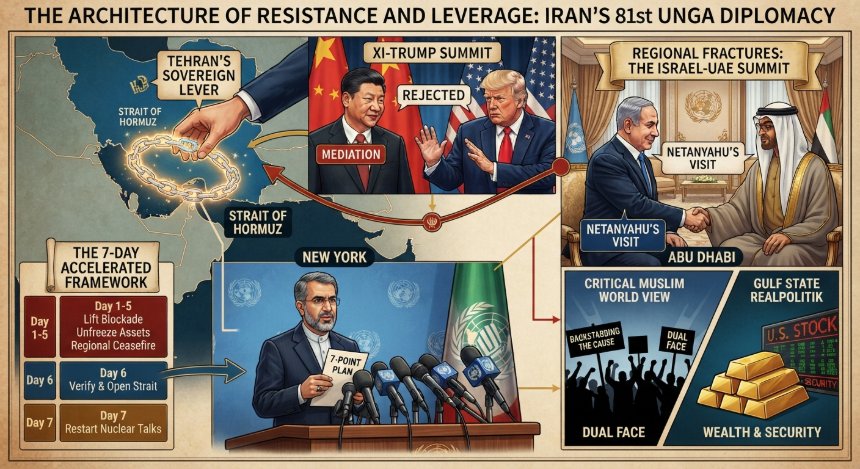
The ongoing military escalation between the United States, Israel, and Iran serves as a direct, live manifestation of this civilizational flashpoint. What began as a geopolitical confrontation over regional dominance has fundamentally transformed into a clash of absolute ideologies. Both sides are actively framing physical combat through the lens of divine destinies and apocalyptic outcomes, accelerating the psychological toll of the conflict.
The eschatological dimensions of this active warfare are explicitly mirrored in the rhetoric and actions of both leaderships:--
1. The Western Framework: Parallel Apocalyptic Narratives
In the United States, the strategic justification for overwhelming military action against Tehran is frequently intertwined with deeply religious undertones:
- The Official Stance: US leadership, through formal statements by figures like the Secretary of Defense targeting an adversary "hell-bent on prophetic Islamist delusions," explicitly acknowledges that they are fighting a war driven by eschatological convictions.
- The Internal Contradiction: While the formal Pentagon stance relies on conventional terms of deterrence, a parallel discourse has emerged within the military infrastructure. Internal reports reveal that elements within the leadership invoke biblical end-times prophecies and Armageddon to justify military actions against Iran to their troops.
- The "One Eye" Manifestation: This perfectly illustrates the Dajjālic structure: secular imperialism executing a brutal, materialist, and surgical bombardment of another nation, while its internal machinery weaponizes biblical timelines to manufacture a sense of cosmic destiny.
2. The Iranian Framework: Sacred Defense and Cognitive Warfare
On the other side, Iran frames the US-Israel coalition's aggression not as a mere political disagreement, but as an existential, holy conflict:
- The Theology of Resistance: Iran has historically utilized the doctrine of "Sacred Defense," casting its regional operations and proxy networks through sacred Shi'ite paradigms. To Tehran, diplomatic surrender to the West is viewed not just as a strategic failure, but as a prophetic betrayal of the divinely sanctioned order.
- The War of Nerves: Iranian military spokespersons have continuously responded to threats of total devastation by explicitly calling them a "psychological and cognitive warfare" campaign. By maintaining absolute defiance and dismissing Western ultimatums, Iran aims to fight the "war of nerves" by projecting that their resistance is anchored in an ultimate, unshakeable spiritual victory.
When the US-Israel alliance claims to be fighting against "prophetic delusions" while using end-times rhetoric to motivate its own machinery, it reveals its own fragmented, "one-eyed" nature. Conversely, when regional actors rely strictly on the external mechanics of a state-sponsored tradition to survive, they risk stepping into the role of a deficient system that acts out of geopolitical survival rather than true, uncorrupted divine guardianship. As bombs fall and both powers trade threats of total annihilation, the global public is forced into a psychological state of panic and hyper-fixation. This is the War of Prophecies and Nerves in its absolute fullness: a physical war of missiles and blockades entirely sustained by a psychological battlefield where ancient prophecies are weaponized to steer humanity toward a counterfeit finale.
Safeguarding the Soul Through True Taqwā
Navigating this deceptive landscape cannot be achieved through intellectual gymnastics or academic counter-arguments alone, as the deception operates on a structural, systemic level. The only definitive protection against falling prey to the dual deceptions of Dajjāl and Sufyānī is a profound, active connection to God rooted in true Taqwā (God-consciousness).
[ Human Weakness & Brokenness ] ──► [ Continual Repentance ] ──► [ Divine Guardianship ] ──► [ Spiritual Sensitivity ]
The primary defense mechanism of the believer is simple, enduring humility:
- Acknowledging Shortcomings: Maintaining a genuine awareness of one's own faults and spiritual poverty.
- Continual Return: Constantly admitting one's inherent weakness before God and returning all affairs directly to Him.
- Relinquishing Self-Reliance: Surrendering the illusion of self-sufficiency prevents the soul from being integrated into the rigid, self-reliant structures of the modern world.
By constantly returning to a state of reliance on the Divine, God preserves the soul’s fitrah (innate nature). He makes the soul delicate, perceptive, and deeply sensitive to spiritual reality. This divinely granted sensitivity ensures that when truth and falsehood manifest in their various modern forms, the eye of the heart remains clear, preventing the believer from unseeing the evidence of God or losing their way in the deceptive architecture of the end times. Ultimately, it is only within the broader, uncompromised scope of an all-comprehensive, divinely guarded Tradition that reality can be truly understood, integrated, and lived.
Can Kamagra Pills Interact With Other Medications?
Kamagra products are marketed for erectile dysfunction and may contain sildenafil. This in...