
The Stags of Maluka
Storytelling is an important tool because it builds emotional connections, helps people remember information, and fosters empathy. Fiction is defined as any creative literary or narrative work that portrays imaginary characters, settings, and events. "The Stags of Maluka" is a searing political critique of a Banana Republic's governance and its obsession with ad-hoc committees. Drawing on the central themes of Amal Chatterjee’s "Prisoners of Empires" and social metaphors, it argues that national liberation requires dismantling unwanted legacy by enforcing local languages, adopting divine democratic principles, and establishing an open government driven by native expertise. This write up is a fictional critique for public awakening and enduring cosmic hope.
أَعُوذُ بِاللّٰهِ مِنَ الشَّيْطَانِ الرَّجِيمِ
بِسۡمِ ٱللهِ ٱلرَّحۡمَـٰنِ ٱلرَّحِيمِ
In the name of ALLAH, the Most Gracious, the Most Merciful
The Stags of Maluka
In the Banana Republic of Maluka, nature had ordained a strict law: just like anywhere else in the world, the donkeys here were born without horns. For centuries, the ordinary citizens of Maluka used a common proverb to describe an absolute impossibility: "Go ahead and wait for a donkey to grow horns." But then, foreign colonizers invaded this land. They enacted a bizarre law decreeing that under the Crown, donkeys would be highly revered, and only those donkeys that could pass themselves off as stags with grand antlers would hold the divine right to rule.
Under this occupying regime, Maluka transformed into a bizarre and alien land. Its entire population was branded as ignorant and boorish, and the language of the *Farangi* crown was elevated to the status of divine revelation. The inhabitants were enticed by an artificial lifestyle—a way of life not even practiced by the common people of the *Farangi* homeland itself. Their traditional attire was replaced by garments entirely unsuited to the local climate and environment. Furthermore, under the pretext of shedding their "boorishness," they were forcibly discouraged from their customary ways of eating. Perhaps the greatest cruelty was this: if anyone dared to dissent, the nation would be fractured into factions based on "new innovations"—ensuring that enemies were cultivated from within their own ranks.
Thus, both during the *Farangi* rule and in the era that followed, the heavens witnessed a convoluted, labyrinthine scheme unfolding upon this land. The "noblest of all creatures" (human beings) in the Republic of Maluka found themselves caught up in a "donkey race"—a race dominated by a ruling elite who had emerged from the very "antlered" class. Jokes began to circulate, suggesting that these figures were merely the lackeys of the *Farangi* masters, manipulated to serve foreign agendas. And the true objective behind it all? The exploitation of Maluka’s own resources and treasures.
After decades of exploitation, the 'Great White Masters' finally departed from Maluka. However, before boarding their ships, they left behind a magical cage and an absolute army of loyal surrogates—a very specific breed of native caretakers. These loyal watchmen of colonial culture—meticulously documented in the secret pages of the masterpiece Prisoners of Empires by the ancient scholar Amal Chatterjee—wore the finest foreign tweed suits, spoke in a strange, elevated accent that sounded like a rhythmic, native "Hee-Haw," and openly considered themselves far superior to the rest of the oppressed nation.
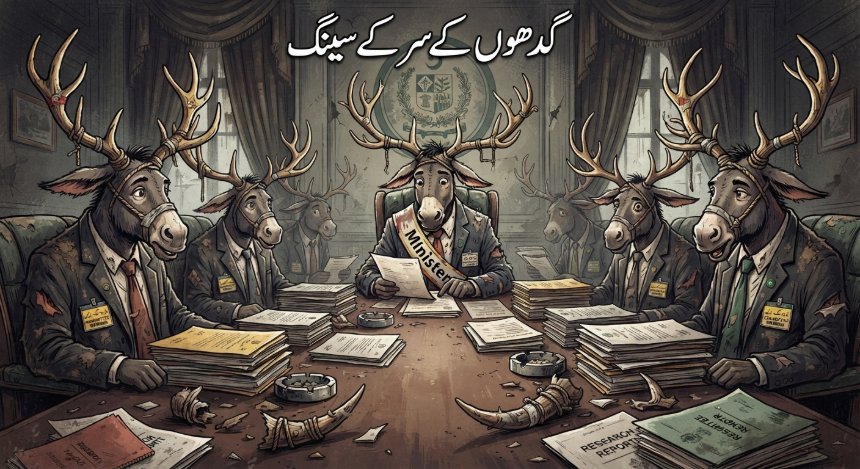
To prove their absolute majesty and royal splendor, these rulers orchestrated a brilliant theatre: they crafted heavy, artificial deer antlers out of papier-mâché (paper pulp) and strapped them tightly to their heads with ropes. They would admire their reflections in the polished marble mirrors of the state secretariat and proudly declare, "We are the 'Supreme Council of Stags'—the ultimate leadership of Maluka." The only problem was that every time they opened their mouths to deliver a high-level decree, the harsh, shattering bray of a donkey echoed through the valleys of Maluka.
A Major Crisis of Royal Carriages
One Tuesday, as the cosmic cycle took a regressive turn and the celestial shadow-point Ketu cast its gaze upon the royal palace, a dire crisis descended upon the Banana Republic of Maluka. The royal treasury had run dry, the state’s grand carriages and the machinery of plunder had ground to a halt, the prices of fodder and bananas in the marketplaces were skyrocketing, and the city’s merchants were seething with rage. The Prime Minister—who appeared in the guise of a magnificent donkey, sporting the largest and heaviest pair of artificial horns in the room—felt his primal instincts stir. He slammed his hoof firmly onto the table and, in a distinctly foreign accent, brayed:
"We must immediately form a 'Grand Ad-hoc Committee'!"
And so, the bells of the royal court began to toll. Inside a soundproof, enclosed chamber, a massive round table was set. Following the protocols of an archaic colonial manual, the allocation of seats for the committee members was determined as follows:
• 36 percent of the seats were assigned to the "political stags"—creatures who spent the better part of their time standing before mirrors, adjusting their fake antlers to ensure their grandeur remained on full display for the subjects.
• 55 percent of the seats went to the high-ranking bureaucrats—essentially state-owned beasts of burden, buried deep beneath towering stacks of files and official notes. Yet, even while buried under this weight, they were guaranteed their daily rations, with no questions asked as to the legitimacy or propriety of their gains. • Less than 10 percent of the seats went to "outsiders"—not independent economists or scientists, but representatives of major commercial groups and corporations. They arrived bearing thick stacks of documents containing demands for tax breaks, handouts, and exemptions from regulations.
Outside the locked and bolted doors of the palace stood an army of Maluka’s own true experts. Maluka was not a barren wasteland incapable of producing brilliant minds; it was home to countless "hidden gems"—talents that were consistently overlooked. Yet, foreigners would eagerly snap them up, recognizing the immense value of such intellect and high-level capability. These were independent economists, engineers, data specialists, and university researchers—people who arrived armed with scientific blueprints and concrete evidence to mend the crumbling system—only to be turned away.
Whenever a storm struck or disaster loomed, the "stags" of Maluka would appeal for help—not just from the global community, but from the patriots within their own country. By "help," they invariably meant money. If, by chance, a brilliant mind stepped forward—seeking to apply their expertise to fix the systemic flaws—the royal guards would block their entry into the government offices.
And whenever the outcry grew too loud, and the patriotic factions began to protest, the booming voice of the Chief Secretary would echo from deep within the system: "Be silent! Knowledge resides solely with our offices and departments. The Secretary knows because he is the Secretary, and the Minister makes the decisions because he is the Minister. The very nexus and treasury of wisdom, intellect, knowledge, and insight are tied exclusively to the official chair; those outside the government hold no standing or status here—nor is this a task within their capacity!"...
Administrative Theater
To an outside observer, this committee room appeared to be a grand center of knowledge and wisdom. It was, in reality, an elaborate "administrative theater." Bureaucrats shuffled files back and forth—from left to right and right to left—while clerks drafted meaningless memos. The scene was reminiscent of old fables in which beasts of burden are laden with massive, heavy tomes; the animals carry the weight of the books, yet remain entirely oblivious to the knowledge and wisdom contained within them. The committee members were submerged in an ocean of data and files, yet they were utterly devoid of genuine insight or wisdom.
At one time, the land of Maluka was ruled by the most egregious hypocrites—men to whom this verse by Allama Iqbal perfectly applied:
*You, too, are a master in the ways of the hypocrite:*
*With a longing for London in your heart, yet the mention of the Hejaz upon your lips.*
They employed an antiquated Hegelian dialectic to exert control over the populace. It was a sinister technique, wielded by the government to coerce its own citizens into voluntarily surrendering their fundamental freedoms and submitting to ever-greater state control. First, they would manufacture an artificial crisis—a "false flag" operation (the *thesis*); next, they would await the inevitable, intense public reaction (the *antithesis*); and finally, they would impose a pre-packaged, colonial-style solution (the *synthesis*), thereby shackling the public even more firmly in the chains of mental and legal servitude. Whenever the ordinary citizens of Maluka would ask, "What is the committee doing to fix the system?"... Then, the palace press secretary would appear on the balcony, brandishing a confidential document in the air, and proclaim in a booming voice: "A historic meeting has taken place! Trust in our actions! This will change your destiny—a 'game-changer' initiative has arrived! Soon, rivers of milk and honey shall flow..."
Yet, the citizens of Maluka were never permitted to witness the proceedings of these meetings. They never saw any rivers of milk and honey; instead, before long, reports would invariably emerge that these 'stags'—the ruling elite—had built opulent palaces in distant Western lands, and that their secret coffers on foreign soil were overflowing. Those ludicrous 'game-changer' initiatives were never intended for the people of Maluka; rather, they served as a lucrative feast for the personal interests of these predatory 'stags.'
The state apparatus of Maluka was a convoluted, labyrinthine mess. Instead of investigating the root causes—such as how the very axle of the entire system had snapped—the so-called 'committees of wisdom and insight' would squander weeks debating trivialities: which official gazette notification required a minor amendment, where the state seal should be affixed, or how to appease a particular tycoon, contractor, or political 'stag.' They did not establish a platform for genuine reform; instead, they curated a grand marketplace for backroom deals, designed exclusively for a privileged elite.
The outcomes were always the same: the system became even more dysfunctional than before, and increasingly catastrophic for the common people. Consequently, bread for the people and fodder for the animals became even more expensive, while the ordinary citizens of Maluka sank ever deeper into a quagmire of destitution. Yet, remarkably, whenever the committee’s proceedings concluded, a lavish, opulent banquet would be held for all its members—an occasion where, despite their abysmal performance, they would adorn one another’s chests with grand state medals. Though showered with such honors, they dared not face the public; for in the eyes of the people, these medals were nothing more than symbols of shamelessness and cautionary emblems of disgrace.
The Five Pillars of the Gilded Cage
Standing in the square of Maluka, a sharp-minded, elderly citizen—a poet of the people known as Bang-e-Kabir—watched the procession of these self-styled 'stags' (elites) pass by, their chests adorned with medals. Turning toward the youth, he pulled an old copy of *Prisoners of Empires* from his satchel.
"Do you see those gleaming medals?" Kabir whispered. "These people are actually celebrating the preservation of five colonial pillars. They will never fix the system, because these very broken paths are the source of their own survival."...
Pointing toward the palace, he continued:...
1. The Colonial Architecture of Property: "These 'stags' still uphold the old laws that vest land rights in a select elite. This ensures that the farmers of Maluka remain trapped in a cycle of poverty, forced to toil over crops destined for foreign lands rather than growing food for their own sustenance."...
2. The Extraction of Resources: "They have maintained loopholes in the law that allow Maluka’s gold, gas, and minerals to be systematically siphoned out of the country—facilitated by multinational corporations and a corrupt elite—leaving the common people empty-handed."...
3. One-Way Trade Routes: "Look at these roads and trade routes. They do not connect our own villages and cities to one another; instead, they run directly from the mines and resource sites to the ports—designed solely to facilitate the easy extraction of our wealth. Local development is not their objective at all."... 4. The Magic of a Foreign Language: "They impose an educational system upon our children that alienates them from their own heritage and history. Whoever can bray most proficiently in a foreign language is deemed worthy of a seat at the 'high table,' while native intellect is cast aside."...
5. Secrecy and Police Laws: "Furthermore, the laws of their courts are not designed for justice, but rather to control the populace and crush dissent—ensuring that no one dares to challenge the 'paper horns' they wear."...
Awakening
The younger generation looked at the palace, then at their own destitute lives and the beasts of burden they rode, and finally at the hollow, paper horns perched upon the heads of these rulers. The old spell that had held their minds captive was broken. The false aura of these self-styled "stags" vanished, and their true, donkey-like nature was laid bare before every citizen of Maluka.
"How do we break this colonial spell?" asked a young girl.
Kabir stepped forward and placed his hands on the shoulders of the youth of Maluka; a revolutionary spark ignited in his eyes.
"We must cease to be participants in this charade of theirs," Kabir declared in a thunderous voice. "First and foremost, we must rid ourselves of their Western-influenced textbooks and an educational system that, rather than fostering intellect, breeds mental servitude. We must educate our children in our national language, Urdu, and in our regional languages; furthermore, every government office in Maluka must be compelled to adopt the language of the common people, so that this false sense of superiority may be brought to an end. Beyond that, we must fundamentally overhaul a system of governance that—instead of prioritizing public welfare and transparent accountability—operates through backroom deals and a farcical, asinine administrative theater. Maluka cannot progress under a shroud of secrecy and the legacy of colonial-era laws; it requires a new architectural framework for governance—one rooted in openness, genuine indigenous expertise, public accountability, and the mandate of the people. An Islamic welfare state can only flourish when built upon democratic and divinely-inspired principles. For decades, we have endured the disastrous consequences of the sheer stupidity of these self-appointed 'stags' [pompous, posturing elites]; the time has come for the people of Maluka to awaken!"
Kabir’s voice rang out across the public square of Maluka. Invoking the memory of the renowned Western poet Percy Bysshe Shelley, he echoed a revolutionary message—the very words Shelley had once penned for the oppressed people of England: "Farmers and laborers of Maluka! Why do you serve as fodder for the plunderers who suck your very blood? Why do you build palaces for those heartless vultures who humiliate you on their own doorsteps? Why do you forge weapons to defend those who keep your own generations in bondage? The silk they have woven is rightfully yours; their hollow medals are merely the spoils of your exploited labor. Cease living under the shadow of the lashes they wield against you!"...
And then, breathing the spirit of Lawrence Treble’s timeless poem "Awaken" into the horizon of Maluka, Kabir concluded his address:…
"The time has come to open your eyes and wake up! For as long as you remain in a deep slumber, these 'sham stags' will continue to auction off your rights. If you do not defend your educational system, your language, and your inspired democratic principles today, remember: this dark night of slavery will never end. Awakening will not be gifted to you by another; it must spring from within you.
Awaken! Before it is too late—before the curtains of this administrative theater are drawn shut forever."…
The procession continued, yet the citizens of Maluka were no longer clapping. Having witnessed decades of empty promises—and the absurd, artificial antlers strapped to their own heads—they had long since ceased to smile. A sharp surge of awakening had shaken Maluka to its very core, and the people now stood with full resolve to draft a new, independent, and inspired constitution for the destiny of their nation.


How to Find the Best Luxury Earrings for Halloween 2026: Shopping Tips...