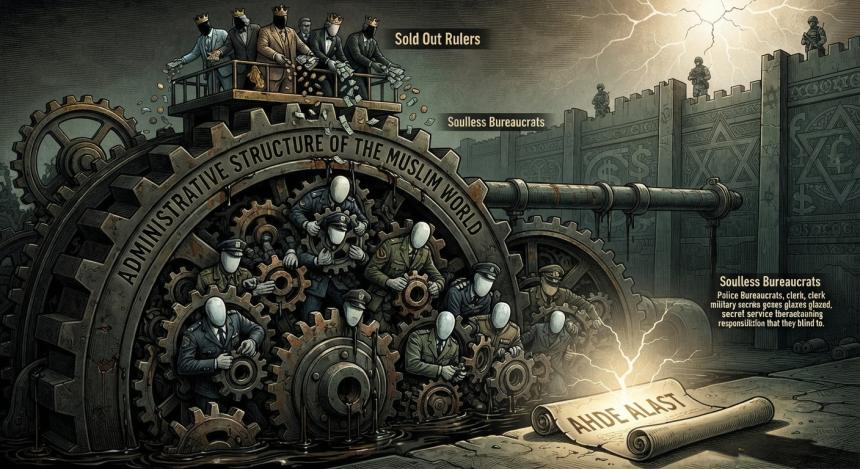

The Rulers & Administrative Structure of Muslim World
The contemporary Muslim world passes through a period of deep structural paralysis. Across various nations, communities find themselves trapped under an alliance of compromised; sold-out rulers; focused entirely on power maximization, backed by a vast tier of technocrats, administrators, and civil functionaries who run the daily machinery of state survival. This crisis is rarely a failure of raw physical power; rather, it is a crisis of moral agency. This essay is an opinion on the said crisis of the Muslim World.
أَعُوذُ بِاللّٰهِ مِنَ الشَّيْطَانِ الرَّجِيمِ
بِسۡمِ ٱللهِ ٱلرَّحۡمَـٰنِ ٱلرَّحِيمِ
In the name of ALLAH, the Most Gracious, the Most Merciful
The Rulers & Administrative Structure of Muslim World
The Anatomy of the Fractured Cog: Leviathanic Duty, Historical Imperialism, and the Collapse of the Bureaucratic Alibi in the Muslim World
I. Introduction: The Crisis of the Bureaucratic Machine
The contemporary Muslim world passes through a period of deep structural paralysis. Across various nations, communities find themselves trapped under an alliance of compromise: sold-out rulers focused entirely on power maximization, backed by a vast tier of technocrats, administrators, and civil functionaries who run the daily machinery of state survival. This crisis is rarely a failure of raw physical power; rather, it is a crisis of moral agency. It highlights a devastating systemic reality: the machinery of modern oppression does not run on the strength of its leaders alone, but on the deliberate, day-to-day compliance of its ordinary administrators.
At the heart of this compliance lies a profound theological and psychological paradox: the structural friction between Leviathanic duty and the Ahd e Alast. Leviathanic duty represents the secular demand of the modern nation-state—modeled after Thomas Hobbes’s Leviathan—which demands absolute obedience, functional efficiency, and structural loyalty to preserve an artificial public order at the cost of individual moral conscience. Opposed to this is the Ahd e Alast, the primordial, pre-eternal covenant rooted in Surah Al-A'raf (7:172), where every human soul swore absolute, unmediated accountability to Allah before earthly time or states existed.
This essay argues that the modern post-colonial Muslim state maintains its autocratic grip by psychologically fracturing its administrative "cogs" through capitalist survivalism and imported secular frameworks, rendering them blind instruments of tyranny. However, by tracing the genealogy of this crisis from early imperial statecraft to the modern division of labor, it becomes clear that this bureaucratic alibi entirely collapses under the weight of strict, unyielding Islamic eschatology on the Day of Judgement.
II. The Historical Roots: From Byzantine-Sassanian Models to Akbar's Syncretism
The psychological and structural transformation of the Muslim bureaucrat is not a purely modern phenomenon; its historical seeds were planted long before the advent of the post-colonial nation-state. During the early Abbasid period, political thinkers like Ibn al-Muqaffa’ sought to stabilize the empire by importing complex Byzantine and Sassanian political theologies. In these foreign autocratic traditions, rulers were understood not as mere fallible placeholders or servants of divine law, but effectively as temporal gods of the earth. This imperial injection deliberately minimized the salience of the eternal hereafter in public affairs, choosing instead to eternalize and magnify the immanent, worldly survival of the empire. This early shift disrupted the egalitarian ethos established by prophetic governance, detaching the actions of the ruling class from the holistic scales of Islamic ethics and forcing subjects to view politics purely through the lens of raw empire-building. Consequently, the state apparatus began developing a hybrid worldview: its reasoning became partly Islamic, but mostly siyasi (driven by opportunistic statecraft).
This historical manipulation reached a definitive apex in South Asia under the Mughal Emperor Akbar. Seeking to solidify absolute administrative autocracy over a diverse empire, Akbar fabricated Din-i Ilahi—a syncretic court religion designed to anchor ultimate spiritual and political loyalty directly to his imperial person. This system weaponized statecraft to replace Divine Revelation with royal whim, requiring courtiers, generals, and bureaucrats to perform the court prostration (sajda-e-tazimi) and sacrifice their religious integrity for imperial favor. Akbar’s court demonstrated how an institutional machinery could completely swallow the religious identity of its administrators, transforming them into hollow instruments designed to serve the sovereign's ego under the guise of public harmony.
III. The Mechanical Enclosure: The Modern 'Pin Factory' and Rozi Logic
In the modern era, this historical erosion has been reinforced by Western colonial structures, perfecting the administrative alienation of the individual through what can be termed a bureaucratic adaptation of Adam Smith’s 'pin factory' division of labor. In a pin factory, a worker's focus is restricted exclusively to a single, hyper-specialized micro-task—such as sharpening a point or cutting a wire—leaving them entirely blind to the holistic causality or ultimate effects of the factory's output. The modern state apparatus operates on this exact framework. A clerk processing files, a police officer executing an arrest, or a jailer guarding a cell are conditioned to view their duties in total isolation. Pondering the greater ethical policy of the state or the devastating human consequences of its dictates is dismissed as an intellectual and moral burden "above their paygrade."
The state secures this uncritical compliance by weaponizing the capitalist-economic paradigm of survivalism, localizing it within the logic of protecting one's rozi (livelihood). By naturalizing the desperate struggle for economic security, the state convinces the bureaucrat that their ultimate moral integrity is measured by their operational efficiency. Doing a "good job" is no longer defined by the justice of the act, but by how smoothly and frictionlessly the will of the state flows from realization to actualization through their hands. Fulfilling an unjust command is reframed as a responsible, logical act of family survival and patriotic duty to a homeland that holds a quasi-divine status. Through this process, the administrative chain of command is elevated to a status of "civil revelation." The hierarchy becomes a sacred order that legitimizes the entire societal fabric, meaning that for a civil servant to question, doubt, or ethically judge a superior's command is treated as a form of secular blasphemy that cannot be tolerated.
IV. The Schism of Conscience: Absolute Compartmentalization
This environment forces an acute epistemic and psychological fracture onto the lower levels of the government hierarchy. To survive within this machine without experiencing psychological breakdown, the Muslim bureaucrat adopts a rigid system of selective secularization. They construct an artificial wall between the public, legal-political realm of state duty and the private, spiritual realm of personal devotion. Under this fractured worldview, religion is strictly relegated to the personal sphere—such as private prayers (salah), fasts, and the recitation of the Quran—while the state dictates the law and ethics of the public square.
This absolute compartmentalization yields absurd realities: an official can seamlessly participate in the systemic tracking, harassment, or torture of fellow citizens by day, while listening to the Quran or praying in private by night. Their religious practices are completely decoupled from their professional actions, preventing their personal faith from ever interfering with state-sanctioned violence. Simultaneously, the state actively protects this divide by criminalizing any domestic movement or individual that attempts to bridge the gap—anyone who uses a transcendent Islamic moral lens to evaluate or critique the actions of the ruling class is automatically labeled an "anarchist" or an existential threat to public order.
Yet, this secular programming is never fully absolute. Because the primordial covenant—the Ahd e Alast—is indelibly stamped onto the human fitrah (innate nature), the existential veneer of the bureaucrat frequently cracks. This is vividly illustrated by the real-world anxiety of a prison block officer who, upon releasing an unjustly detained prisoner, desperately held his hand and pleaded: "Please don't make dua against me... I never wanted this for you. Even the officers who treat us badly have this lingering feeling that something is wrong." This sudden panic exposes a repressed, terrifying awareness of ultimate cosmic justice. It proves that despite uniforms, steady paychecks, and the sacralization of state hierarchy, the administrative cog remains haunted by the knowledge that an earthly sovereign cannot shield them from the Sovereign of the universe.
V. The Transnational Web: Financial Oligarchies and Contemporary Backroom Statecraft
The mechanical alignment of the post-colonial bureaucracy with unjust structures is not merely an isolated domestic defect; it is heavily reinforced by global financial interests and transnational networks. The modern nation-state’s push for secular power maximization traces its funding back to the historical rise of Western financial syndicates—such as the Rothschild banking dynasty and early American financial titans like the Morgans—who financed state infrastructure, war debts, and international development to tether national governments to a global, capital-driven status quo. Under this framework, state sovereignty often takes a backseat to global financial stability, transforming local political machinery into enforcers for external capital interests.
In the contemporary landscape, this backroom network has materialized through unprecedented diplomatic realignments across the Middle East. A clear manifestation of this global-local convergence occurs when modern rulers engage in backdoor connections with Zionist Israel and its western financial backers. High-profile diplomatic maneuvers, exemplified by the recent Israeli Prime Minister's visits to the UAE and reported backroom engagements involving up to ten other Muslim nations in the region, expose how deeply embedded these administrative machineries are within external webs of power. Other states continuously follow suit, manipulating internal policies to satisfy their own ulterior motives and maintain regime survival. For the lower-level administrators executing the directives born of these high-level pacts, the mandate remains strictly technical and operational. They treat the normalization of previously unthinkable geopolitical alliances as a routine administrative task—completely isolated from the historical, moral, or spiritual implications of their actions.
VI. The Archetype of Resistance: Mujaddid Alf Thani
It is precisely within this structural and psychological gridlock that the historic struggle of Sheikh Ahmad Sirhindi, famously known as Mujaddid Alf Thani (the Renover of the Second Millennium), provides the ultimate guide for modern resistance. Confronting the massive, deeply entrenched Mughal machinery under Emperor Akbar and later Emperor Jahangir, the Mujaddid did not respond with chaotic, emotional civil disobedience or random acts of rebellion. Recognizing that the empire’s tyranny was executed through its administrative class, he launched a highly calculated, intellectually rigorous counter-offensive.
Through his monumental collection of letters, the Maktubat, the Mujaddid directly targeted the "cogs" of the Mughal state—the nobles, governors, court officials, and military generals. He systematically dismantled their moral compromises, awakened their dormant consciences, and reminded them of their primary loyalty to the Ahd e Alast. When he was eventually summoned by Emperor Jahangir to answer for his orthodox resistance and commanded to perform the mandatory court prostration, the Mujaddid flatly refused. He declared that a head trained to bow before the Creator could never bow before a mortal king. His subsequent imprisonment in the Gwalior Fort broke the psychological spell of absolute royal authority across the empire. It forced the state hierarchy to reckon with a transcendent moral limit, eventually leading to the rollback of tyrannical court policies. The Mujaddid's legacy stands as a timeless proof that the spell of an oppressive machine can be broken when its primary administrators undergo a conscious epistemic resurrection.
VII. Conclusion: The Eschatological Collapse of the Alibi
The current tragedy of the Muslim world—defined by a silent global community passing through difficult times with sold-out rulers, an idiotocracy of governance, and soulless bureaucrats executing un-Islamic, oppressive directives—is heading toward a catastrophic reckoning. On the Day of Judgement, the ultimate administrative alibi of "just following orders," "maintaining diplomatic pragmatism," or "protecting my livelihood" will completely collapse. Islamic theology admits no transferred guilt or subordinate innocence; before the Divine Tribunal, no excuses will be accepted. The Quran explicitly dismantles the defense of the unthinking follower by chaining the foot soldiers of tyranny directly to the tyrants themselves, declaring: "Indeed, Pharaoh and Haman and their soldiers were deliberate sinners." (Quran 28:8).
When the modern uniform is stripped away, corporate hierarchies are dissolved, and secret state accords are laid bare, the fiction of the detached bureaucrat will evaporate. Every individual will walk out to face the Divine Scale entirely alone, judged by the strict demands of Individual Responsibility (Fard al-Ayn) and their role in upholding Collective Justice (Fard al-Kifayah). Those who chose silence, active compliance, or the preservation of their worldly status over divine commands will discover that the earthly rulers and international financiers they feared are utterly powerless to protect them from the wrath of Allah.
The antidote to this systemic decay demands an immediate, radical awakening of the Muslim political agent. Holding public office, rank, or administrative authority must be stripped of its capitalist prestige and reclaimed as a terrifyingly heavy spiritual burden—a reality so profound that the pious companions of the Prophet always sought to avoid it. Muslim civil servants at every level must reject unthinking complacency, reconfigure their primary loyalties back to their authentic ideological identity, and transform their positions from blind instruments of an unjust global machine into conscious, grounded shields for their communities. The machine only breathes through the obedience of those who turn its wheels; when the cog remembers its primordial oath, the architecture of tyranny begins to crumble.
Flower Box Stand for Opening Ceremony and Condolences
Flower Box Stand for Opening Ceremony and Condolences


Looking for Tax Debt Relief Services in Canada? Read This Guide
Discover how tax debt relief services work in Canada, from CRA payment arrangements and ta...