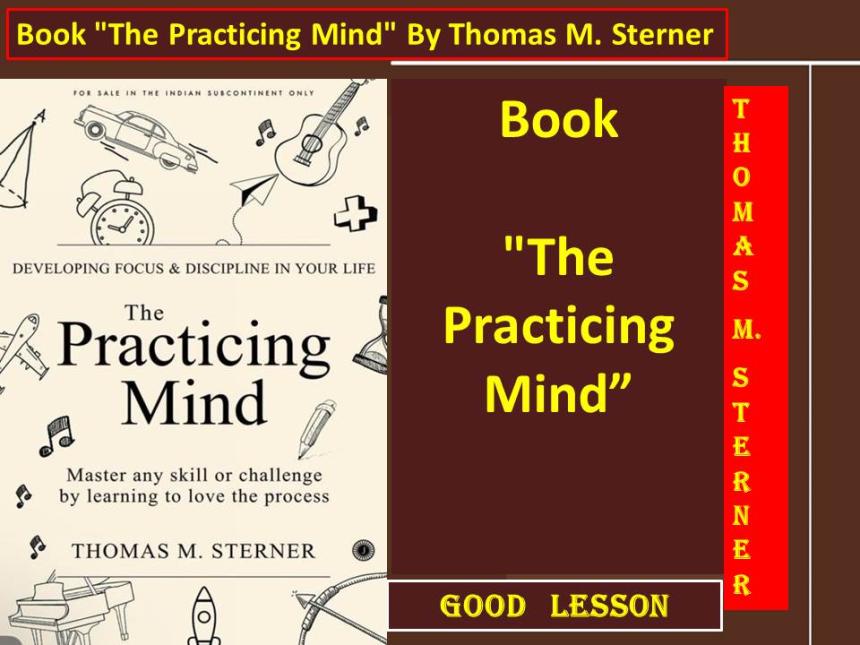

"The Practicing Mind" By Thomas M. Sterner
Thomas M. Sterner is and American born founder and CEO of The Practicing Mind Institute and is an accomplished musician, private pilot, student of archery, and avid golfer. He is also a bestselling author of the Book "The Practicing Mind" published in 2006; which is a comprehensive help for the individual to understand exactly what present moment awareness is. This write up is an introduction of the Book "The Practicing Mind" By Thomas M. Sterner and arranged for educational purposes from material available freely on Web Net.
أَعُوذُ بِاللّٰهِ مِنَ الشَّيْطَانِ الرَّجِيمِ
بِسۡمِ ٱللهِ ٱلرَّحۡمَـٰنِ ٱلرَّحِيمِ
In the name of ALLAH, the Most Gracious, the Most Merciful
Book "The Practicing Mind" By Thomas M. Sterner
Thomas M. Sterner is and American born founder and CEO of The Practicing Mind Institute and considered an expert in Present Moment Functioning or PMF tm. Thomas M. Sterner has studied Eastern and Western philosophy and modern sports psychology and trained as a jazz pianist. He served more than as the chief concert piano technician for a major performing arts center while operating a piano remanufacturing facility. He has served more than 25 years in the sound and video arts fields as a recording engineer, audio and video editor and processor, and composer.
Thomas M. Sterner is an accomplished musician, private pilot, student of archery, and avid golfer. He lives in Wilmington, Delaware. He is also a bestselling author, coach, & founder of The Practicing Mind Institute. The Book "The Practicing Mind" By Thomas M. Sterner was published in 2006. The purpose of Book "The Practicing Mind" By Thomas M. Sterner is to comprehensively help the individual understand exactly what present moment awareness is, how we are raised in a manner contradictory to this, and how we change our mindset to make this a part of our daily living.
From the Inside Flap of Book "The Practicing Mind" By Thomas M. Sterner "In those times when we want to acquire a new skill or face a formidable challenge we hope to overcome, what we need most are patience, focus, and discipline, traits that seem elusive or difficult to maintain. In this enticing and practical book, Thomas Sterner demonstrates how to learn skills for any aspect of life, from golfing to business to parenting, by learning to love the process".
"Early life is all about trial-and-error practice. If we had given up in the face of failure, repetition, and difficulty, we would never have learned to walk or tie our shoes. So why, as adults, do we often give up on a goal when at first we don&;t succeed? Modern life&;s technological speed, habitual multitasking, and promises of instant gratification don&;t help. But in his study of how we learn (prompted by his pursuit of disciplines such as music and golf), Sterner has found that we have also forgotten the principles of practice — the process of picking a goal and applying steady effort to reach it. The methods Sterner teaches show that practice done properly isn&;t drudgery on the way to mastery but a fulfilling process in and of itself, one that builds discipline and clarity".
"By focusing on “process, not product,&; you&;ll learn to live in each moment, where you&;ll find calmness and equanimity. This book will transform a sense of futility around learning something challenging into an attitude of pleasure and willingness".
From the Back Cover of Book "The Practicing Mind" By Thomas M. Sterner "In those times when we want to acquire a new skill or face a formidable challenge we hope to overcome, what we need most are patience, focus, and discipline, traits that seem elusive or difficult to maintain. In this enticing and practical book, Thomas Sterner demonstrates how to learn skills for any aspect of life, from golfing to business to parenting, by learning to love the process".
"Early life is all about trial-and-error practice. If we had given up in the face of failure, repetition, and difficulty, we would never have learned to walk or tie our shoes. So why, as adults, do we often give up on a goal when at first we don’t succeed? Modern life’s technological speed, habitual multitasking, and promises of instant gratification don’t help. But in his study of how we learn (prompted by his pursuit of disciplines such as music and golf), Sterner has found that we have also forgotten the principles of practice the process of picking a goal and applying steady effort to reach it. The methods Sterner teaches show that practice done properly isn’t drudgery on the way to mastery but a fulfilling process in and of itself, one that builds discipline and clarity".
"By focusing on process, not product,” you’ll learn to live in each moment, where you’ll find calmness and equanimity. This book will transform a sense of futility around learning something challenging into an attitude of pleasure and willingness".
The main theme of book "The Practicing Mind" by Thomas M. Sterner is shifting focus from the final outcome to the present-moment process of learning. The book centers on three core concepts: loving the journey, mastering self-control through awareness, and treating all of life as an ongoing practice.
1. Process Versus Product
Enjoy the present: Real satisfaction comes from being fully engaged in what you are doing right now, rather than rushing to reach a final goal.
Goals as a compass: Goals give you a general direction, but the actual work or practice is where you spend your time and find fulfillment.
2. Focus and Discipline
Control your thoughts: True power and peace come from being aware of your mind and gently bringing your focus back when it wanders.
Do, Observe, Correct (DOC): Use a simple loop of taking action, watching yourself without judgment, and fixing mistakes calmly.
3. Handling Mistakes
Embrace errors: Mistakes are not failures; they are normal and helpful parts of growing and learning.
Stay patient: Impatience happens when your mind lives in the future instead of staying focused on the current step.
The Summary of the Book "The Practicing Mind" By Thomas M. Sterner
Book "The Practicing Mind" By Thomas M. Sterner may be summarised as creating the practicing mind comes down to a few simple rules: Keep yourself process-oriented. Stay in the present. Make the process the goal and use the overall goal as a rudder to steer your efforts. Be deliberate, have an intention about what you want to accomplish, and remain aware of that intention. The book may also be summarised as "All of life is practice in one form or another. Actively practicing something is very different from passively learning. You will never reach a level of performance that feels complete, so learn to love the art of practicing your skill".
Summarized by James Clear (https://jamesclear.com/book-summaries/the-practicing-mind)
The skill is practicing the goal, not having the goal.
All of life is practice in one form or another.
Good practice is not stressful, it is free flowing. (You get in flow.)
Actively practicing something is very different from passively learning.
Education: when school funding is determined by how many high test scores we put out, what students actually learn is merely a footnote.
Japanese perfect plate story. “Why would I need someone to make sure I do my job correctly?”
Your goals are like a rudder on a boat, they provide direction. (Goals as rudder versus a dock?)
Judging your work is wasted energy that can’t go into the work.
If your mind races off, you’re like a chariot without the reigns. Take the reigns and be in control of your mind.
Your goals are a compass, not the buried treasure. The goal is not the destination or where you end up, but rather the compass that guides the journey.
The greatest part of entrepreneurship is breaking down your limiting beliefs. It has nothing to do with money.
Zen concept of Beginners Mind. It’s harder to concentrate as you advance in skill level.
A habit is the “natural way we do something.”
There is no point of performance you can achieve where you will feel “done”.
Make time to just sit. You need relaxing time.
Book "The Practicing Mind" By Thomas M. Sterner Explains
Book "The Practicing Mind" Developing Focus and Discipline in Your Life—Master Any Skill or Challenge by Learning to Love the Process by Thomas M. Sterner explains "What if the biggest obstacle to success isn’t a lack of talent…but our obsession with the finish line? Most of us want results as quickly as possible. We want to master a skill, build a business, get fit, or achieve a goal, but we become frustrated when progress feels slow. The Practicing Mind offers a completely different way of thinking.
Thomas M. Sterner argues that lasting success comes when we stop obsessing over outcomes and learn to enjoy the process itself. Instead of constantly asking, “How much farther do I have to go?” he encourages us to focus on the small actions we can take today. One lesson that may really stay with the passionate reader is that mastery is simply the result of showing up consistently. The people we admire aren’t usually successful because they stayed motivated every day. They’re successful because they learned to value practice more than immediate results.
That shift in perspective is incredibly freeing. What is most appreciable about the book is that isn’t just about productivity. It’s about peace of mind. When you stop rushing toward the destination and become fully present in the work you’re doing, you naturally become more focused, more patient, and more disciplined. Whether you’re learning a new skill, pursuing a career goal, growing a business, or trying to build better habits, the principles in this book apply to every area of life.
By the end of the book, it is reminded that success isn’t created by one extraordinary effort. It’s created by ordinary actions repeated with extraordinary consistency.
A Dive into Book "The Practicing Mind" By Thomas M. Sterner
Mastery is self-control and self-control requires an awareness of our thoughts: "If you are not in control of your thoughts, then you are not in control of yourself. Without self-control, you have no real power, regardless of whatever else you accomplish. If you are not aware of the thoughts that you think in each moment, then you are the rider with no reins, with no power over where you are going. You cannot control what you are not aware of. Awareness must come first."
* If we want to change our thoughts, we need to become aware of them: "Who is this second party who is aware that you are aware? The answer is your true self. The one who is talking is your ego or personality. The one who is quietly aware is who you really are: the Observer. The more closely you become aligned with the quiet Observer, the less you judge. Your internal dialogue begins to shut down, and you become more detached about the various external stimuli that come at you all day long. You begin to actually view your internal dialogue with an unbiased (and sometimes amused) perspective."
* It is a trap to focus too much on the product (goal) rather than the process: "What these are all saying is 'focus on the process, not the product that the process was meant to achieve.' It’s a paradox. When you focus on the process, the desired product takes care of itself with fluid ease. When you focus on the product, you immediately begin to fight yourself and experience boredom, restlessness, frustration, and impatience with the process. The reason for this is not hard to understand. When you focus your mind on the present moment, on the process of what you are doing right now, you are always where you want to be and where you should be. All your energy goes into what you are doing. However, when you focus your mind on where you want to end up, you are never where you are, and you exhaust your energy with unrelated thoughts instead of putting it into what you are doing. In order to focus on the present, we must give up, at least temporarily, our attachment to our desired goal."
* Same theme, but illustrated nicely: "I once read an interview with a coach for the U.S. Olympic archery team. He commented that the biggest problem he faced in coaching the American team was that they were fixated on their scores, or the result of their shots. It was as if they were drawing the bow and releasing the arrow only to hit the bull’s-eye and earn a good score. This was in contrast to the Asian teams, who, having grown up in different cultures, were consumed in the process of properly executing the technique that led up to releasing the shot. Where the arrow hit the target was almost unimportant compared to the motion of drawing the bow correctly and releasing the shot. They viewed the result with an almost detached indifference. For them, the desired goal was a natural result of prioritizing the proper technique of drawing the bow. They operated in a completely different paradigm, and because of it, they were very difficult to beat."
* Again, same concept but with goal as rudder: "When you stay on purpose, focused in the present moment, the goal comes toward you with frictionless ease. However, when you constantly focus on the goal you are aiming for, you push it away instead of pulling it toward you. In every moment that you look at the goal and compare your position to it, you affirm to yourself that you haven’t reached it. In reality, you need to acknowledge the goal to yourself only occasionally, using it as a rudder to keep you moving in the right direction."
* Radical concept (I think) that the difference between fun and work is often just a decision (i.e., how we think about it): "I have found that the only difference between the two sorts of activities is that we prejudge them. We make a conscious decision that if we enjoy an activity, it is not work. So we must temporarily suspend our definition of work as referring to our daily vocation. Work, in this discussion, refers to any activity we don’t feel like doing, and though it could certainly include our job duties, or at least parts of them, it could also include any activity that we think is 'undesirable'."
* Four S Words: Simplify (When you work at a specific project or activity, simplify it by breaking it down into its component sections. Don’t set goals that are too far beyond your reach. Unrealistic goals create frustration and invite failure, which can make you doubt your abilities. The success of attaining each simple goal will generate motivation that propels you along in the process, and you won’t suffer the mental fatigue you experience when you bite off more than you can chew); Small (... break down the overall goal into small sections that can be achieved with a comfortable amount of concentration. You will find that focusing on small sections is easier than focusing on the entire task and gives you repeatable success); Short (You can survive just about anything for forty-five minutes.); Slow (Incorporating slowness into your process is a paradox. What I mean by slow is that you work at a pace that allows you to pay attention to what you are doing.)
The Conclusion
The key lessons from "The Practicing Mind" by Thomas M. Sterner are to focus on the process rather than the outcome, stay fully present in the moment, and treat goals as a compass rather than a finish line. Enjoy the current action instead of rushing for the final result, which stops frustration and anxiety. Use goals to guide your direction, but live and work entirely in the present step. Make practice easier by keeping things Simple, Small, Short, and Slow.
"The Practicing Mind" by Thomas M. Sterner advices to fall in love with the process, and the results will eventually take care of themselves. The journey we once wanted to rush through often becomes the very thing that transforms us. True discipline means watching your own mind and gently bringing your focus back when it wanders. Learn to embrace mistakes and see errors as a normal, helpful part of learning.
U4GM Explains How to Save Monopoly GO Dice and Progress
Running out of dice in Monopoly GO can put a stop to building upgrades, tournament progres...

From Squirrel to Moose: Matching Ten Cartridges to the Animal
From Squirrel to Moose: Matching Ten Cartridges to the Animal