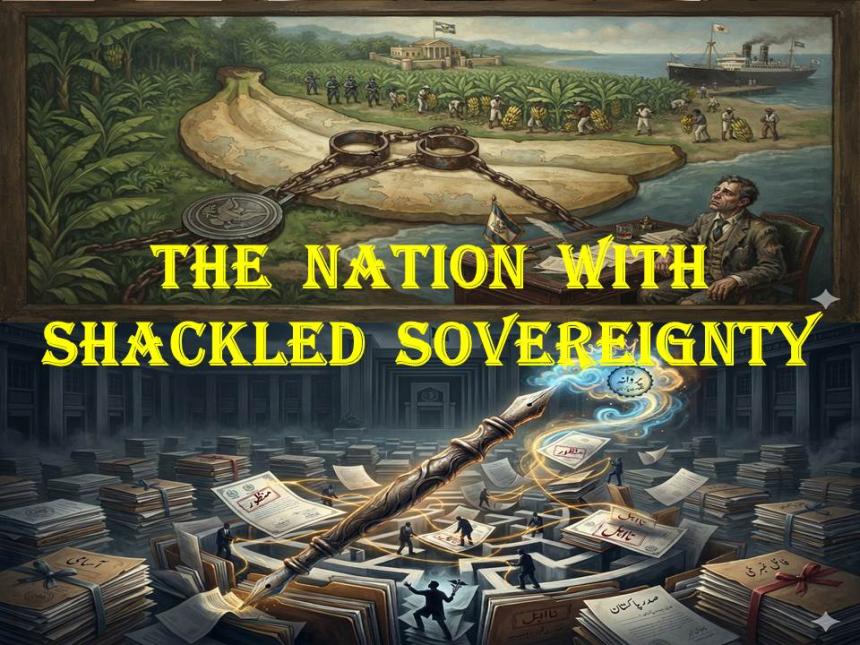

The Nation with Shackled Sovereignty
The state of Maluka functioned not as a modern republic, but as an exploitative extraction mechanism disguised as a democracy. Its administrative architecture was a direct clone of a 19th-century colonial apparatus, meticulously preserved by self-serving elite to keep power concentrated at the top while treating its own geographic regions as internal colonies. This is a brief story of a banana republic.
أَعُوذُ بِاللّٰهِ مِنَ الشَّيْطَانِ الرَّجِيمِ
بِسۡمِ ٱللهِ ٱلرَّحۡمَـٰنِ ٱلرَّحِيمِ
In the name of ALLAH, the Most Gracious, the Most Merciful
The Nation with Shackled Sovereignty
The Story of A ‘Banana Republic’:The state of Maluka functioned not as a modern republic, but as an exploitative extraction mechanism disguised as a democracy. Its administrative architecture was a direct clone of a 19th-century colonial apparatus, meticulously preserved by self-serving elite to keep power concentrated at the top while treating its own geographic regions as internal colonies. Thus, the people were enslaved and forced to live impoverished lives. On the surface, it appeared to be functioning like a country, but underneath the pomp and pageantry, there lay a fractured state with a nation having its sovereignty shackled through its ruling elite.
In the capital city of Maluka, the illusion of statehood was grand. Polished marble secretariats stood tall, protected by high iron gates, while forty-foot mahogany conference tables hosted endless high-level briefings. To the foreign diplomat or casual observer, Maluka possessed all the trappings of a functioning sovereign nation.
Beneath this veneer lay a parasitic apparatus. The central governments operated like an occupying imperial metropole, viewing the country's outer provinces not as constitutional partners, but as revenue fields to be harvested. Natural gas, agricultural yields, and tax revenues were aggressively sucked inward from the periphery. Once inside the capital's vault, this wealth was systematically hollowed out to fund a sprawling, feudal ecosystem of bureaucratic entitlement.
At the apex of this system sat the generalist executive elite—the Central Administrative Corps (CAC). They ruled by colonial lineage rather than specialized skill. A single CAC officer could be rotated from managing the wildlife federation on a Monday to dictating the national energy tariff by Friday. They possessed no deep technical domain expertise, yet they held absolute veto power over the state's certified doctors, structural engineers, and scientists.
This domestic empire was maintained through the systemic exploitation of the poor. Thousands of low-wage public employees, officially hired into the civil service as "office runners" or "clerks," were illegally pulled from their public desks and deployed to the private residences of the elite. They served as cooks, stable-hands, gardeners, and nannies—their salaries paid for by the very taxpayers they were barred from serving.
To insulate themselves from democratic backlash, the civil elite formed a fierce, symbiotic duopoly with the military high command. By routinely appointing active and retired military officers to lucrative, civilian regulatory posts—such as civil aviation, logistics, and housing authorities—the regime ensured that the administrative machinery remained fiercely loyal to the center. Any murmur of provincial dissent or demand for financial autonomy was swiftly painted as a threat to national security, allowing the center to routinely militarize civil spaces and suppress local leadership.
The structural rot finally collapsed under the weight of its own greed. Faced with severe macroeconomic default, the central secretariat chose to bail out the capital's untaxed real estate cartels and heavily subsidize non-productive sugar and textile oligarchs, while entirely halting the flow of life-saving medical budgets to the provinces. The tipping point arrived when provincial hospitals ran completely out of basic anesthesia, forcing doctors to perform surgeries by the light of smartphone screens while the capital’s luxury zones remained brightly lit.
While the central dashboards in the capital continued to report optimized macroeconomic indicators, the physical reality across the urban and rural divide of Maluka told a devastating truth. The true cost of the state's extractive architecture was not measured in deficit percentages, but in the shrinking size of a family dinner.
The nation was starving. People were eating less, and they were eating worse, simply because they could no longer afford basic sustenance.
Data quietly leaked from the Maluka Bureau of Statistics (MBS) revealed a harrowing structural collapse over a six-year trajectory: food consumption had plummeted across every single category, wiping out the nutritional baseline of an entire generation.
The clinical lines of the data translated into a grim daily ritual of sacrifice inside the homes of ordinary citizens. Families were forced to systematically cut back on the most fundamental elements of survival:
The Roti: Bread was deliberately rolled thinner and smaller, with mothers rationing wheat flour to ensure the stove could burn for another day.
The Meat: Once a weekly staple, meat became a distant luxury, cooked perhaps once a month or entirely omitted as poultry and beef prices soared beyond reach.
The Milk: Children were given watered-down milk, or denied it altogether, as parents watched their infants fall behind on basic developmental milestones.
The Tea: Even the minor solace of a cup of tea was rationed, with households cutting down from three cups a day to one, skipping the sugar entirely to save pennies.
This silent famine was not a natural disaster; it was the direct outcome of the state logic. The GRE-tested technocrats had systematically raised sales taxes on essential food items and fuel to service debt and maintain the non-productive perks of the ruling class. The sugar and textile oligarchs continued to receive subsidized electricity to export their goods, while the local wheat markets were manipulated by untaxed cartels to artificially inflate prices.
It was this unbearable squeeze on the human stomach that finally transformed the political critique into an existential fury. The fight for democratic oversight and district autonomy was no longer an ideological debate about decentralization—it became a literal battle for the food on the table.
The clinical data from the leaked Maluka Bureau of Statistics (MBS) household survey was paired with staggering social indicators that laid bare a deep humanitarian crisis.
Between 2019 and 2025, the percentage of households categorized as "moderate to severely food insecure" in Maluka surged from 15.92 percent to 24.35 percent.
At the extreme end, severe food insecurity more than doubled, jumping from 2.37 percent of households to 5.04 percent in the same six-year span. This meant that more than a quarter of Maluka’s households faced some form of active hunger and acute malnutrition.
The true cruelty of this crisis lay in one undeniable fact: none of this was because Maluka lacked food. Maluka was not a barren land. The country was rich, fertile, and agriculturally self-sufficient. It grew its own vast yields of wheat and rice. Its green pastures made it one of the largest producers of poultry, eggs, and milk in the region. The state even boasted a modest, rapidly growing meat export sector that regularly sent premium cuts to wealthy foreign markets.
The problem was not availability; the problem was purely affordability.
The food was there; stacked high in markets and storage silos, but it had been priced completely out of reach for the ordinary citizen. While children in the districts suffered from stunted growth due to a lack of milk, the state-backed dairy cartels were exporting milk powder to stabilize their corporate profit margins. While families cut their daily rotis in half, the sugar and textile oligarchs weaponized their political connections within Dr. Faustus's technocratic cabinet to secure cheap, state-subsidized fuel and electricity.
To pay for these elite subsidies and maintain the non-productive perks of the bureaucracy, the central government slapped heavy sales taxes on local grain distribution, domestic poultry feed, and fuel. The ruling class was effectively starving its own population to keep its luxurious, colonial-era estates air-conditioned and its electric luxury fleets charged.
This artificial scarcity shattered the final remnants of the state’s legitimacy. The public realized that the ruling elite were not just incompetent—they were actively predatory. The battle on the streets transitioned from a territorial sovereignty to freedom from shackled sovereignty of enslaved ruling elite. It didn’t happen overnight there was a method in the madness.
The Architecture of Exploitation
The forty-foot mahogany table in the main committee room of the Establishment Division was polished to a mirror shine. At its head sat Malik Sikandar Jah, a senior member of the elite Central Administrative Corps (CAC). Surrounding him were three domain specialists: a public health epidemiologist with a doctorate from Oxford, a senior structural engineer who had spent two decades building municipal water grids, and a macroeconomist specializing in rural development.
They had spent six grueling months drafting the Provincial Devolution Blueprint, a data-driven plan to transfer healthcare, infrastructure finance, and agricultural budgets directly to local municipal councils.
Sikandar did not look at the document. He adjusted the starched collar of his foreign masters’ uniform, his eyes drifting out the window toward the parking lot where four immaculate, state-funded luxury SUVs stood idling, their air conditioning running to keep the leather seats cool for the executive elite.
"An impressive academic exercise," Sikandar said, his voice dripping with the quiet condescension of a man whose position was protected by imperial precedent. "But it fails to account for administrative realities."
"Administrative realities," the epidemiologist replied, "or the fact that this blueprint eliminates sixty executive oversight posts currently occupied by your cadre."
Sikandar smiled. It was the same smile his bureaucratic ancestors had given local chieftains in 1887 when the colonial Crown consolidated the land-revenue systems. The language had changed from "civilizing the natives" to "maintaining federal harmony," but the architecture remained untouched.
The fictional state of Maluka functioned not as a modern republic, but as an extraction mechanism disguised as a democracy. Its administrative architecture was a direct clone of the 19th-century colonial apparatus, preserved precisely to keep power concentrated at the top.
The state was anchored by the CAC. This elite cadre functioned exactly like colonial administrators of the past, operating under the myth of the "generalist." CAC officers were rotated across vastly different sectors—from public health to nuclear energy—with zero specialized training. True domain experts were treated as second-class staff, locked out of policy-making and forced to report to generalist bureaucrats. By keeping leadership positions general, the elite ensured that no metrics-driven accountability could ever take root.
In Maluka, public service was an investment that yielded immense private returns. The state budget was systematically cannibalized to fund the lifestyle of the ruling class. The state purchased and maintains thousands of high-end, imported SUVs for civil servants, complete with free fuel quotas, while public transport systems rotted.
That evening, Sikandar returned to his three-acre estate. At the gate, two police officers stood guard—civil servants pulled from active duty to protect a bureaucrat. Inside, four personal servants tended to the gardens and prepared dinner.
Later that night, Major General Tariq Chaudary arrived. He wore civilian clothes but carried the unmistakable bearing of the military high command. He had recently been appointed to run the National Housing Authority—a civilian post traditionally reserved for urban planners.
"The southern provinces are murmuring again," Tariq said, pouring a drink. "They are demanding forty percent of the federal infrastructure pool to be released unconditionally."
"If we release it unconditionally," Sikandar replied, "we lose the leverage to direct the contracts. The central pool must remain centralized. We will tell them the funds are delayed due to compliance auditing."
This was the routine militarization of civil posts. The executive elite and the military command had formed a symbiotic duopoly. By placing military officers into lucrative civilian chairs—civil aviation, housing, telecommunications—the regime ensured that the administrative machinery remained fiercely loyal to the center, completely insulated from the democratic demands of the provinces and districts.
The Collapse of the Old Guard
By midnight, the underground manifesto—titled The Blueprint for a Post-Colonial Republic—was broadcasting across every encrypted digital channel in Maluka.
It wasn't an academic paper; it was a forensic audit of systemic theft. The domain specialists had spent years secretly documenting how the CAC systematically subverted expertise to protect their feudal entitlement. The manifesto exposed how Sikandar’s Ministry of Finance had intentionally buried a multi-billion dollar municipal water grid project designed by the senior structural engineer. The project was killed simply because the engineer refused to route the construction contracts through a shell company owned by Tariq’s National Housing Authority.
Worse for the elite, the manifesto laid bare the exact cost of their colonial lifestyle. The numbers were staggering. Maluka spent more on spare parts and high-octane fuel for executive SUVs than on life-saving medicines for rural clinics. The elite residential enclaves in the capital occupied land valued at three billion dollars—land that paid zero municipal tax while generating zero public utilities.
The next morning, the contrast between the capital and the rest of Maluka became impossible to hide.
While Sikandar’s personal servants ironed his linen suits and polished the silver for his morning briefing, seventy miles away in the southern agricultural belt, provincial hospitals ran out of basic anesthesia. The doctors there were forced to perform surgeries by the light of smartphones because the centralized grid had cut power to the province to keep the capital’s air conditioners humming.
The public outrage was immediate, shifting from protests to an organized strike. The provincial assemblies, realizing they had the backing of the entire working populace and the technocratic class, unilaterally declared a tax strike. They refused to remit a single rupee of local revenue to the central secretariat.
By noon, the capital city was paralyzed. A human wall of doctors, engineers, teachers, and municipal workers surrounded the sprawling, fortified zone of the Establishment Division.
Sikandar arrived at the main gate in his armored SUV, his security detail attempting to clear a path. But the police officers looked at the crowd, looked at their own meager pay slips, and quietly lowered their batons. They walked away from the barricades.
The structural engineer who had designed the water grid stepped forward from the crowd, holding a copy of the manifesto. He walked up to the idling SUV and tapped on the tinted glass. Sikandar rolled it down, his face pale, his imperial composure completely shattered.
"The generalist era is over, Sikandar," the engineer said, his voice calm but absolute. "You can step out of the vehicle now. It belongs to the public."
The Technocratic Trap
The transition of power inside the capital city’s central secretariat was swift, but it quickly revealed a deeper, more insidious trap.
Within weeks of the CAC’s apparent collapse, the old bureaucratic elite were replaced. Out went the generalist political-science graduates who had ruled by colonial lineage, and in came a sleek, new vanguard: GRE-tested technocrats, Ivy League-educated policy analysts, and sharp private-sector accountants. They wore tailored business suits instead of starched uniforms, spoke the language of data-driven efficiency, and replaced the dusty paper files with cloud-based dashboards.
Sikandar Jah was gone, but his office was now occupied by Dr. Kamran (Faustus Pedigree), a brilliant economist with an immaculate quantitative resume.
Technocratic efficiency inside an extractive state merely creates a more polished instrument for elite capture. Replace generalist officers with GRE-tested technocrats or private-sector accountants changes nothing; if the underlying state logic remains dedicated to protecting untaxed real estate cartels, subsidizing sugar and textile oligarchs, and servicing non-productive elite interests.
The new technocrats did not dismantle the structural rot of Maluka; they optimized it. Dr. Kamran and his team of private-sector accountants used their advanced econometric models to streamline the state’s cash flows. But the algorithms were meticulously programmed to protect the capital's untaxed real estate cartels—vast tracts of speculative land held by the wealthy that paid zero municipal tax while driving the working class into homelessness.
"You see," the epidemiologist remarked bitterly to the structural engineer as they reviewed the new federal budget, "Sikandar Jah used to rob us with a colonial stick. These guys are doing it with an Excel spreadsheet. The destination of the money hasn't changed. Only the vocabulary has."
The technocratic regime in the capital proved that true administrative decolonization cannot stop at restructuring elite service groups in capital cities. The real fortress of colonial continuity wasn't just the central secretariat—it was the district governance model scattered across the geography of Maluka.
In every district, the ghost of the colonial Collector still ruled in the form of the Generalist Deputy Commissioner (DC). The DC was an un-elected, centrally appointed viceroy who held absolute executive, fiscal, and judicial authority over hundreds of thousands of local citizens. Whether the DC was an old-school aristocrat or a modern, GRE-tested manager changed nothing about the absolute nature of their power. They still controlled the land records, commanded the local police, allocated district development funds, and answered only to the metropole in the capital, entirely bypassing the local population.
The provincial leaders and domain specialists realized they had been fighting the wrong battle. Reforming the center was a distraction. True administrative decolonization required stripping executive authority from generalist DCs and transferring fiscal and legal power directly to elected district councils.
The Final Standoff
The movement pivoted, shifting its momentum away from the capital city and down to the rural districts. A massive, coordinated civil disobedience campaign shut down the offices of every Deputy Commissioner across the provinces. The demand was singular, structural, and non-negotiable: the total abolition of the office of the DC.
Dr. Kamran adjusted his wire-rimmed glasses and tapped his fountain pen against a tablet displaying a series of intricate, multi-colored regression models. Across the sleek glass table sat Zainab, a local schoolteacher from the southern agricultural belt, who had been chosen by the striking district councils to lead the negotiation team. She wore a simple cotton tunic and carried a worn, dog-eared copy of the updated Provincial Manifesto.
Beside Kamran sat a senior risk analyst from a top-tier private consulting firm, typing rapidly on a silver laptop.
"Zainab, let’s look at this objectively," Dr. Kamran said, his tone smooth and measured. "We have spent the last seventy-two hours optimizing the transition model. Look at the dashboard on the monitor. By replacing the old generalist cadre with certified, GRE-tested financial managers, we have already projected an eight percent reduction in municipal waste across your home district. We are modernizing the state. What you are asking for—this sudden, absolute transfer of fiscal authority to elected district councils—is an economic hazard. It introduces political noise into a finely calibrated engine."
"Your finely calibrated engine is currently running on fuel subsidized by farmers who can’t afford antibiotics for their children, Dr. Kamran," Zainab replied calmly, not looking at the screen. "You talk about political noise. We talk about human survival."
The risk analyst interjected his tone urgent. "With all due respect, Zainab, you aren't seeing the macroeconomic picture. If we dissolve the central authority of the Deputy Commissioners and decentralize the land records, the international rating agencies will flag Maluka as high-risk. Capital will flee. The real estate cartels in the capital provide the liquid collateral that prop up our banking sector. If we tax them at the municipal level, the entire urban financial structure collapses."
Zainab leaned forward, resting her hands on the glass table. "Then let it collapse. If a banking sector can only survive by keeping real estate untaxed while our schools rot and our municipal water grids are poisoned, then it isn't an economy. It's a protection racket. You’ve merely replaced Sikandar Jah’s colonial stick with a clean Excel spreadsheet, but you're still robbing the same people."
"That is an unfair and scientifically illiterate characterization!" Dr. Kamran's polite facade cracked, his voice rising slightly. "We are not Sikandar Jah. We don't care about feudal lineage or colonial pomp. We care about structural efficiency. We have removed the luxury SUVs. We have cut the personal servant quotas. We are implementing rigorous, data-driven oversight!"
"Oversight by whom, Doctor?" Zainab countered. "To whom do you present your dashboards at the end of the day?
To an international lender?
To each other?
You sit in this air-conditioned room and decide which sugar oligarch gets a tax holiday and which province gets its electricity cut. That isn't efficiency. It is a highly polished instrument for elite capture."
"You cannot run a modern republic through raw street sentiment, Zainab!" Kamran snapped. "A schoolteacher cannot balance a sovereign balance sheet. A local farmer cannot negotiate a trade tariff. True decolonization means putting the most capable, technically proficient minds at the wheel. Without our expertise, your decentralized councils will descend into chaos within forty-eight hours."
Zainab stood up, looking directly into Kamran's eyes. "The people who build the water grids, the doctors who perform surgeries under smartphone lights, and the teachers who educate the generation that broke your gates—they are the capable minds. For a century, your 'expert' center has treated us like an internal colony. We are not asking you to hand us efficiency. We are here to take democracy."
She reached down, took a physical document from her folder, and slid it across the glass table, covering Kamran’s tablet.
"This is the signed resolution from twenty-two district councils," Zainab said. "As of six o'clock this evening, the local revenue streams have been entirely diverted away from the central bank. The district gates are boarded up. The offices of the Deputy Commissioners are closed. If you want a single rupee to run your central secretariat tomorrow, your technocrats will have to stand before an elected public tribunal and justify every single line item in your budget."
Dr. Kamran looked down at the document, then up at the glass wall. On the streets below, the crowds were no longer shouting. They were setting up voting booths, organizing street committees, and taking roll call. The technocrats' pen remained silent. The empire of the few had run out of data points.
Sovereignty of the Street
The transformation of Maluka was no longer confined to the air-conditioned corridors of the capital or the quiet boardrooms of the technocrats. It had spilled permanently into the town squares, the dusty rural hubs, and the crowded municipal streets.
Outside the gated walls of the now-defunct Deputy Commissioner offices, thousands of citizens gathered under a blazing sun. This was not a crowd seeking handouts or temporary relief; it was an organized populace rallying for a permanent change in their fate, demanding complete democratic oversight of the whole system through an unyielding democratic process.
Engineers, nurses, peasant farmers, and local traders stood side-by-side, holding printed copies of the new decentralized constitution. For over a century, their destinies had been decided by a rotation of unelected rulers—first by colonial conquerors, then by generalist bureaucrats, and finally by polished corporate accountants. Every iteration of the elite had treated the public as subjects to be managed rather than citizens to be served. But the illusion had shattered. The people had learned that true sovereignty could not be granted from above; it had to be exercised from below.
A local schoolteacher stepped onto a makeshift wooden platform in the center of the district square, her voice amplified by a megaphone that echoed across the brick buildings.
"We were told for decades that we are not ready to govern ourselves!" she shouted to a roaring crowd. "We were told we need generalists to protect us, and then we were told we need technocrats to calculate our poverty for us. But efficiency without democracy is just a prettier cage!"
The crowd surged forward, raising banners that demanded an immediate transition to absolute democratic oversight. Their demands were clear, structural, and rooted in the democratic process:
• No Budget Without a Vote: Every single rupee of public money—from local municipal funds to the national defense ledger—must be debated, audited, and approved by elected representatives in open, televised hearings.
• Recall Elections for Public Officials: The community demanded the immediate constitutional right to vote out any local council member or specialized administrator who failed to deliver on public mandates.
• Dismantling the Deep State Duopoly: Total subordination of both the civil bureaucracy and the military command to the sovereign parliament, stripping the elite of their independent legal immunities.
As the sun began to set over the district, the people did not disperse. They set up camps, turning the old administrative lawns into open-air town halls. For the first time in the history of the banana state of Maluka, the working class was organizing local voter registration drives and drafting municipal agendas on their own terms.
The era of elite capture, administrative entitlement, and colonial continuity was facing its ultimate adversary: an awake, unyielding, and democratically organized society. The people of Maluka had finally realized that the power to change their fate did not lie in changing the managers of the empire, but in dismantling the empire itself through the ballot, the council, and the collective voice of the street.
NOTE: The above is an AI assisted story created for the purpose of education...
CrownX.com.pk: Exploring Android Games, Mobile Apps, and Digital Enter...
CrownX.com.pk: Exploring Android Games, Mobile Apps, and Digital Entertainment in Pakistan





Folding Box Board Paper Price Trend 2026 | Q3 Forecast, Chart, Prices...
