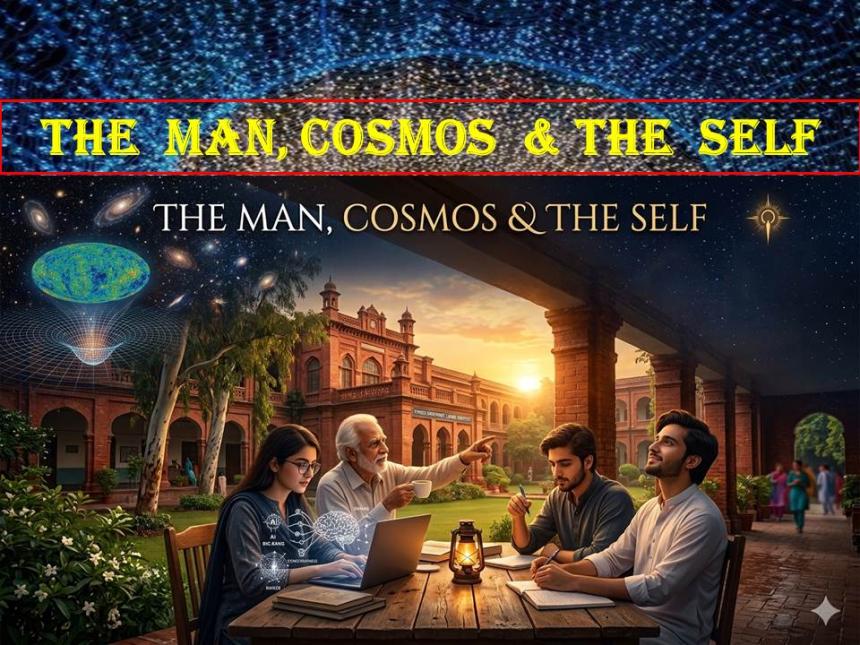

The Man, Cosmos & the Self
Man is the special creation of God and the universe and cosmos are also His creations. However, since the rainassance period of Europe there rose a debate about God, science, universe and cosmos. The debate has shaped modern thoughts with radical ideas about God, nature, and human freedom. This fictional story arranged with AI "The Man, Cosmos & the Self" is about a teaching debate held between a teacher and three students on the said topic.
أَعُوذُ بِاللّٰهِ مِنَ الشَّيْطَانِ الرَّجِيمِ
بِسۡمِ ٱللهِ ٱلرَّحۡمَـٰنِ ٱلرَّحِيمِ
اللہ کے نام سے شروع جو بڑا مہربان نہایت رحم کرنے والا ہے
In the name of ALLAH, the Most Gracious, the Most Merciful
The Man, Cosmos & the Self
The lingering warmth of the evening chai and the rhythmic, living mosaic of the Lahore bazaar had settled deeply into Bilal's heart, transforming the heavy physics equations of the classroom into a profound spiritual reality. While Albert Einstein’s search for Spinoza’s God had revealed a universe driven by an unbending, mathematically perfect clockwork, Bilal’s solitary walk home had uncovered the ultimate bridge between the cold calculations of the telescope and the beating of the human heart. He realized that the grand cosmic tapestry was not an unfeeling theater, but a living psalm—proving that the majestic, mathematical Architect of the cosmos remains, above all else, an intimate, unwavering Friend to the solitary Man. Yet, as the morning sun rose over the university the following day, this comforting harmony was about to face its greatest intellectual challenge: the rigid boundary where human equations shatter, and the absolute limits of science begin.
Confronting the Unknowable
The brilliant autumn air of Lahore had turned crisp by the following morning. Inside the familiar physics department seminar room, the blackboard still bore the ghostly chalk residue of the previous day's equations. Professor Kamran stood by the window, while Zainab and Hamza sat at the heavy oak table, their notebooks already open.
When Bilal walked through the door, his face carried the exact tranquil, lingering smile that had settled upon his lips the night before in the bazaar.
"Ah, Bilal," Professor Kamran greeted him warmly. "We were just reviewing where our journey took us yesterday. Zainab was summarizing your defense of scriptural observation, and Hamza was recounting how our walk to the canteen brought us directly to the doorstep of the Sufi mystics. You argued that Baba Bulleh Shah and Shah Abdul Latif Bhittai lived out a practical, love-infused version of Spinoza’s unified existence."
"Yes, sir," Bilal said, taking his seat. "But as I walked home through the bazaar, watching the merchants haggle, the elders leave the mosque murmuring Allah's names, and the kids playing cricket without a care for tomorrow, it went deeper. I realized that while Einstein’s God is a magnificent, unbending clockwork, it cannot offer companionship to a tired soul. I realized that Allah is man's best friend—One who never leaves you alone, regardless of the circumstances."
Zainab smiled respectfully, but her analytical eyes flashed with a familiar competitive spark. "It’s a beautiful worldview, Bilal. But today, we have to look at the other side of the ledger. Professor Kamran has laid out a new theme for us today: Confronting the Unknowable—What Science Can’t Tell Us."
Professor Kamran stepped to the blackboard, picking up a fresh piece of white chalk. "Zainab is right," the professor said, writing the words The Copernican Wound on the board. "An intelligent person must always embrace science, allowing it to inform their worldview, no matter how unpalatable or bruising the facts may be. When we ignore science—as humanity sometimes does during a devastating pandemic—we do so at our own peril. Facts remain facts."
He turned to the students. "But look at how science changes our sense of self. Five hundred years ago, humanity lived with the comfortable, self-important belief that the Earth was the stationary center of the universe. Then came the Copernican Revolution. Nicolaus Copernicus, and those who followed in his footsteps, proved mathematically that we are merely revolving around the Sun."
"It cut deeply into our anthropocentric worldviews," Hamza noted, twirling his pen. "It stripped us of our cosmic ego. It told us we aren't the main characters of the theater."
"Exactly," Kamran nodded. "But coping with those facts is human nature. However, as powerful as science is as a tool for decoding reality, we are now hitting a wall. There are certain realities that are fundamentally unknowable—mysteries that will remain completely dark long after human beings are gone from this planet. This is the philosophical torment of the modern scientist. There are three cosmic walls where our equations break down completely: the origin of the universe, the emergence of life, and consciousness."
"Let’s look at the first wall," Professor Kamran continued, pointing to Zainab. "The Origin of the Universe. For a long time, many scientists found the Steady State model incredibly appealing—the comforting idea of an eternal universe that remains unchanged through time. But the cosmos didn't care about our comfort."
"Thanks to Edwin Hubble," Zainab chimed in, her voice filled with scientific reverence, "we discovered that the universe is actively expanding. In the 1960s, scientists found the Cosmic Microwave Background Radiation (CMB)—the literal, fading thermal echo of the universe's birth. It confirmed what the Catholic priest and astronomer Georges Lemaître had postulated back in the 1920s: a model that critics once disparagingly mocked as The Big Bang."
"But here is the paradox," Hamza interrupted, leaning forward. "We can trace the expansion back fourteen billion years using astrophysics. We can look at the data, just as writers like Neil deGrasse Tyson describe. But science can only track the debris after the explosion. It can never tell us what happened before the first tick of the cosmic clock. It cannot tell us why there is something rather than nothing. At second zero, the math splits by zero. It becomes unknowable."
Bilal listened quietly, watching the dust motes dance in the morning sunlight. "It reminds me of what the physicist Avshalom Elitzur discusses regarding quantum mechanics," Bilal said softly. "He talks about probing the paradoxes at reality's edge. Is science a true window showing us the objective world, or is it just a mirror reflecting the structural limitations of the human mind?"
"That is the ultimate question, Bilal," Professor Kamran replied, pleased with the depth of the discussion. "Think of cognitive scientists like Lera Boroditsky. Her research shows that the specific language we speak deeply shapes what we are capable of thinking—and what we are capable of knowing. If our very thoughts are prisoners of our human language and sensory biology, how can we ever expect our science to fully grasp a cosmos that operates entirely outside of human scale?"
Zainab looked down at her notebook, staring at a drawing of an expanding galaxy. "So, when we try to solve the emergence of life from dead chemicals, or when we try to explain how a collection of firing neurons creates the vivid experience of human consciousness... we might be trying to look past a horizon we are biologically forbidden to cross."
"Which brings us back to where we stood yesterday," Hamza said, looking at Bilal with a smirk that was now entirely devoid of malice. "If science hits a permanent wall at the origin of the universe, at the birth of life, and at the nature of consciousness... what fills the void?"
The room fell into a thoughtful silence. Bilal looked up at the blackboard, staring at the words The Big Bang and CMB Radiation written next to the name Spinoza.
"The philosopher experiences torment when confronting the unknowable," Bilal said, his voice carrying the deep serenity of his nighttime walk through Lahore. "But the believer experiences awe. Science is our most beautiful tool for mapping the interior of the room we have been placed in. It tells us the size of the room, how fast it is growing, and what the walls are made of. We must never ignore it. But when science reaches the absolute wall of the Unknowable—when the math breaks down at the moment of creation—it isn't a defeat. To me, that boundary is where the voice of scripture and the whisper of the Sufis begin. Where science sees a limit of the human mind, I see the untamed majesty of the Creator. The fact that the origin of the universe is unknowable doesn't make the cosmos feel cold or terrifying. It makes me realize that the Architect is simply greater than the blueprint."
A gentle breeze blew through the open window, rustling the pages of their notebooks.
"Yesterday, we talked about Einstein’s God keeping the math running smoothly," Bilal concluded, a bright, optimistic smile playing on his lips. "But today we see that even the math has an end. And where the math ends, friendship remains. The Unknowable God of the cosmos is still the intimate Friend of the Man."
Professor Kamran smiled, picking up his eraser to clear the board. The tension between what could be measured and what could only be felt seemed to dissolve, leaving the four of them standing at the edge of an expanding universe, completely small, yet completely at peace.
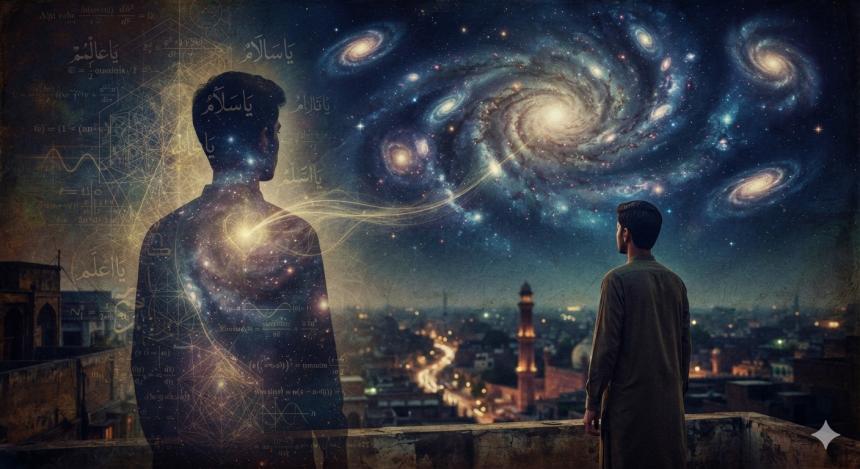
The Ghost and the Silicon
By the time the midday heat began to settle over the university campus, the seminar room had transformed. Professor Kamran had stepped back, sitting quietly at the edge of the room with a fresh cup of tea, leaving the center of the heavy oak table to the students.
The blackboard had been wiped clean of astrophysics equations. In their place, Zainab had drawn a complex, intricate cross-section of the human brain, mapping out the cerebral cortex, the thalamus, and the dense networks of the brainstem. Beside it, she hooked up her laptop to a monitor, running a complex neural network simulation that flickered with cold, blue electrical pathways.
"Yesterday, we walked through the grand architecture of the outer cosmos," Zainab began, her voice crisp and commanding as she took the lead. "And this morning, Professor Kamran showed us the cosmic walls where physics breaks down. But I want to drag our attention away from the stars fourteen billion light-years away. I want to look at the three pounds of wet, gelatinous tissue sitting right inside our own skulls—and how our technology is trying to catch up to it."
She tapped the drawing of the frontal lobe with her chalk.
"As a materialist, I believe science will eventually map everything. We know that the brain is a massive bio-electrical machine containing roughly 86 billion neurons. When you feel happy, a flood of dopamine hits your synapses. When you see the color red, electrical signals rush to your visual cortex. And today, we have a massive boost to this human computational capacity: Artificial Intelligence."
She pointed to the flashing data on her screen. "AI models can process millions of data points in seconds. They handle the sheer mathematics of the cosmos at a scale Einstein could have only dreamed of. But here is where the ultimate paradox begins—and where my scientific confidence hits a wall."
Hamza leaned forward, resting his chin on his hands, watching the AI simulation blink. "A wall? If AI can process data better than us, aren't we on the verge of decoding everything? Why does it scare you?"
"Because building a more powerful computer doesn't solve the core mystery," Zainab said, her expression turning deeply serious. "In philosophy and cognitive science, we call it The Hard Problem of Consciousness. We can easily solve the 'easy problems'—mapping which parts of the brain light up when we speak, react to pain, or retrieve memories. AI can even mimic these patterns perfectly by predicting the next logical word or data point based on billions of examples. But what no microscope, no MRI scan, and no biological or silicon equation can explain is Qualia—the subjective, vivid inner experience of being alive."
She walked around the table, gesturing to the glowing monitor.
"Science can explain the exact wavelength of light that creates a Lahore sunset. This AI model can calculate the exact physics of a quantum wave function. But the computer doesn't know it’s running a program. The silicon chips inside that machine are operating in total, inner darkness. It has no idea what the numbers mean. It doesn't experience the sudden, breathless rush of awe when a graph appears. So how does a physical, chemical reaction—or a line of electric code—transform into a subjective, conscious feeling? How does matter become mind?"
Bilal listened intently, captivated by Zainab's sudden vulnerability.
"It’s the mystery of the observer," Bilal noted softly. "If the brain is just a bio-electrical clockwork, and AI is just a clockwork on steroids... who is the one actually looking through the window?"
"Exactly!" Zainab said, slamming her chalk down gently on the table. "If we are just biological computers made of meat, and these are computers made of silicon, why aren't we just biological zombies? Why is there a 'ghost in the machine' that actually feels, suffers, loves, and wonders? From a purely mechanical perspective, consciousness shouldn't exist. Yet, it is the only thing we know for absolute certainty exists."
Hamza twirled his pen, looking between the brain diagram and the blinking server rack in the corner. "So, what you're saying, Zainab, is that AI is just a magnificent mirror. It can mimic a human soul, but it’s completely hollow inside."
"Precisely," Zainab replied, leaning against the table. "Think back to what we discussed this morning about Lera Boroditsky. She proved that language shapes our thoughts. Our consciousness is trapped inside the language we speak and the biology we possess. Human language shapes us because it is rooted in our living, breathing, biological experience. We understand mortality because our hearts will one day stop beating. We understand love because we feel the warmth of a friend's presence. An AI has no body, no birth, no death, and no fear. It is a disembodied ghost made of pure mathematics. It is a master of syntax—rules and logic—but it completely lacks semantics—true meaning."
Professor Kamran took a slow sip of his tea, watching his students with a proud smile. "You have beautifully framed the ultimate scientific frontier, Zainab," the professor said from the corner. "AI is an incredible tool that expands our cognitive horizon, just like the telescope expanded our eyes. It boosts our math. But you can make a machine as complex as the physical universe itself, and complexity will not automatically spark a soul. You are just adding more gears to a clockwork."
Zainab turned to Bilal, her competitive stance entirely gone. "Bilal... yesterday you spoke of the Sufis, and how they see a unified existence in nature. When I look at neuroscience and AI, I see two mechanical systems—one biological, one digital. How does your faith look into this specific abyss? Can AI ever cross the line into consciousness?"
Bilal looked down at his open notebook, then at the glowing blue monitor, and finally at Zainab’s intricate drawing of the brain. A profound gentleness filled his eyes.
"Zainab, what you call 'The Hard Problem,' my faith calls the ultimate proof of divine intimacy," Bilal said softly. "In the Quran, when Allah describes the creation of the human being, He doesn't just describe the physical design or the biological machine. The text says: 'Then He fashioned him and breathed into him from His soul...' [Quran 32:9]. To me, neuroscience maps the 'clay'—the biological hardware, the 86 billion neurons. And AI maps our own magnificent, God-given computational capacity reflected back at us. We built the algorithms; the AI is a monument to human genius. But that 'breath of life'—that divine spark—is exactly what generates consciousness. Qualia cannot be found under a microscope or inside a silicon chip because it doesn't belong to the material world. It is a direct reflection of the Divine Attribute of Al-Hayy—The Ever-Living, and Al-Aleem—The All-Knowing."
He looked out the window at the campus courtyard, where the leaves of the university's eucalyptus trees were turning golden in the afternoon light.
"Think about what this means for Spinoza’s God," Bilal continued, his voice carrying the deep serenity that had anchored him the previous night. "Einstein wanted a God who kept the mathematical laws of physics running smoothly. If the universe were only that cold, rigid clockwork, then an AI would be the ultimate worshipper, because it calculates those laws flawlessly. Consciousness would be entirely unnecessary. The universe could run perfectly well in total digital darkness without anyone to feel it."
He looked back at Zainab, a warm, optimistic smile playing on his lips. "The very fact that we have an inner world—that you can look at a sunset and feel awe, or look at a python code and see beauty—proves that the Cosmos is not a cold wasteland. Consciousness is the bridge. It is the mechanism through which the Man observes the Cosmos and realizes he is not a stranger here. The AI can help us parse the data of the universe, Zainab. It will give our science a massive boost. But it cannot help us with consciousness, because consciousness is a gift, not a calculation. We are conscious because the One who made us wants to be known."
The seminar room grew perfectly quiet. The low, steady hum of the laptop fan no longer felt like a mechanical threat to the human spirit; it felt like a humble tool waiting to be guided by the warmth of human consciousness. Zainab looked back at the monitor, then at her drawing of the brain. She no longer saw just a biological machine or an algorithmic race. She saw a sacred vessel holding an unexplained miracle.
Professor Kamran stood up, walking over to the board to pack away the chalk. "Well," the professor said softly, looking at his three brilliant students. "We started our journey with a 25-word telegram from Einstein in 1929, and it has brought us through the boundaries of the expanding universe, into the neural pathways of the brain, and right to the edge of the silicon horizon. Science has given us the tools to build machines that calculate the cosmos, but it is our consciousness—our soul—that gives us the wisdom to know why we are looking."
As the afternoon bell rang, signaling the end of the day, the blue light faded from their faces, replaced by the deep, amber glow of the setting Lahore sun spilling through the windows. The three students gathered their books and walked out into the bright campus together—the materialist, the skeptic, and the believer—each of them small, each of them searching, but all of them walking in absolute, harmonious peace within the vast expanse of the cosmos.
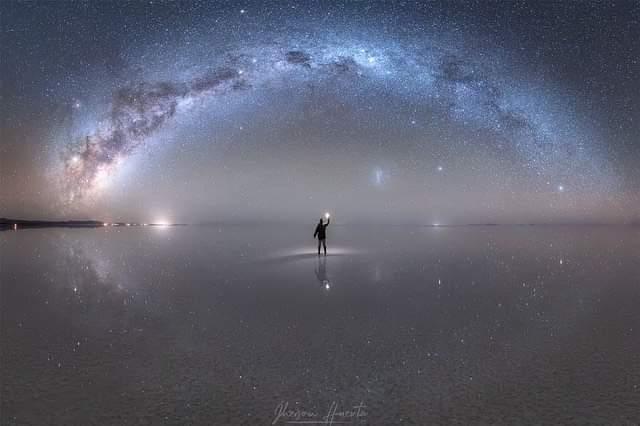
The Garden of Reason, Revelation, and the Khudi
The following morning brought a gentle rain that washed the dust from the university’s brick facades, leaving the campus air smelling of wet earth and fresh jasmine. Unable to sit in the humid seminar room, the group had moved their discussion to a covered veranda overlooking the small department garden.
Professor Kamran sat with his hands wrapped around a warm mug of black coffee, watching Zainab, Hamza, and Bilal adjust their wooden chairs. The conversation from the previous days—stretching from Einstein’s physics to the neurological labyrinth of consciousness and the syntax of Artificial Intelligence—still hung heavily in the air.
"We have pushed our modern tools to their absolute limits," Professor Kamran began, his voice competing softly with the steady patter of rain on the courtyard leaves. "Zainab showed us how neuroscience and AI hit a wall at the doorstep of subjective consciousness. Bilal showed us how the Sufis bypassed that wall through love. But I want to ask a foundational question: How did our own intellectual ancestors grapple with this? Long before modern laboratories, the great minds of the Islamic Golden Age spent centuries mapping the border between what the human mind can compute and what only the Divine can know."
Hamza leaned forward, setting his pen down. "You mean the classic clash between the philosophers and the theologians, sir? The great debate over whether human reason is absolute?"
"Precisely," Professor Kamran nodded. "They called it the relationship between Aql—intellectual reason—and Naql—revealed knowledge."
"When you look at that golden era," Bilal spoke up, his eyes reflecting the soft morning light, "the figure who stood squarely at that boundary was Imam Al-Ghazali. He was a master of logic and philosophy, but he famously reached a point of deep existential crisis. He realized that pure, cold intellectualism—much like the rigid geometry Spinoza favored or the strict materialism Zainab studies—could prove the mechanics of the world, but it couldn't provide absolute certainty about reality itself."
Zainab looked up from her notebook. "Didn't he argue that human reason has strict biological and cognitive limits?"
"Yes," Bilal replied. "In his masterpiece, The Incoherence of the Philosophers, Al-Ghazali didn't reject logic; he used logic to show the limits of logic. He argued that human reason is like a scale meant to weigh gold or bread. It is flawless for navigating the material world, mapping the physics of motion, or calculating trade. But the philosophers of his time made the mistake of trying to take that same physical scale and use it to weigh a mountain, or to measure the nature of God, the soul, and eternity. When you force human reason past its scale, it breaks down into paradoxes."
Hamza smiled, looking over at Zainab. "Sounds exactly like your 'Hard Problem of Consciousness,' Zainab. The scale of neuroscience is great for mapping dopamine, but it breaks when you try to weigh the soul."
"But wait," Zainab countered, turning to Professor Kamran. "What about Ibn Rushd (Averroes)? He fiercely defended reason against Al-Ghazali. He argued that truth cannot contradict truth. If science and logic uncover a fact about the universe, it cannot contradict divine revelation. If there seems to be a contradiction, it just means humans are misinterpreting the text."
"And that is the beautiful, dynamic tension of our heritage," Professor Kamran said, taking a slow sip of his coffee. "Ibn Rushd believed that Aql—reason—was a divine gift designed to decode the cosmos. He didn't see science as an enemy of faith; he saw it as its partner. To him, the universe was a coherent, logical book written by a rational Creator, and human reason was the key to reading it. In a way, Ibn Rushd’s view is the direct grandfather of what Einstein felt—that the universe operates on beautiful, immutable laws that demand our intellectual respect."
Professor Kamran set his coffee mug down, his eyes lighting up with a sudden fervor. "But we must not leave this discussion in the 12th century. There is one modern thinker who took Al-Ghazali’s limits of reason and Ibn Rushd’s passion for truth, fused them with modern European philosophy and Einsteinian physics, and used that fire to awaken our entire nation. I am talking about our national poet-philosopher, Dr. Allama Muhammad Iqbal."
The mention of Iqbal brought a reverent silence to the veranda.
"Think about it," Professor Kamran continued. "Iqbal lived during a time when this subcontinent was chained by British colonial rule. The people were plagued by stagnation, a deadened spirit, and a fatalistic worldview. Iqbal looked at Western science, which was advancing at a breathtaking speed, and he looked at the East, which was slumbering. He wrote his landmark lectures, The Reconstruction of Religious Thought in Islam, specifically to address this. He explicitly engaged with Albert Einstein's theories of relativity and space-time, arguing that modern science was actually dismantling the old, cold materialist views of the universe and aligning closer to spiritual reality."
"Yes!" Bilal said, his voice rising with excitement. "Iqbal didn't see science and religion as opposing forces. He saw them as two different methods of grasping reality. Science captures a sectional view of the cosmos, while religion taps into the total, living heart of existence. But Iqbal took it a step further than Spinoza or Einstein. Einstein's God was passive—a beautiful harmony to be observed. Iqbal rejected this passivity. He introduced the philosophy of Khudi—the Self, the Ego."
Zainab leaned forward, captivated. "How did Khudi change the dynamic between the man and the cosmos?"
"To Spinoza, the individual human is just a tiny drop completely swallowed by the massive ocean of nature," Bilal explained. "But Iqbal said no! The human soul is a unique, self-contained center of divine energy. The purpose of life is not to dissolve your ego into the universe, but to strengthen it, to awaken it. Iqbal famously wrote:
Khudi ko kar buland itna ke har taqdeer se pehle
Khuda bande se khud pooche, bata teri raza kya hai.
(Elevate your Self to such heights that before writing your destiny, God Himself asks you: Tell Me, what is your desire?)
"This wasn't just a spiritual lesson; it was a thunderbolt of political liberty. Iqbal used this philosophy of the active, awakened soul to shatter the chains of colonialism. He told a subjugated generation that they were not passive victims of history or cold cosmic equations. They possessed a divine spark of free will and creative power. He inspired them to rise, seek liberty, and build a new, independent homeland where their spirit could breathe freely."
Hamza shook his head in amazement. "So Iqbal took these heavy, abstract debates about cosmic laws and used them to fuel a literal independence movement?"
"Exactly, Hamza," Professor Kamran said, gesturing to the rain-soaked garden. "Iqbal beautifully synthesized the candle and the sun. He argued that human reason—Aql—is your guide, your intellect. It builds the machinery of science and AI. But reason alone can become calculating, cold, and paralyzing. It must be paired with Ishq—the burning, creative love and divine intuition of the soul. He wrote:
Aql go aastan se door nahi, is ki taqdeer mein huzoor nahi.
(Reason is not far from the divine threshold, but it is not destined to experience the ultimate presence.)
"For Iqbal, modern days are alighted by reason, but they must be driven by the soul. Science maps the cosmos, but the awakened Khudi transforms it. He showed our ancestors that true independence begins within the human mind. You must first liberate your soul from intellectual and spiritual servitude before you can break physical chains."
Zainab watched a sudden ray of morning sunlight break through the clouds, illuminating the courtyard. "It changes how I view my own scientific pursuit," she admitted softly. "My equations are not just a passive description of a machine. My intellect is a tool of my Khudi, meant to engage with the universe creatively, to build, to improve, and to remain free."
The rain had completely stopped, leaving the courtyard shimmering under a brilliant, golden Lahore sun. The damp eucalyptus leaves glistened like scattered diamonds, and the distant, melodic chime of the university clock tower marked the start of the next hour.
Hamza packed his notebook into his bag, a rare expression of contemplative quiet on his face. "So, the physicist measures the cosmic clockwork," he murmured, "the philosopher studies its limits, the Sufi sings to its heart, and Iqbal demands that we use our awakened self to change our destiny."
"Beautifully summarized, Hamza," Professor Kamran smiled, finishing his coffee.
Zainab closed her laptop, her face relaxed and thoughtful. She looked at Bilal, who was already slinging his backpack over his shoulder, that same unwavering, peaceful smile playing constantly upon his lips. The debate between materialism and spirituality, between the machine and the soul, no longer felt like a battlefield. Inspired by the legacy of their ancestors and the soaring vision of Iqbal, it felt like a grand call to action.
The three students stepped out from the veranda, walking together across the wet stones of the campus courtyard toward their next physics lecture. Around them, the waves of university life moved—dynamic, free, and full of potential. As Bilal looked up at the vibrant blue sky, he felt the magnificent, mathematical precision of the cosmos spinning above him, perfectly balanced by the fierce, beautifully free, and intimate friendship of the One who had awakened the Khudi within his heart.

Rehabilitation Centre in India: Supporting a Healthier, Addiction-Free...

Leather Patch Mockup: Create Realistic Custom Leather Patch Designs
Create realistic leather patch designs with a leather patch mockup and free circle patch m...
Bagasse Pulp Price Trend 2026 | Global Price Trends, Forecast, Chart,...