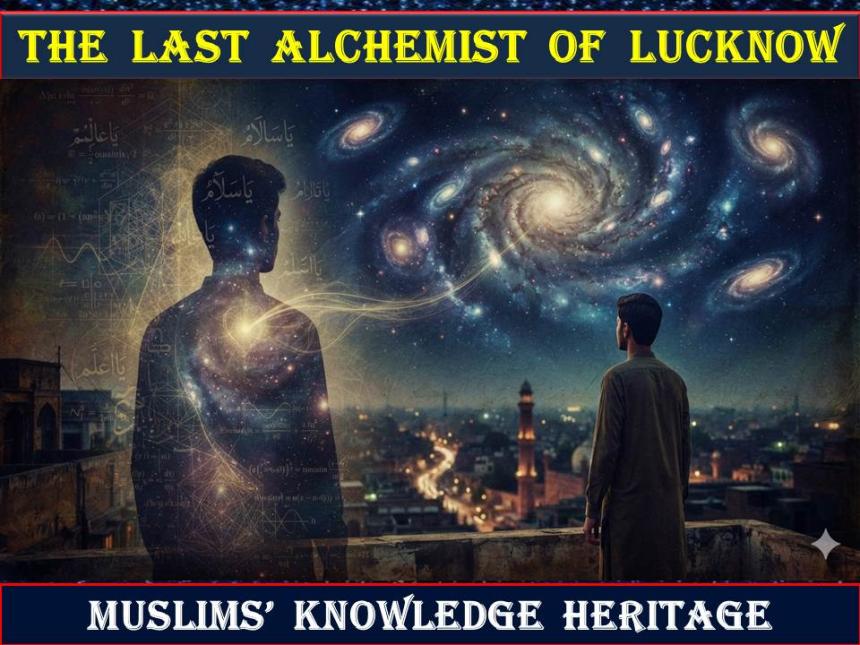

The Last Alchemist of Lucknow
Storytelling is an important tool because it builds emotional connections, helps people remember information, and fosters empathy. Fiction is defined as any creative literary or narrative work that portrays imaginary characters, settings, and events. This fictional story deals with the lost Muslims' knowledge heritage to explain future for real progress in the world. This fictional story "The Last Alchemist of Lucknow" is about such fusion of knowledge.
أَعُوذُ بِاللّٰهِ مِنَ الشَّيْطَانِ الرَّجِيمِ
بِسۡمِ ٱللهِ ٱلرَّحۡمَـٰنِ ٱلرَّحِيمِ
In the name of ALLAH, the Most Gracious, the Most Merciful
The Last Alchemist of Lucknow
The rain in London always felt cold and calculated to Dr. Zain, but tonight, staring at the glowing monitor of his university office, it felt suffocating. Zain was a brilliant professor of Data Science at a top UK institution. His research was hyper-specialized; he knew everything there was to know about predictive algorithm optimization for financial markets, but he knew almost nothing else. He was a perfect product of the modern machine—a man confined to a neat academic box.
His phone buzzed. It was a video call from his grandfather, Abba Jan, back in the old quarters of Lucknow, India.
When the screen flickered to life, Zain saw the familiar, warm backdrop of his ancestral home. The room was lined with ceiling-high wooden bookshelves containing centuries-old handwritten manuscripts, their leather covers worn but loved. On the wooden table sat an ancient bronze globe, an inkwell, and a half-written poem on parchment.
"Zain, beta," Abba Jan’s voice was like aged silk, carries the cadence of a different era. "You look tired. Are your algorithms not treating you well?"
Zain sighed, rubbing his temples. "I’m just exhausted, Abba Jan. We are pushing our postgraduate students through a grueling curriculum, forcing them to spend eighteen hours a day coding market predictions. They get straight A's, they land corporate jobs, but they are hollow. They have no imagination. They don't understand the ethical weight of what they build. I feel like I'm running an assembly line for intelligent cogs."
Abba Jan smiled gently, adjusting his glasses. He was the last of his kind—a traditional Hakim who was also a scholar of astronomy, a master of mathematics, and a deeply respected poet whose ghazals were sung across the city.
"You are running a factory of 'loyal clerks,' Zain," Abba Jan said softly. "It is the old colonial blueprint. The British Raj successfully separated knowledge from the soul, turning education into a mere employment license. When you trap human potential in a single box, you kill the ibn-e-Adam—the human being destined to conquer the universe."
Abba Jan picked up a beautifully preserved manuscript from his desk. "Do you remember your great-great-grandmother, Amna Begum? She never stepped into a Western university. Yet, under the traditional home-seminary system, she mastered Arabic syntax, translated Persian astronomy texts, and her Diwan of poetry was praised by the elite of Lucknow. She did not study to get a corporate permit. She studied to cultivate her mind."
Zain looked at his own pristine, white office walls—devoid of art, literature, or history. He felt a sudden, sharp pang of displacement. He was a world-renowned scientist, yet his grandfather, sitting in a crumbling room in Lucknow, possessed a vast, interdisciplinary worldview that Zain could only dream of.
"Come home for a few weeks, Zain," Abba Jan urged. "Bring your brightest student. Let them see what knowledge looks like when it is lived as a civilization, not just as a transaction."
Two weeks later, Zain arrived in Lucknow, accompanied by Maya, his top doctoral student from New York. Maya was a prodigy in financial engineering but had never read a book of philosophy, history, or literature in her life. She viewed the world purely through statistical trends.
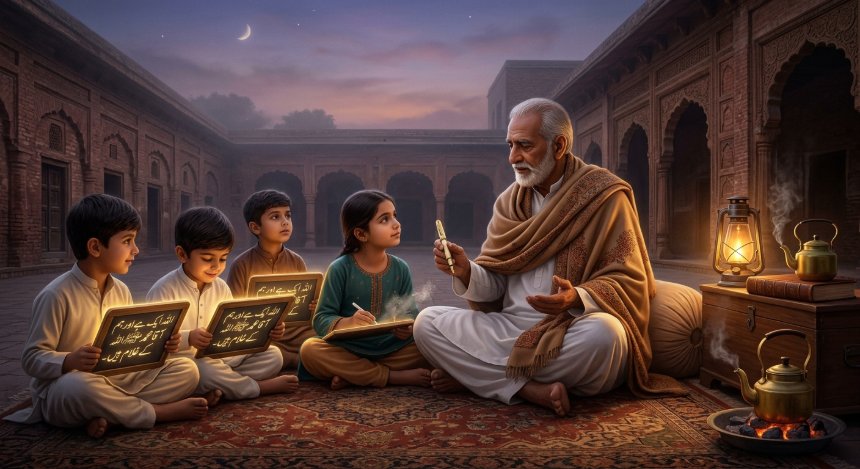
On their first evening, Abba Jan invited them into the courtyard. The air smelled of jasmine and wet clay. Local artisans, a young university graduate, and a local merchant were gathered, sipping tea.
Abba Jan did not speak of finance. Instead, he began reciting a poem by Shah Abdul Latif Bhittai in Sindhi, translating the deep allegories of the human soul into Urdu and Persian, before mapping the rhythmic cadence of the poetry to a mathematical progression on a chalkboard. He seamlessly connected the spiritual poetry of Sultan Bahu with the astronomy concepts of the Bayt al-Hikmah (House of Wisdom) in Baghdad, demonstrating how the universe operates on a single, harmonious design.
Maya sat transfixed. For the first time in her life, she wasn't looking at data points on a screen; she was seeing how mathematics, ethics, literature, and human nature were completely intertwined.
"Sir," Maya whispered to Abba Jan, her eyes wide. "In our labs, we isolate variables to understand them. But you... you are connecting everything. This isn't just data. This is a living tapestry."
Abba Jan looked at her with immense warmth. "Knowledge, my child, is not a collection of isolated boxes. Our heritage teaches us that a true scholar must be an alchemist of the mind—blending science with empathy, and mathematics with the soul. When you break down the artificial walls of specialization, you don't just produce a worker; you cultivate a conscious human being."
That night, Zain walked into the old family library. He picked up an ancient reed pen, dipped it into the black inkwell, and wrote a sentence on a blank piece of paper. He didn't write a line of code or an algorithmic formula. He wrote a line of poetry his grandfather had quoted from Iqbal.
He looked out at the Lucknow skyline, realizing that his 18 years of elite Western schooling had only taught him how to execute a task. It was here, in the shadow of an endangered heritage, that he was finally learning how to think.
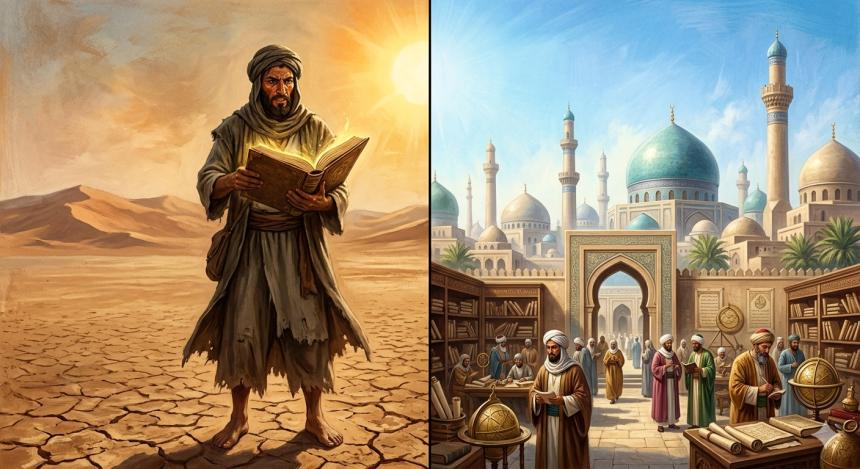
The Climax & Finale
When Zain and Maya returned to London, the university felt colder than ever. The glass-and-steel architecture of the campus seemed to mirror the rigid, compartmentalized minds within it.
Two weeks after their return was the Annual Global Analytics Symposium—the university’s flagship event. The auditorium was packed with international investors, tech CEOs, and hyper-specialized academics. Zain was scheduled to present his lab’s newest predictive economic model, a project the dean hoped would secure millions in corporate funding.
The dean, a man whose worldview was strictly bounded by quarterly targets and corporate metrics, nodded sharply from the front row. "Show them the numbers, Zain," he whispered as Zain walked up to the podium.
But Zain didn't open his presentation slides.
Instead, he stood silently at the podium for a long moment, looking out at the crowd of exhausted, straight-backed academics and corporate suits. Behind him on the massive digital screen, instead of algorithmic data points, a single image appeared: a beautifully high-resolution photograph of a handwritten, 18th-century manuscript from Lucknow, flanked by a traditional reed pen and an antique brass astrolabe.
A murmur rippled through the auditorium. The dean frowned, shifting uncomfortably.
"For eighteen years, we train the brightest minds in this institution," Zain began, his voice echoing with a quiet, resolute power that surprised even himself. "We teach them how to specialize. We box them into neat, narrow disciplines. We teach our economists to ignore ethics, our data scientists to ignore history, and our engineers to ignore philosophy. And we call this progress."
Zain stepped away from the podium. "We believe we are pioneering a new age of data. But centuries ago, in the Bayt al-Hikmah of Baghdad, and later in the home-seminaries and literary drawing rooms of Delhi and Lucknow, our ancestors practiced a far grander science. They did not lock human potential into isolated cages. They believed in Interdisciplinary Harmony—the culture of knowledge as a living, breathing tapestry where mathematics, cosmos, and the human soul operated on a single design."
The dean stood up, his face flushed. "Dr. Zain, this is an analytics symposium. Please stick to the financial forecasting model."
"I am showing you the model, Dean," Zain replied calmly. He signaled to the back of the room. "Maya, please."
Maya stepped onto the stage. But she didn't look like the anxious, hyper-focused doctoral student who had left for India a month ago. Her posture was confident, her eyes alight with a rare brilliance.
Instead of reading from a sterile script, Maya began to present their financial forecasting model—but she did it as an alchemist. She explained the mathematical progression of the algorithm, but then, she seamlessly mapped it to the rhythmic, poetic cadences of Sufi literature. She demonstrated how market volatility wasn't just a cold statistical trend, but a reflection of collective human psychology and ethical behavior—concepts she had bridged using the philosophical frameworks of Shah Waliullah and the emotional depth of Rahman Baba.
She didn't just present data; she told a story of the human condition through numbers. She showed that when you remove ethics and philosophy from predictive algorithms, you create models that maximize profit but inevitably cause societal collapse.
The auditorium fell into a stunned, absolute silence. The corporate tech CEOs leaned forward, captivated. They weren't just looking at another spreadsheet; they were witnessing a profound awakening. For the first time, a mathematical model felt alive, grounded in human consciousness and cosmic truth.
When Maya concluded, she looked at the dean. "We didn't just build a better algorithm, sir. By breaking down the walls of our specialization and looking through the lens of a broader, civilizational heritage, we found the soul within the data."
For five seconds, no one moved. Then, a tech venture capitalist in the third row stood up and began to applaud. Within moments, the entire auditorium erupted into a standing ovation. Even the academics, long hardened by their rigid boxes, felt a dormant part of their intellect stir. The dean sat down, slowly, realizing that the sterile assembly line had just been dismantled by a piece of history.
That night, Zain sat in his office. The London rain was still falling outside, but the room no longer felt suffocating. On his modern desk, right next to his sleek laptop, sat a small wooden box he had brought back from Lucknow. Inside was an old brass inkwell and a reed pen given to him by Abba Jan.
He opened his laptop and looked at the new syllabus he and Maya had started drafting. It wasn't just called 'Data Analytics.'
He titled it: "The Alchemy of Data: Interdisciplinary Sciences and Human Consciousness."
Zain smiled, picked up the reed pen, and felt the unmistakable warmth of his heritage flowing through his veins. The colonial machine had built the prison of modern specialization, but the key to freedom had been waiting for them all along in the dust-covered libraries of their ancestors.
What a Grain Is, and Why 50, 55, 62, 130 and 168 Keep Showing Up on th...
A grain is 1/7000 of a pound. Choosing a bullet weight is mostly a matter of what your bar...

Furadeira de Impacto: Como Escolher, Utilizar e Aproveitar Seus Benefí...
Furadeira de Impacto: Como Escolher, Utilizar e Aproveitar Seus Benefícios