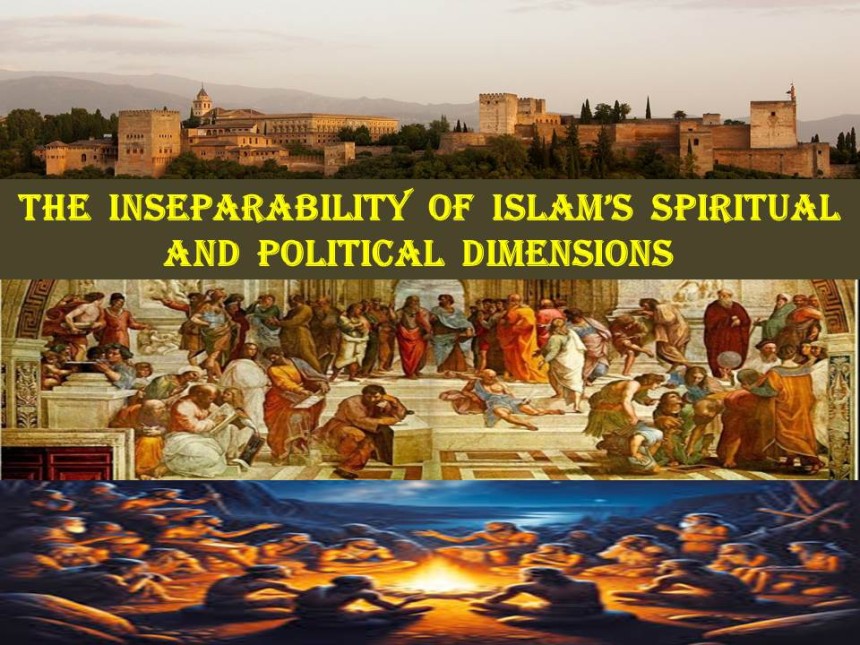

The Inseparability of Islam’s Spiritual and Political Dimensions
The religion "Islam" is a complete code of life and its as old as the Prophet Adam (AS). The last version revealed upon Holy Prophet Muhammadﷺ as prescribed by ALLAH i.e. ISLAM. Can Islam undergo a transformation similar to the Christian Reformation, a separation between the spiritual and political realms? This article is an opinion from West about Islam based upon fear of rising Muslims' population. This opinion is being shared for a meaningful debate on this subject.
بِسۡمِ ٱللهِ ٱلرَّحۡمَـٰنِ ٱلرَّحِيمِ
In the name of ALLAH, the Most Gracious, the Most Merciful
The Inseparability of Islam’s Spiritual and Political Dimensions
Can Islam undergo a transformation similar to the Christian Reformation, a separation between the spiritual and political realms? Is there any hope that Islam might evolve into a purely personal faith, detached from political ambitions and free from theocratic aspirations? Such a separation faces both structural and theological impossibilities within Islam itself. The problem is not merely historical or cultural; it is embedded within the very fabric of Islamic revelation, law, and prophetic example.
Unlike other major religions, Islam did not emerge as a spiritual movement that later developed political influence. From its inception, it was both a theological claim and a political project. Muhammad was not merely a preacher or a mystic; he was a legislator, judge, general, and head of state. His religious message was inseparable from his political leadership.
When Muhammad migrated from Mecca to Medina in 622 CE, the Hijra, marking the beginning of the Islamic calendar, he did not just seek refuge. He established a polity: the first Islamic state. In Medina, Muhammad drafted the so-called Constitution of Medina, uniting various tribes under his leadership and declaring himself both the prophet of God and the ruler of men. Religion and governance were fused in one person.
In Christian terms, this would be as if Jesus not only preached the Sermon on the Mount but also built a government, commanded armies, and legislated divine law. In Islam, this fusion is not incidental; it is foundational. Muhammad’s life is the supreme model (uswa hasana), his actions forming the binding precedent (sunnah) for all Muslims. Thus, Islam’s spiritual and political components are not parallel tracks, they are one and the same.
The Quran does not treat governance as a secular concern. Political authority is directly tied to divine revelation. Verses such as “Those who do not judge by what Allah has revealed are disbelievers” (Quran 5:44) make the application of divine law, sharia, a core religious duty. To separate religion from governance would be an act of disbelief (kufr).
This idea is reinforced by Islamic jurisprudence, which developed after Muhammad’s death. The Islamic scholars elaborated on the concept that sovereignty belongs to God alone (hakimiyyat Allah). The role of human rulers, then, is merely to implement divine law, not to legislate independently. In the Islamic worldview, there is no such thing as a morally neutral state, only states that obey or defy divine command.
The result is a perpetual expectation that the political order must reflect Islamic revelation. Any government not founded on Islam is considered temporary, illegitimate, or corrupt, a sign that the Muslim community has strayed from its divine mandate.
Why Reformation is Theologically Impossible
Western observers often invoke the Christian Reformation as a model for Islamic reform. However, the comparison fails at a structural level. Christianity could separate church and state precisely because Jesus made no claim to political authority. His kingdom, as he said, was “not of this world.” The New Testament contains no political program, no civil code, and no military strategy. When Constantine Christianized the Roman Empire, he did something alien to Christianity’s original ethos, a fusion that later reformers could undo.
Islam, however, began as both faith and polity. To separate mosque and state is not to reform Islam, it is to rewrite it. Since Muhammad’s prophetic authority included governance, war, and law, removing these elements would mean rejecting his prophetic model itself. Such rejection is not reform but apostasy.
Even so-called “reformist Muslims” who argue for a secularized Islam face this paradox: if they deny Muhammad’s political role as normative, they undermine the theological principle of his perfection. Yet if they affirm it, they affirm the very fusion that makes Islam a political project.
The engine of Islam’s political nature is sharia, the divine law encompassing every dimension of human life, from prayer to taxation, diet to warfare. Unlike the Christian distinction between Caesar and God, Islam recognizes no such dualism. The law of Allah is supreme over all human institutions.
Sharia derives not from reasoned deliberation or consensus but from revelation: the Quran and the Hadith. It governs not only personal morality but public order. It defines marriage, contracts, inheritance, warfare, and the treatment of non-Muslims. In Islam, there is no neutral or secular space; every action falls within the boundaries of what is commanded, permitted, or forbidden by divine authority.
After Muhammad’s death, the caliphate was established to preserve both his religious and political legacy. The first four caliphs (Abu Bakr, Umar, Uthman, and Ali) were regarded as his rightful successors, leaders of both faith and state. The wars of apostasy (ridda wars) fought under Abu Bakr were not against atheists or pagans, but against tribes who refused to pay taxes or recognize Medina’s political authority. Disobedience to the political center was treated as rebellion against God.
This conflation of religious and political loyalty became a permanent feature of Islam. The Muslim community (ummah) was not just a fellowship of faith but a political body. Membership implied allegiance to an Islamic state, and defection was both treason and heresy.
Western policymakers assume that by promoting education, democracy, and economic opportunity, Muslims will naturally privatize their faith. This assumption reflects a Western bias, the belief that religion is primarily a matter of personal conscience. In Islam, faith is not personal; it is communal and juridical. To be a Muslim is to belong to a body governed by divine law.
Attempts to promote a “moderate Islam” or “cultural Islam” have repeatedly failed because they rest on a false premise: that Islam can exist without its political core. The reality is that an apolitical Islam is not Islam. It would require a theological revolution, not merely a political reform, and every such attempt has been met with accusations of heresy or apostasy.
Judaism and Christianity both emerged from covenants that ultimately transcended political authority. In Judaism, the covenant was national but divine authority rested above human kingship. When Israel demanded a king, the prophet Samuel warned them of the danger of fusing divine and political authority. Later, when Israel fell into exile, Jewish faith survived without a state, proving that its essence was spiritual, not political.
Christianity went even further. Jesus rejected the sword as a tool of spiritual authority, distinguishing between God’s kingdom and Caesar’s. This separation, unique in the ancient world, laid the groundwork for the Western concept of limited government. Over centuries, this produced the conditions for pluralism, free thought, and moral accountability, the very foundations of Western civilization.
Islam followed the opposite trajectory. Its founder wielded both the sword and the scripture, and the two have never been disentangled. The result was a civilization that produced order through dominance, not liberty; unity through coercion, not consent.
The Modern Dilemma
Modern Muslims who seek to reform Islam face a cruel dilemma: they must either reinterpret or reject key elements of the faith. To secularize Islam, they must deny the political dimension of the Quran, the authority of sharia, and the prophetic example of Muhammad, all central pillars of Islam. But to preserve Islam is to preserve the political imperative.
This is why reformers such as Mahmoud Muhammad Taha in Sudan or Nasr Hamid Abu Zayd in Egypt were executed or exiled. They attempted to spiritualize Islam by downplaying its legal and political components, and the orthodox establishment responded by declaring them apostates.
Islamic theology centers around submission, not just spiritual submission to God, but societal submission to His law. The very word Islam means “submission.” In the Quran, faith is expressed through compliance: “It is not for a believing man or woman, when Allah and His Messenger have decided a matter, to have any choice in their affair” (Q 33:36).
In this worldview, freedom of conscience is not a virtue; obedience is. Political independence from divine law is rebellion. The West’s separation of religion and state is thus not seen as progress but as moral decay, a revolt against God.
This is why, even among Muslims living in Western democracies, there is a deep ambivalence toward secular governance. Many enjoy the freedoms of liberal society but view those freedoms as instruments of corruption. They may vote, pay taxes, and integrate economically, yet they retain the conviction that Islam must ultimately prevail.
Every major attempt to reform Islam has failed because reform requires breaking the link between faith and power, a link sanctified by scripture and history. The modernist movements of the 19th and 20th centuries, from Egypt’s Muhammad Abduh to Turkey’s Ataturk, sought to confine Islam to the private sphere. Yet, even Ataturk’s secularism depended on authoritarianism; he replaced the rule of clerics with the rule of the state.
In Muslim-majority societies, democracy itself tends to empower Islamic movements because political participation becomes a means to achieve theological ends. As the saying goes: “Democracy is like a train, you ride it until you reach your station, then you get off.” Muslims embrace democracy only until they can replace it with divine law.
For Western societies grappling with the rise of Islam within their borders, the first step is intellectual honesty. Islam is not merely a religion but a comprehensive system, a civilization with its own legal, political, and moral order. Treating it as a private faith like Christianity is a category error.
This doesn’t mean that every Muslim seeks to impose sharia. But it does mean that the theological foundation for such ambitions is authentic and enduring. Ignoring that fact for the sake of tolerance is not compassion, it is blindness.
Western policymakers and intellectuals must confront the uncomfortable truth: Islam cannot be secularized without ceasing to be Islam. The path forward lies not in pretending that the religion can be reformed into something it is not, but in defending the moral and institutional boundaries that make the West free.
NOTE: The above is taken from link below:-
Additional Comments by Blogger
The above is an opinion of Mr Dan Burmawi @DanBurmawy; who is CEO @IDICenter. He claims #1 Bestselling Author 'Islam, Israel and the West' | Middle East Affairs | Political Theology | Judeo-Christian Values.
His opinion challenges Muslims across the globe to scan their belief and find the "Truth" of their own level of "Emaan".
The religion "Islam" is a complete code of life and its as old as the Prophet Adam (AS). The worlds famous Abrahamic Religions (Judaism, Christianity & Islam) are also the same religion as was awarded to Prophet Adam (AS). The latest and last version was revealed upon Holy Prophet Muhammadﷺ and Muslims preferred to retain the same name as prescribed by ALLAH i.e. ISLAM.
In Islam, the spiritual (faith/rituals) and political (governance/social justice) dimensions are inherently linked, with the Shari'ah providing a comprehensive framework for both individual morality and societal organization. This holistic view integrates divine sovereignty with humans' responsibility, aiming for justice, equality, and ethical governance as per the divinely revealed dictums and directions along with Sunnah of Prophet Muhammad ﷺ (PBUH). The state serves as an institution within this framework to uphold the principles (regulations and instructions) ordained in Quran and Sunnah.
YES.. today Muslims are unable to enforce & implement the "True" Religion. The True Religion may be defined as:-
"Tawhid" (Oneness of God); this core principle dictates that God’s authority applies to all aspects of life, including public and private affairs, making the separation of religion from state a foreign concept. "Shari'ah as a Guide"; the legal and moral code covers personal piety and social, economic, and political interactions, linking spiritual accountability with legal justice.
In an Islamic State, the state is not merely political, but is considered an extension of community, tasked with maintaining justice and upholding religious values. The goal is often defined as ensuring political decisions are guided by divinely revealed guidance and ethical values like compassion and justice, ensuring the spiritual well-being of the society. It requires "Integrated Approach", where political power is used to implement divine law. However, institutional state power shall allow freedom of practicing religion for a truly free religious life. The ultimate aim and emphasis is on building a just civil society, rather than just focusing on state institutions.
The union of these dimensions means that for any Muslim, true piety is expressed through active participation in upholding justice within society, reflecting a holistic view of faith.

Convenient Ways to Buy Wine Online Ontario
Exploring options to buy wine online Ontario helps wine enthusiasts discover selections fr...