
The Impact of Vibe Coding and AI on Modern UI/UX Design
Discover how vibe coding and AI are transforming modern UI/UX design by speeding up prototyping, improving collaboration, and making digital product creation more accessible. This article explores the benefits, challenges, and future of AI-powered design workflows, including their connection with no-code tools and modern design agencies.
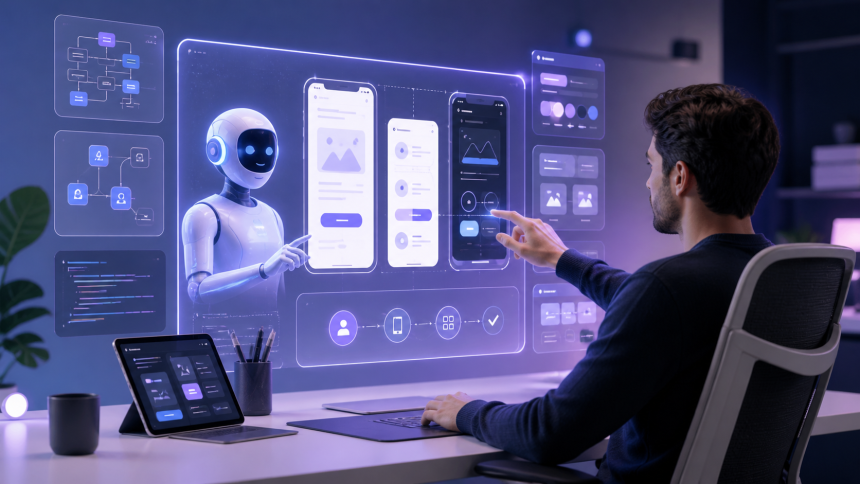
The world of UI/UX design is changing faster than ever. A few years ago, creating digital products required long design cycles, detailed technical documentation, and heavy collaboration between designers and developers. Today, the rise of artificial intelligence and a new approach known as vibe coding is reshaping how teams imagine, design, and build digital experiences.
Vibe coding is not just about writing code quickly. It is about describing an idea, mood, interaction, or product experience in natural language and allowing AI-powered tools to help turn that concept into functional interfaces, prototypes, or even production-ready components. Combined with AI, this approach is creating a major shift in modern UI/UX design, making the process faster, more creative, and more accessible.
For designers, developers, startups, and businesses, this transformation opens exciting opportunities. It allows teams to move from idea to execution with less friction, test concepts more rapidly, and create user-centered experiences with greater efficiency. However, it also raises important questions about creativity, design quality, human judgment, and the future role of design professionals.
What Is Vibe Coding?
Vibe coding refers to a workflow where users communicate their desired outcome to AI tools using plain language prompts instead of manually writing every line of code. For example, a designer might describe, “Create a clean dashboard for a finance app with a modern card layout, dark mode, and smooth hover animations.” The AI then generates interface code, layouts, or design structures based on that instruction.
The word “vibe” matters because the process is often less about technical syntax and more about communicating the overall feeling, style, and user experience. Instead of only thinking in terms of grids, components, or frameworks, creators can express the emotional and functional direction of a product.
This approach is especially useful in UI/UX design because experience design has always been about more than visuals. It includes usability, flow, clarity, accessibility, and emotional connection. Vibe coding helps bridge the gap between creative intention and technical execution.
How AI Is Changing UI/UX Design
Artificial intelligence has already become part of many design workflows. Designers now use AI to generate wireframes, write UX copy, analyze user behavior, create design variations, summarize research findings, and even suggest accessibility improvements.
One of the biggest impacts of AI is speed. Tasks that once took hours can now be completed in minutes. For example, instead of creating multiple landing page concepts manually, a designer can use AI to generate several layout directions and then refine the best one. This allows teams to focus more on strategy, testing, and user needs rather than repetitive production work.
AI also supports better decision-making. By analyzing user data, heatmaps, feedback, and behavior patterns, AI tools can help identify where users struggle in a digital product. This gives designers valuable insight into what needs improvement, whether it is a confusing navigation menu, a weak call-to-action, or a long checkout process.
However, AI does not replace human empathy. Good UI/UX design still requires understanding real people, business goals, culture, emotions, and context. AI can assist with execution and analysis, but human designers remain essential for making thoughtful experience decisions.
The Connection Between Vibe Coding and UI/UX
Vibe coding and UI/UX design work well together because both focus on translating ideas into experiences. Traditional coding often requires precise technical instructions, while vibe coding allows designers to describe what they want in a more natural and creative way.
This is powerful for early-stage product design. Instead of waiting for developers to build a prototype, a designer or product manager can quickly generate an interactive version of an idea. This prototype can then be tested with users, shared with stakeholders, or refined before moving into development.
For example, a team designing a mobile fitness app could use vibe coding to generate several onboarding flows. One version might feel energetic and bold, while another could feel calm and minimal. By testing these variations, the team can better understand which experience connects with users.
This process encourages experimentation. Designers can explore more ideas without being limited by time or technical barriers. As a result, UI/UX work becomes more flexible, creative, and iterative.
Benefits for Businesses and Product Teams
The combination of vibe coding and AI offers major advantages for businesses that want to launch digital products quickly. One clear benefit is faster prototyping. Instead of spending weeks on early design and development, teams can create clickable or functional prototypes in much less time.
This speed is especially valuable for startups and growing companies. When resources are limited, being able to validate ideas quickly can reduce risk and save money. Businesses can test product concepts before investing heavily in full development.
Another benefit is improved collaboration. Designers, developers, marketers, and founders can use AI-generated outputs as a shared starting point. Rather than discussing abstract ideas, teams can react to something visual and interactive. This makes feedback clearer and decision-making easier.
A professional UI UX Design Agency can also use these tools to improve its workflow. AI can help speed up research, ideation, wireframing, and prototyping, while designers focus on strategy, branding, usability, and user psychology. The result is not simply faster work, but potentially better-aligned digital experiences.
The Role of No-Code and Low-Code Tools
Vibe coding is also connected to the growth of no-code and low-code platforms. These tools allow people to build websites, apps, and workflows without deep programming knowledge. When AI is added to this process, the barrier to creating digital products becomes even lower.
For non-technical founders, marketers, and designers, NO Code development makes it possible to launch landing pages, MVPs, internal tools, and simple applications without relying completely on engineering teams. AI-powered prompts can further simplify the process by generating layouts, content, database structures, and user flows.
This does not mean traditional development is no longer needed. Complex products still require strong engineering, security planning, performance optimization, and scalable architecture. However, no-code and AI-assisted creation are extremely useful for prototyping, testing, and launching early versions of products.
The real value lies in flexibility. Teams can build quickly, learn from users, and then decide whether to scale with custom development or continue improving through no-code platforms.
Challenges and Limitations
Despite its benefits, vibe coding and AI in UI/UX design also come with challenges. One major issue is quality control. AI-generated interfaces may look attractive but still have usability problems. A button might be visually appealing but poorly placed. A layout might seem modern but fail accessibility standards.
Another challenge is originality. Since AI tools are trained on existing patterns, they may produce designs that feel generic or repetitive. This is why human creativity remains important. Designers need to guide the output, refine details, and ensure that the final experience matches the brand and user needs.
There is also the risk of relying too heavily on AI. If teams accept AI-generated designs without testing or critical thinking, they may create products that look polished but do not solve real user problems. UI/UX design should always be grounded in research, feedback, and iteration.
Privacy and data security are also important. When using AI tools, businesses must be careful about sharing confidential product ideas, customer information, or sensitive business data.
The Future of UI/UX Design
The future of UI/UX design will likely be a partnership between human creativity and AI-powered execution. Designers will spend less time on repetitive tasks and more time on strategy, storytelling, research, and experience quality.
Vibe coding may also change the skills designers need. While not every designer must become a full developer, understanding how to write effective prompts, evaluate AI-generated code, and communicate with technical teams will become increasingly valuable.
The best designers will not be those who fear AI, but those who learn how to direct it. They will use AI as a creative assistant, not as a replacement for design thinking. Similarly, businesses that adopt these tools wisely will be able to innovate faster while still maintaining high standards for usability and brand experience.
Ultimately, vibe coding and AI are not removing the need for UI/UX design. They are expanding what is possible. They allow more people to participate in the creation process and help teams move from ideas to interactive experiences with greater speed.
Conclusion
The impact of vibe coding and AI on modern UI/UX design is significant. These technologies are making design and development faster, more accessible, and more experimental. They help teams generate ideas, build prototypes, analyze user behavior, and improve digital products with less friction.
However, successful design still depends on human insight. AI can generate options, but people must decide what is meaningful, ethical, usable, and valuable. Vibe coding can speed up execution, but designers must still understand users, solve real problems, and create experiences that feel intuitive.
As the digital world continues to evolve, the most effective UI/UX teams will be those that combine technology with empathy. AI and vibe coding are powerful tools, but the best user experiences will always come from a balance of creativity, strategy, and human understanding.
FAQs
1. What is vibe coding in UI/UX design?
Vibe coding is a way of creating digital interfaces or prototypes by describing the desired style, layout, and functionality in
natural language. AI tools then help generate code or design structures based on that description.
2. Can AI replace UI/UX designers?
No, AI cannot fully replace UI/UX designers. It can support tasks like wireframing, content creation, and prototyping, but human designers are still needed for research, empathy, strategy, creativity, and decision-making.
3. How does vibe coding help product teams?
Vibe coding helps product teams create prototypes faster, test ideas quickly, and improve collaboration between designers, developers, and stakeholders. It reduces the gap between idea and execution.
4. Is AI-generated design always reliable?
Not always. AI-generated designs may look good visually but still need human review for usability, accessibility, branding, and user experience quality. Testing and refinement are still essential.
5. What skills will UI/UX designers need in the AI era?
Designers will need strong research, problem-solving, prompt-writing, critical thinking, and collaboration skills. Understanding AI tools and basic technical concepts will also help them stay competitive.





السِّلْمُ الاجْتِمَاعِيُّ: مَسْؤُولِيَّةٌ تَجْمَعُنَا وَأَمَانٌ يَحْمِ...