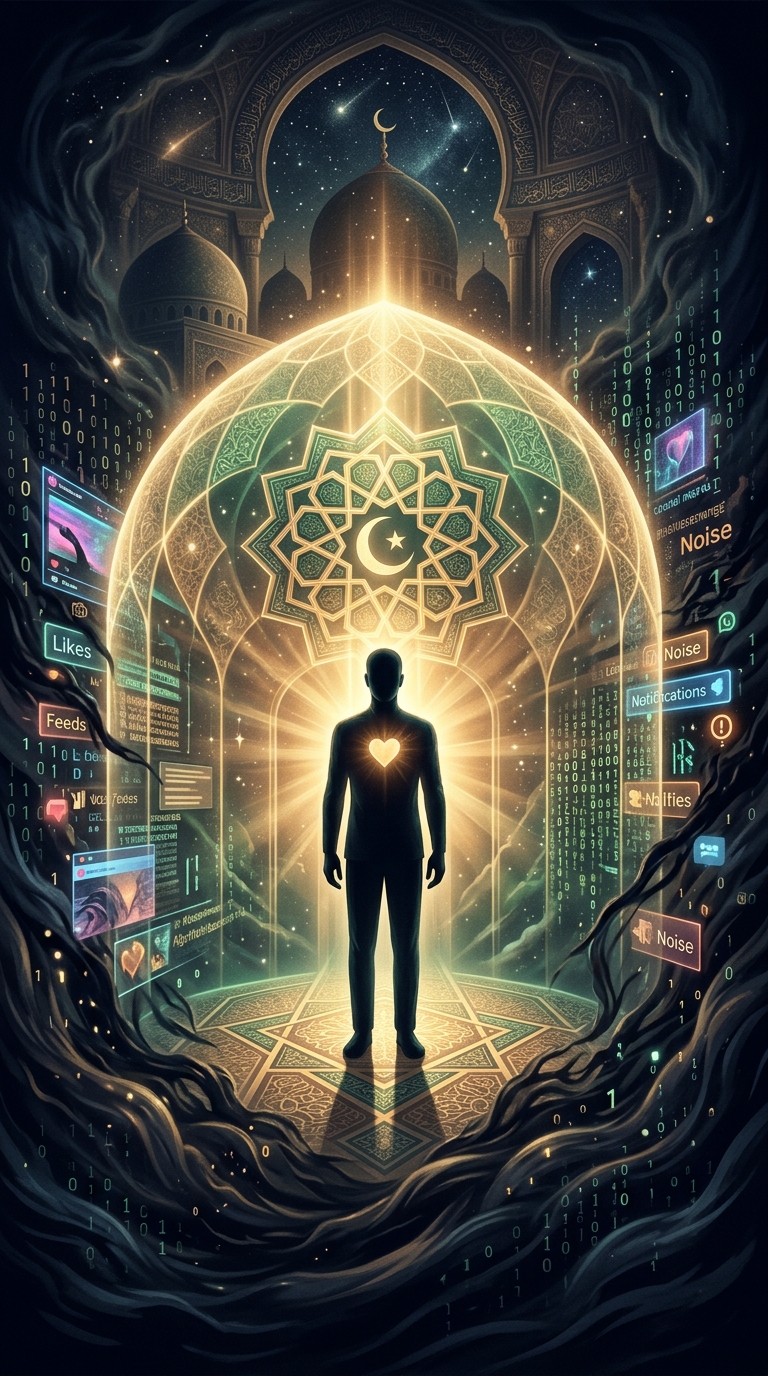

The Greatness of Human!
This essay "The Greatness of Human!" bridges contemporary Western psychology and philosophy—spanning Nietzsche, Jung, Marcus Aurelius, Clear, and Frankl—with the timeless wisdom of the Quran, Hadith, and Allama Iqbal’s philosophy of Khudi (the Self). It reveals how secular frameworks for habit formation, shadow integration, and resilience find their ultimate spiritual fulfillment in Islamic concepts as coined by Allama Iqbal like Banda-e-Sehrai (the Desert Dweller) and Mard-e-Hurr (the Free Man). By breaking free from modern algorithmic distractions and material greed, humanity can reclaim its true rank as Ashraf-ul-Makhluqat (the Crown of Creation). Ultimately, the essay "The Greatness of Human!" outlines a divine blueprint for fulfilling our sacred earthly vicegerency and becoming a more intentional human being.
أَعُوذُ بِاللّٰهِ مِنَ الشَّيْطَانِ الرَّجِيمِ
بِسۡمِ ٱللهِ ٱلرَّحۡمَـٰنِ ٱلرَّحِيمِ
In the name of ALLAH, the Most Gracious, the Most Merciful
The Greatness of Human!
Abstract
This essay examines the crisis of human autonomy in the digital and material landscape of the twenty-first century, where algorithms, the pursuit of fame, and material greed have alienated humanity from its true identity. Western thinkers—Friedrich Nietzsche, Carl Jung, Marcus Aurelius, James Clear, and Viktor Frankl—offered profound insights into understanding the human mind and cultivating intentionality, yet their frameworks remained incomplete due to the absence of a divine center. Allama Muhammad Iqbal evaluated the essence of these Western philosophies through the illuminating lens of the Quran and Hadith, perfecting them into the concepts of Khudi (the Self), Banda-e-Sehrai (the Desert Dweller), and Mard-e-Hurr (the Free Man). This paper establishes that the universal value of humanity across all eras lies solely in servitude to Allah, self-purification, continuous action, and unwavering loyalty to the Prophet Muhammad (ﷺ)—culminating in fulfilling our ultimate rank as the Ashraf-ul-Makhluqat
(the Crown of Creation) and becoming a more intentional human being.
Introduction: The Illusion of Modernity and Universal Human Value
To be a human being in the digital and material age of the twenty-first century is to appear radically free on the outside while remaining trapped within an intense psychological and material siege on the inside. Amidst social media algorithms, the blind race for fame, material greed, and existential nihilism, modern man has lost his authentic self. Over the past few centuries, major Western thinkers proposed various pathways to untangle the human mind; some urged us to demolish old values, others called for confronting the unconscious shadow, and others advocated changing daily habits to discover an earthly meaning.
However, when we turn toward divine guidance and Eastern wisdom, it becomes clear that these secular efforts merely echo the universal message of the Holy Quran, the Prophetic traditions (Hadith), and the Poet of the East, Allama Muhammad Iqbal. The Prophet Muhammad (ﷺ) stated the foundational principle of human nobility in a timeless maxim:
"The person who recognizes his true value will never be ruined."
This human "value" transcends material fluctuations and worldly status. It is defined by our connection to the Creator, the purification of the soul, and the conscious act of living as a principled, intentional being.
1. Philosophical Demolition vs. Sibghatullah and Iqbal’s Banda-e-Sehrai
Friedrich Nietzsche urged humanity to dismantle societal conformity and "herd morality" in order to author their own values. Yet, due to his denial of God, Nietzsche’s ideal of the Übermensch (Overman) remained lost in the darkness of nihilism. Allama Iqbal deeply understood Nietzsche’s intellectual yearning as well as his spiritual deprivation, describing him in these famous verses:
"His heart is that of a believer, yet his intellect is that of a disbeliever." (Javid Nama)
"Had that ecstatic European sage been alive in this era,
Iqbal would have explained to him what the station of Divine Majesty truly is." (Bal-e-Jibril)
The Holy Quran actively invites humanity to break free from blind ancestral imitation and societal enslavement by reflecting upon the universe, warning against uncritical conformity:
Surah Al-Baqarah (Verse 170):
"And when it is said to them, 'Follow what Allah has revealed,' they say, 'Rather, we will follow that which we found our fathers doing.' Even though their fathers understood nothing, nor were they guided?"
Instead of leaving man to invent subjective values driven by his own flawed ego, the Quran commands him to adopt Sibghatullah (The Color of Allah):
Surah Al-Baqarah (Verse 138):
"Adopt the color of Allah! And whose color is better than Allah’s? And we are His worshippers."
In contrast to the artificial, hyper-connected modern individual, Iqbal titled this Quranic human Banda-e-Sehrai (the Desert Dweller)—someone untamed by false societal idols and close to pure nature:
"The true guardian of nature’s grand designs,
Is either the Desert Dweller or the Man of the Mountains." (Bal-e-Jibril)
2. Shadow Integration vs. Nafs-al-Lawwamah and Iqbal’s Khudi
According to Carl Jung, the human unconscious harbors a "Shadow" containing repressed rage, envy, and primitive impulses. Without confronting and integrating this shadow, an individual remains at the mercy of self-sabotage.
In Islam, this internal dynamic is addressed by awakening Nafs-al-Lawwamah (the self-reproaching conscience) against Nafs-al-Ammarah (the ego that commands evil) through the process of Tazkiyah (self-purification). In the Quran, Allah swears by this awakened conscience:
Surah Al-Qiyamah (Verses 1-2):
"I swear by the Day of Resurrection; and I swear by the self-reproaching soul!"
When a human follows the Sunnah of Prophet Adam (Alayhi Salaam) by acknowledging their flaws and turning to Allah in humility ("Our Lord, we have wronged ourselves, and if You do not forgive us and have mercy upon us, we will surely be among the losers" — Surah Al-A'raf: 23), their internal darkness is transformed into divine light. The Prophet Muhammad (ﷺ) said:
"The wise person is one who keeps his lower self subjugated and works for what comes after death, and the foolish person is one who follows his desires and yet pins empty hopes on Allah." (Tirmidhi)
Allama Iqbal termed this self-recognition and spiritual discipline Tameer-e-Khudi (The Construction of the Self), which elevates man to a co-creator of his destiny:
"Elevate your Self (Khudi) to such heights that before every decree of fate,
God Himself asks His servant: 'Tell me, what is your will?'" (Bal-e-Jibril)
3. The Emotional Fortress vs. Eradicating Greed and Iqbal’s Mard-e-Hurr
The Roman Emperor Marcus Aurelius taught the construction of an "Inner Citadel" within the mind to remain unshaken by external storms. Islam targets the very root of emotional instability by freeing man from the enslavement of greed for wealth and status. The Prophet Muhammad (ﷺ) warned:
"Two hungry wolves unleashed into a flock of sheep do not cause more destruction to them than a man's greed for wealth and status causes to his religious commitment." (Tirmidhi)
By revealing the fleeting nature of this world, the Quran keeps the human soul balanced in both adversity and triumph:
Surah Al-Hadid (Verse 23):
"In order that you not despair over what has eluded you and not exult [in pride] over what He has given you. And Allah does not like everyone self-deluded and boastful."
This spiritual detachment defines what Allama Iqbal calls Mard-e-Hurr (The Free Man)—one who shatters every chain of material and mental servitude:
"In slavery, neither swords nor strategies avail;
When the passion of true conviction is born, all chains are severed." (Bang-e-Dra)
4. Habit Formation vs. Quranic Character and Iqbal’s Amal-e-Paiham
James Clear popularized the concept of building identity through small daily habits (Atomic Habits). The Holy Quran presents the complete behavioral blueprint of a successful human being through the profiles of the Mu'min (Believer) and Ibad-ur-Rahman (Servants of the Merciful):
- Surah Al-Mu'minun (Verses 1-11): "Certainly, the believers have succeeded: those who are humbly submissive in their prayers, who turn away from ill speech and vanity, who observe Zakah, who guard their chastity, and who are faithful to their trusts and promises. These are the inheritors who will inherit Al-Firdaus forever."
- Surah Al-Furqan (Verses 63, 67, 72): "And the servants of the Most Merciful are those who walk upon the earth humbly, who respond with words of peace when the ignorant address them harshly, who maintain moderation between extravagance and stinginess when they spend, and who do not bear witness to falsehood."
To save humanity from loss, the Quran mandates faith and righteous deeds alongside mutual exhortation to truth and patience (Surah Al-'Asr: 1-3), while the Hadith instructs the believer to actively change evil with their hand, tongue, or resolute heart (Muslim).
Modern man, trapped in lethargy and nostalgia for past glories, has abandoned active struggle. In Jawab-e-Shikwa, Iqbal shook humanity out of this stagnation, calling for continuous action (Amal-e-Paiham):
"Those ancestors were indeed yours, yet what are you?
Sitting idle with hands folded, merely waiting for tomorrow!" (Bang-e-Dra)
For Iqbal, daily actions directly architect our eternal reality:
"By action is life formed, both paradise and hell;
This creature of dust, by nature, is neither of light nor of fire." (Bang-e-Dra)
5. The Will to Meaning vs. Divine Pleasure and Iqbal’s Ishq-e-Rasool (ﷺ)
Viktor Frankl identified the Will to Meaning as the primary driving force enabling humans to endure suffering. The Quran clarifies that human creation is never purposeless (Surah Al-Mu'minun: 115); rather, our ultimate goal is servitude to Allah, striving for excellence in deeds, upholding justice and grace, reforming humanity, and achieving eternal success in the Hereafter:
- Surah Adh-Dhariyat (Verse 56): "And I did not create the jinn and mankind except to worship Me."
- Surah Al-Mulk (Verse 2): "[He] who created death and life to test you as to which of you is best in deed."
- Surah Ali 'Imran (Verse 110): "You are the best nation produced for mankind: you enjoin what is right, forbid what is wrong, and believe in Allah."
- Surah An-Nahl (Verse 90): "Indeed, Allah orders justice, good conduct (Ihsan), and giving to relatives, and forbids immorality, bad conduct, and oppression."
Allama Iqbal connected this supreme cosmic purpose to Ishq-e-Rasool (Love for the Prophet ﷺ) and universal reform, reminding modern man of his global mission:
"Through the power of Love, elevate every lowly state;
Illuminate the entire world with the name of Muhammad (ﷺ)." (Bang-e-Dra)
When a human being fulfills true loyalty to their Creator and His Messenger (ﷺ), cosmic sovereignty and authority over destiny fall at their feet:
"If you remain loyal to Muhammad (ﷺ), We are yours;
What is this fleeting world? The Tablet and the Pen of Destiny are yours!" (Bang-e-Dra)
Conclusion: The Ultimate Manifesto for Humanity Across All Eras
Synthesizing Western thinkers, the Quran and Hadith, and Allama Iqbal’s philosophy offers a complete code of life for the fragmented modern human:
+-------------------------------------------+
| Divine Pleasure, Akhirah & Loyalty to ﷺ |<--- Ultimate Meaning & Destiny
| (Essence of Frankl + Iqbal's Ishq) |
+---------------------+---------------------+
|
+---------------------+---------------------+
| Mu'min, Ibad-ur-Rahman & Continuous Action| <--- Daily Habits & Movement
| (Essence of Clear + Jawab-e-Shikwa) |
+---------------------+---------------------+
|
+---------------------+---------------------+
| Detachment from Greed, Tawakkul & Freedom | <--- Emotional Citadel & Grace
| (Essence of Aurelius + Hadith) |
+---------------------+---------------------+
|
+---------------------+---------------------+
| Self-Purification, Conscience & Khudi | <--- Inner Reformation
| (Essence of Jung + Iqbal's Self) |
+---------------------+---------------------+
|
+---------------------+---------------------+
| Sibghatullah, Reflection & Desert Dweller | <--- Authentic Value Formation
| (Essence of Nietzsche + Quranic Thought)|
+-------------------------------------------+
If the modern human trapped in digital algorithms and material turmoil wishes to reclaim their lost dignity, they must recognize their Khudi and adopt the natural purity of the Banda-e-Sehrai. By molding daily habits into the Quranic blueprint of Ibad-ur-Rahman, breaking the chains of greed, and making loyalty to the Prophet Muhammad (ﷺ) their guiding star, humanity can break free from every era's enslavement.
Ultimately, the true value of a human being lies solely in ascending to the rank of Ashraf-ul-Makhluqat (the Crown of Creation)—the rightful inheritor of Khilafat-e-Arzi (divine vicegerency on Earth). Whoever fulfills this sacred trust with justice, integrity, and servitude is truly successful—and this is the pinnacle of becoming a more intentional great human being.
Best Event Management Companies: Choose the Right Partner
Choosing the right event partner is important for creating successful business experiences...

Looking for CPA Coaching in Hyderabad?
The demand for qualified accounting and finance professionals is increasing as businesses...

How to Improve Sperm Health Naturally for Better Fertility
How to Improve Sperm Health Naturally for Better Fertility Male fertility plays an impo...



Jabra Conference Room Supplier and Distributor in India
Video conferencing is an important part of business operations, enabling teams to communic...
