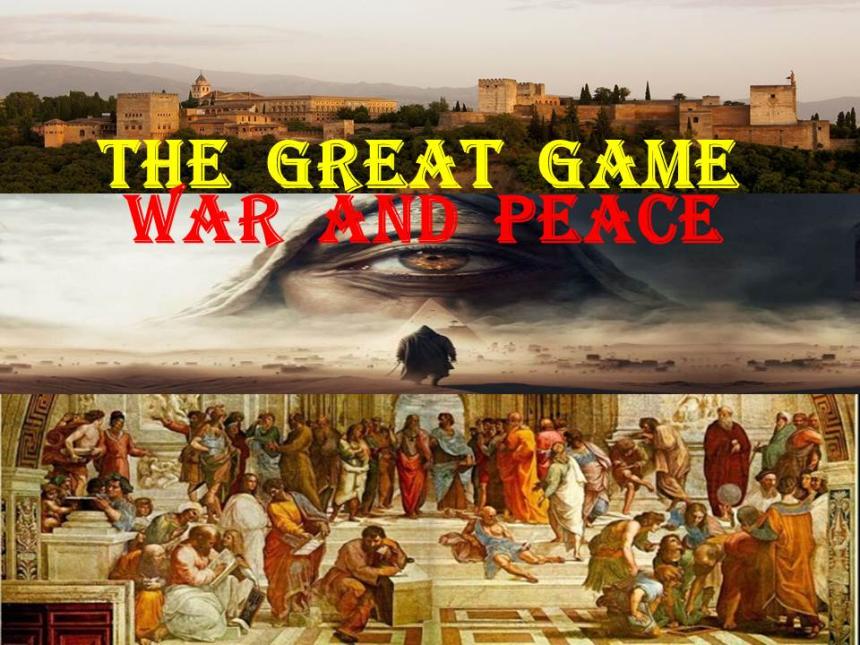

The Great Game: War & Peace
"The Great Game" was a political and diplomatic confrontation that existed for most of the 19th century (approx. 1830–1907) between the British Empire and the Russian Empire over Afghanistan and neighboring territories for maintaining peace. However, many conflicts and wars were fought for seeking peace. This write up "The Great Game: War and Peace" discusses the very concept and real purposes with the help of few book written over a period of last two decades.
أَعُوذُ بِاللّٰهِ مِنَ الشَّيْطَانِ الرَّجِيمِ۔
بِسۡمِ ٱللهِ ٱلرَّحۡمَـٰنِ ٱلرَّحِيمِ
In the name of ALLAH, the Most Gracious, the Most Merciful
The Great Game: War & Peace
"The Great Game" was a political and diplomatic confrontation that existed for most of the 19th century (approx. 1830–1907) between the British Empire (Great Britain being central to Pax Britannica as a Super Colonial Power) and the Russian Empire (the Tsarist Russian rule) over Afghanistan and neighboring territories in Central and South Asia. It is said that the "great game" mostly ended with the Anglo-Russian Convention of 1907. Russia and England agreed to stay out of Tibet, only deal with it through China. Russia agreed to leave Afghanistan to the British sphere of influence, but Britain agreed to keep Afghanistan from allying with Russia's Central Asian regions against Russian rule.
However, the "great game" (rivalry based policies and politicking) continued even in 20th century; with a different premise between the American-British-Allied NATO countries and USSR (Socialist-Communist Russian) for supremacy in Eurosia including Central and South Asia. The great game centered on Afghanistan as a buffer state, it involved intense espionage, diplomatic maneuvers, and localized military conflicts, aiming to protect Sub-Continent Indo-Pak from Russian expansion (direct invasion took place in 1979 by USSR). War was ravaged in the region for the peace. (The Russia remained the center of focus for many reasons and that requires another essay).
The Great Game was orchestrated for maintaining closer ties between Britain and the states along her northwest frontier. Britain believed that it was the world's first free society and the most industrially advanced country, and therefore that it had a duty to use its iron, steam power, and cotton goods to take over Central Asia and develop it. The same attitude continued in different phrasing even after establishment of League of Nations and United Nations Organization and the world witnessed next phase of great game as "Cold War" between NATO countries and WARSAW pact countries with enhanced areas / region of conflict. (the ultimate sufferers were the Global South; from where the real riches were extracted at no cost).
The Great Game was a cold war carried on from about 1830 till about 1900 between Russia and England over control of the approaches to British India, which the 'Bear' threatened and the 'Lion' defended. The same game continued and WW-1 and WW-2 were the battles fought between the Super Power aspirants on the lands of Europe and Asia. The US and Allied Nations surfaced as NATO countries and USSR with Eastern Europe Block countries and the "Cold War" meant "No War" between European Nations but countries of Asia were ravaged with gun powder. The real purpose of the "great game" was known later through various publications authored by well known writers of Western Hemisphere. In the following few books will be discussed which exposed the real motives behind all those games played in 19th and 20th centuries.
Books Which Revealed the Real Game
Several books, often characterized as exposing "hidden" systems, secrets, or insider strategies, written to reveal the "real game" in the world of state craft, geopolitics and strategies employed for war and peace. These books argue that there is a underlying, often rigged, system known only to a few, and that understanding this system is key to success. Such books focus on the "Hidden Game" claiming that most of the games are actually rigged plays designed by insiders ("the Players") to benefit a few, while most people remain unaware of how it works.
In the following, let's read about some books to comprehend the "great games" of war and peace being faced by common people (innocent or otherwise) of the world. These books generally argue that the "real game" is often masked by conventional wisdom or societal rules to hide the real motives (which most of the times are sinister), and that knowledge of the true system provides a massive advantage. The authors aimed to provide window to common people to seek that advantage.
“A Peace to End All Peace” by David Fromkin
The first book to discuss about is “A Peace to End All Peace” by David Fromkin (1932-2017), which documents, how Britain and France literally drew the lines, manufactured the states, and engineered the collapse. "A Peace to End All Peace: The Fall of the Ottoman Empire and the Creation of the Modern Middle East" (also subtitled Creating the Modern Middle East, 1914–1922) is a 1989 history book written by Pulitzer Prize for General Nonfiction finalist David Fromkin, which describes the events leading to the dissolution of the Ottoman Empire during World War I, and the drastic changes that took place in the Middle East as a result, which he believed led to a new world war that is still continuing.
Professor David Fromkin was the founding director of the Pardee Center (2000–2007) and also served as the chair of the Department of International Relations at Boston University for three years. He spent most of his professional life as a practitioner attorney and a private investor. David Fromkin's "A Peace to End All Peace" argues that the modern Middle East was arbitrarily created between 1914 and 1922 by European powers, primarily Britain, which dismantled the Ottoman Empire and replaced it with artificial, often dysfunctional, state boundaries. The book argues this peace led to ongoing conflict.
David Fromkin’s A Peace to End All Peace (1989) argues that the modern Middle East’s chaos stems from the Allied powers—primarily Britain—dismantling the Ottoman Empire after WWI, replacing a complex, organic system with arbitrary, artificial borders. The book argues that Western imperial motives and deceit created a lasting, unstable political inheritance. The Key themes and arguments may be summarized as follows:-
The "Great Game" Mentality: Britain viewed the Middle East primarily through the lens of its security competition with Russia, seeking to build a buffer zone rather than responding to local needs.
Failed Policies: Fromkin highlights how Western, especially British, ignorance and double-dealing resulted in contradictory promises (e.g., to Arabs, French, and Zionists), leading to a "peace" that was fundamentally flawed and unstable.
Arbitrary Borders: Western leaders drew borders on an "empty map" (1914–1922), creating nations like Iraq, Jordan, and Lebanon without regard for ethnic or religious realities.
Ending of Ottoman System: The book chronicles the end of a centuries-old, religiously based Ottoman rule, replacing it with a secular, artificial, and chaotic state structure.
A Peace to End All Peace focuses heavily on British decision-making (the Great Britain had lead role in Pax Britannica), offering a detailed analysis of key figures like Churchill and Lloyd George during the war's later stages. The book is a notable work for understanding the origins of today's Middle Eastern conflicts. Many of the current conflicts in the Middle East are largely a result of the haphazard way in which national boundaries were established after the fall of the Ottoman Empire. Fromkin discusses the consequences of poor policies and weak intelligence on the part of the British as they reshaped the Middle East. Fromkin’s work shows that Ottoman Empire was an area of great concern for both the Allied and the Central Powers, and played a key part in the conflict. One must remember that Ottoman Empire was the seat of Caliphate; central religious authority; for all the Muslims of the world. The elimination of seat of caliphate managed Muslims' "diaspora" and creation of localized nationhood (factionalism and sectarianism was wedged as well).
Change of Super Power Status
The transition of global power from Great Britain to the United States across the two World Wars is a widely accepted historical narrative, marking the end of the Pax Britannica and the beginning of the Pax Americana. While Britain was the leading global hegemon from roughly 1815–1914, the immense financial and military strain of the 20th-century world wars shattered this hegemony, making the United States the primary global power by 1945.
Following the defeat of Napoleon in 1815, Britain acted as the "global policeman," dominating naval, trade, and financial systems.
Britain leveraged the Royal Navy to secure trade routes and maintained a policy of free trade, creating a relatively stable international order (informal empire) alongside its formal colonial empire. Britain was the world's largest creditor and controlled access to major regions, including India, Africa, and parts of Asia.
World War-1 (1914–1918) forced Britain to shift from the world's largest creditor to one of its biggest debtors, financing both its own war effort and those of its allies, largely through borrowing from the USA. While Britain was victorious, the economic strain damaged its ability to maintain its massive empire. The US started gaining prominence as a financial hub and its navy began approaching parity with the Royal Navy.
World War II (1939–1945) accelerated Pax Britannia's decline, leaving Britain largely bankrupt and physically devastated. By 1945, the United States was the world's leading economic and military power, manufacturing more than half of the world's goods and holding the majority of the world's gold reserves (this was the most important element). The US, under President Roosevelt and later Truman, actively shaped the post-war world, with the Atlantic Charter (1941) laying the groundwork for a new world order driven by American ideals, such as self-determination and free trade, rather than British imperialism.
The 1956 Suez Crisis solidified the transition, where American pressure forced Britain to withdraw from Egypt, effectively highlighting that Britain was no longer an independent, first-rate global power. The post-WW-2 era saw a new bipolar world, with the USA and the Soviet Union as the dominant superpowers, replacing the previous Pax Britannica. The real players yielding real power remained hidden in the change of status of Super Power for a longer period of times, till recently, when scholars of world's standing exposed them. Let's read about a book in the following, which exposed the real beneficiary of the great games.
“The Israel Lobby and U.S. Foreign Policy” by Mearsheimer & Walt
"The Israel Lobby and U.S. Foreign Policy" (2007) by John Mearsheimer and Stephen Walt argues that U.S. foreign policies in the world and particularly in the Middle East is not driven by shared strategic interests or moral imperatives, but primarily by the influence of a "pro-Israel lobby". The main theme of "The Israel Lobby and U.S. Foreign Policy" by John Mearsheimer and Stephen Walt is that U.S. foreign policy in the Middle East is heavily influenced in favour of Israel, and often driven, by a powerful, loosely organized "Israel Lobby". They argue this influence pushes American interests to serve Israel’s interests, leading to policies that are detrimental to U.S. national security. They claim that "Jewish Lobby" shifts U.S. policy away from USA's national interests.
The Core Arguments and Key Points of “The Israel Lobby and U.S. Foreign Policy” by Mearsheimer & Walt are listed as follows:
The "Lobby" Definition: Mearsheimer and Walt define the lobby as a loose coalition of individuals and organizations (e.g., AIPAC) that work to influence U.S. foreign policy in a pro-Israel direction.
Impact on Policy: The authors contend the lobby has significant leverage over the executive branch and a "stranglehold" on Congress, influencing U.S. policies in Iraq, Iran, and Lebanon, and toward the Israeli-Palestinian conflict.
National vs. Israeli Interests: The book argues that these policies often violate U.S. national interests and may not serve Israel's long-term interests either.
Methodology: The authors state that the lobby is not unique in its operation but rather "extraordinary" in its effectiveness compared to other interest groups.
Media and Debate: The authors suggest the lobby has the ability to ensure its perspective is widely reflected in the media and that it tries to suppress criticism by accusing opponents of antisemitism.
The above work generated intense debate and controversy, with critics arguing the authors overstated the lobby's power and others supporting their analysis. The authors are prominent scholars associated with the "realist" school of international relations. Therefore, the book settled the issue, for any sane mind-interested in world's politics, on the real players behind the democratic veil of USA; the country of freedom and liberty. The real player in all the “great games” is none but Zionist Jews.
The controversial debate has always ignited, when ever any scholarship work, on the real great game exposing the real player, i.e. Zionist Jews was published; so as to muddy the water and solidify the hidden agenda. The creation and establishment of State of Israel, drawn as dagger in the heart of "Islamic Faith" was also a key element in the great game. Here in the following, let's discuss a book, exposing the solid propaganda and highlighting the real purpose of the creation of Israel; homeland for Zionist Jews.
"Ten Myths About Israel" By Ilan Pappe.
In "Ten Myths About Israel", Israeli historian Ilan Pappe examines the most contested ideas concerning the origins and identity of the contemporary state of Israel. The “ten myths” include:
1. Palestine was an empty land
2. The Jews were a people without a land
3. Zionism is Judaism
4. Zionism is not colonialism
5. The Palestinians voluntarily left their homeland in 1948
6. The June 1967 war was a war of ‘No Choice’
7. Israel is the only democracy in the Middle East
8. The Oslo Mythologies
9. The Gaza Mythologies
10. The Two-States Solution is the only way forward
Here is an excerpt from the introduction, "This book is yet another attempt to redress the balance of power on behalf of the colonized, occupied and oppressed Palestinians in the land of Israel and Palestine. It would be a real bonus if advocates of Zionism or loyal supporters of Israel were also willing to engage with the arguments herein. After all, the book is written by an Israeli Jew who cares about his own society as much as he does the Palestinian one. Refuting mythologies that sustain injustice should be of benefit to everyone living in the country or wishing to live there. It forms a basis on which all its inhabitants might enjoy the great achievements that only one privileged group currently has access to".
"History lies at the core of every conflict. A true and unbiased understanding of the past offers the possibility of peace. The distortion or manipulation of history, in contrast, will only sow disaster. It is not surprising, therefore, that policies of disinformation continue to the present and play an important part in perpetuating the conflict, leave very little hope for the future. The Zionist historical account of how the disputed land became the state of Israel is based on a cluster of myths that subtly cast doubt on the Palestinians’ moral right to the land".
This book challenged and exposed the myths spread through propaganda, (acts of crafting lies and manufacturing truths), thus presenting propaganda in the public domain as indisputable truths. The geopolitical, geo-strategic jargons were mere propaganda developed in respect of "great game"; thus were nothing more than distortions and fabrications (acts of crafting lies and manufacturing truths). The Zionist Jews were the inhabitants of Russian Lands and some wealthy Jews of Europe (Rothschilds and Morgans) wanted to populate them on the holy lands of Al-Quds (Palestine); so as to control the region through an outward post and a client state. The Zionist Jews were never concerned about land or country, but economic gains i.e. "riches"-gold and silver (Pounds, Dollar, and Euros). They can get killed millions of humans, even their own clan (Zionist Jews), for seeking power to gather "riches". In the following let’s read about a book that foretells the future plans of Zionist Jews.
“Return to Mecca”, By Dennis Avi Lipkin
Dennis Avi Lipkin, alias Victor Mordecai (1949 – N/A; intriguingly info about the author is not available freely at digital media) was an American-Israeli preacher, author, and political activist whose ministry focused on fostering Judeo-Christian alliances and warning against Islamic extremism.
Lipkin has written six books to date, the first three under the pseudonym Victor Mordecai (for security reasons-very interesting reason), and the third under his real name. The “Return to Mecca”, by Dennis Avi Lipkin was his sixth book, published in 2012. Its cover depicted not the real Kaaba, but a black cube resembling it, with two black straps extending outward — the Jewish tefillin (phylacteries), a ritual object that the author blasphemously likened to the Kaaba itself.
In the book, Lipkin outlined what amounts to a plan for Israel to occupy Saudi Arabia. He argued that Jews have a “historical right” to the Arabian Peninsula, claiming that during the biblical forty years of wandering, the Israelites settled there. He went further, alleging that God spoke to Prophet Moses (peace be upon him) not at Mount Sinai but at Mount Lawz in Tabuk, northern Saudi Arabia.
The Real Purpose of Writing Book "Return to Mecca"
“I am here for a historic and spiritual mission that future generations will remember; I fully believe in Greater Israel,” stated by current Israeli Prime Minister Benjamin Netanyahu. The idea of Greater Israel is not new. It has been a central dogma of Zionist ideology, since the days of its founder-Theodor Herzl, who declared at the First Zionist Congress that Israel’s borders should extend “from the Nile to the Euphrates.”
David Ben-Gurion, Israel’s first prime minister, turned this into military doctrine. In a May 1948 address to the general staff, he said; “We must prepare to attack. Our aim is to crush Lebanon, Transjordan, and Syria, and then seize Port Said, Alexandria, and Sinai. It is not about maintaining the status quo. We must build a dynamic state aimed at expansion.”
"Return to Mecca" by Dennis Avi Lipkin, alias Victor Mordecai devolves into Zionist Jews plans for defeating / terminating Islam by the Judeo-Christian West and conquering Mecca and Medina? Dennis Avi Lipkin, alias Victor Mordecai has penned a detailed plan in the book's introduction. In the following, let's read about another book that details the real method adopted by Zionist Jews for achieving their real motive i.e. gaining economic gains of "Riches" for manipulating all concerned.
“Confessions of an Economic Hit Man” by John Perkins
The main theme of "Confessions of an Economic Hit Man" by John Perkins is that a "corporatocracy"—a, coalition of U.S. government, corporate, and financial institutions—uses fraudulent, debt-driven, or coercive financial strategies to establish a global empire. Perkins describes his role in trapping developing countries in debt, exploiting resources, and fostering corruption. This book shows the mechanism of how the West dismantles and controls nations. Very applicable to Muslim-majority states; as it maps exactly how policy gets shaped in almost all the Muslim countries. Key themes and takeaways from the book are as follows:-
Systematic Exploitation (Economic Hit Men): The core mechanism involves high-paid professionals (economic hit men) who persuade leaders of underdeveloped nations to accept massive loans for infrastructure projects (e.g., power plants, ports). These projects usually benefit U.S. companies rather than local populations, creating insurmountable debt.
The Debt Trap: Once nations are saddled with massive debt they cannot repay, they become subservient to U.S. interests. This ensures loyalty in political decisions, control over natural resources, and military cooperation.
The "Corporatocracy": Perkins argues that this is not a conspiracy of a few, but a systemic effort by a global elite consisting of corporations, banks, and government agencies to maximize profits regardless of human or environmental cost.
"Jackals" and Enforcement: When economic hit men fail to convince a leader to cooperate, a more violent arm known as "jackals" (CIA-sanctioned assassins) steps in to orchestrate coups or assassinations.
The Shift to a "Life Economy": While the book reveals dark exploitation, it also serves as a call to action. Perkins advocates for transforming the current "Death Economy" (focused on destruction and exploitation) into a "Life Economy" that prioritizes environmental sustainability, social justice, and genuine global partnership.
Evolution of Tactics: Later editions, such as The New Confessions of an Economic Hit Man, explain that these tactics have evolved and are now frequently used by other nations also.
The core lesson is that global economic development is often a system of manipulation and neocolonialism designed to create a "corporatocracy," causing massive debt, income inequality, and ecological devastation while enriching a small elite. Following Key Lessons and Takeaways may be listed:-
The global south shall avoid EHMs; who in effect are stooges of Zionist Jews (corporations, agencies, NGOs etc) and shall not adopt their proposed infrastructure projects; which are designed to fail in helping local populations, and instead trap countries in debt to Western powers. The book advocates for transitioning to a "Life Economy" that supports environmental restoration, renewable energy, and equitable, sustainable development. If an EHM fails, they are often followed by "jackals"—agents who threaten, orchestrate coups, or assassinate leaders who oppose the system.
The new edition of the book notes that EHM tactics have evolved beyond just U.S. efforts, with China now also using its own version of the EHM strategy, including debt traps in Latin America, Asia, Africa, and beyond. Perkins emphasizes that the public can disrupt this system by holding corporations and governments accountable, spreading awareness about the hidden truths of economic exploitation, and supporting sustainable local initiatives. Perkins ultimately urges that the system is not inevitable, and that collective awareness and action can change it from a destructive force into one that benefits all. But will Muslim Nation be able to get rid of Western Influence, entrenched deep into their body politics? In the following; let's discuss another book to answer the query:-
“Islam and the West” by Bernard Lewis
“Islam and the West” by Bernard Lewis presents the seasoned reflections of an eminent authority on one of the most intriguing and little understood regions in the world. If one have to pick 'One Book' for a Muslim wanting all three dimensions simultaneously: political, geopolitical, and with a civilizational Islamic consciousness; “Islam and the West” by Bernard Lewis will be recommended. Let's read it as the enemy’s manual, not as scholarship; because, Lewis literally shaped U.S. and Israeli policy toward the Muslim world for 50 years. This Book reveals that exactly how they think, what they fear, and what they’re trying to prevent?
The main theme of Bernard Lewis’s Islam and the West (1993) is the historical, often adversarial, relationship between Islamic civilization and Christendom / the West, spanning from the 7th century to the modern era. Lewis explores centuries of interaction in war, culture, and commerce, examining how perceptions, religious differences, and political actions shaped a lasting cultural "clash".
Key Aspects of the Book are listed as follows:-
Lewis highlights that Christianity and Islam both claimed universal validity, leading to a long history of conflict and confrontation, with Christendom often on the defensive. The essays cover the shifting balance of power from the rise of Islam to the subsequent dominance of European powers. The work analyzes how each culture viewed the other, and the religious-political implications of these views. The book addresses contemporary issues like the growth of Islamic minorities in Europe, Islamic revivalism, and the rise of political violence, often framing it as a crisis of civilization. Islam and the West argues that Western problems in the region are often self-inflicted by Islamic societies rather than purely a result of foreign colonialism, offering a controversial yet influential view on the perceived backwardness and struggles of the Islamic world.
From a Muslim perspective, lessons from Bernard Lewis’s "Islam and the West" highlight the need for intellectual humility, self-criticism regarding development, and a proactive, objective study of Western societies to navigate complex relations and draw methods to deal with their military and economic power and modernity driven civilization without abandoning Islamic principles.
The Muslim world today, as a whole, are economically unstable, geographically and socially fragmented, politically medieval, scientifically backwards, culturally decayed, technologically behind, internally scattered, militarily undisciplined and unorganized, and morally weak and highly confused. On the other hand Europe started to rise since 16th Century; to become militarily organized and disciplined, and economically productive because of mercantilist market principles, politically organized in stable hierarchies, socially disciplined, industrially advanced, culturally developed and internally connected. Their art and literature were more thought-provoking for raising a civilization suiting their needs, and at the advent of 16th century they started controlling all the trade routes.
Concluding Remarks
The rise of western civilization is well documented and money played central role in the whole affairs. The money as the heart in the economic cycle contributed in social up bringing and financial growth, well being and rise of living standards of the western countries; (the riches were flown from global south through extortion of colonial powers). The money stacked and filled the vaults of Jews of the Europe (Rothschilds and Morgans); who were in control of all the banks in Europe (Pax Britannia) and Later in USA (Pax Americana). The rise of West was a precursor for disasters in the third world as it was all wars (violence and conflicts) in the name of peace for the Global South.
The third world countries in Asia, Africa or South America were living peacefully in their own regions (the violence if any was mainly between the competing rivals of kingship and those conflicts never disturbed the economic cycle for common man). The awakening of Europe gave rise to colonialism which resulted in vast exploitation and misery for the common man in the Global South. It also nurtured a selected "ruling elite" in almost all the Global South countries, who played the dirty game of exploitation and tyranny on local people on behalf of their foreign masters. The Muslim world witnessed mass killings, exploitation and misery earlier at the hands of Mongols, however, the western hegemony was well organized, well orchestrated and designed for longer duration of time; therefore, it continued even after liberating the colonial states as "Independent Nations" of the UNO.
The western nations have used Global South as consumers, and sold their products at exorbitant prices and taken away able minds at cheap rates. They have nurtured and cultured violence on the lands of Global South Countries by exploiting differences created by drawing faulty national boundaries (e.g. Kashmir b/w India and Pakistan) and harbouring terrorist organizations; thus significantly altering the peaceful atmosphere into violance and disturbances. The jargons propagated were about peace but almost all the third world countries faced war, conflicts and devastation on their lands.
The rise of China in the 21st century has significantly impacted the Global South by offering an alternative development model, fostering infrastructure growth through the Belt and Road Initiative (BRI), and providing confidence to nations seeking to reduce reliance on Western financial institutions. This shift promotes South-South cooperation, emphasizing sovereign equality, technology sharing, and poverty reduction. The Global South countries must rise above factional, national and regional biases and work for improvements in educational standards (fulfilling local needs and fueling local development and progress) and living standards by helping each other through regional trade and commerce.
The India-Pakistan War 2025 and US-Israel-Iran-War 2025 had shown weakening military muscle of the west and significant indigenous worth while progress of the weak Asian countries. The latest 40 days war of US-Israel-Iran has bolstered the hopes that madman bully approach of the west and clients states like Israel can be countered. The whole paradigm of the rise of west is at stake now and there is a need generally for Global South and particularly for Muslim Nations to see through the to new reality and forge a combined front suitable to their needs and requirements. The Global South shall now seek new methods for geo-politics and regional and global peace efforts. It’s time to create new doctrines of war and peace away from the influences of the western capitals and western scholarship.


How Can Childcare Centres Maintain Cleaner Playrooms and Rest Areas?

Polyester Industrial Yarn Price Trend Q2 2026 | Price Trends, Forecast...



Academic Excellence in AI and Data Science Engineering | HOD's Desk at...
