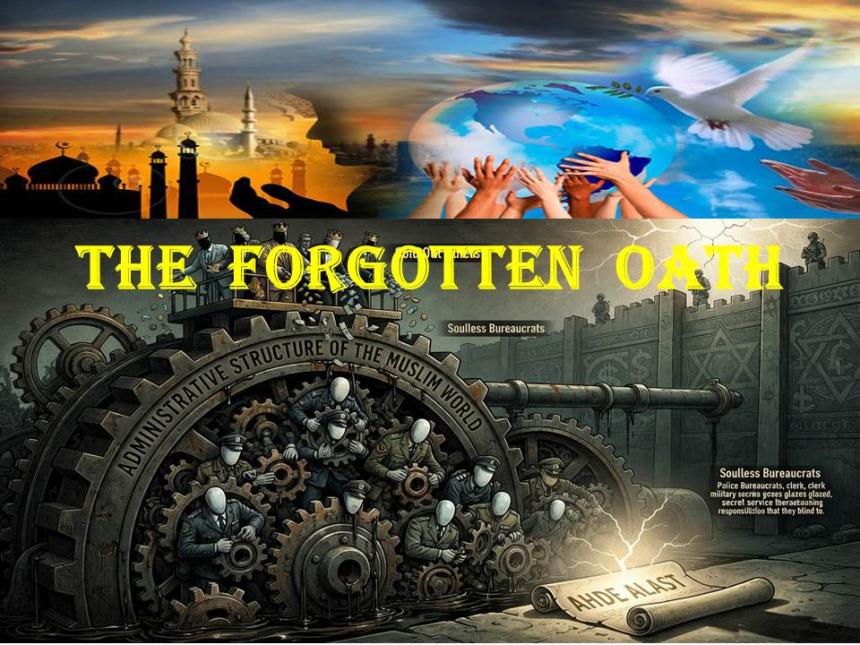

The Forgotten Oath
Storytelling is an important tool because it builds emotional connections, helps people remember information, and fosters empathy. Fiction is defined as any creative literary or narrative work that portrays imaginary characters, settings, and events. The contemporary Muslim world passes through a period of deep structural paralysis. This crisis is rarely a failure of raw physical power; rather, it is a crisis of moral agency. This write up "The Forgotten Oath" is a story based upon the above state of affairs.
أَعُوذُ بِاللّٰهِ مِنَ الشَّيْطَانِ الرَّجِيمِ
بِسۡمِ ٱللهِ ٱلرَّحۡمَـٰنِ ٱلرَّحِيمِ
اللہ کے نام سے شروع جو بڑا مہربان نہایت رحم کرنے والا ہے
In the name of ALLAH, the Most Gracious, the Most Merciful
The Forgotten Oath
The warm, dust-laden evening air of Rawalpindi hung heavy as Professor Haris took a long stride along the edge of the busy avenue [September 2026] [September 2026]. At forty-five, the college lecturer was a quintessential "Gen Y Uncle"—deeply rooted in his books, slightly weathered by decades of watching his country cycle through crises, but still carrying the idealistic fire of his youth. Flanking him were his twin nephews, Zain and Bilal. Having freshly graduated from university with engineering and economics degrees, the Gen Z duo were currently being ground down by the exhausting reality of corporate job hunts and entry-level bureaucratic internships.
"I'm telling you, Uncle," Zain muttered, adjusting his sneakers as they walked. "The internship at the Ministry is soul-crushing. It’s not about solving problems. It’s just about keeping the file moving so the boss looks good to the higher-ups."
Before Haris could reply, a violent screech of tires shattered the evening hum. A sleek, black SUV with tinted windows and official-looking plates had swung sharply around the corner, clipping a dilapidated motorcycle. The rider, an elderly delivery man in a faded kameez, was sent skidding across the asphalt, his packages scattering into the dirt. Instead of checking on the injured man, the SUV doors flew open. Two burly men in plain clothes, accompanied by a young man in designer wear, stepped out.
"Are you blind?!" the young man screamed, kicking the delivery man’s dented front wheel. When the bruised rider tried to stand, apologizing frantically with clasped hands, one of the guards roughly shoved him back onto the tarmac.
"Hey! Leave him alone!" Bilal shouted, his Gen Z impulse for immediate social justice overriding any sense of fear. The three of them surged forward. Zain quickly stood between the guard and the fallen rider, while Professor Haris used his commanding classroom voice. "We are witnesses here! Get back into your vehicle before this goes any further!" Seeing a gathering crowd and a college professor recording on his phone, the young elite spat on the ground, cursed under his breath, and signaled his men back into the SUV. The vehicle roared away, leaving a cloud of exhaust.
They helped the shaken delivery man up, gathered his scattered parcels, and ensured he was unhurt before moving him safely on his way. Adrenaline still pumping, Bilal pointed toward a neon sign glowing down the road. "Uncle, we need to sit down. My hands are literally shaking. Let’s hit that Quetta Tea stall."
A few minutes later, the three of them were huddled around a green plastic table, the aroma of strong, cardamom-infused doodh patti rising from transparent glasses. Zain pulled out his phone, his thumb rapidly scrolling through a social media feed. "Look at this, Uncle," he said, turning the screen around. "What we just saw? It’s a systemic disease. Look at this clip from last week."
The screen showed a viral video of a massive luxury SUV driving down a busy city highway, entirely unbothered by a motorcycle caught squarely under its front bumper. Sparks flew violently as the heavy vehicle dragged both the mangled bike and its helpless rider along the asphalt bonnet for miles, while onlookers screamed in horror.
"It’s an absolute idiotocracy," Bilal said, his voice raw with frustration. "The guy driving that car probably has a father in the ministry or a backroom connection to some multi-national cartel. But what drives me insane isn't just the rulers who think they own the tarmac—it's the people behind them. The police officers who will cover up the hit-and-run, the clerks who will bury the file, the soulless bureaucrats who sign off on their immunity. Why does everyone just follow along?"
The young tea boy, a lad of no more than fourteen with a grease-stained apron and quick, vigilant eyes, deftly swapped their empty glasses for a fresh round of steaming doodh patti. He lingered at the edge of the green plastic table, his gaze darting between Professor Haris and the twins. He had been quietly absorbing their conversation over the hiss of the milk steamer.
"Sir jee," the boy spoke up, his voice cracking with a raw, precocious weariness. "You are speaking the truth. But what you saw just now is nothing. Only an hour before you sat down, the exact same thing happened right there at the intersection. A wildly turning luxury car—one of those big imported ones with the flashing guard lights—swerved to beat the signal. It smashed straight into a young boy on a bicycle delivering bread. His leg was completely broken, snapped like wood, sir jee. He was screaming in the dirt."
The boy’s eyes hardened, reflecting the neon hum of the avenue. "And what did the people in the car do? They didn't even tap the brakes. They sped off toward the VIP enclave. The traffic warden standing right at the post just turned his head the other way and pretended to check his phone. Sir jee, in this city, the poor man has no respect and no value for his life. I stand by this stove from Fajr until midnight, and I see it daily from here—the raw injustices carried out by the Baray Sahibs and their spoiled wards. The bigger the name, the less they care if we bleed."
Bilal slammed his fist lightly against the plastic table, his face flushed. "You see, Uncle? Even the kids on the street can see the systemic rot! The traffic warden who turned away is the exact 'cog' you're talking about. He sold his conscience just to avoid trouble with a Baray Sahib."
Professor Haris looked at the young tea boy, handed him a generous tip, and spoke with gentle gravity. "You are a witness to their crimes, beta. Never let your heart become numb to what you see. Those Baray Sahibs and the wardens who look away think their earthly ranks make them untouchable. But they are building their palaces on shifting sand."
As the boy nodded quietly and walked back to the roaring stove, Zain looked directly at his uncle. "But why, Uncle? Why is this all happening to us specifically? No such things happen in the West. If a politician's son hits a delivery man in London or New York, they get arrested. The media blows it up, and they are held accountable. How are they held accountable, and why are our rulers and administrative structures escaping all accountability?"
Professor Haris adjusted his glasses and leaned back against his plastic chair. "It is the classic post-colonial illusion, Zain. You are comparing our raw, visible lawlessness with their highly polished, systemic legal architecture. But to understand why our administrators escape accountability while theirs seem to face it, you have to look under the hood of how both systems were historically engineered.
The West didn't eliminate the capitalist self-preservation or the 'Leviathanic duty'; they simply perfected it. In the West, accountability is maintained because their institutions are designed to protect the system itself, not just the individual ruler. Their 'pin factory' is highly automated and legalistic. If a wealthy man breaks a routine traffic law in the West, the lower-level cogs—the police officer, the local magistrate—will enforce the law because their own professional survival and paycheck are tied to the clockwork efficiency of that impersonal legal machine. The system stays predictable, clean, and orderly on the surface.
But here is the catch that your generation often misses," Haris leaned forward, tapping his finger on the table. "The very historical institutions that keep the West orderly at home are the ones that engineered the chaos abroad. The Western financial oligarchy—the systems built by dynasties like the Rothschilds and the Morgans—pioneered a global extractive architecture. For centuries, they exported a model of statecraft to the colonized world that was designed to do one thing: extract wealth and maintain a subservient, hyper-centralized elite. When the colonizers left, our rulers didn't dismantle that predatory machine; they merely took over the controls. They inherited an administrative structure engineered to be unaccountable to its domestic population."
Haris gestured toward the neon-lit square. "Look at the current landscape. Why can a regional Prime Minister fly into Abu Dhabi, host secret summits with representatives from ten Arab and Muslim nations—including our neighbors—and arrange sweeping geopolitical realignments while the domestic populations are left entirely in the dark? It is because our leadership is fundamentally unaccountable to us. They operate as local managers for a global status quo. To keep themselves entrenched, they deliberately keep the domestic administrative structure weak, lawless, and dependent on raw, personalized power (Siyasah) rather than transparent, institutional justice. The others continuously follow suit, manipulating internal policies to satisfy their own ulterior motives."
Bilal spoke up, his voice taking on a measured, analytical tone. "So, if you look at it fundamentally, Uncle, the state is a concept. It’s an arrangement where people living in a defined land entrust their collective republic trust into the core pillars of the state—the judiciary, the executive, the legislature. The citizens give up a degree of individual autonomy, and in return, they expect those pillars to deliver security, basic rights, and objective justice. But here, that public trust has been completely weaponized against the very people who gave it."
"You’ve defined the classical political theory perfectly, Bilal," Haris nodded. "That is the secular ideal of the republic. But the missing link in the post-colonial world is that when you strip a society of its foundational moral grammar, the state turns into a predatory entity. And this is exactly where the secular concept of the state violently collides with the Islamic worldview. In Islam, the ultimate sovereignty does not belong to a parliament, a constitution, or a king. Sovereignty belongs solely to Allah. Therefore, the public trust (Amanah) handled by any state pillar or administrative official is not just a civil contract—it is a sacred, spiritual weight.
In Islam, it is the absolute moral and Islamic duty of all individuals—whether you are the head of the state, a senior director, a middle-tier bureaucrat, or the traffic warden standing at the front square—to remain steadfast with Allah's directives. Worldly laws, administrative protocols, and superior commands are only legitimate as long as they align with divine justice. The moment a Baray Sahib commands you to cover up a hit-and-run, doctor a financial audit, or implement a policy that actively harms the community, the state's authority instantly evaporates.
They tell themselves, 'Thinking about the ethics of this policy is above my paygrade. I’m just a small piece in a big factory.' Like Adam Smith’s pin factory—if you only focus on sharpening the pin, you never have to take responsibility for what the factory is actually producing. And the state reinforces this using the weapon of absolute survivalism—your rozi, your livelihood. They adopt a rigid system of selective secularization, treating the state command as a sacred law of this world while relegating religion to private rituals like salah or Quranic recitation. They can participate in systemic injustice by day and pray by night, viewing the two realms as entirely separate.
This isn't entirely new, either. Thirteen hundred years ago, imperial courts imported foreign Byzantine and Sassanian political concepts to turn rulers into 'temporal gods' on earth, severing politics from prophetic justice. We even saw it in the Mughal era when Akbar created Din-i Ilahi to demand that his bureaucrats value his imperial cult over divine revelation.
And when he was dragged before the Emperor, he refused to perform the court prostration, proving that a head trained to bow before the Creator can never bow before a mortal king."
"But Uncle," Zain interrupted, his voice dropping to a sharp whisper as he leaned over the green plastic table, "that was five hundred years ago. Look at us today. We are still struggling just to comprehend the basic, core message of the Quran and Sunnah, and now, there is no Mujaddid left to lead us."
Bilal nodded in heavy agreement, swirling the dregs of his doodh patti. "Exactly, Uncle. Just look at the jubba and dastar—the very religious scholars who are supposed to hold the line. Instead of standing up like Sheikh Ahmad Sirhindi, they are actively pacifying the public. They lecture the masses to unconditionally submit to these sold-out rulers, and now they are openly siding with the regime and its foreign masters. How did we get to a point where the people wearing the garments of the Prophet are the ones manipulating religious dictums to shield tyrants?"
Professor Haris sighed, the steam from the fresh tea glasses swirling between them under the harsh neon lights of the Rawalpindi street. He adjusted his glasses, his expression darkening with a mixture of academic sorrow and theological urgency.
"They are doing it by reviving the ancient heresy of extreme Murji'ism, packaged in modern bureaucratic compliance," Haris explained, his voice low and firm. "To manipulate the religious dictums, these palace scholars employ a highly selective reading of traditional texts. They tear the prophetic commands regarding obedience to the ruler (uli al-amr) completely out of their context. They intentionally ignore the absolute prerequisite laid down by the classical jurists: that worldly obedience is strictly conditional upon the ruler upholding justice and divine law."
"So the jubba and dastar have just become another department of the state machine?" Bilal asked, the grim reality settling in. "Aren't they behaving the same way as the Quran tells about the scholars of Yahood, selling Ayat for money and twisting meanings to earn a miserable price?"
"Precisely, Bilal," Professor Haris said, his voice dropping into a solemn, heavy cadence that cut through the background hiss of the tea stall's milk steamer. "You have struck exactly at the root of the matter. They are behaving in the exact same manner that the Quran explicitly warns us about when it describes the degradation of the religious elite before us.
When the Quran details the behavior of the scholars of Bani Isra'il, it is not doing so merely as a passive history lesson; it is giving us a permanent diagnostic mirror. The text repeatedly condemns those who 'sell the verses of Allah for a miserable price' and 'twist their tongues with the Scripture to make you think it is from the Scripture when it is not.' What we are witnessing today with these court-affiliated scholars is the exact replication of that ancient pathology."
"But how do they justify it to themselves, Uncle?" Zain asked, his fingers tightly gripped around his warm glass of tea. "It seems so brazen."
"It happens through a slow, systemic erosion," Haris explained, leaning forward. "They do not wake up one morning and decide to betray their faith. Instead, the state machine—tied to its global backers like the financial syndicates and foreign interests—creates institutional networks of patronage. They offer these scholars prestigious council seats, official media slots, state-funded endowments, and comfortable positions within the bureaucratic hierarchy. In return, the price demanded by the Leviathan is subtle but total: selective silence and convenient interpretation.
To earn their worldly status and protect their rozi, they do exactly what the historical texts warn against. They take clear, unyielding Quranic commands regarding public justice, systemic corruption, and individual accountability, and they hide them behind a wall of convoluted legalisms. They twist the meanings of the texts to provide religious cover for the 'idiocracy' of our rulers. When a state enters into backroom realignments with external powers or when its spoiled wards crush the poor on our streets, these modern palace scholars step forward not to condemn the oppressor, but to pacify the oppressed, telling them that patience means silent submission to authority.
This is the ultimate form of selling the Ayat for a miserable price. They trade the eternal weight of the Ahd e Alast for temporary comfort, prestige, and a seat at the table of the Baray Sahibs. But the Quranic warning remains absolute. The fire they swallow into their bellies is real, and on the Day of Judgement, when the state pillars crumble and the uniforms are stripped away, their long robes and beautiful titles will not save them. The Divine Tribunal accepts no transferred guilt and no manipulated excuses—neither from the tyrant, the bureaucrat, nor the scholar who sold the truth to validate them."
A heavy, profound silence fell over the small green plastic table. The ambient noises of the Rawalpindi night—the distant honking of cars on the avenue, the rhythmic clinking of glass cups, and the steady hiss of the milk steamer—seemed to fade into a dull, insignificant hum. Zain and Bilal sat completely still, staring down into the dark dregs of their doodh patti. The raw realities of the evening—the crushed delivery man, the boy with the shattered leg at the front square, and the chilling realization of how deeply their rulers and compromised scholars had sold out the community's trust—hung in the air between them like a physical weight.
Professor Haris looked at his two nephews, his gaze steady and filled with a solemn, unyielding intensity. He removed his glasses, placed them deliberately on the table, and leaned forward, bringing the entire discussion to its ultimate, inescapable conclusion.
"Listen to me carefully, boys," Haris said, his voice dropping to a low, resonant whisper that felt heavier than the night itself. "What we are witnessing is The Eschatological Collapse of the Alibi. The current tragedy of the Muslim world—defined by a silent global community passing through difficult times with sold-out rulers, an idiotocracy of governance, and soulless bureaucrats executing un-Islamic, oppressive directives—is heading toward a catastrophic reckoning. On the Day of Judgement, the ultimate administrative alibi of 'just following orders,' 'maintaining diplomatic pragmatism,' or 'protecting my livelihood' will completely collapse. Islamic theology admits no transferred guilt or subordinate innocence; before the Divine Tribunal, no excuses will be accepted."
He tapped his finger firmly on the plastic tabletop, directly anchoring his words into their hearts. "The Quran explicitly dismantles the defense of the unthinking follower by chaining the foot soldiers of tyranny directly to the tyrants themselves, declaring: 'Indeed, Pharaoh and Haman and their soldiers were deliberate sinners.' (Quran 28:8). The guards, the scribes, and the enforcers are judged right alongside the dictator because the tyrant cannot tyrannize without them."
Bilal looked up, his expression strained under the harsh glare of the tea stall’s neon tube. "So tomorrow, when we step back into our offices... the ranks, the titles, the department policies... none of it shields us?"
"None of it," Haris replied firmly. "When the modern uniform is stripped away, corporate hierarchies are dissolved, and secret state accords are laid bare, the fiction of the detached bureaucrat will evaporate. Every individual will walk out to face the Divine Scale entirely alone, judged by the strict demands of Individual Responsibility (Fard al-Ayn) and their role in upholding Collective Justice (Fard al-Kifayah). Those who chose silence, active compliance, or the preservation of their worldly status over divine commands will discover that the earthly rulers and international financiers they feared are utterly powerless to protect them from the wrath of Allah."
The young tea boy walked past their table once more, carrying a fresh tray of empty glasses back to his stove. Haris watched him for a brief second before locking eyes with the twin brothers again.
"The antidote to this systemic decay demands an immediate, radical awakening of the Muslim political agent," Haris concluded, his words carving out a definitive path forward for his nephews. "Holding public office, rank, or administrative authority must be stripped of its capitalist prestige and reclaimed as a terrifyingly heavy spiritual burden—a reality so profound that the pious companions of the Prophet always sought to avoid it. Muslim civil servants at every level must reject unthinking complacency, reconfigure their primary loyalties back to their authentic ideological identity, and transform their positions from blind instruments of an unjust global machine into conscious, grounded shields for their communities. The machine only breathes through the obedience of those who turn its wheels; when the cog remembers its primordial oath, the architecture of tyranny begins to crumble."
Haris picked up his glasses, slid them back onto his face, and stood up from the plastic chair. Zain and Bilal slowly followed suit, pushing back their chairs. As they walked away from the neon hum of the Quetta tea stall and stepped back onto the darkened sidewalk of the avenue, the brothers felt a profound shift within themselves. The early career struggles, the corporate job hunts, and the bureaucratic pressures they faced were no longer mere hurdles of economic survival. They were an existential trial of the soul. Under the vast night sky, the uniform was gone, the files were closed, and only the unyielding memory of the Ahd e Alast remained to guide their next steps into the world.

Looking for Tax Debt Relief Services in Canada? Read This Guide
Discover how tax debt relief services work in Canada, from CRA payment arrangements and ta...