
The Empty Boat Theory
A Chinese sage named Zhuangzi is credited with "The Empty Boat Theory". The "Empty Boat Theory" is an ancient Daoist parable, which says that most harm isn’t personal. It’s projection. Two worlds collide. Each person is fighting battles you can’t see. This write up is about the message of the empty boat theory.
أَعُوذُ بِاللّٰهِ مِنَ الشَّيْطَانِ الرَّجِيمِ
بِسۡمِ ٱللهِ ٱلرَّحۡمَـٰنِ ٱلرَّحِيمِ
In the name of ALLAH, the Most Gracious, the Most Merciful
The Empty Boat Theory
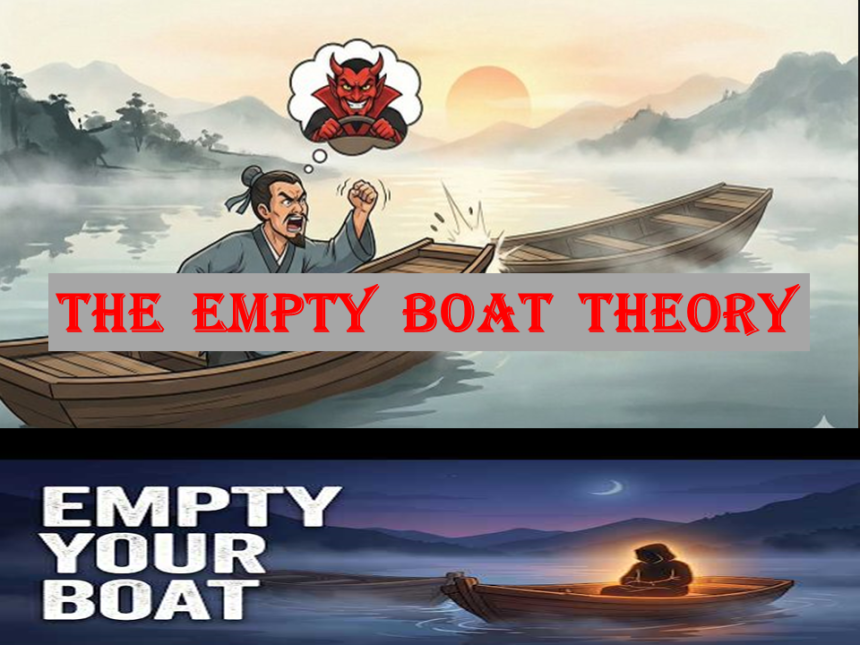
A Chinese sage named Zhuangzi is credited with "The Empty Boat Theory". Let's imagine that anyone of us is meditating in a small boat on a calm lake. Suddenly, another boat crashes into our boat. The most likely immediate instinct will be an intense irritation and anger at the person who collided with the boat and disrupted the meditation. But when, one opens his eyes and look around; he finds a totally empty boat. Now let's ponder upon the realization that the other boat is empty—it had simply drifted untethered from the dock. Bewilderment may catch suddenly, what happened! But, what about the "intense irritation and deep anger" anguishing inside?
Instantly, the anger vanishes and some sense of bewilderment appears, and no one to blame for the trouble. Wasn't the irritation and anger developed foolishness?
The "Empty Boat Theory" is an ancient Daoist parable, often discussed in modern wellness circles, that teaches emotional regulation. It asserts that anger stems from assuming someone intentionally harmed you. When you realize the instigator is "empty" or acting without malicious intent, your frustration instantly vanishes.
The Empty Boat Theory says: Most harm isn’t personal. It’s projection. Two worlds collide. Each person is fighting battles you can’t see. Their actions are about their storms. Not your worth. The Core Lessons may be summarized as follows:-
Stop Taking Things Personally: Most interpersonal slights, missed deadlines, or rude gestures aren't personal attacks. People act out of their own stress, conditioning, or struggles—they are essentially "drifting" in their own storms.
The Power of Perception: You rarely suffer from the event itself, but rather from your interpretation; that it was done maliciously. By assuming there is no negative intent, you strip the situation of its power to upset you.
Reclaim Control: When you stop assuming bad actors are targeting you, you stop giving away your emotional peace.
Empty Your Boat
An empty boat hits. The damage is done. Only interpretation creates the wound.
A coworker says something rude. If one doesn't slip away from anger and overthinks, the mind multiplies the pain. The rude comment happens once, but the anger and anxiety makes one suffer for hours. One cannot control what others do, but can control his own actions and feelings. Fixing one own mindset is the key to true peace. When a casualty happens, the best thing to do is to wash away worries and concentrate on possible solutions.
We are now living in modern era with a sea of humans following each others owns rituals and routines.It's a high pace travel on a busy expressway but with no lane restrictions; a chaotic and horrifying spectacle. Someone cuts you in traffic, honks and does rash driving. Someone ignores your email; or unfollows you on digital world. Why shall people's (many unknown personally) unwarranted comments or arguments bother us? Let's stop our brain invent intent; disrespect; rejection; threat. Just remember that most boats are empty and people are busy, tired, distracted.
How the "Empty Boat Theory is Applicable in Everyday Life?
When you feel anger or anxiety rising—whether stuck in traffic, dealing with a difficult colleague, or in a personal argument—pause and ask yourself: "Am I just getting angry at an empty boat?" Zhuangzi’s parable teaches us a lesson with a brutal point. "We suffer more from the story in our head than from the event itself"; or "We suffer more from the own shortcomings than the event unfolding against us".
This idea reflects ancient Stoic philosophy. It means our reactions and flaws hurt us more than bad events do. When things go wrong, we often make it worse through anger or worry. The Roman philosopher Seneca said we suffer more in imagination than in reality. When we face a problem, we often guess the worst will happen. This causes pain before the event even starts.
The philosopher Epictetus taught that events do not hurt us. Instead, our judgment of the event hurts us. If you lose a job, the event itself is neutral. If you tell yourself "I am ruined," you suffer. If you tell yourself "I will find a new job," you stay strong. It is easy to blame other people or bad luck when things fail. However, the Stoics tell us to look inward. If you are too proud to ask for help; or too quick to give up; that is your real hurdle. You cannot control the rain, but you can control whether you bring an umbrella.
What Scripts Our Sufferings Quietly?
We are living in modern times but we are carrying codes from centuries when our ancestors used to live close to nature and faced many wild dangers. Our nervous system hates uncertainty. So it fills gaps with stories. Usually negative ones; because survival once depended on assuming danger. A rustle in the grass wasn’t “maybe.” It was “tiger.” We still run that software.
The real dangers to modern day humans is not from outside (the boat is empty) but from his own shortcomings; lurking somewhere hidden inside him. Modern humans face their biggest threats from within. Hidden habits like self-sabotage, procrastination, and a fear of success drive failure. Instead of blaming outside forces, we often build our own roadblocks; by nurturing:-
• Ego
• Assumption
• Projection
• Narrative
These hidden factors inside us turn neutral events into personal attacks. You relive them for years; over boats that were empty from the start. Zhuangzi wasn’t teaching passivity. He was teaching clarity. See reality before adding meaning. Pain is inevitable. Personalization is optional. That gap is where emotional freedom lives. We are all accidental boats in each other’s rivers.
Bumping.
Drifting.
Colliding.
Rarely intending harm. Yet constantly misread. Human life is a river of misinterpretations.
The Conclusion
We, the modern day humans, can fix our habits by changing how we let our brain thinks. There is always a inner voice that constantly tells and guides us. Let's not try to be perfect but practical (be a person of action). Remember that doing something poorly is better than doing nothing at all. We are traversing on a high paced chaotic expressway and the other boat is empty. We, individually, are not engaged in meditation and all others are following their own rituals and routines.
The bumps, drifts, collisions are natural outcomes of this day (modern) and how we shape our ego, assumptions, projections and narrative is our choice? We cannot always stop bad things from happening; but we get to choose how we react to them. Think life like driving a car. We can't control the potholes or the bad weather; but steering wheel shall be in our control. Don't let the empty boat make decision for us while moving forward in life.
NOTE: A beautiful explanation is also available here https://www.youtube.com/watch?v=AEY1Jv5KL2I


Audio Transformers in Public Address Systems: Why Are They Needed?
Imagine yourself inside an active factory during the first hour of a working shift. You ne...