
أَعُوذُ بِاللّٰهِ مِنَ الشَّيْطَانِ الرَّجِيمِ
بِسۡمِ ٱللهِ ٱلرَّحۡمَـٰنِ ٱلرَّحِيمِ
In the name of ALLAH, the Most Gracious, the Most Merciful
The Dawn of New Era is Possible
It was three in the morning. Hassaan, a final-semester university student, sat in his room with his head in his hands before a glowing laptop screen. On the desk lay two empty teacups and a thick Urdu dictionary opened wide. He had to prepare a comprehensive assignment for his Iqbal Studies course on the theme: "Memaar-e-Haram! Baaz ba Tameer-e-Jahan Khaiz" (O Architect of the Sanctuary! Rise once more to rebuild the world).
Due to his English-medium education, Hassaan’s grasp of Urdu was quite weak. He had spent the entire night scouring the internet for articles, yet comprehending the philosophical depth and historical context of this single verse—and translating it into his own words—felt like climbing a mountain. Before he knew it, the pale light of dawn began peeking through the window curtains. A full day and night had slipped away, and the assignment was due the very next day.
At the breakfast table that morning, seeing Hassaan’s bloodshot eyes and crestfallen face, his father, Professor Mahmood, immediately sensed what was wrong. Hesitantly, Hassaan explained his predicament.
Folding his newspaper with a hint of sternness, Professor Mahmood remarked, "Hassaan! You wasted an entire day and night just like that? When you knew your command over Urdu and Iqbaliyat was weak, you should have asked me yesterday. Failing to value time has become our greatest weakness."
Setting a cup of tea before the Professor, Hassaan’s mother smiled and chimed in gently, "Come now, stop scolding him—the boy is already stressed enough. Finish your breakfast and sit down to help him; he has to present this paper tomorrow."
After breakfast, father and son sat together in the drawing room. Hassaan opened his notebook and asked, "Abu, I understand that 'Architect of the Sanctuary' refers to the Muslim Ummah, but why did Iqbal urge 'rebuilding the world' with such intensity in this verse?"
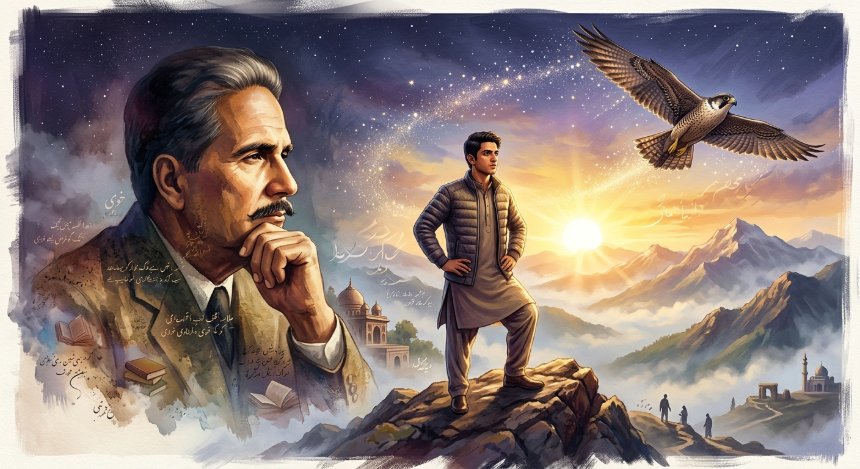
Professor Mahmood adjusted his glasses, took a deep breath, and began, "Son, to understand that, you must look at Iqbal’s era. In the time Iqbal lived, the Indian subcontinent was bound in the chains of British imperialism, and almost the entire Islamic world suffered under Western colonial dominance and intellectual subjugation. Yet, even in that darkness, a wave of awakening was rising. Whether through Jamal al-Din al-Afghani’s calls for pan-Islamic unity or the movement-based struggles of reformers like Hassaan al-Banna, efforts were underway everywhere to rouse the Ummah. Iqbal wanted to transform Muslims from a lifeless crowd into a 'living nation.' That is why he cried out:--
Memaar-e-Haram! Baaz ba Tameer-e-Jahan Khaiz
(O Architect of the Sanctuary! Rise once more to rebuild the world)
In other words, your purpose is not merely to remain a passive spectator of the world or accept servitude, but to construct a new and better world."
Hassaan quickly jotted down the points, then paused to ask, "But Abu, ordinary people are tangled up in daily survival and earning a livelihood. How can they rebuild the world?"
"That is precisely Iqbal’s core message!" Professor Mahmood replied passionately. "An ordinary person views life as nothing more than eating, breathing, and accumulating material comforts, whereas Iqbal declares:
Zindagani hai sadaf, qatra-e-Naisan hai Khudi
Woh sadaf kya ke jo qatre ko guhar kar na sake
(Life is an oyster shell, and Selfhood is the spring raindrop within it;
What worth is that shell which cannot turn the drop into a pearl?)
This worldly life is an oyster shell, and human Khudi (selfhood) is that special raindrop destined to become a priceless pearl. Embedded here is a message for the youth: embrace knowledge and action to refine yourself into a unique pearl (Guhar-e-Yagana). You are commanded to reach the heights of the Pleiades (Auj-e-Surayya). You are the standard-bearer of the Sanctuary’s glory; through purposeful struggle, you must build a world anchored in the supreme sovereignty of Allah."
Hassaan nodded thoughtfully. "And what is the biggest obstacle standing in the way?"
"The fear of material vastness and a limited intellect!" the Professor explained. "When a person looks through physical eyes, this earth and sky appear boundless, and opposing forces seem invincible. Yet, a single leap of Ishq (Divine Love) settles the entire matter:
Ishq ki ik jast ne tay kar diya qissa tamam
Is zameen o aasman ko be-karaan samjha tha main
(A single leap of Love settled the entire matter;
I had once thought this earth and sky to be boundless.)
Through Ishq, one realizes that true infinity does not lie in the physical universe, but within one’s own inner soul. And remember this, Hassaan: this Ishq is servitude to Allah, yet no Muslim can even reach the foundation of this love—let alone its heights—without becoming a true, devoted follower of the Noble Master, Prophet Muhammad ﷺ. Love for the Holy Prophet ﷺ grants that immense strength which turns a believer into a traveler of realms far beyond even the heights of the Pleiades:
Quwwat-e-Ishq se har past ko bala kar de
Dahr mein ism-e-Muhammad ﷺ se ujala kar de
(Through the power of Love, elevate every lowly state;
Illuminate the world with the name of Muhammad ﷺ.)"
Just then, Hassaan’s mother walked in carrying a plate of fruit. Overhearing their conversation, she remarked, "Hassaan, my son, what your father is telling you are not mere bookish theories. When the world inside a person changes, the external world naturally transforms."
Professor Mahmood smiled. "Your mother is absolutely right! Iqbal finds the solution in awakening Khudi, dusting off its rust of heedlessness, and fulfilling our duty as God’s vicegerent on earth (Niyabat-e-Arzi) through Divine Gnosis. When national reform and the welfare of humanity become life’s guiding principles, a person becomes fearless even of death:-
Ho agar khud-nigar o khud-gar o khud-geer Khudi
Yeh bhi mumkin hai ke tu maut se bhi mar na sake
(If Selfhood is self-observing, self-building, and self-mastering,
It is even possible that death itself cannot make you die.)
And when a revolution ignites within Khudi, the entire surrounding world transforms:-
Teri Khudi mein agar inqilab ho paida
Ajab nahi hai ke yeh chaar su badal jaye
(If a revolution is born within your Selfhood,
It is no wonder that all four corners of the world will change.)
People often wonder what value these ideas hold in today's modern era. Yet look at history: in this very world, an ordinary barrister, Muhammad Ali Jinnah, through the power of his selfhood, became Quaid-e-Azam and altered the course of history. Sheikh Muhammad Iqbal himself became Hakim-ul-Ummat (Sage of the Ummah). In the modern era, Iran’s revolutionary leadership—first Ayatollah Ruhollah Khomeini and subsequently Ali Khamenei—embraced this philosophy of self-reliance and resistance, setting an example of standing firm before major global powers, particularly the United States."
A spark had now lit up in Hassaan’s eyes. "That means in today’s age, we must also excel in modern science and technology?" he asked.
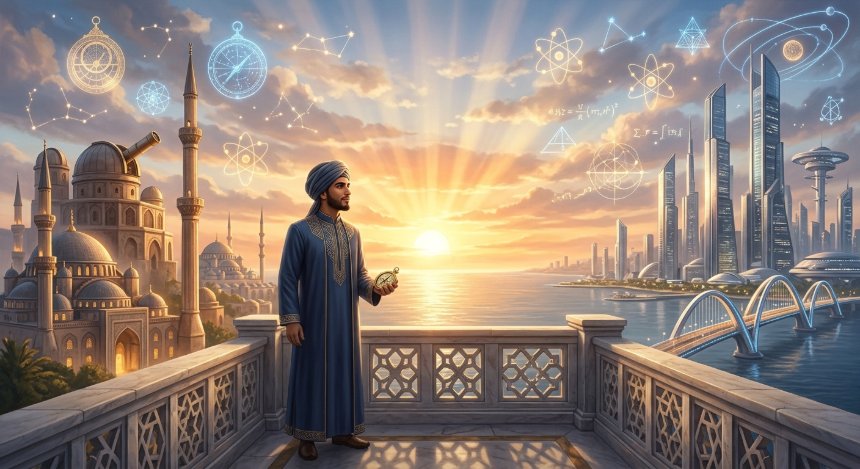
"Undoubtedly!" Professor Mahmood said, tapping the table for emphasis. "For Iqbal, there is no contradiction between faith and science. Today we are subdued, yet it was not always so. For centuries, Muslims led the world. You might be surprised to learn that even modern science fiction stories were pioneered by Muslim writers, who wrote works of scientific imagination for centuries. The Muslim soil has never been barren—we simply grew foolishly content with intellectual servitude:
Nahin hai na-umeed Iqbal apni kisht-e-weeran se
Zara nam ho to yeh mitti bohat zarkhaiz hai saqi
(Iqbal is not despondent over his barren field;
Given a little moisture, this soil is remarkably fertile, O cupbearer.)"
The Professor took a sip of water and continued, "Today’s tragedy is that humanity is trapped in self-serving materialism. As Iqbal says:
Is dair-e-kuhan mein hain gharaz-mand pujari
Ranjida buton se hon to karte hain Khuda yaad
(In this ancient temple, the worshippers are driven by self-interest;
Only when displeased with their idols do they remember God.)
You must break free from this self-serving worship. O Muslim youth of the modern era! Master science and technology and conquer the world—for more trials of Love still await! From among your own ranks can rise the Newtons and Einsteins of a new age. Modern science has only just learned to stand on its feet! Who is destined to journey across the stars? You must conquer the horizons of East and West like Dhul-Qarnayn; collapse time and distance like Prophet Sulayman (peace be upon him)—for whom a morning’s journey covered a month’s distance and an evening’s journey another month’s; and unlock the secrets of transporting matter across hundreds of miles in the blink of an eye through scriptural knowledge, like Asif ibn Barkhiya. Yet always remember one thing, my son!"..
Looking straight into Hassaan’s eyes, Professor Mahmood declared, "You must conquer the world, not ruin yourself by getting lost in its fleeting pleasures and glamour—for the true means of conquering the universe will emerge from the boundless depths of Khudi, not merely from laboratories!"
Silence fell over the room for a moment. Hassaan’s mother affectionately placed her hand on his head and said, "Now go, my son, sit down and write with this very spirit. May Allah bless your efforts."
The Next Day: The Classroom — "An Individual Exists Through the Bond of the Millat; Alone, He Is Nothing"
The following day, complete silence filled the university lecture hall. Hassaan stood at the podium delivering his paper. The same young man who, until yesterday, had hesitated to string together a few Urdu sentences now spoke with remarkable confidence, passion, and conviction. When he invoked the examples of Prophet Sulayman (peace be upon him), Dhul-Qarnayn, and Asif ibn Barkhiya, declaring that "the true means of conquering the universe will emerge from the boundless depths of Khudi, not merely from laboratories," the entire hall erupted into applause.
At the conclusion of the presentation, his classmate Hamza raised his hand and said, "Hassaan, your presentation has truly opened our eyes. As science and engineering students, we used to limit our ambitions to merely landing a good job, but today we realize our true calling. I am going home tonight to discuss this with my younger siblings and parents."
Another student, Ayesha, nodded in agreement. "Absolutely! It gives our generation a completely fresh perspective on how modern technology, guided by faith and Khudi, can reclaim global leadership."
The course instructor, Dr. Saleem, rose from his seat and addressed the class with a warm smile. "Dear students, today Hassaan has not merely presented an assignment; he has practically demonstrated what the modern approach to rebuilding the world looks like. Reflect on how this thought travels: yesterday morning, in the drawing room of one home, a father and mother lit the lamp of knowledge and Khudi inside their son. Today, that same lamp arrived in this university classroom, and now fifty students sitting here will carry that light back into fifty different homes and families."..
Dr. Saleem continued, "How heartening it is that such a vital message has reached us. Look around—the world is stretching into a new era. The global leadership the West has held is perhaps now journeying toward its twilight. Look at how China has risen! What, then, prevents us Muslims from surging forward? This is the very moment when Iqbal’s call echoes as a living reality:
Uth ke ab bazm-e-jahan ka اور hi andaaz hai
Mashriq o Maghrib mein tere daur ka aaghaz hai
(Arise, for the assembly of the world now takes a different turn;
In East and West alike, the dawn of your era has begun.)"...
Congratulating Hassaan, Dr. Saleem concluded with resolute conviction, "This is the journey from an individual to a nation, and onward to the leadership of the Muslim Ummah and the stewardship of the world! When the upbringing of homes unites with the research of universities, living nations are born—not mere individuals. And this is the very path upon which every young Muslim can become the fulfillment of Iqbal’s dream:
Khudi ke saaz mein hai umr-e-jawidan ka suragh
Khudi ke soz se roshan hain ummaton ke chiragh
(In the melody of Selfhood lies the secret of eternal life;
By the flame of Selfhood are the lamps of nations lit.)"