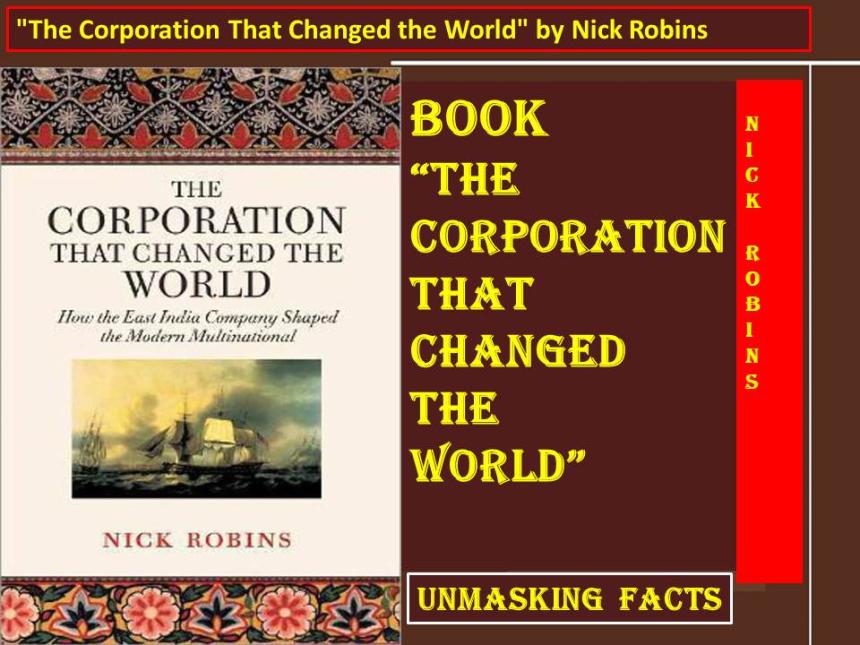

"The Corporation That Changed the World" by Nick Robins
Nick Robins is a sustainable finance expert and author who wrote the book "The Corporation That Changed the World", which focuses on the English East India Company. He is a historian by training and has spent over 25 years working in sustainable finance, investment management, and policy. This write up is about his book and lessons learnt from the cruel facts revealed in the book, about the Sub Continent Indo-Bengal-Pak.
أَعُوذُ بِاللّٰهِ مِنَ الشَّيْطَانِ الرَّجِيمِ۔
بِسۡمِ ٱللهِ ٱلرَّحۡمَـٰنِ ٱلرَّحِيمِ
In the name of ALLAH, the Most Gracious, the Most Merciful
"The Corporation That Changed the World" by Nick Robins
"The Corporation That Changed the World: How the East India Company Shaped the Modern Multinational" by Nick Robins
Nick Robins is a geologist by profession, is acknowledged for setting maritime history within the bigger social and political picture. Nick is co-founder of Carbon Tracker and also co-founder of Planet Tracker. Nick has published widely and is the author of The Corporation that Changed the World: How the East India Company Shaped the Modern Multinational ' (2005) and co-editor of Sustainable Investing: the Art of Long-Term Performance (2008).
The English East India Company, founded in 1600, the East India Company was the forerunner, mother of the modern multinational.
The English East India Company was incorporated by royal charter on December 31, 1600 and went on to act as a part-trade organization, part-nation-state and reap vast profits from overseas trade with India, China, Persia and Indonesia for more than two centuries. Its trading empire encircled the globe, importing Asian luxuries such as spices, textiles and teas. Starting life as a trader in Asian spices, the Company ended its days running Britain's Indian empire.
But the Company’s takeover of much of India was achieved by force and fraud; in China, the battering ram was opium. This book takes up the history of the East India Company and its enduring legacy as a corporation, dealing in exploitation and violence. This is the first-ever book to expose the East India Company's social record. The Company’s corruption and violence shocked its contemporaries and still reverberates today. Robins reveals a hidden story of tragedy and intrigue. The Corporation That Changed the World is the first book to examine the Company’s enduring legacy as a corporation. It uncovers the factors that drove it to excess and eventual collapse. The book looks at recent activist and cultural responses to the Company in China and India, and the corporate reform agenda in light of the economic crisis.
The book explores how the four forces of scale, technology, finance and regulation drove its spectacular rise and fall. War, famine, stock-market bubbles and even duels between rival executives are all to be found in this new account. This story provides vital lessons on both the role of corporations in world history and the steps required to make global business accountable today.
East India Company: Flag Bearer of British Empire
The East India Company was an English trading enterprise established in 1600 under a royal charter from Queen Elizabeth I, aimed at monopolizing the spice trade in Southeast Asia. However, it quickly shifted focus to India's lucrative textile industry, establishing factories and exporting textiles worldwide. The book delves into the company's establishment as the first corporate monopoly, its aggressive expansion and dominance in global trade, and its eventual role in shaping modern multinational corporations.
Although the East India Company's first aim was to secure spices, they soon expanded their business to trade in cotton, silk, indigo, tea, and saltpeter (an ingredient used in gunpowder.) Competition was intense, especially with the Dutch. The company founded a trade center at Masuli patam in 1611, taking permission from the Sultan of Gol kunda. The company built it's second trade center at Armagaon in 1636. In 1639, it made a treaty with the King of Chandragiri to shift the Armagaon trade center to a nearby place of Madras and renamed it as Fort St.
The company's transformation from a trading corporation to a colonial power began with the British victory in the Battle of Plassey in 1757. Company troops commanded by Robert Clive defeated the forces of Siraj al-Dawlah, gaining control of the lucrative and strategic region of Bengal. But in 1766, not long after Clive's victory at the battle of Plassey, the Company acquired the "diwani", the right to collect the taxes, in Bengal. A situation of “unrequited trade” was thus established. Suddenly the profits from tax collecting more than covered the cost of trade goods. The dividend, jumped from six per cent in 1766 to 12 per cent in 1769. The shares soared.
Then the Company's position in South India was threatened and the share price collapsed. The Company had overwhelming debts, but was judged “too big to fail”. It had to be bailed out by the British government, which in return secured the right to nominate representatives to the Bengal Council. Corruption and accountability became increasingly important themes. By the time Warren Hastings was Governor-General the company was purchasing vast quantities of tea from China. What could be sold to China in return? Answer: Indian opium. This trade notoriously led to war with China. But by the end of the Second Opium War, the Indian Mutiny had put paid to the Company's rule over India, though the Company continued a financial existence until 1874.
Rise of Multinational; So as the Mal-Practices
Nick Robins’ book, The Corporation That Changed the World: How the East India Company Shaped the Modern Multinational (2006/2012), argues that the East India Company (EIC) served as the primary blueprint for the modern multinational corporation. It explores how the EIC pioneered corporate structures—such as shareholder models and executive malpractice—and uses its history to advocate for greater contemporary corporate accountability.
For over 200 years the East India Company was the world's largest corporation. Set up as a merchant trading house in 1600, it became a permanent joint stock company in 1657, the forerunner of the modern multinational. In the beginning bullion was brought from Britain to pay for Indian goods, which were then shipped to Britain. By examining the EIC’s rise from a merchant trading house to a territorial power that collected taxes and commanded private armies, Robins provides a cautionary tale about the dangers of unchecked corporate power.
This book offers a fascinating account of the forerunner of the modern multinational: the British East India Company (1600-1874). Nick Robins shows how the East India Company pioneered the model of the corporation that we see today. Its innovations included the shareholder model of ownership, and the administrative framework of the modern firm. Global in reach, it achieved market dominance in Asia, trailblazing the British Empire in the East. In the process, the company shocked its age with the scale of its executive malpractice, stock market excess and human rights abuse.
Lessons to Learn from the Book
East India Company remains a topic for continued interest for most people especially in India. India lost much of its glorious past due to this privately held company. There are many books which have gone onto document how the company marshalled by a few highly ambitious people turned a trading company into an imperialist superpower. The book has a really interesting account of how EIC went about its business and the way it manipulated politics on its rise to the top. The players which shaped EIC to the top and the critics who tried to pull it down.
One of the earliest and principal architects of the Company’s vision was Sir Josiah Child; " he fervently believed profit and power must go together.” [page 48] “On 9 June 1686, Child underlined the imperative for the Company to transform itself from ‘a parcel of mere trading merchants’ into a ‘formidable martial government in India’.” [page 49] (Can this be termed as "wolf in sheep clothing"?).
(A business company could possibly be a political tool for enhancing profits through manipulation and corruption).
The first multinational corporation the world saw was also the most rapacious and corrupt, ruining the world’s most prosperous economy, beggaring a seven-thousand year old civilization along the way. The title of the book may seem like hyperbole, but when you consider the impact that the Company Bahadur (which was the honorific bestowed on the company by the natives of the land it ruled) had on much of the world, including India and China – mostly for the worse – and mostly with tragic consequences, hyperbole does not seem like an exaggeration. This book documents the social impact of the Company’s rule in India. (The business company could also be used for social engineering and subjugation of its own customers for turning them into loyal subject status)
When it comes to the soiled legacy of the East India Company, there is expectedly a marked amount of disconnect and denial that abounds in some quarters of the British aristocracy. The chief executive of the Standard Chartered Bank remarked that the challenge was now (in 2002) to “build upon the courageous, creative, and truly international legacy of the East India Company.” [page 14]. “Rod Eddington, one time chief executive of British Airways” in a similar vein saw it “as a case study in how corporations succeed ‘by dint of hard work, shrewdness and charm.’ ” [page 14, 15]. Yes, charm indeed, one wonders. The charm of the likes of Robert Clive, a petty thief, who found himself dealing with another thief, Mir Jafar, and managed to come out ahead. (The manipulation of governmental authorities through corruption and bad practices may also be a matter of pride).
Cruel Facts Revealed in the Book
The book reveals that “The Indian subcontinent was then the workshop of the world, accounting for almost a quarter of global manufacturing output in 1750.” and even more so that “Even in the first century AD, the Roman historian Pliny was complaining that the extensive importing of cotton fabrics from India was draining Rome of gold.” [page 61]
The book further on informs that “there is compelling evidence that India’s weavers had ‘higher earnings than their British counterparts and lived lives of greater financial security.'” [page 77].
The above is a fact that was removed from the conscience of habitants of Indian Sub Continent (which itself is a subject of research about dark colonial legacy); which may be phrased that " India was once a manufacturing power in textile handloom industry; which is quite natural as cotton has been a cash crop of Indian Sub Continent". It matches with the input that India's wealth as 25% of the world; therefore the abject poverty is a colonial legacy.
The colonial legacy trumpets about "civilizational advancement of goodness"; however, the data reveals "exploitation" was a happy trend with western masters", as the author documents; “One practice that was particularly resented was the classification of perfectly good cloth as sub-standard (ferreted). According to William Bolt’s celebrated account, ‘various and innumerable’ were the ‘methods of oppressing the poor weavers, such as fines, imprisonments, floggings, forcing bonds on them, etc.’ … the Company’s practices led to a shocking form of self-mutilation, stating that ‘instances have been known of their cutting off their thumbs to prevent their being forced to wind silk.’ ” [pages 77, 78]
If cheating, looting, and exploitation were the defining traits of the East India Company, decadence and corruption couldn’t be far behind. Such was the extent of corruption and decadence in the lifestyles of the Company’s leaders that “A new catchphrase entered the language – ‘a lass and a lakh a day’.” [page 83]
Europe had always been Asia’s commercial supplicant, for at least two millennia, from Roman times; as they were shipping out gold and silver in return for spices, textiles and luxury goods from Indian Sub Continent. And for the first 150 years after EIC's establishment by Queen Elizabeth-1 in 1600, the Company had to repeat this practice, as there was simply nothing that England could export that the East wanted to buy. The situation changed dramatically in the middle of the eighteenth century, as the Company’s officials took territorial control and turned the trade in its favour. The Company had managed to halt the export of bullion eastwards, using the East’s own resources to pay for exports back to Europe.
PROFESSOR OM PRAKASH of the Delhi School of Economics says that “Asia played a great role in civilizing Europe”. From the middle of the seventeenth century on, the growing influx of cottons into Europe radically improved hygiene and comfort, while tea transformed the customs and daily calendar of the people. The Company’s past at Cutlers Gardens is marked with ceramic tiles that bear a ring of words: “silks, skins, tea, ivory, carpets, spices, feathers, cottons”.
As the EI Company’s imports grew, so local manufacturers in England panicked. In 1699, London’s silk weavers rioted, storming East India House in protest at cheap imports from India. The following year, Parliament prohibited the import of all dyed and printed cloth from the East, an act to be followed 20 years later by a complete ban on the use or wearing of all printed calicoes in England – the first of many efforts to protect the European cloth industry from Asian competition.
The Conclusion
"The Corporation That Changed the World: How the East India Company Shaped the Modern Multinational" by Nick Robins frames the EIC as the ancestor of today's global firms. The ultimate purpose of the work is to draw parallels between the EIC's historical abuses (such as monopoly power and human rights issues) and the challenges of regulating modern global corporations. EIC was the first to implement key features like the joint-stock model and complex administrative frameworks. A major focus is the tension between profit and ethical responsibility.
Nick Robins being a historian by training and sustainable finance, investment management, and policy expert has highlighted that how the EIC engaged in corruption, violence, and stock market excess, ultimately failing due to its own lack of accountability. The book analyzes how forces like global scale, speculative finance, and the "too big to fail" status—which eventually required a government bailout—shaped the company's trajectory.
Nick Robins while performing the task in his current area of expertise has reflected upon a cruel, dirty hateful and not much of pride legacy left behind by the British Colonial Empire and its flag bearer East India Company. EIC performed business in "wolf in sheep clothing"; as business company which adopted pleasing ways to earn profit and gain power; and then assumed role from mere trading merchants’ into a ‘formidable martial government’.
"The Corporation That Changed the World: How the East India Company Shaped the Modern Multinational" by Nick Robins also tells that East India Company became a business company and a political tool for enhancing profits through manipulation and corruption. EIC also became a business company for social engineering and subjugation of its own customers for turning them into loyal subject. The EIC also enforced manipulation of governmental authorities through corruption and bad practices.
"The Corporation That Changed the World: How the East India Company Shaped the Modern Multinational" by Nick Robins also reflects that there are many lies and disconnect from facts that are taught through education system in Sub Continent Indo-Bengal-Pak; where as the reality was much different before the EIC complete take over of Rule in India after 1857; e.g. Sub Continent was once a hub of agricultural brilliance and textile loom industry and possessed world's 25% wealth.


Academic Excellence in AI and Data Science Engineering | HOD's Desk at...

LED magnifying mirror for hotels Oman
LED magnifying mirror for hotels Oman

Carbon Fibre Price Trend Q2 2026 | Price Trends, Forecast, Chart, Pric...