
The Complete Guide to Emergency Light Testing for London Businesses
Emergency light testing in London for offices and commercial premises. Monthly and annual tests, certificates and repairs. Get a quote today.
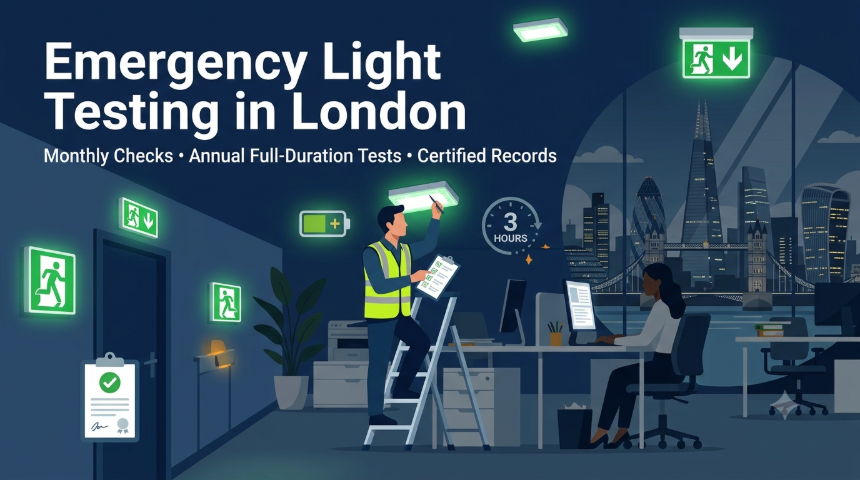
When the power fails or a fire breaks out, the lights you rely on every day can disappear in seconds. In a busy London office, hotel or restaurant, that can turn an orderly evacuation into a dangerous scramble. Emergency lighting is the safety net that keeps escape routes visible, and it only works if it has been tested.
Many businesses install emergency lights and then forget about them until a bulb fails or an inspector asks for records. This guide explains what emergency light testing is, what the law expects, how often tests should happen and how to stay on top of it.
Regular emergency light testing is the only way to know your lighting will actually perform when it matters. A fitting can look perfectly fine on the ceiling while its battery has quietly degraded and would last only a few minutes. Testing finds these hidden faults, confirms each unit works for its full intended duration and creates the written record you need to prove it.
Emergency lighting is also just one part of a wider safety picture. Businesses that manage fire safety compliance as a joined-up programme tend to find it far easier to keep tests, servicing and paperwork on schedule than those handling each task separately.
What Is Emergency Lighting?Emergency lighting switches on automatically when the normal mains supply fails. It is designed to help people leave a building safely, and it covers several functions:
- Escape route lighting: Illuminates corridors, stairs and exits so people can find their way out.
- Open area (anti-panic) lighting: Reduces the risk of panic in large spaces by giving enough light to reach an escape route.
- High-risk task area lighting: Allows hazardous processes to be shut down safely.
- Exit and directional signs: Illuminated signs that guide people towards the nearest way out.
Most fittings contain a battery that charges from the mains and takes over when power is lost. Over time those batteries wear out, which is the main reason regular testing matters.
Is Emergency Light Testing a Legal Requirement?In England and Wales, the Regulatory Reform (Fire Safety) Order 2005 requires the responsible person for non-domestic premises to make sure emergency routes and exits are properly lit and that safety equipment is maintained in efficient working order. Emergency lighting falls squarely within that duty.
The recognised technical guidance sits in British Standards, including BS 5266-1 for the design and installation of emergency lighting and BS EN 50172 for ongoing inspection and testing. Following these standards is the accepted way to show you are meeting your obligations, and an enforcing authority or insurer will usually expect to see evidence that you have.
How Often Should Emergency Lights Be Tested?The standard testing pattern has two main parts:
- Monthly function test: A short test, often called a “flick test”, simulates a power failure for long enough to confirm each light and sign switches on and the charging indicator works. It is usually brief, so the batteries are not drained.
- Annual full-duration test: Each unit is run for its full rated duration, commonly three hours, to prove the battery can last as long as it is supposed to. Some premises are designed for shorter durations, so the correct period depends on your system.
Ideally the annual test is scheduled for a time when the building is empty or quiet, because lights need time to recharge afterwards. If a test is carried out during opening hours, there is a risk the batteries will not have fully recovered if an emergency occurs.
What Happens During a Professional Test?A competent engineer will typically:
- Inspect every fitting and sign for visible damage, dirt or obstruction.
- Simulate a mains failure to confirm all units switch to battery power.
- Run the full-duration test, checking each light remains lit throughout.
- Check that batteries recharge properly and that indicator lights show the correct status.
- Record the results for every unit, noting any failures.
- Repair or replace faulty lamps, batteries or fittings, or report them for remedial work.
- Issue a test certificate and update your emergency lighting log book.
Because it can involve working on live circuits and ceiling-mounted equipment, this is not something most office teams should attempt themselves. Professional testing also gives you a clear, dated record that stands up to scrutiny.
Common Problems Testing UncoversExperienced engineers regularly find the same issues across London premises:
- Failed or degraded batteries that no longer hold a charge for the required time
- Blown or dim lamps that are barely noticeable in daylight
- Fittings blocked or hidden by ceiling tiles, signage, partitions or stored items
- Poor coverage after a refit, where new layouts leave dark spots on escape routes
- Missing or faded exit signs that no longer meet current expectations
- Isolated or disconnected units where a circuit has been switched off or damaged
- Incomplete records, with no log book or gaps in the test history
Many of these are cheap to fix when caught early, but expensive and dangerous when discovered during a real emergency or an enforcement visit.
Why Keeping Records MattersA test is only half the job. You also need proof it happened. A well-kept log book should record the date and result of every test, any faults found, the remedial action taken and who carried out the work. These records help you:
- Satisfy fire authority inspections
- Support insurance claims and renewals
- Show due diligence if something goes wrong
- Plan battery and fitting replacements before they fail
- Provide evidence when selling, letting or refurbishing a property
Emergency lighting should never be treated in isolation. A suitable fire risk assessment identifies which escape routes need lighting, how long the lights must run and how the layout affects coverage. If your building has changed since the last assessment, with new partitions, extra floors or a different use, your emergency lighting may no longer be adequate even if every unit still works.
It also overlaps with your electrical systems. The circuits that power and charge emergency units need to be properly maintained, which is why many businesses coordinate lighting tests with broader electrical compliance and testing. Doing both together reduces disruption and helps spot wiring issues that could affect the whole system.
Choosing an Emergency Light Testing Provider in LondonWhen comparing providers, ask:
- Do the engineers hold relevant qualifications and test to the recognised British Standards?
- Will you receive a full certificate and updated log book after every visit?
- Can they repair or replace faulty units, or will you need a second contractor?
- Will they schedule tests at quiet times to limit disruption?
- Do they send reminders so you never miss a due date?
- Can they bundle testing with fire alarms, extinguishers and other compliance work?
A provider that handles everything under one roof saves time and avoids the gaps that appear when multiple contractors are involved.
Final ThoughtsEmergency lighting is one of those systems nobody notices until the moment it is needed, and by then it is too late to find out it doesn’t work. Regular monthly checks, an annual full-duration test and clear records give you confidence that your people can get out safely if the worst happens.
For London businesses, the simplest approach is to place testing in the hands of an experienced local provider who keeps your schedule, carries out the work and handles any repairs.
About Office Compliance ManagementOffice Compliance Management provides fire safety, electrical testing and health and safety compliance services for offices, schools, restaurants, hotels and other commercial premises across London. With over 10 years of experience, the team offers a one-stop service that removes the need to juggle multiple contractors, and fixed-cost options of up to 24 months help clients budget with confidence. To arrange a test or request a quote, contact the team or call 0203 856 9802.






How Omnichannel Pharma Engagement Connects to Pharma Supply Chain Stra...


Engine Oil Manufacturing Plant Setup 2026: Cost, Machinery, Raw Materi...
