
أَعُوذُ بِاللّٰهِ مِنَ الشَّيْطَانِ الرَّجِيمِ
بِسۡمِ ٱللهِ ٱلرَّحۡمَـٰنِ ٱلرَّحِيمِ
In the name of ALLAH, the Most Gracious, the Most Merciful
Play: The Choices in the Drama of Life
Theme: The currency of age in the cycle of life, the power of moral choice, human milestones, and taking charge of one's own destiny.
Main Characters:
• First Character (The Actor): A dignified, eloquent man dressed in classic Shakespearean attire.
• Second Character (The Wise Elder): A sage-like figure whose voice carries spiritual depth and calm authority.
• The Frail Elder (Grandfather / Man of Insight):
A venerable, experienced elder who reflects on life's ultimate truths at the beginning, during the children's mentorship, and at the end.
• Third Character (The Narrator / Commentator): An educated, modern young man who addresses the audience directly with analytical clarity.
• Supporting Cast (Stages of Life): Four young children (two boys, two girls), four boys in their tweens/early teens (carrying books, bat and ball, a spade, and a begging bowl), young couples, college students, athletes, a lawyer, a soldier, a bride, a groom and his father, working professionals, and mature forty-year-olds.
Act I: The Curtain Rises — The World as a Stage and Human Choice
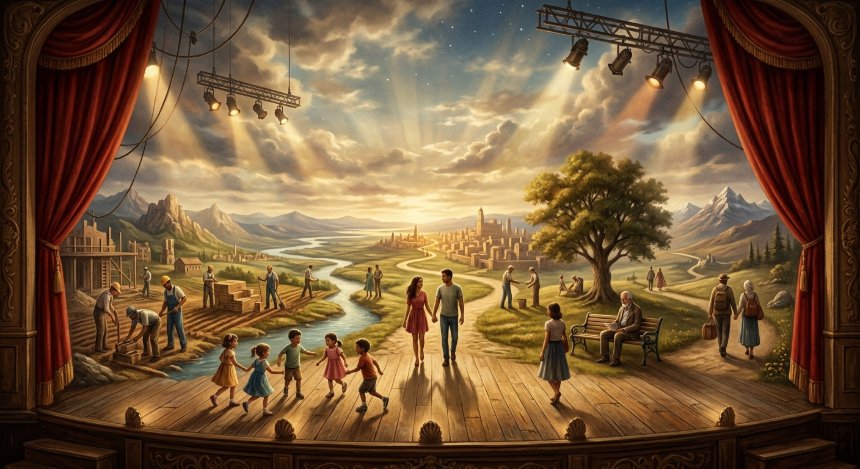
(The stage is dimly lit. In the background, the faint, steady ticking of a clock is heard. Slowly, the curtain rises. A sharp spotlight illuminates the exact center of the stage, where the First Character (The Actor) stands with theatrical grace.)
First Character (The Actor): (Spreading his arms wide, echoing Jacques' famous monologue from Shakespeare's 'As You Like It' in a resonant voice)
"All the world’s a stage, and all the men and women merely players! They have their exits and their entrances; and one man in his time plays many parts, his acts being seven ages... At first the infant, then the whining schoolboy, then the lover, then a soldier, then the justice, then the lean and slippered pantaloon, and last scene of all, second childishness and mere oblivion... sans teeth, sans eyes, sans taste, sans everything!"
(The First Character finishes his lines, falls silent, and bows his head. A soft light rises from the left side of the stage as the Second Character (The Wise Elder) and the Frail Elder walk slowly forward.)
Second Character (The Wise Elder): (Smiling gently toward the First Character, then turning to the audience with a deep, soulful voice)
"O people! Are we not all mere characters, mere puppets in this world, whose strings are held somewhere high above by the Master of Both Worlds? This coming and going never ceases. Yesterday belonged to our elders, today belongs to us, and tomorrow will belong to our children. The stage remains the same; only the players change."
(After this line, both elders pause, exchange a meaningful glance as if realizing something vital, and turn directly toward the audience with immense dignity, urgency, and compassion.)
Frail Elder: (Resting his weight on his walking stick, speaking in a commanding voice)
"Wait, O people! This is what matters most... You are not helpless puppets—you have a choice!"
Second Character (The Wise Elder): (Looking directly at the audience with profound conviction)
"Yes! Every human being inevitably arrives at this fundamental crossroads of choice: whom will they make the center and purpose of their existence—who is their true Lord, and upon what principle will they build their life?"
Frail Elder: (Stepping forward with spiritual poise)
"The Creator of the Universe made the true purpose of human creation crystal clear in the Holy Quran:
'And I did not create the jinn and mankind except to worship Me.' (Surah Adh-Dhariyat: 56)"
Second Character (The Wise Elder): (Addressing the audience decisively)
"The choice is yours: will a human live under the supreme sovereignty of Almighty God, or follow in the footsteps of Iblis (Satan)? Remember, there is no third path! As asked in Surah Ya-Sin:
'Did I not enjoin upon you, O children of Adam, that you not worship Satan—for indeed, he is to you a clear enemy—and that you worship only Me?'"
(The stage lights grow brighter and purer. Both elders radiate pride in human potential.)
Second Character (The Wise Elder): (In a warm, encouraging tone)
"You are capable of making this choice because humanity is the finest masterpiece of God's creation. The Creator Himself bore witness to human greatness:
'We have certainly created man in the best of stature and balance.' (Surah At-Tin: 4)"
Frail Elder: (Raising his hands slightly in a gesture of supplication before looking at the crowd)
"And then, granting humanity consciousness, open-heartedness, and eloquence for truth, He taught this magnificent prayer:
'My Lord, expand for me my breast [with assurance], and ease for me my task, and untie the knot from my tongue that they may understand my speech.' (Surah Taha: 25–28)"
Second Character (The Wise Elder): (Stepping forward, his tone steeped in history and philosophy)
"This foundational philosophy of human free will and choice is illuminated throughout the Quran. In human history, the very first test of choice began with Prophet Adam (peace be upon him), when the temptation of Iblis created a severe trial: on one side lay the path of straying through deception, and on the other stood the command and warning of the Almighty."
Frail Elder: (Concluding the thought with calm certainty)
"Through human vulnerability, he slipped in that moment—yet when the next choice arrived, between despairing arrogance and returning to God, he chose repentance and bowed before the Lord of the Universe. Proclaiming this human freedom and accountability, the Holy Quran shows humanity the way and places two paths before it:
'Indeed, We guided him to the way, be he grateful or be he ungrateful.' (Surah Ad-Dahr: 3)"
(The two elders step quietly to the side. From the right side of the stage, a bright light illuminates the Third Character (The Narrator) as he enters and addresses the audience directly.)
Third Character (The Narrator): (Speaking directly to the audience)
"Ladies and gentlemen! What you have just witnessed is the very essence of 'Staging the Drama of Life'—playing our roles upon the stage of existence. It is a profound literary and philosophical theme. Viewing life as a stage and human beings as its actors is an ancient metaphor across both Eastern and Western literature—just as you heard in Shakespeare's famous words that all the world's a stage.
Here, human life passes through distinct eras... childhood, adolescence, youth, adulthood, middle age, and old age.
Come, let me present before you a few glimpses of this grand drama of the cycle of life. From birth until death, a person steps into different phases and relationships—as a child, a parent, a friend, and a leader. Behold... Childhood!"
Act II: Glimpses of the Cycle of Life
Glimpse I: Innocent Childhood, Two Paths of Upbringing, and Eco-Stewardship
(The center stage brightens. Four young children run in laughing and playing. They chase one another, fly paper airplanes, and giggle carefree.)
Third Character (The Narrator): (In an enthusiastic, heartfelt voice)
"This is the childhood of us all... an age of play, mischief, and meaningless yet utterly truthful chatter. Here, there are no masks and no hypocrisy. This is the age and the playground where we forge lifelong friendships—companions parted only by death. At this stage, we are siblings, relatives, neighbors, and schoolmates. This is the age when we say: 'Coming events cast their shadows before them.'
(Turning toward the audience with a pause)
O people! Remember this... this is the age of innocence. If we are a successful nation with a bright future, we never allow our children's innocence to be wasted. Nations whose children are denied the right to play can never truly progress or earn an honorable place in the world!
O people! Children are the future of a nation... educating and nurturing them is a national duty. Neglecting this is equivalent to destroying a nation's future. So the question is... what must be done?"
(The children freeze playfully in the background as the spotlight shifts toward the Second Character (The Wise Elder) and the Frail Elder standing near the edge of the stage.)
Second Character (The Wise Elder): (In a dignified, inspiring tone)
"Look! Within the pages of history lie two contrasting examples of a mother's lap and childhood upbringing that can alter the destiny of an entire nation. On one side is the upbringing of Sheikh Abdul Qadir Jilani (may God have mercy on him). When he set out in his youth toward Baghdad in pursuit of sacred knowledge, his mother sewed forty gold coins inside the lining of his cloak and gave him one strict instruction as she bade him farewell: 'My son! No matter what happens, never tell a lie in your life, and always speak the truth.'
Along the journey, a band of highwaymen ambushed the caravan and began plundering everyone. When a robber asked the young boy what he possessed, he answered without hesitation: 'I have forty gold coins sewn into my cloak by my mother.' At first, the robbers thought he was joking. When he was brought before their chief and the coins were actually found, the astonished chief asked why he had revealed them instead of hiding them. The boy replied: 'I promised my mother I would speak the truth under all circumstances, and I cannot break my promise to my mother for a few coins!' The truthfulness and integrity of that young child struck the bandit chief so deeply that he broke down weeping, repented alongside his entire gang, and abandoned crime forever!"
Frail Elder: (Sighing deeply, speaking in a solemn, cautionary tone)
"Now look at the other side of that same coin—the famous, sobering tale of a thief and his mother! As a child, a boy stole a small item from a classmate—a wooden slate or a pen—and brought it home. Instead of scolding him and making him return it, his mother beamed with pride, praised him, and said, 'My son is so clever!' That encouragement erased the fear of stealing from the boy's heart. Over time, petty thefts escalated into major robberies, until he became a dangerous bandit.
Eventually, he was caught, and the judge sentenced him to death by hanging. At the gallows, he asked to see his elderly mother one last time. As she approached weeping, the son leaned in under the pretext of whispering in her ear—and bit her ear fiercely with his teeth! When the crowd condemned his cruelty, he cried out: 'The true culprit behind my standing on these gallows today is my mother! Had she stopped me and corrected me the day I committed my first theft as a child, I would never have lived to see this day!'"
(A heavy silence falls over the stage for a moment. The Third Character (The Narrator) steps back to center stage to offer practical solutions.)
Third Character (The Narrator): (In a confident, reformative tone)
"Audience! Proper education and character-building are not the duty of parents alone, but the collective responsibility of society as a whole. To fulfill this national duty and nurture the next generation, we must take practical steps at three levels:
First: The Role of Home and Parents (The Primary School):
• Teaching by Example: Children learn far more from what elders do than what they say. When parents speak the truth and keep promises, children naturally follow.
• Avoiding Blind Indulgence: Fulfill children's legitimate needs, but never cover up their stubbornness, lies, or violation of others' rights. Teach them right from wrong from the very beginning.
• Giving Time and Attention: Step away from mobile phones and busy schedules to sit with your children, listen to them, and stay aware of their company and activities.
Second: The Role of Educational Institutions and Teachers:
• Character Over Mere Degrees: Instead of rote memorization and a blind race for grades, schools and colleges must provide practical training in ethics, honesty, and civic sense.
• Empowering Teachers: A teacher is the architect of a nation. Educators must recognize that they are responsible not merely for teaching textbooks, but for shaping human beings.
Third: The Responsibility of Society and the State:
• Providing Positive Environments: Provide healthy recreation, playgrounds, and libraries so children's energies flow in constructive directions.
• Monitoring Media and the Internet: Discourage content on television and social media that breeds violence, dishonesty, or moral decay, and promote educational and reformative media.
• Equal Education: Ensure uniform, quality education for both rich and poor children so no child is driven toward destructive paths out of deprivation."
All Three Characters (In unison, addressing the audience):
"In short, if every individual among us honestly takes moral and educational responsibility for just their own home and neighborhood children, the future of the entire nation can shine bright!"
Part II of Glimpse I: Stewards of the Earth and the Return of Nature's Song
(The four children at center stage stop playing and gather eagerly around the Frail Elder (Grandfather) and the Second Character (The Wise Elder). In the background, soft visuals and gentle sounds of lush trees, chirping birds, and a flowing river emerge.)
Third Character (The Narrator): (In a warm, gentle tone)
"And the loveliest facet of this upbringing is raising our children to be friends of humanity and the environment—so that instead of becoming a burden on this earth, they become its beauty!"
Frail Elder (Grandfather): (Placing a loving hand on the children's heads, speaking with warmth)
"And remember, children... instead of considering ourselves the 'owners' of the universe, we must become 'curators' and 'guardians of the earth.' To make the earth so vibrant and alive that every hue of nature seems to converse with us, love for nature and a commitment to restoring it is the very first step. When we offer the earth respect and peace, the trees, flowers, and birds return on their own, and the music of life echoes through the air."
Second Character (The Wise Elder): (Reminding the children of history and heritage)
"Our ancestors once regarded the forest as their protector and the river as the symbol of life. Remember our Sufi poetry! Whether it is Shah Abdul Latif Bhittai, Bulleh Shah, or Khwaja Ghulam Farid—in their verses, the Indus River, the Rohi desert, and the birds are living companions and confidants of humanity. And in the 1970s, when the women of the Himalayas hugged the trees to protect them from loggers during the Chipko Movement, they were defending them as if saving the elders of their own family! Above all, our faith did not make us 'masters' of the earth, but 'Khalifas' (stewards) and 'trustees,' forbidding us from disrupting the cosmic balance—the 'Mizan'!"
(Inspired by the elders' words, the four children stand up enthusiastically and step forward one by one to make their pledges.)
First Child (Boy): (Eagerly — Calling Nature Back)
"Grandfather! We will call nature back! We will plant native trees and flowers that belong to our soil and climate—like tamarind, neem, golden shower (amaltas), jasmine, and roses—so fragrant blossoms perfume the air and become nature's voice!"
Second Child (Boy): (Raising his hand in agreement)
"Yes! And along street corners, empty plots, and rooftops, we will create micro-forests and green nooks so the earth can breathe even inside this concrete jungle!"
Third Child (Girl): (Smiling brightly — Welcoming Birds and Butterflies)
"And I will invite birds and butterflies as my guests! We will hang small wooden birdhouses on trees and place fresh water and grain in clay bowls on our patios and roofs every day, so morning and evening ring with birdsong!"
Fourth Child (Girl): (With excitement)
"And we will plant colorful, nectar-rich flowers to attract butterflies and honeybees, bringing a wave of life into our gardens!"
First Child (Boy): (In a thoughtful, responsible tone — Keeping the Sky and Air Clean)
"Grandfather, if we want starry skies and fresh air back, we must cut down pollution and noise. We will give up single-use plastics, never burn garbage, and avoid unnecessary honking so peace returns to our surroundings—a stillness where we can hear the rustle of wind and leaves!"
Fourth Child (Girl): (Confidently — Lightening the Earth's Burden)
"And most importantly, we will lighten the earth's burden. Instead of chemical fertilizers, we will use natural compost made from kitchen scraps so tiny organisms in the soil stay safe, and we will treat cleaning streams, parks, and streets as an act of devotion!"
(The elders raise their hands in blessing over the children, who spread their arms like birds and skip off happily to the other side of the stage as the lights dim briefly.)
Glimpse II: Adolescence — The First Folly of Love and the Divide of Destiny
(The lights rise again. Adolescents enter the stage. On one side, boys and girls carrying books recreate neighborhood and schoolyard scenes—stealing shy glances and blushing. On the other side stand four boys holding symbols of their diverging fates: the first holds books and a pen; the second holds a cricket bat and ball; the third carries a laborer's spade on his shoulder; and the fourth holds a beggar's bowl.)
Third Character (The Narrator): (In a deep, poignant, analytical voice)
"The moment childhood's border ends, Adolescence begins. Now, the currency of this age carries a unique value, determined by the naivety, dreams, and emotional honesty exclusive to these years. These are priceless days; once they pass, that raw magic, value, and uncalculated innocence of 'love's first folly' never returns. Companionships, gatherings, and affections in later years become bound by logic, pragmatism, and cost-benefit calculations. This is the very phase mocked in adulthood with phrases like: 'Why are you acting so childish? Grow up now!'
Adolescence is like a fable that concludes as maturity sets in. It is the age whose signature currency is commonly called a 'crush.' Scholars attribute it to coming of age, yet nearly every human being mints this currency through 'love's first folly.' By the time adolescence concludes, it introduces a person to society—proving the adage 'the child is father of the man.' It draws a young person out of the home into the wider neighborhood and community."
(The Narrator steps forward and gestures toward the boys holding the spade and the begging bowl, his voice rising in protest.)
Third Character (The Narrator):
"Yet look... the stage of life does not hand everyone the same script! Into one child's hands fall the book and pen of knowledge; into another's, the playground of sport. Yet in a corner of this very same stage, a heavy spade of labor is placed upon one child's shoulder, and a begging bowl of helplessness into another's hand! Right here, human beings begin playing roles dictated by circumstance.
O people! Between childhood and adolescence lie only a few short years—why, then, such a chasm? This is the age for seeking knowledge, the age for befriending pen and paper... what cruel game is this that pushes them onto another path?"
(The adolescent characters slowly exit the stage.)
Glimpse III: Youth — The Peak of Beauty and the Pursuit of Dreams
(Vibrant, colorful lights wash over the stage. Groups and pairs of young adults appear: college and university students with books, athletes in action, a young lawyer in a black coat, a soldier in uniform, and in one corner, a young bride dressed in crimson bridal attire bidding farewell.)
(A young couple steps to center stage. In the background, the upbeat melody of a classic song plays:)
"Papa kehte hain bada naam karega... beta hamara aisa kaam karega..."
(Papa says he will make a great name... our son will accomplish great things...)
(The music fades down as a spotlight focuses on the young couple.)
Young Man: (Looking at the young woman with dramatic, cinematic emotion)
"I cannot live without you... I am the Ranjha of this era, and you are my Heer!"
Young Woman: (Smiling shyly)
"And no matter what this world says, our bond will last forever!"
(As she finishes, colorful lights brighten around them. Holding hands as if lost in a dreamworld, they stand transfixed while a passionate song echoes in the background:)
"Come, let us leave this society far behind,
Let us break the customs and traditions of the world,
May our tale be the most unique of all,
Let us turn the tide of love stories!"
(The moment the final lyrics end, the music cuts off abruptly. A deep, echoing voice booms across the stage, and every actor freezes in place.)
Disembodied Voiceover (Resonant and cautionary):
"Remember... there is a proper time for everything!"
(Normal lighting resumes as the Third Character (The Narrator) steps forward to address the audience.)
Third Character (The Narrator): (In an inquisitive, compelling tone)
"Stepping out of adolescent naivety into Youth, human capabilities awaken and energy surges toward its zenith. This is the era when dreams set out in search of reality, and a person strives to discover their identity and purpose.
Tell me honestly yourselves: does a human being ever look more radiant at any other stage than in youth? If the highest value of youth's currency is to appear 'most beautiful,' this is that age—whether young man or young woman! One compelling reason is the lingering glow of departing childhood innocence; for once that innocence crosses into full adulthood and raw strength takes over, that delicate beauty begins to fade... Remember, O people: raw strength, by itself, is never the nurturer of beauty!"
(Lights focus on a group of young people at center stage, who deliver brisk, conversational lines revealing the truth of this phase.)
First Youth: (Thoughtfully)
"One facet of youth is also the expansion of love's first folly—the infatuation or 'crush'..."
Second Youth: (Warningly)
"Yet it must conclude within this very phase! Because carrying such folly past youth extracts a heavy price!"
Third Youth: (Making a symbolic gesture)
"Just like consuming medicine past its 'shelf life'—once healing, now turned into poison!"
(The spotlight shifts toward the young woman in crimson bridal attire.)
Young Woman (In Bridal Attire): (In a calm, dignified voice)
"In our Pakistani society, a large number of young women enter marriage during this stage of life..."
Elder Woman / Companion:
"And a widely held view is that for embarking upon this vital milestone of life, this is indeed the finest age!"
(The characters of youth exit the stage.)
Glimpse IV: Adulthood — Peak Performance, Civilization's Turning Point, and National Rise
(Bright, energetic lights flood the stage. Faint wedding festivities in the background swiftly transition into the bustling sounds of industry, work, and daily life. On one side, a young groom is welcomed; on the other, young men and women—engineers, farmers, teachers, scientists, and workers—stride forward with determination.)
Third Character (The Narrator): (In a confident, powerful voice)
"Now arrives Adulthood! The most powerful era in the cycle of life... the age of peak performance and maximum productivity! If a human being were a product, this is the stage where it operates at the most effective and durable phase of its shelf life. Physical strength, mental acuity, and willpower are at their strongest, and society demands the highest output during these years."
(The light focuses on the wedding gathering.)
Young Groom: (With poise, looking toward the audience)
"In the modern era, most young men tie the knot of marriage at this age."
Elder (Groom's Father): (Placing a hand on the groom's shoulder, speaking earnestly)
"Son, always remember that marriage is a pivotal and solemn turning point in human civilization! It is the strongest pillar for the continuity of the human race and the preservation of culture—and perhaps that is why every society celebrates it with such grandeur."
(The spotlight moves to the young professionals and workers standing before an elder citizen.)
Elder Citizen: (Looking at the young adults with hopeful eyes)
"Adulthood is the very stage when elders like us long to see our youth shoulder the responsibilities of life. The time for mere daydreaming has passed; this is the era to step forward into practical life!"
First Young Adult (Worker / Creator): (Loudly and enthusiastically)
"Yes! This is the most powerful era of the life cycle, and the era of our finest output! This is when the sapling of 'children are the future of a nation' grows strong and bears fruit."
Second Young Adult (Scientist / Builder): (Confidently)
"Remember, comrades! Our adulthood is the very measure of national rise or decline. If we squander this strength, history will never forgive us; if we channel it into building, we will make our nation's future radiant and extraordinary!"
Third Young Adult (Young Leader): (Turning to the audience decisively)
"Because what any nation achieves in the race of life is determined entirely by the drive, competence, and capability of its adults!"
(The young adults unite in a gesture of collective resolve as the stage lighting shifts to a warm, steady golden hue.)
Glimpse V: Middle Age — The Crossroads of Forty and the Crown of Leadership
(The stage lighting becomes warm, golden, and serene. Dignified, experienced individuals enter; their stride reflects confidence, composure, and leadership rather than haste. Reaching center stage, they pause briefly to look back toward their youth.)
Third Character (The Narrator): (In a dignified, reflective tone)
"Next comes the turning point of Middle Age... the crossroads of forty! The first step toward advanced years, an era of accounting for the past and forging a new covenant for the future! Here, the boundary of shelf life gradually becomes visible, and the performance graph settles into a steady, mature rhythm."
(A spotlight illuminates a mature forty-year-old standing at center stage, raising his hands in prayer toward the sky, flanked on one side by his elderly parents and on the other by his teenage children.)
Mature Person (At Forty): (In a soft, humble, deeply spiritual voice)
"My Lord! When a human being reaches full maturity, Your Word places this prayer upon their lips:
'My Lord, enable me to be grateful for Your favor which You have bestowed upon me and upon my parents, and to work righteousness of which You will approve, and make righteous for me my offspring. Indeed, I have repented to You, and indeed, I am of the Muslims [those who submit to You].' (Surah Al-Ahqaf: 15)"
(From the other corner of the stage, a dignified woman or seasoned elder who has weathered life's trials steps forward.)
Second Experienced Character: (In a calm, patient tone)
"At this age, one realizes that life is not merely the pursuit of desires, but being refined like gold through the furnace of trials—just as the Creator declared:
'And We will surely test you with something of fear and hunger and a loss of wealth and lives and fruits, but give good tidings to the patient—who, when disaster strikes them, say, "Indeed we belong to Allah, and indeed to Him we will return."' (Surah Al-Baqarah: 155–156)"
Third Experienced Character: (Looking at the audience with gratitude and peace)
"And when a person holds fast to gratitude alongside patience at this crossroads, the heart is blessed with the certainty that:
'What would Allah do with your punishment if you are grateful and believe? And ever is Allah Appreciative and Knowing.' (Surah An-Nisa: 147)"
(The Third Character (The Narrator) steps forward again to describe the worldly and leadership stature of this era.)
Third Character (The Narrator): (Confidently and respectfully)
"This is the juncture where competence, wisdom, and experience become a person's true identity. Here, one requires greater care, discernment, and a balanced lifestyle to avoid stumbling. It is a delicate, thoughtful bridge between the stormy passion of youth and the frailty of old age.
The currency of this age shines true to Allama Iqbal's verse: 'When someone proves worthy, We bestow upon them many a glory.' This era presents a person as a seasoned expert across every field of life. Though no longer as impetuous as youth, people at this stage become trusted pillars who carry weighty responsibilities. The currency of this age is the crown of leadership; individuals endowed with wisdom, intellect, and insight become the 'captains' of their respective domains. The pages of history are filled with the remarkable achievements of this 'currency of age.'"
(The middle-aged figures exit the stage with quiet dignity.)
Glimpse VI: Old Age — The Hidden Expiry Date and Empty Pockets
(The lights dim to a pale amber. The Frail Elder enters slowly, leaning on his walking stick, sits in a chair, and gazes down at his empty pockets. From the shadows at the back of the stage, the First Character (The Actor) and the Second Character (The Wise Elder) step forward quietly to stand beside him.)
Third Character (The Narrator): (In a tender, measured voice)
"And finally arrives Old Age... the outer edge of human shelf life, where the expiry date draws close. Physical limbs and mental faculties no longer meet their former performance demands. Memory blurs, bones grow fragile, and a human being resembles medicine or nourishment whose physical potency has run its course. The only difference is that products on a store shelf carry clearly printed expiration dates, whereas Nature has kept the expiry date on human packaging hidden. None of us knows how many coins of age remain in our pocket.
Here we are reminded of Ibn-e-Insha's poignant poem, 'Now the Currency of Age is Spent,' where he writes:
'When the currency of age ran out,
Now we stand in need of credit;
Is there anyone who will act as banker?
Is there anyone who will lend?'"
Act III (Finale): Departing the House of Wonder, Freedom, and the Final Awakening
(A deep, serene, spiritual stillness settles over the stage. In the background, bathed in soft white light, characters from earlier stages of life pass silently in a shadowy procession, like a caravan of memories.)
Third Character (The Narrator): (In a deep, soulful, peaceful voice)
"On this journey of life, when we cast a glance backward, we realize that the heaviest price paid for spending the currency of age is bidding farewell to those we love. Whether a loyal companion animal or our dearest kin—their departure feels like nothing short of the end of the world. Accepting the bitter truth that they will never return is the hardest ordeal of human existence. Until this grief snatches away someone woven into the fabric of our daily lives, we assume such loss only happens to others, and that we are somehow immune."
Second Character (The Wise Elder): (Placing a comforting hand on the Frail Elder's shoulder)
"Yet as our own allotted time—our 'shelf life'—on this earth grows shorter, a quiet transformation takes place. A person learns to accept every ending with a serenity and stillness they never possessed before. There is no guarantee that tomorrow we will walk this earth or that the currency of our breaths will remain. It is a stark reality none can deny. Watching loved ones depart one by one teaches humanity this greatest of lessons."
Frail Elder: (With moist eyes yet a gentle smile on his lips)
"In a way, we feel grateful to our departed loved ones for teaching us how to live the remainder of our lives. Though they left behind a deep sorrow, they also left a radiant beam of light that illuminates the darkness. The passing of a beloved brother or dear one teaches us to cherish the balm, gentleness, and empathy they left planted within our hearts. Through this loss, we feel the fragility of life more acutely; we love and celebrate the presence of everyone we meet along life's path, honoring the wonderful virtues that, through the grace of their companionship, have taken root inside us as well."
(The Frail Elder rises slowly from his chair, leaning on his stick as he looks toward the shimmering light at the back of the stage, where dreamlike images of his past life glow softly.)
Frail Elder: (Gazing at his past with a soft, contented voice)
"Today, standing at this bend in the road and looking back... I feel no fear. Here, the philosophy of life steps out of fear and reaches the place where the American poet Mary Oliver writes in her poem 'When Death Comes':
'When it's over, I want to say: all my life
I was a bride married to amazement...'
(He pauses for a moment, a faint smile gracing his face.)
That line teaches me that when death arrives, if a person looks back, they should feel their years were spent wedded to a house of wonder... treated with honor and reverence—just like a bride.
(Turning toward the audience)
Today I am at peace... knowing I did not merely pass empty time on this earth, but lived through a beautiful era! One should not meet death like a frightened traveler, but like a bride who forged a deep, lasting, and active bond of wonder, curiosity, and passionate love with life.
(Spreading both arms slightly in quiet joy and fulfillment)
Mary Oliver did not come into this world to be a passive observer on a 'brief visit'... she was the bridegroom taking the world into her arms—and today, I too am ready to bid farewell to my universe with that same contentment!"
(A spotlight illuminates the First Character (The Actor), who steps forward filled with vigor, awakening, and the spirit of freedom.)
First Character (The Actor): (In a resonant, impassioned voice)
"And O people! Remember that life always belongs to the free! Servitude to the ego leaves a person nowhere; it turns them into a slave... and life belongs only to the free! As Allama Iqbal famously declared:
'One cannot trust the insight of slaves,
For in this world, only the eyes of the free truly see!'
Recognize the Iblis within your own lives and cast it out—whether it be a deceitful person, a false love, or a destructive habit!"
(Soft, evocative music rises on stage. The First Character and the Frail Elder recite together in a measured, meditative cadence:)
First Character and Frail Elder:
"If I am taken away,
Do not search for me.
If I go missing,
Do not search for me.
If there is anything at all you can do,
Then search for yourself,
Examine yourself,
Live and experience yourself.
We shall meet there once again,
With freedom of character and breath!"
(A moment of silence holds the stage. The Second Character (The Wise Elder) steps slowly forward as the faint, soothing sound of ocean waves rises in the background.)
Second Character (The Wise Elder): (Pausing briefly, speaking in a gentle, spiritual voice)
"And a remarkably similar message... was given by the celebrated English poet Alfred, Lord Tennyson in his poem 'Crossing the Bar.'"
(Stepping a few paces closer to the edge, gazing toward a distant horizon)
"At the arrival of death, instead of fear or lamentation... he wishes for a tranquil sea voyage—a journey where there is no moaning of the bar, and no sadness of farewell."
(A soft blue, moonlit glow spreads across the stage as a serene smile lights up his face.)
"He says... that when I cross the boundary of this world and put out into the boundless ocean of eternity, may my ship glide peacefully forward... because I hope—and I trust—that beyond the bar, I shall see my true 'Pilot' face to face!"
(The three main characters and the Frail Elder stand together in a line at center stage. In the background, the ticking of the clock softens into a peaceful, melodic chord.)
Third Character (The Narrator): (In a concluding, decisive tone)
"Listen well! This play is not merely about passing through the stages of life, nor is a human being a helpless puppet! The purpose of this drama is to teach you to take the reins of your own life into your own hands! When the currency of age nears its end, may a person be filled not with regret and sorrow, but with the contentment of having lived every moment and every stage with its full beauty and unique purpose. Those who invest this capital in love, knowledge, and service to humanity—their physical shelf life may end one day, yet the legacy of their deeds never 'expires' in this world. Accepting the reality of death, they still depart celebrating their 'one wild and precious life'—and that is the finest expenditure of the currency of age."
All Characters (In unison, looking directly at the audience): (In a dignified, resolute voice)
"Always remember that no one knows when this drama of the human cycle of life will end, and no one holds the exact measure of their 'shelf life'—the 'currency of age'—so live every single moment at your absolute best, as if there were no tomorrow!"
(The stage lights slowly dim. The characters bow with grace and dignity toward the audience as the curtain gradually falls.)
THE END