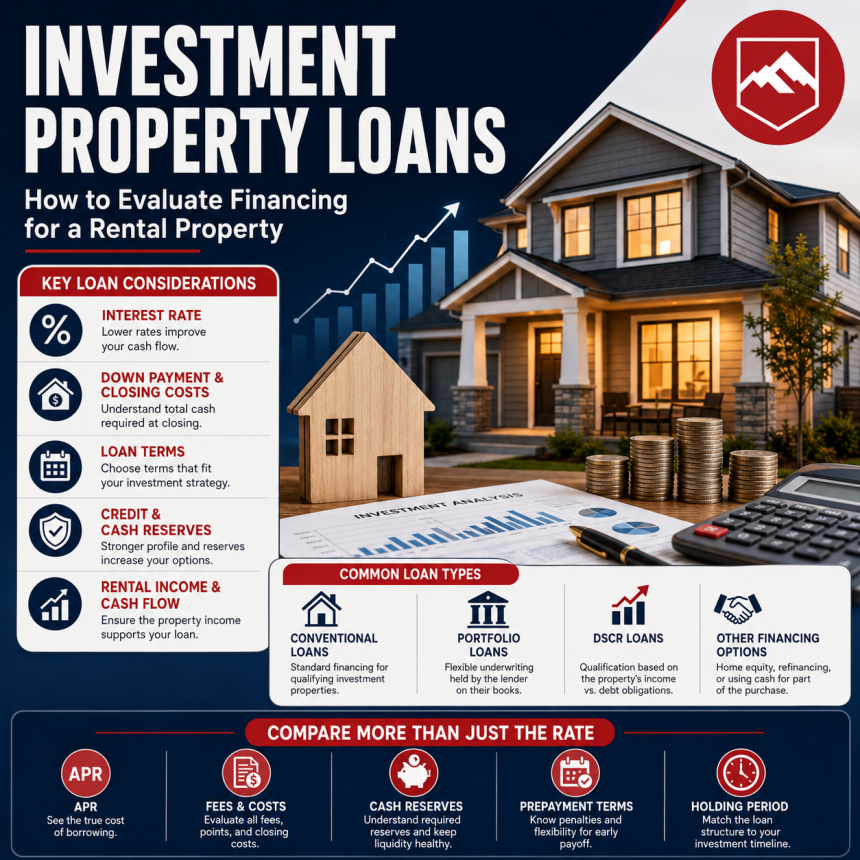

The Changing Landscape of Investment Property Financing in 2026
A practical look at how real estate investors can evaluate investment property financing in 2026, from mortgage rates and loan terms to cash flow, reserves, and the factors that influence the right financing choice.
Buying a rental property can look deceptively simple from the outside. You find a property, estimate the rent, arrange financing, and expect the monthly numbers to work. In practice, financing an investment property can be considerably different from getting a mortgage for a primary residence.
Lenders typically look more closely at the property's expected income, the borrower's existing debts, available cash reserves, credit profile, and experience with real estate. The interest rate and loan structure can also have a meaningful effect on whether a rental property produces positive cash flow or requires additional money each month.
That makes choosing among investment property loans less about finding a universally "best" loan and more about finding financing that fits the property, investment strategy, and borrower's financial position.
What Makes an Investment Property Mortgage Different?
A mortgage on a rental property is generally viewed as a different type of risk than a mortgage on a home you occupy yourself.
With a primary residence, the borrower is usually expected to make the mortgage payment from personal income. With an investment property, the lender may also consider the property's potential rental income, but that income doesn't necessarily eliminate the need to demonstrate sufficient personal income and financial strength.
Investment-property financing can also involve:
• Higher interest rates than owner-occupied mortgages
• Larger down-payment requirements
• Minimum cash-reserve requirements
• More stringent credit and debt-to-income standards
• Restrictions based on property type or number of financed properties
• Different documentation requirements
These factors matter because the mortgage is only one part of an investment property's financial picture. A loan with a slightly lower rate isn't necessarily the right choice if its structure doesn't align with the investor's expected holding period or cash-flow strategy.
Common Types of Investment Property Loans
There isn't one financing product that works for every rental property. Investors in the U.S. may encounter several different approaches depending on the property and their qualifications.
Conventional Investment Property Mortgages :
Conventional mortgages are commonly used for qualifying rental properties. These loans generally require the borrower to meet established standards related to credit, income, assets, debt, and the property itself.
For investors who have strong personal finances and can provide the required documentation, conventional financing can be an important option to compare.
However, borrowers should pay attention to the total cash required at closing, not simply the advertised interest rate. Down payment, closing costs, prepaid expenses, and required reserves can all affect the amount of capital needed to complete the purchase.
Portfolio Loans :
Portfolio lenders may keep loans on their own books rather than selling them into the secondary mortgage market. Because of that, their underwriting criteria can sometimes differ from standardized conventional lending requirements.
Portfolio financing may be considered for properties or borrower situations that don't fit neatly into conventional guidelines. The terms, however, can vary significantly between lenders, so investors should carefully review pricing, fees, repayment terms, and qualification requirements.
DSCR Loans :
Debt Service Coverage Ratio (DSCR) loans are another financing approach used by some real estate investors.
Rather than relying primarily on the borrower's personal income, DSCR underwriting focuses on the relationship between the property's income and its debt obligations. In simplified terms, the lender wants to determine whether the property's projected or actual rental income is sufficient to cover the loan payment and other qualifying expenses.
This can be particularly relevant for investors building a rental portfolio, although eligibility requirements and calculations differ among lenders.
Other Financing Strategies :
Depending on the circumstances, investors may also consider options such as home equity financing, refinancing an existing property, or using cash for part of a purchase.
Each approach has different risks. For example, borrowing against another property can expose that property to additional debt obligations, while paying cash ties up capital that could otherwise be used elsewhere.
The right comparison therefore involves more than asking which loan has the lowest rate.
How to Compare the Best Mortgage for Investment Property
Searches for the best mortgage for investment property often focus heavily on interest rates. While the rate is important, it shouldn't be the only number an investor examines.
A more useful comparison includes:
Interest rate: The rate affects monthly principal and interest payments and the overall cost of borrowing.
Annual percentage rate (APR): APR can provide a broader view of borrowing costs because it incorporates certain fees and charges associated with the loan.
Down payment: A larger down payment can reduce the loan amount, but it also means committing more cash to the property.
Closing costs: Origination charges, appraisal costs, title expenses, prepaid taxes, insurance, and other costs can materially change the amount needed at closing.
Loan term: A 15-year and 30-year mortgage can produce very different monthly payments and interest costs.
Prepayment provisions: Investors who expect to refinance or sell relatively soon should understand whether the loan includes any prepayment penalty or related restrictions.
Reserve requirements: Some investment-property loans require borrowers to maintain a certain amount of liquid assets after closing.
Rental-income treatment: If projected rent is being used in the qualification process, investors should understand how the lender calculates and discounts that income.
Looking at these factors together provides a much clearer picture than comparing interest rates alone.
The Property's Numbers Matter as Much as the Loan
A financing decision shouldn't be separated from the economics of the property.
Before deciding whether a particular mortgage makes sense, investors can build a conservative rental-property analysis that includes expected income and realistic expenses.
Potential expenses may include:
• Mortgage principal and interest
• Property taxes
• Landlord insurance
• Property management
• Repairs and maintenance
• Vacancy
• Utilities paid by the owner
• Homeowners association fees
• Landscaping or other recurring services
• Capital expenditures
• Leasing and turnover costs
For example, a property that appears to generate $2,500 per month in rent shouldn't automatically be treated as producing $2,500 in usable income. Vacancy, repairs, taxes, insurance, management, and other expenses reduce the amount available to service the mortgage and produce a return.
This is especially important when comparing loans. A financing structure that appears attractive on paper may not work well if the property's projected cash flow is already thin.
Credit and Cash Reserves Can Influence Financing
Borrowers often focus on their credit score when preparing for an investment-property purchase, but lenders may consider a much broader financial profile.
Depending on the loan program, factors can include:
• Credit history and score
• Existing mortgage obligations
• Debt-to-income ratio
• Employment or business income
• Liquid assets
• Cash reserves
• Down payment
• Number of properties already owned
• Real estate investment experience
Cash reserves deserve particular attention. Real estate investors can face expenses that aren't predictable from month to month. A vacant property, major repair, insurance increase, or unexpected maintenance issue can create a financial strain even when the property is normally profitable.
Maintaining adequate reserves can therefore be important not only for qualifying for financing but also for managing the property after closing.
Don't Assume the Lowest Rate Is the Cheapest Loan
Suppose two investment-property mortgages have different rates. The lower-rate option might initially appear to be the obvious choice.
But what if it comes with higher upfront fees? Or requires a substantially larger down payment? What if the investor plans to sell or refinance within a few years?
The answer can change depending on the circumstances.
Investors should consider the break-even period when comparing loans with different rates and upfront costs. If one loan costs more initially but reduces monthly payments, the investor can estimate how long it would take for those monthly savings to recover the additional upfront expense.
This type of analysis is especially useful for investors who don't expect to hold a property for the full mortgage term
Investment Property Loans and Different Property Types
The property itself can affect available financing.
A single-family rental may be evaluated differently from a two- to four-unit property, condominium, townhouse, vacation rental, or larger multifamily property. Property condition, occupancy, location, homeowners association requirements, and intended use can also influence underwriting.
Short-term rentals deserve additional consideration. Income from platforms such as Airbnb or Vrbo may be treated differently from traditional long-term lease income, depending on the lender and loan program.
Investors should determine the financing requirements before becoming committed to a particular property. A property that works well operationally may not necessarily fit the requirements of every mortgage program.
A Practical Way to Evaluate Financing
Instead of searching for a single "best" investment-property mortgage, investors can use a consistent process when comparing options.
1. Establish the investment strategy
Determine whether the property is intended for long-term rental income, appreciation, a future sale, or a combination of objectives.
2. Calculate the total cash requirement
Include the down payment, closing costs, prepaid expenses, initial repairs, furnishing if applicable, and post-closing reserves.
3. Analyze conservative rental income
Use realistic rent assumptions rather than the highest advertised rental rate. Account for potential vacancy and changes in market conditions.
4. Compare multiple financing structures
Review rate, APR, term, fees, reserve requirements, amortization, and prepayment provisions.
5. Calculate projected cash flow
Subtract the mortgage payment and realistic operating expenses from expected rental income.
6. Stress-test the investment
Consider what happens if the property sits vacant for several months, repairs cost more than expected, property taxes increase, or rents decline.
7. Review the loan documents carefully
Before closing, borrowers should understand the actual terms of the financing rather than relying solely on an initial quote or online estimate.
Questions Investors Should Ask Before Choosing a Loan
A few straightforward questions can uncover important differences between financing options:
• How much cash will be required at closing?
• What reserves must remain after closing?
• How is rental income calculated for qualification?
• Are there restrictions on the number of financed properties?
• Is the interest rate fixed or adjustable?
• Are there points or lender credits?
• Is there a prepayment penalty?
• What property types qualify?
• How are closing costs calculated?
• What happens if the property is vacant?
• How does the loan fit the expected holding period?
Getting clear answers to these questions can make loan comparisons considerably more meaningful.
The Right Mortgage Depends on the Investment, Not Just the Rate
There is no single mortgage that can accurately be called the best investment-property loan for every U.S. investor. The appropriate financing depends on the borrower's financial position, the property's expected performance, available capital, investment horizon, and tolerance for risk.
For someone researching investment property loans, the goal should be to understand the complete cost and structure of the financing rather than simply searching for the lowest advertised rate. Likewise, finding the best mortgage for investment property requires comparing the loan against the actual economics of the property.
Real estate investing works best when the financing decision is made as part of the broader investment analysis. A mortgage should support the property's numbers—not be the reason the numbers appear to work.
NBA 2K27 Set and Fire Guide for Spot-Up Shooters by U4gm
Set and Fire rewards patient perimeter shooting in NBA 2K27, giving a boost to three-point...

Revolutionizing Powder Handling: The Complete Guide to Powder Transfer...
<p>Powder transfer bags have emerged as a critical component in contemporary industrial ma...