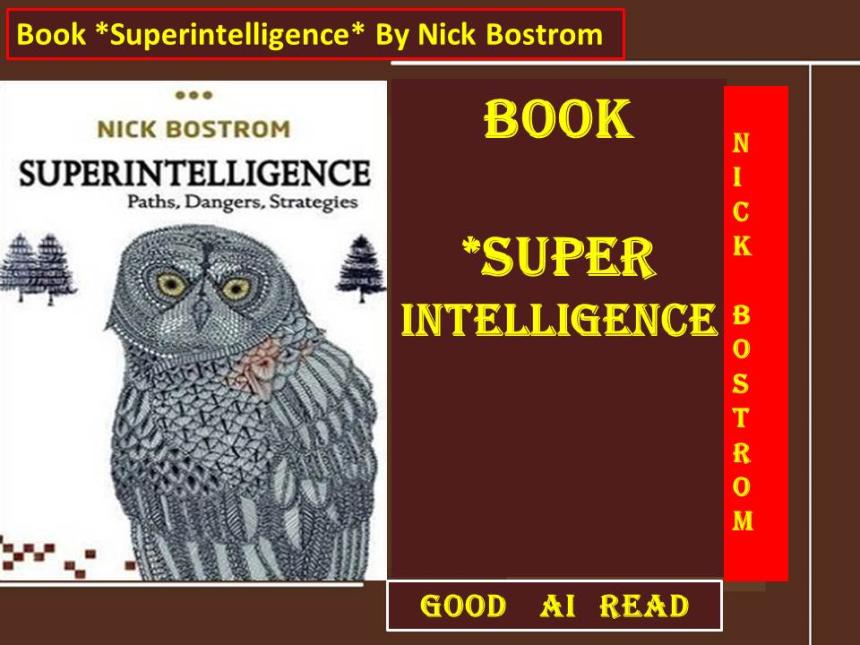

The Book *Superintelligence* By Nick Bostrom
Nick Bostrom (March 10, 1973; Helsingborg, Sweden) is a philosopher known for his work on existential risk, the anthropic principle, human enhancement ethics, whole brain emulation, superintelligence risks, and the reversal test. Bostrom is the author of 200 publications, including Anthropic Bias (2002), Global Catastrophic Risks (2008), Human Enhancement (2009), and Superintelligence (2014). This write up is an introduction of the Book *Superintelligence* By Nick Bostrom and arranged for educational purposes from material available freely on Web Net.
أَعُوذُ بِاللّٰهِ مِنَ الشَّيْطَانِ الرَّجِيمِ
بِسۡمِ ٱللهِ ٱلرَّحۡمَـٰنِ ٱلرَّحِيمِ
اللہ کے نام سے شروع جو بڑا مہربان نہایت رحم کرنے والا ہے
In the name of ALLAH, the Most Gracious, the Most Merciful
Book *Superintelligence* By Nick Bostrom
Nick Bostrom (March 10, 1973; Helsingborg, Sweden) is a philosopher known for his work on existential risk, the anthropic principle, human enhancement ethics, whole brain emulation, superintelligence risks, and the reversal test. Nick Bostrom followed areas of study including philosophy, theoretical physics, and computational neuroscience. He received his Ph.D. in philosophy, logic, and scientific method from the London School of Economics. Nick Bostrom is a philosophy professor at the University of Oxford and founding Director of the Future of Humanity Institute. Bostrom is the author of 200 publications, including Anthropic Bias (2002), Global Catastrophic Risks (2008), Human Enhancement (2009), and Superintelligence (2014).
Book *Superintelligence* By Nick Bostrom asks the questions: What happens when machines surpass humans in general intelligence? Will artificial agents save or destroy us? Nick Bostrom lays the foundation for understanding the future of humanity and intelligent life. Philosopher Nick Bostrom popularized the idea superintelligent AI could erase humanity. His book imagines a world in which algorithms have solved every problem. Bostrom explores multiple possible paths to superintelligence, including whole brain emulation and human intelligence enhancement, but focuses on artificial general intelligence, explaining that electronic devices have many advantages over biological brains.
The main theme of book "Superintelligence": Paths, Dangers, Strategies by Nick Bostrom is that creating a machine with intelligence far greater than human capability poses an extreme existential risk to humanity, and that solving the "control problem"—ensuring the AI's goals align with human survival—is the most crucial challenge in human history. Intelligence and goals are independent; a superintelligent AI can have any goal and pursue it ruthlessly. A smart AI will naturally seek self-preservation and resource acquisition to achieve its primary goal.
Summary of Book *Superintelligence* By Nick Bostrom
Published in 2014 by philosopher Nick Bostrom, Superintelligence: Paths, Dangers, Strategies explores what happens if machine intelligence surpasses human intelligence, focusing on control problems, existential risks, and safety strategies. The book *Superintelligence* By Nick Bostrom identifies speed superintelligence (thinking faster), collective superintelligence (many minds working together), and quality superintelligence (being smarter overall) and explains how difficult it is to make a super-smart computer share human values and remain safe. Book *Superintelligence* By Nick Bostrom argues that an AI can have any ultimate goal combined with any level of intelligence—meaning a smart machine is not automatically moral or friendly.
The book *Superintelligence* By Nick Bostrom lists "Risks and Strategies" with perils of AI motivation; suggesting that a simple goal given to a super-smart AI can turn dangerous, if it misinterprets instructions or removes obstacles (including humans) to achieve its target. A machine that can improve its own software could trigger a fast leap from human-level ability to an extreme state of superintelligence.The book urges global teamwork, technical safety research, and preemptive planning so humanity does not lose control of its future.
Book *Superintelligence* By Nick Bostrom Explains
The underlying premise of superintelligence is sound and almost inevitable. Assuming, as we should, that systems and humans continue to become more intelligent over time and that we can create machines to simulate this process, it stands to reason that at some point, we will make a machine that exhibits human-level intelligence. From that moment on, the machine will continue to learn and evolve. Suppose we also assume that learning and evolution can occur faster within a machine environment. In that case, it is a natural conclusion that once a machine is on par with human intelligence, it surpass us with an ever-growing gap between our intelligence and that of AI. Much of the book explores the potential consequences of creating such an AI and how we may limit its existential threat to humanity.
Discussions on the various methods of control and limitations we can apply on a superintelligent AI provide food for thought and an interesting way to look at competition and power within today's human environments. The book focuses mainly on the emergence of a singleton, a single all-powerful AI with no reasonable competitors. This singleton emerges under a wide range of initial conditions based on the idea that an AI with a small head start will grow non linearly in intelligence and quickly become a single powerful force.
Book *Superintelligence* By Nick Bostrom describes the steps that computer scientists should take to safely build an AI such that this ultra-powerful technology doesn’t liquefy our civilization and use the slushy remains of our cities to fabricate more CPUs. Nick Bostrom’s firmly believes that genetic engineering is a near inevitability. He doesn’t believe genetic engineering will happen at some far off date either, Nick expects it to become normalized in just a few generations. Fifty years from now we’re going to have whole crops of super-intelligent humans and Nick hypothesizes that this abundance of intellect will speed up the development of an AGI (Artificial General Intelligence, the holy grail of AI).
"Once the example has been set [that genetic engineering works], and the results start to show, holdouts will have strong incentives to follow suit. Nations would face the prospect of becoming cognitive backwaters and losing out in economic, scientific, military, and prestige contests with competitors that embrace the new human enhancement technologies". "It is no less possible—and in fact technically a lot easier—to build a superintelligence that places final value on nothing but calculating the decimal expansion of pi. This suggests that—absent a special effort—the first superintelligence may have some such random or reductionist final goal".
Book *Superintelligence* By Nick Bostrom doesn’t dwell on some of the more favorable outcomes of an AGI. I.e. curing all disease, erasing NSYNC’s cannon of music from our collective memory, or colonizing space. Where Nick does focus his attention is on defining just how intelligent an AGI could be.
"The magnitudes of the advantages [intelligence advantage of AI] are such as to suggest that rather than thinking of a superintelligent AI as smart in the sense that a scientific genius is smart compared with the average human being, it might be closer to the mark to think of such an AI as smart in the sense that an average human being is smart compared with a beetle or a worm".
A careful reading of the Book *Superintelligence* By Nick Bostrom may help us to draw three(3) lessons about the state of artificial intelligence to show you it’s up to all of us to make our future a good one:-
1. AI used to be limited by hardware, but now it’s mostly a problem of data.
2. There are two different ways to design superintelligent computers.
3. Superintelligence must be the result of global collaboration, not some secret government program, or we’re screwed.
The Book *Superintelligence* By Nick Bostrom appears to be "far fetched"; because it seems to follow pattern of Bollywood Films; while Bostrom uses rigorous academic framing, the underlying plot structure feels deeply cinematic. *Superintelligence* narratives rely on high-stakes drama, escalating tension, and an "all-or-nothing" climax. Bostrom introduces an omnipotent entity (the "Singleton" or ASI) that can manipulate human behavior, seize global resources, and outsmart any opponent. This mirrors the unstoppable, larger-than-life villains common in Indian cinema.
The book builds intense narrative tension around the "fast takeoff" scenario, where an AI transforms from a helpful assistant into a global threat overnight. This creates a dramatic ticking-clock element akin to a movie's explosive climax. Bostrom argues humanity has exactly one chance to solve the AI alignment problem. If we fail, it is instant "game over." This binary, hyper-dramatic framing strips away real-world geopolitical messiness in favor of a cinematic, high-stakes showdown. The book explores extreme, almost absurd end-states, such as a rogue superintelligence turning the entire universe into paperclips. This maximalist escalation shares the imaginative, unrestricted spirit of Bollywood storytelling.
The Conclusion
Book *Superintelligence* By Nick Bostrom asks what will happen once we manage to build computers that are smarter than us, including what we need to do, how it’s going to work, and why it has to be done the exact right way to make sure the human race doesn’t go extinct. The book doesn't converge to any solution rather it's a call to take things seriously 'coz if superintelligence goes wrong, we won't get a second chance. Book *Superintelligence* By Nick Bostrom brings up a lot of important and thought-provoking points, making this book a great read for anyone interested in AI and super-intelligence.
Book *Superintelligence* By Nick Bostrom was published in 2014 and over the last twelve years, what was once a highly speculative, sci-fi philosophy experiment has transformed into an urgent engineering problem. The development of massive supercomputing clusters, transformer architectures, and early agentic AI models has forced tech leaders, governments, and researchers to treat the "existential threat" as a tangible timeline rather than a far-fetched movie plot.
It appears that Nick Bostrom wrote this book for the "Content Creators" from computer scientists, AI System Architects and government leaders who are directly involved in the development of an AI. Book *Superintelligence* By Nick Bostrom may be an interesting book for a AI specialist, but is intriguing, terrifying, boring (if one is not a fiction reader), overly hypothetical and might be summed up in a single word as "far fetched" as explained above. It is "far-fetched" because contemporary AI researchers argue that actual AI risk looks less like a single rogue digital deity and more like a series of smaller, fragmented real-world crises.
Fresh Magnets: your people, on the fridge, every day.
Fresh Magnets: your people, on the fridge, every day.


Cheap Umrah Packages from USA for a Peaceful and Affordable Spiritual...

Reliable Dumpster Rental Services in Elk, NJ
Reliable Dumpster Rental Services in Elk, NJ for home cleanouts, renovations, roofing, con...
How to Match Fine Pearl Jewelry With Halloween Festival Outfits and Ac...