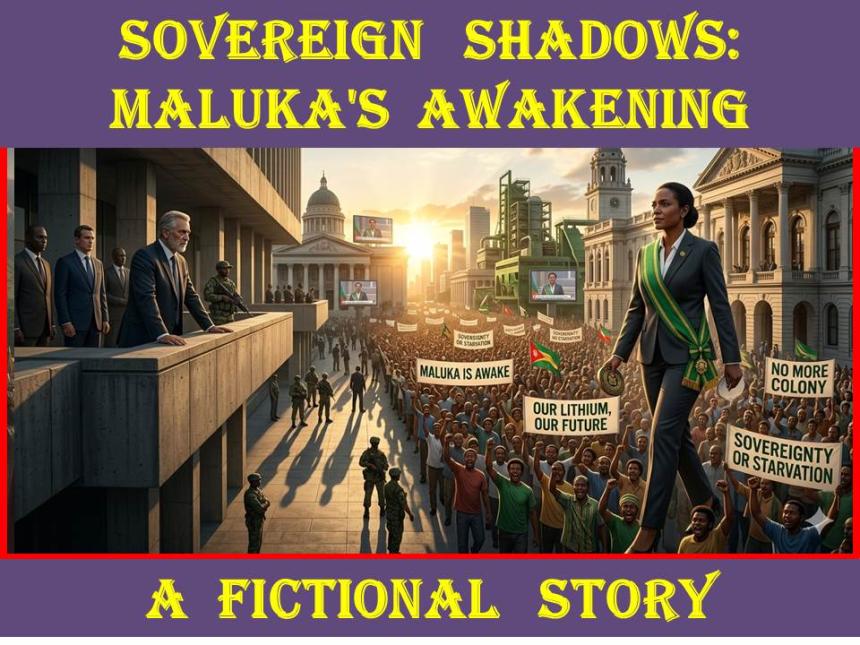

Sovereign Shadows: Maluka's Awakening
The Law of the Run is the ultimate law of national survival: to cease fighting is to forfeit your country. The jungle of global statecraft demands the unyielding spirit of a people to escape the vulture. The modern arena does not threaten a nation with claws, but with structural adjustment traps, engineered collapses, and financial servitude. This "Sovereign Shadows: Maluka's Awakening" is a fiction story arranged with the help of AI and told for the purpose of education and motivation for survival in the fast paced life.
أَعُوذُ بِاللّٰهِ مِنَ الشَّيْطَانِ الرَّجِيمِ
بِسۡمِ ٱللهِ ٱلرَّحۡمَـٰنِ ٱلرَّحِيمِ
In the name of ALLAH, the Most Gracious, the Most Merciful
Sovereign Shadows: Maluka's Awakening
The Law of the Run is the ultimate law of national survival: to cease fighting is to forfeit your country. Where the wild wilderness demanded the speed of the flesh to escape the beast, the jungle of global statecraft demands the unyielding spirit of a people to escape the vulture. The modern arena does not threaten a nation with claws, but with structural adjustment traps, engineered collapses, and financial servitude. To survive, a state must run faster than the mechanisms of foreign exploitation. True democracy demands a relentless sprint for sovereign honor, generational progress, and absolute self-governance—because a nation that waits for outside permission is already a colony in disguise. Let’s read the following story generated with AI for consumption of the concept:-
The Great Ergs of the Sahara
The sun did not rise over the eastern dunes of the Sahara; it detonated. One moment the desert was a bruised violet, cold as flint; the next, a blinding, liquid gold spilled across the crests of the sand.
A slender-horned gazelle named Kael shifted his weight. His ribs pulsed beneath a pale coat that mirrored the sand. He licked a microscopic film of morning dew from a brittle tuft of desert grass, his dark eyes scanning the shifting horizon. Kael did not need a clock to know the rule of the sands. His muscles hummed with a singular, inherited truth: Run. This was a primal mathematics. A single mistake meant the absolute end of his physical existence.
A mile away, shifting out of the shadow of a weathered sandstone outcrop, a maned lion named Zampa stretched. His belly was flat, hollowed out by three days of failed stalks. Every ribs-to-spine alignment in his massive frame screamed for sustenance. Zampa looked at the horizon, his amber eyes settling on the faint, distant tremor of movement. He felt no malice, nor did Kael feel hatred. This was a binary world: hunger or survival, blood or breath.
Zampa coiled, his pads testing the loose gravel, before exploding into a forward charge. Kael’s ears pinned back. The dust kicked up behind them in symmetrical plumes. The desert floor became a blur of friction. Zampa lunged, his claws missing Kael’s flank by inches, but Kael pivoted on a dime, throwing himself up an impossible dune. Zampa scrambled, lost his traction in the loose powder, and slid down, his lungs burning with dust.
Kael did not look back to celebrate. Zampa did not stop to mourn. Their stakes were simple, heavy, and absolute: nourish the body, or save the flesh. As the sun began its descent, the chase cooled. In the wilderness, darkness brought a fragile truce of exhaustion; both predator and prey surrendered to the night to rest, waiting for the safety of the next dawn to run again.
The Emerald Canopies of the Ituri Jungle
Centuries or seconds later, the world shifted, drowning the sand in an ocean of suffocating green. The heat remained, but it was thick now, wet and heavy with the scent of damp moss and decaying wood.
A sleek black leopard named Kira crouched on a damp, massive branch sixty feet above the jungle floor. Below her, the canopy was dense, a chaotic web of lianas. The open field of the desert was gone; survival here was a matter of vertical agility. Like the desert, the jungle operated on pure biology. The predator hunted to keep its heart beating; the prey fled to keep its pulse from stopping. There was no ego in the canopy, no complex morality beneath the ferns.
Through the undergrowth beneath her, an agile bongo antelope navigated the maze of roots. Kira tightened her hindquarters and dropped from the branch like a falling stone.
The bongo caught the shadow a millisecond before the strike, twisting its body through a narrow gap between two colossal mahogany trees. Kira hit the muddy floor, rolled instantly, and leaped after it, bounding over fallen logs. The jungle tore at their skin. Sharp thorns drew blood, but to stop was to slide backward into death. They ran for the most basic right on earth: the right to exist for one more day. When night choked out the remaining slivers of daylight, the forest grew heavy with a quiet, tense stillness. The biological clock demanded a pause. The hunt was tethered to the cycle of the sun.
The Canyons of Concrete and Glass
The roar of the jungle morphed into the screech of motorcades, the rhythmic chanting of protesting crowds, and the constant digital hum of global statecraft. The green and gold dissolved into the imposing neoclassical government ministries and heavily fortified presidential palaces of a megacity in the Global South—the ultimate jungle of human power.
In this concrete wilderness, old fables found entirely new teeth. Decades prior, a 1985 issue of The Economist magazine had perfectly prophesied the spirit of this place, introducing a text that would echo through modern folklore:
"Every morning in Africa, a gazelle wakes up. It knows it must run faster than the fastest lion or it will be killed. Every morning a lion wakes up. It knows it must outrun the slowest gazelle or it will starve to death. It doesn't matter whether you are a lion or a gazelle—when the sun comes up, you'd better be running."
Here, the sun rose over a horizon fractured by sprawling shantytowns and gleaming diplomatic enclaves, casting long, sharp shadows across the militarized avenues below. But as the physical threat of teeth and claws receded, the nature of the hunt underwent a terrifying evolution. In this geopolitical arena, survival was no longer just a matter of blood or finance; it was sovereign honor, systemic dignity, and national respect on the line. The weapons were invisible—sanctions, media campaigns, and deep-state leverage—and the wounds cut deeper than flesh.
Salina, the prime minister of the rising global south country, Maluka (till yesterday better known as a banana republic), stepped out of her armored vehicle into the humid morning air of the Capital District, surrounded by military guards. She gripped her briefing portfolio tightly, her mind fixed on the newly independent, resource-rich democratic coalition she had spent years building as a reformist Prime Minister (she faced challenges from ruling elite-the western masters' puppets).
Across the grand plaza, looking down from the heavily guarded balconies of the Central Bank, Arthur watched. He was a veteran regional autocrat and a shadow kingmaker (backed by hidden hands of the western fund managers), a titan who had built his empire by devouring smaller factions, orchestrating coups, and capitalizing on state debt. During the daylight hours, they played by the public rules of international diplomacy—structured summits, bilateral treaties, and calculated state dinners.
But unlike the Sahara or the Ituri, the jungle of global governance never sleeps. In this world, the setting of the sun does not signal a truce; it simply changes the color of the blood. In the digital age, when life goes on round the clock (24/7) and breaking news is transmitted instantly across the globe by electronic media, social networks, and web resources, the chase is relentless. The infrastructure of modern conflict is global and awake at every hour. Push notifications, scrolling tickers, and emergency midnight broadsheets flood the airwaves. This hyper-connected reality weaponizes information in real time, turning the public square into a psychological battlefield that doesn't allow even the common man a decent night’s sleep. The entire population is dragged into the arena, restless and hyper-vigilant, waiting to see who falls by dawn.
When the streetlamps flickered to life and the state palaces glowed against the dark sky, the true modern hunt began. The daytime diplomatic protocols dissolved. Under the cover of heavy drapes in embassy backrooms, over quiet military briefings, and through encrypted midnight intelligence servers, the titans and the mighty preyed on one another without mercy.
At 2:00 AM, Salina sat in a dimly lit emergency ministry cabinet room, her eyes bloodshot, staring at a predatory, structurally adjusting sovereign debt and restructuring agreement pushed across the table by Arthur’s foreign proxies. It was an ambush timed for when the human spirit is weakest. At this hour, sovereign resources and national honor changed hands in whispers. Dignity was no longer a public shield; it was a currency traded away in desperate backroom compromises under threat of an engineered economic collapse. Arthur, blocks away in his intelligence command center, tracked global currency markets on flashing monitors, launching a midnight currency-shorting campaign to artificially devalue Salina's national reserve before the international markets opened.
In this neon-lit wilderness of statecraft, the night did not offer rest—it offered a cloaked venue for absolute geopolitical destruction. Here, national respect was stripped away in the dark, and reformist administrations were assassinated politically before the dawn could even break.
The clock struck midnight. The red and blue police lights bled into the wet streets. And nobody was waiting for permission.
The Breaking Dawn
The emergency sirens of the city did not fade; they were slowly washed away by a cold, gray fog creeping in from the national harbor. At 5:30 AM, the mirrored windows of the towering government ministries began to catch the first pale, horizontal slivers of the morning sun. The bureaucratic canyon was silent for a fleeting fraction of an hour—the exact moment where the night predators retreated and the day runners laced their shoes.
Inside the executive briefing room, the air tasted of stale espresso, gunpowder residue from distant perimeter checkpoints, and quiet desperation.
Salina stood by the floor-to-ceiling window, looking out at the waking capital of Maluka. Her blazer was draped over a chair, her sleeves rolled up, her hair slightly unraveled. On the polished mahogany table behind her lay the final, unsigned structural adjustment treaty. Beside it sat a fountain pen, its cap removed.
For three hours, Arthur’s diplomats and deep-state operatives had used every geopolitical lever in their arsenal. They threatened to trigger coordinated civil unrest by morning. They promised to dry up international development loans. They offered her a massive, multi-million-dollar offshore payout—a golden exile that would make her wealthy beyond imagination, on one condition: she had to sign over her country's lithium and rare-earth mineral rights, step down publicly, and sign a transition clause that would legally hand over control to a puppet military junta.
They wanted to buy her sovereign silence. They wanted to consume Maluka's hard-won legacy and hand it back to the Western-backed ruling elites.
Salina looked down at the paper. The amount of personal safety on the page was staggering. It was enough to buy a lifetime of protection in Switzerland. But as she stared at the high-stakes pressure of the document, the old lines she had read years ago echoed fiercely in her mind, etched deeply into her psyche: Every morning in Africa, a gazelle wakes up... It doesn't matter whether you are a lion or a gazelle—when the sun comes up, you'd better be running.
The quote was no longer just text on a page; it was her very baseline for national survival. The gazelle doesn't bargain with the lion; it outruns it. In this room, her life wasn't her beating heart—it was her nation's sovereign dignity. If she signed, Maluka would slide straight back into being the banana republic it once was, and she would walk out a wealthy exile, but a traitor to the Global South.
She picked up the fountain pen. The foreign operatives leaned forward, expecting the capitulation.
Instead, Salina capped the pen, slid it into her pocket, and picked up her sovereign seal. She looked the lead foreign envoy dead in the eye.
"Tell Arthur that if he wants to break this republic, he is going to have to spend his own blood and reputation to do it," Salina said, her voice steady, devoid of fear.
"I was elected by the people of this soil, not by his Western fund managers. The international community knows my mandate, and they know our strength. Let him short our currency."
She walked out of the briefing room, her heels clicking sharply against the marble floor of the palace. She was the democratically elected Prime Minister of her country, and it had taken her immense effort, grassroots mobilization, and a brutal electoral campaign to finally form a government in the state of Maluka. She had entered office with a singular, unyielding purpose: to fundamentally change the fate of her nation and break the shackles of generational exploitation. She decided she would not fight this midnight ambush in the shadows; she would speak directly to the people. The grandest and best platform available to her was the National Assembly.
As the early morning sun flooded through the stained-glass windows of the parliament building, she took the floor. The galleries were packed, the air thick with tension. Standing before the assembly, she addressed the speaker of the house, her voice echoing through the chamber and carrying instantly over the live digital broadcast networks:-
"My dear Speaker, and my beloved nation! There is a battle raging right now between the beast that takes away our resources and the poor countrymen who toil all day long just to earn their bread and butter. My job—the mandate given to me by the blood and sweat of this soil—is to protect our people and our country from all the vultures and predators lurking both outside and inside our borders. I know that they are incredibly powerful. I know they have the leverage to try and force me out of this position. But while they might manipulate a system, how can they ever out-spirit the soul of my nation? We will fight the devil. We will snatch back our sovereignty and our freedom. We will make decisions for our own future—at all costs!"
Down in his command center, Arthur sat before his banks of glowing monitors, surrounded by the flashing red indicators of the global markets. Suddenly, a high-priority notification flashed across his screen from his intelligence operatives on the ground:
Target refused to sign. She walked away and is now speaking live in the National Assembly. Cellular traffic spiking nationwide—citizens are abandoning all affairs, closing shops, and turning on every screen with immense zeal and zest to listen to her address. Public sentiment is shifting dynamically.
Arthur looked out at the city, now fully illuminated by the morning sun. The streets below were no longer just moving in compliance; they were surging with citizens inspired by her words—thousands of working-class souls stepping off buses, gathering around radios, united in a collective refusal to be preyed upon anymore. They were marching in the streets and roads, raising slogans against the predators' club of Western fund managers and hidden hands controlling their finance and resources, loudly demanding that these assets be taken under government control. The message roaring from the asphalt up to his balcony was deafeningly clear: foreign investment is a blessing, but foreign interference in national governance and financial management will not be supported.
Arthur stared at the live video feed of Salina commanding the parliament floor, then down at the sea of people moving in absolute unison. For a second, a flicker of ancient, primal fury crossed his face. But then, as the audio of her voice filled his command room—backed by the roaring applause of the assembly, the thunderous chants from the streets, and the rising digital tide of a mobilized population—his expression shifted. A slow, grim smile tugged at the corner of his mouth.
He had spent decades devouring post-colonial leaders who broke under midnight threats, feeding the pockets of his offshore puppet masters. He had surrounded himself with corrupt dictators and terrified dependents. But Salina hadn't broken. She had looked at the ultimate regional kingmaker, refused to surrender her nation's dignity, and chosen to fight him in the broad daylight of the democratic floor. She had preserved her honor, and in doing so, she had earned something Arthur rarely gave anyone: absolute respect.
"Sir?" his chief of staff asked over the secure line, his voice shaking as the digital news tickers began to turn violently against them.
"The Western fund managers are panicking. Do we initiate the 9:00 AM destabilization protocol? The markets are reacting to her speech."
"No," Arthur said quietly, closing the economic warfare dashboard.
"Cancel the protocol. Call the regional development bank. Tell them we are bypassing the Western funds and backing her infrastructure coalition ourselves. At her original sovereignty terms."
He stood up, adjusting his ceremonial lapel pins, his own hunger temporarily satisfied not by a conquest, but by the thrill of an unbreakable opponent.
Salina stepped out into the crisp, dawn air of the parliament plaza. The sun hit her face, warm and blindingly bright. Her state budget was exposed, her administration was still in the crosshairs of global powers, and the day ahead would be a brutal, public battle against the old ruling elites. But as she inhaled the morning air, she heard the cheers of the crowds gathering outside the gates. Maluka was still theirs. Her dignity was intact.
The sun was up. The savanna of geopolitical struggle was alive. And she was already running.
The Confluence of Titans
The 9:00 PM reservation at The Horizon Summit Room was no longer a platform for an ultimatum; it was a baseline for an historic restructuring. Located on the restricted top floor of the Capital District's highest neutral tower, the hall offered a panoramic view of the glowing metropolis below. In the wild, a lion like Zampa would never sit across a table from a gazelle like Kael to negotiate a treaty. Nature dictated that one must break for the other to survive.
But the human jungle possessed an evolutionary trait unknown to the Sahara or the Ituri: the strategic realignment. Here, the ultimate hegemon and the unyielding reformist could recognize each other's strength, redefine the hunt, and combine to form a completely new geopolitical titan.
Salina sat at the secure table, her posture flawless. She wore a tailored traditional sash over her charcoal suit, her expression unreadable. She had spent the day riding the wave of public fervor, stabilizing the domestic banks, and preparing the state apparatus for a prolonged siege. Instead of an economic declaration of war, she had received a formal diplomatic summons from Arthur.
The heavy mahogany doors slid open, and Arthur walked in. He didn't move with the frantic haste of the panicked Western diplomats or the fleeing local puppet elites. He moved with the slow, heavy stride of a statesman who knew how to pivot when the ground shifted beneath his feet. He sat down opposite her, signaled his security detail to clear the room, and waited until two glasses of local tea were poured before speaking.
"You didn't bend," Arthur said, his voice a low, gravelly baritone.
"I don't sign away the sovereignty of my people," Salina replied smoothly, meeting his gaze without flinching.
"Especially not when a gun is pointed at Maluka under the cover of night."
Arthur let out a short, appreciative chuckle.
"Most leaders mistake the night for a hiding place. They think because the Western markets are asleep, the rules disappear. They forget that some of us see perfectly well in the dark. My Western fund managers expected you to take the money and flee to Europe."
"Then they miscalculated the value of what I represent," Salina said, leaning forward.
"My administration isn't just a political party, Arthur. It’s the awakening of an entire nation. You can manipulate our currency, you can freeze our foreign assets, but you cannot buy our honor. If you try to colonize our economy, the fire on those streets will bleed your resources dry."
"Maluka will no longer be a banana republic," Salina continued, her voice ringing with the absolute authority of the mandate she had just claimed in the National Assembly.
"We have learned what it means to live as a true nation—with our own sovereignty and our own financial control. From this day forward, Maluka will use its vast resources first to provide basic necessities, healthcare, education, and better living standards to our own citizens. We are closing the chapter of exploitation."
Arthur looked at her for a long moment, the amber glow of the city lights reflecting in his eyes—a look remarkably similar to the one Zampa possessed when calculating an entirely new pursuit.
"And what of my investors?" Arthur asked, his eyes narrowing, though his tone lacked its previous hostility.
"The capital needs to move, Salina."
"We are not closing our doors to the world," Salina replied, sliding a revised framework document across the dark marble table.
"We will allow foreign investors rightful, lucrative business opportunities. But it will be on our terms. We are raising our engineering standards across the board. We will not export raw, unrefined dirt to enrich offshore banks. Foreign capital is welcome, but only if it invests in setting up state-of-the-art domestic plants for the extraction, refining, and processing of our minerals right here on Malukan soil. You provide the technology and the capital; we provide the resources, the labor, and the sovereignty. Investment is a blessing, but interference in our governance is dead."
Arthur looked down at the folder. He opened it, her eyes scanning the geopolitical and engineering terms. It was clean. It was fair. It didn't strip Maluka of its honor; it guaranteed structural development while offering his capital a protected, legitimate return. He wasn't conquering a territory; he was partnering with an emerging titan.
In the animal kingdom, the chase always ends in a feast or an escape. But in the cosmopolitan jungle of international politics, the greatest leaders don't destroy their rivals—they absorb their strength. They play a larger, more calculated game of combined regional dominance.
Arthur closed the folder and raised his glass.
"To a sovereign Maluka. And to the new engineering of the South."
Salina clinked her glass against his, the sound ringing clearly against the quiet hum of the high-security room.
"To the run."
Outside the glass, the borders of Maluka stretched out like an endless plain of electricity and unexploited potential. The old ruling elites had been sidelined, the Western puppet masters outmaneuvered, and a new economic blueprint had just been born.
For true democracy is about a government of the people, for the people, and by the people. Its truest essence lies in the well-being, dignity, and progress of the nation across all sections and fields of life—ensuring that the fruits of the soil belong to the hands that toil upon it.
The Sovereign Symphony
The desert sands are quiet now under the silent night,
The hunter's ancient tracks are gone, wiped out of public sight.
The jungle canopy grows dark, the heavy branches weep,
While primal beasts of tooth and claw surrender to their sleep.
For nature keeps a steady watch on setting of the sun,
The wild predator relents when daylight hours are done.
But turn your eyes to concrete walls, to canyons made of stone,
Where laws of chase have transformed, where corporate seeds were sown.
Where sharp, invisible daggers hide within a legal brief,
And foreign vultures try to bring a sovereign land to grief.
No twilight brings a healing truce to this contested ground;
Through 24/7 news, the midnight plots are found.
The digital age broadcasts the hunt across the global net,
A restless, hyper-connected world that has not rested yet.
But Maluka has broken chains, its people have awake,
Refusing to be preyed upon or bend for master's sake.
No longer called a colony, or titled "poor and small,"
The democratic mandate stands to benefit them all.
For government of the people rises from the dusty floor,
For public well-being and growth, they slam the tyrant’s door.
A rightful trade is offered now to those who wish to build,
With engineered refineries and sovereign promises fulfilled.
The extraction serves the country first, from plaza to the slum,
Progress across all walks of life ensures the wolves are dumb.
The treaty's signed, the alliance forms, the new horizons gleam,
The lion and gazelle unite to guard a nation's dream.
The Western fund managers retreat, their hidden hands have failed,
Before a fierce reformist soul, true justice has prevailed.
The morning sky is bleeding bright, the shadows slip away,
Leave permissions and your fear.
The sun is up.
Run the day.


TR88 Explained: A Beginner-Friendly Guide to Common Online Gaming Term...

MG Poster Paper Price Trend Q3 2026 | Global Price Trends, Forecast, C...


GO8 and the Evolution of Online Gaming: From Simple Pastimes to Digita...
