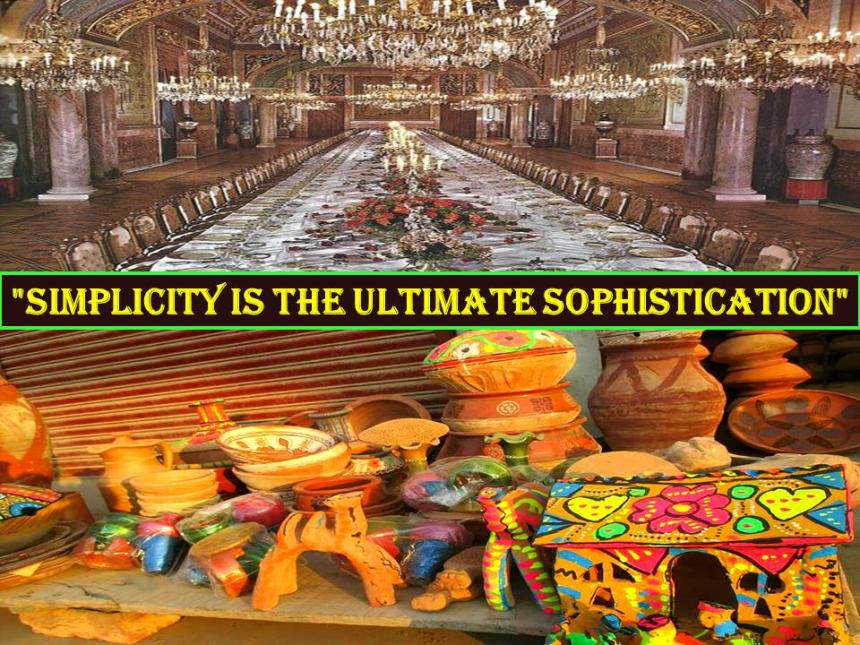

"Simplicity is the Ultimate Sophistication"
'An honest man's the noble work of God'..." is the line from Poet Robert Burns. There is a well-known verse from Mirza Asadullah Khan Ghalib having deep meanings and carries loud message for an individual and a for any nation when read with another verse of Allama Muhammad Iqbal. This write up "Simplicity is the Ultimate Sophistication" is discussing the concept and message contained wrt the auspicious Independence Day of Pakistan.
أَعُوذُ بِاللّٰهِ مِنَ الشَّيْطَانِ الرَّجِيمِ
بِسۡمِ ٱللهِ ٱلرَّحۡمَـٰنِ ٱلرَّحِيمِ
In the name of ALLAH, the Most Gracious, the Most Merciful
“Simplicity is the Ultimate Sophistication”
"Princes and lords are but the breath of kings,
'An honest man's the noble work of God'..."
The above are the lines from Poet Robert Burns ( the national poet of Scotland) taken from the poem "The Cotter's Saturday Night"; he wrote extensively about how the simple, honest lifestyle of a peasant is superior to the luxury of lords and kings. Similarly, another great name of English language William Shakespeare has also said the following in a play "Henry VIII":-
"Tis better to be lowly born,
And range with humble livers in content,
Than to be perk'd up in a glistering grief,
And wear a golden sorrow."
(Meaning: It is better to be born poor and live happily in simplicity than to be dressed up in sparkling misery and wear a golden crown of sadness).
One more famous English poet Thomas Gray rendered a poem titled "Country Churchyard" and has rendered a famous stanza; reminding us that the grandeur of royalty and wealth is ultimately meaningless compared to simple virtues:-
"The boast of heraldry, the pomp of pow'r,
And all that beauty, all that wealth e'er gave,
Awaits alike th' inevitable hour.
The paths of glory lead but to the grave."
(Meaning: Royal titles, power, beauty, and wealth mean nothing in the end; simplicity is more honest because everyone meets the same end).
William Collins in a poem titled "Ode to Simplicity", personifies simplicity as a beautiful goddess and explicitly praises it over royal attire:-
"Though taste, though genius bless to some degree,
They're powerless lines without simplicity."
The main purpose of this write up is to discuss some poetic lines from famous Urdu poets namely Mirza Asadullah Khan Ghalib and Allama Muhammad Iqbal. There is a famous line from Ghalib (جامِ جم سے میرا جامِ سفال اچھا ہے) and in the following we will discuss the concept and explain the meanings for an individual and a nation wrt to poetic work of Iqbal.
"My humble earthen cup is better than the Cup of Jam."
This well-known hemistich comes from a verse in a beautiful ghazal by Mirza Asadullah Khan Ghalib. In this line, Mirza Ghalib presents a comparison between two extremes: the *Jam-e-Jam* (the Cup of Jamshid) and the *Jam-e-Sufal* (an earthen cup). The *Jam-e-Jam*—or *Saghar-e-Jam*—is associated with Jamshid, the renowned and legendary fourth monarch of ancient Iran's Pishdadian dynasty. According to Ferdowsi’s *Shahnameh*, his reign is regarded as the golden age of Iran; he is credited with establishing the festival of Nowruz, inventing armor and weaponry, and fostering various arts and crafts. It was this King Jamshid who possessed the magical goblet—known as the *Jam-e-Jahan-Numa* (the cup that reveals the world)—which not only displayed the state of the entire world but was also unique, priceless, and irreparable.
On the other hand, there is mention of the *jam-e-sifal*—an ordinary clay cup that is inexpensive and easily available in the market. The complete verse runs: "And if it breaks, one can simply fetch another from the market; my humble clay cup is better than the legendary Cup of Jam." Mirza Ghalib conveys the message that if a clay cup breaks, it causes no grief, as a new one can be purchased; conversely, if the Cup of Jam were to shatter, the loss would be irreparable.
This verse encapsulates a world of meanings. Firstly, it beautifully portrays contentment, detachment of the heart, and simplicity—suggesting that the best possessions are those whose loss entails little fear. Secondly, viewed through the lens of mysticism and ethics, a profound and realistic interpretation emerges: man is essentially a creature of clay and ought to remain grounded in that nature. For if he retains the quality of earth, he will suffer little harm; whereas, should he become ensnared by the world's various illusions, the resulting loss could prove irreparable.
To elaborate on this concept, a key aspect is that the earthen cup serves as a metaphor for human humility and modesty. Just as man is created from clay, the earthen cup symbolizes that very origin. When a person remains connected to their roots (clay), qualities such as humility, simplicity, and contentment endure within them; furthermore, a simple life carries less fear of loss. If a person—likened to this earthen vessel—encounters worldly hardships or failures (symbolized by the cup shattering), they remain of the same substance—clay—even in their broken state. Consequently, it becomes easier for them to pick up the pieces, rise again, and gather fresh resolve from the marketplace of the world.
On the other hand, there is the intoxication born of the "Cup of Jamshid" and the allure of worldly enchantments—a heady mix of arrogance and fleeting splendor. The "Cup of Jamshid" symbolizes worldly grandeur, power, pride, and materialism. And what is the irreparable loss involved here? When a person forgets their humble origins—their nature as mere dust—and becomes consumed by these transient, illusory positions, ranks, or arrogance, they begin to view themselves as vastly superior. Yet, when such a person falls from their zenith, or when that "enchanted cup" shatters, the loss is truly irreparable, for they have strayed far too wide from their true essence.
The beauty of Ghalib’s verses lies in the fact that their layers unfold over time; thus far, we have viewed this particular verse through a profound Sufi and philosophical lens. Now, before proceeding further, let us consider a Persian verse by Allama Muhammad Iqbal:
*Umam ra az shahan payindah-tar dan*
*Nami-bini ke Iran mand-o-Jam raft*
Consider nations to be more enduring than kings; do you not see that Iran remains, while Jamshid has passed away?
This verse is from Allama Muhammad Iqbal’s Persian work *Payam-e-Mashriq* (specifically, the *Rubaiyat* of *Lala-e-Tur*). Its meaning is as follows: "Regard nations as more enduring—more alive and lasting—than kings; do you not see that while (tyrannical) kings like Jamshid have vanished, Iran (as a nation and civilization) has nevertheless survived?"
In this verse, the word *umam* (plural of *ummah*) refers to nations or peoples, while *shahan* (plural of *shah*) refers to kings, rulers, or monarchs. The term *payindah-tar* signifies something more long-lasting, eternal, or enduringly alive. Finally, the word *Jam* refers to Jamshid—the legendary and illustrious king of Iran—who was renowned for his grandeur, majesty, and royal sovereignty.
Through this verse, Allama Iqbal seeks to clarify that individual existence is transient; even the mightiest of kings eventually perish in the relentless flow of time. In contrast, collective systems, ideologies, and nations possess far greater strength and longevity. While kings and rulers—along with their palaces, swords, and treasuries—crumble into dust, the masses and nations endure, sustained by their collective strength and culture. A ruler of such grandeur and dominion as Jamshid has vanished without a trace, yet the civilization, the land, and the nation (Iran) itself remain present in the annals of history and the world today.
Iqbal’s aim in this quatrain is to reject the cult of the individual or absolute personal rule, and instead to uphold collective self-respect, national unity, and the enduring survival of the nation.
Ghalib’s verse acquires even greater significance when viewed in the context of the aforementioned lines by Allama Muhammad Iqbal: "Consider nations more enduring than kings; do you not see that Iran survived while Jamshid passed away?" This brilliant comparative intellectual insight can be articulated thus: within the framework of Iqbal’s Persian verse, Ghalib’s poetry transcends the realm of individual ethics to embody a collective, historical, and sociological reality. When the verses of these two great poet-philosophers are considered together, a profound political and social philosophy emerges.
1. The "Earthen Cup" as the Common People and the "Cup of Jam" as Monarchy
Ghalib’s *Jam-e-Sufal* (earthen cup): In Iqbal’s terminology, this becomes a symbol of "Iran"—representing the land and its people. The common people are simple like clay, rooted in the earth, and enduring. Even if rulers change or wars erupt, the people (the earthen cup) remain and manage to recover and rebuild themselves.
Ghalib’s *Saghar-e-Jam* (the legendary, magical cup): To Iqbal, this symbolizes "Shah-an" (kings, monarchy, and transient pomp and glory). No matter how dazzling or powerful this system may appear, when it is shattered by the hands of history, not a trace of it remains—just as the reign of Jamshid vanished...
2. The Philosophy of Survival and Perishability (Sustainability vs. Vulnerability): Mirza Ghalib remarked that if an earthen cup breaks, another can be obtained from the market—implying that the vital force of the masses never ceases; when one generation passes, another springs forth from the very same soil. Iqbal affirms this, noting that great figures like Alexander and Jamshid—along with their material grandeur—were buried in the graveyard of history, whereas nations rooted in the soil have remained alive even after millennia.
We have examined a remarkable example of intellectual continuity across distinct Urdu and Persian verses by two eminent poets of our culture, wherein a single hemistich by Ghalib appears to foreshadow Iqbal’s philosophy of *Khudi* (Selfhood) and collectivism. In today’s turbulent, materialistic era—characterized by the worship of material possessions and personalities, as well as the dominance of social media—this verse by Ghalib serves as a profound manifesto of mental peace, economic survival, and self-respect for the common person. If we interpret the "Jam-e-Jam" (the legendary cup of Jamshid) as the luxury of modern times and the "Jam-e-Sifal" (earthen cup) as the simple life of the common man, the verse conveys three significant messages:
1. Liberation from materialism and the race for brands (freedom from consumerism).
Modern man is anxious because he is chasing the "Cup of Jam" (expensive brands, luxury vehicles, and a life of ostentation). Therefore, if you possess a simple earthen bowl—representing modest and affordable items—be content with it. The breaking, loss, or theft of expensive possessions plunges a person into depression, whereas a simple life offers mental peace.
2. Staying away from the deceptive glitz of social media (the illusion of social media)
Social media (Instagram/TikTok) is the "magic mirror" of the modern age, where everyone strives to portray their life as enchanting, perfect, and dazzling. Upon seeing this, the ordinary person often falls prey to a sense of inferiority. The message, therefore, is that this illusory world is extremely fragile; in contrast to that false glitter, your simple, grounded, sincere, and authentic life—humble yet real like unadorned clay—is infinitely superior.
3. Resilience and Survival amidst Economic Crisis (Resilience in Economic Turmoil)
When economic conditions deteriorate, massive enterprises and vast fortunes—akin to the legendary wealth of Korah—collapse, and people often fail to withstand the shock. The message here is that the individual who remains grounded—embracing humility and staying connected to the earth—can weather any adversity. Even if they suffer an economic fall, their nature as an earthen vessel allows them to rise again (or simply be replaced from the market if broken); they possess inherent resilience.
In short, Ghalib urges the modern individual to break free from the "costly servitude of ostentation" and embrace a "life of simplicity and freedom." When we view the modern individual through the lens of this line by Ghalib—alongside Allama Iqbal’s verse ("Consider nations more enduring than kings; do you not see that Iran survived while Jamshid perished?")—it transforms into a profound social, political, and psychological message.
This shared perspective conveys three major messages for the ordinary person of today:
1. Freedom from the fear of the system and the elite (empowering the common man)... Today, the common man often feels helpless when confronted by the might of powerful forces, political crises, and the dominance of the ruling elite.
The shared message of Iqbal and Ghalib: History bears witness that mighty capitalists, tyrannical rulers, and systems akin to Pharaoh—symbolized by the 'Cup of Jam' (an emblem of imperial grandeur)—eventually shatter and become part of history's graveyard. In contrast, the common people—rooted in the soil and symbolized by the 'Earthen Cup'—endure through every era. Therefore, the common man should not view himself as weak; true power lies with the people (the soil).
2. Resilience and the Power to Bounce Back (Resilience vs. Fragility)... Today’s major corporations and capitalist systems may appear formidable, yet they are as fragile as a palace of glass; a single significant shock can destroy them forever.
The shared message of Iqbal and Ghalib is this: the common people possess the resilience (and fortitude) of an earthen bowl. Even if an earthen bowl shatters, the clay can be remolded to create a new one—society rises again (or, if broken, a replacement can simply be bought from the market). The ordinary person possesses an innate strength to recover from any economic or social crisis—a strength that the grand palaces lack...
3. Eradicating 'VIP culture' and the sense of inferiority (rejecting elitist culture)... In today's world, people often succumb to a sense of inferiority when witnessing the fleeting glamour, protocol, and 'VIP culture' surrounding the powerful.
The shared message of Iqbal and Ghalib is this: the pinnacle of success that appears so lofty and enchanting to you is—like the throne of Jamshid—transient and destined to vanish. Remain rooted in your own soil, your heritage, and your simplicity; your simple existence is infinitely more enduring and dignified than that hollow and fragile 'royal' pomp.
As our luck would have it, today also marks the 80th Independence Day of the Nation Pakistan. It is essential that we take to heart a few key messages associated with this day. Together, Ghalib and Iqbal reassure the common person of today that "you are no mere toy of clay destined to be obliterated; rather, you are the very clay—the nation—that shapes history, whereas those of immense pomp and grandeur eventually crumble into dust." And who could deliver a more lucid message than Allama Muhammad Iqbal?
Let us not covet the treasures of the East, for the dazzling light of Western civilization shines bright. Alexander, through strategy, the sword, and sheer might, secured the Mirror of Jamshid. The underlying meaning is this: do not chase after the glitter of Western material civilization and intellect; while majestic rulers like Alexander may acquire worldly dominion (symbolized by the Mirror) through cunning and force, the heart of the believer—illuminated by the light of faith—becomes a repository of the universe's secrets. Endowed with the sublime dignity of the *Khudi* (Self), the believer's heart pulsates with the yearning for the ascension of man and the perfection of humanity. In Allama Muhammad Iqbal’s poetry, material power—symbolized by Alexander—always appears insignificant when contrasted with man's true spiritual insight and the awakening of the heart.
O brethren of the nation—consider the perspective of *Faqr* (spiritual detachment) regarding the grandeur of Alexander the Great. To the state of *Faqr*—which instills reliance solely upon Allah—the material pomp and glory of Alexander hold no significance; for the sovereignty of a Caesar or a Chosroes, dependent as it is upon the tribute of the masses, is itself a form of beggary. Understand and recognize your true position. Fortify your believing heart—a heart illuminated by the light of divine gnosis, the Oneness of Allah, and love for the Holy Prophet (PBUH). Remember, we secured this country with the aim of establishing a "Second Medina."
O people of Pakistan, honor your covenant with Allah—just as He reminded the tribe of Quraish that "He accustomed them to the (trading) journeys of winter and summer. Therefore, let them worship the Lord of this House (the Kaaba)—in gratitude to Him—Who provided them with food amidst hunger (that is, during times of poverty and destitution) and granted them security against fear (bestowing upon them a safe and secure life)". (Surah Al-Quraish, Verses 2-4)
When Allah’s wrath descends upon a nation, He causes its leaders and powerful figures to become rebellious. This state of injustice and arrogance becomes the cause of the nation's ruin. Surah Bani Isra'il states: "And when We intend to destroy a settlement, We command its affluent ones [to obey], but they act defiantly therein; thus, the decree [of punishment] becomes binding upon it, and We utterly destroy it." — Surah Bani Isra'il (Surah Al-Isra), Verse 16.
Surah An-Nahl cites the example of a settlement that enjoyed peace and contentment, with sustenance flowing in from every direction; yet, they showed ingratitude for Allah’s blessings, so Allah made them taste the garment of hunger and fear because of their deeds.
May Allah the Generous grant us the ability to perform deeds in this worldly life that lead us to ultimate success. May He bring about the well-being of our homeland and grant us the grace to establish His supreme sovereignty upon this sacred land. Ameen, and then Ameen.



Explore Creative Kitchen Cabinets Design Ideas for Your Home
A well-planned kitchen cabinets design can transform the appearance and functionality of y...
