
Sign Language Translators: Bridging the Communication Gap Between the Deaf and Hearing Worlds
SLTranslator.com is an innovative online platform designed to bridge communication gaps between the deaf and hearing communities through advanced sign language translation technology.
Sign Language Translators
Communication is at the heart of human connection. For most people, speech and hearing make it easy to exchange ideas, emotions, and information. However, for millions of individuals who are deaf or hard of hearing, traditional spoken communication presents daily barriers. Sign languages—visual languages that use hand shapes, facial expressions, and body movements—serve as their primary means of communication. Yet, since the majority of hearing people do not know sign language, a significant communication gap persists.
To bridge this divide, sign language translators play an essential role. They make communication accessible between deaf and hearing individuals, ensuring inclusion in education, healthcare, workplaces, legal settings, and everyday life. With advancements in technology, the concept of “sign language translation” has expanded from human interpreters to AI-powered tools, mobile apps, and web-based platforms such as SLTranslator.com.
This article explores what sign language translators are, how they work, the technologies behind them, their real-world impact, and what the future holds for this vital field.
A sign language translator (or interpreter) facilitates communication between users of sign language and spoken language. Traditionally, this role has been filled by trained human interpreters who have an in-depth understanding of both sign language (such as American Sign Language—ASL, British Sign Language—BSL, or Pakistan Sign Language—PSL) and the spoken language (such as English or Urdu).
Today, the term “sign language translator” can refer to both human interpreters and automated translation systems. These systems use computer vision, natural language processing (NLP), and artificial intelligence (AI) to translate gestures and signs into text or speech, and vice versa.
In essence, a sign language translator is any medium—human or technological—that makes communication between the deaf and hearing communities seamless and accessible.
The need for sign language translation stems from a universal human right: the right to communicate. According to the World Health Organization (WHO), over 430 million people worldwide live with disabling hearing loss. Without access to communication aids, many face barriers in education, healthcare, employment, and public life.
Here are some key reasons why sign language translation is so important:
- Equal Access to Information:
- Deaf individuals deserve the same access to news, education, and services as hearing individuals. Translators make this possible by converting spoken or written information into sign language or vice versa.
- Inclusion in Education:
- In classrooms, interpreters help deaf students learn alongside hearing peers by translating lectures, discussions, and questions.
- Healthcare Accessibility:
- In medical settings, accurate interpretation ensures patients can describe symptoms, understand diagnoses, and make informed decisions.
- Employment Opportunities:
- Sign language translators enable workplace communication, from interviews to meetings and training sessions.
- Social Integration:
- Beyond formal settings, sign language translation empowers social interaction, helping deaf individuals participate fully in community and cultural activities.
Human sign language interpreters are professionals trained in both sign and spoken languages. They must possess excellent linguistic, cultural, and ethical understanding to interpret accurately and confidentially. Professional interpreters often earn certification from recognized institutions, ensuring they meet established standards.
Their work goes beyond word-for-word translation. Sign languages are independent languages with their own grammar, structure, and regional variations. Translators must convey tone, emotion, and context—not just literal meaning.
Where They Work- Education: Interpreting lectures, classes, and school events.
- Legal Settings: Translating in courts, police interviews, and legal consultations.
- Healthcare: Assisting in doctor visits, mental health counseling, and hospital communication.
- Media: Translating news broadcasts, political speeches, and public events.
- Corporate and Public Services: Ensuring accessibility in workplaces and government offices.
Despite their importance, human interpreters face challenges such as:
- Limited availability, especially in rural areas.
- Variations in sign languages across regions.
- Fatigue from long or complex sessions.
- Ethical concerns regarding privacy and neutrality.
As technology evolves, digital sign language translators have emerged as powerful tools for accessibility. These solutions leverage AI, computer vision, and machine learning to recognize and interpret gestures, converting them into speech or text, and vice versa.
1. Gesture Recognition TechnologyAt the core of digital sign language translation is gesture recognition—a process that identifies and interprets human hand movements and facial expressions. Cameras or sensors capture the user’s gestures, and software algorithms map them to specific words or phrases.
Key technologies involved include:
- Computer Vision: To detect and track hand shapes, motion, and facial cues.
- Machine Learning: To train models on thousands of sign samples.
- NLP (Natural Language Processing): To generate grammatically correct and meaningful translations.
- Speech Synthesis: To convert text output into spoken words.
A growing number of mobile apps and web-based tools have made sign language translation accessible to the public. Users can simply record or perform a sign in front of their device’s camera, and the app translates it into spoken or written language.
Examples:- SLTranslator.com – A free online sign language translator that allows users to translate signs into text or speech using AI-based video recognition.
- SignAll – Uses computer vision and glove sensors to translate American Sign Language in real time.
- HandTalk App – Offers an animated 3D avatar named Hugo who translates Portuguese text and speech into Brazilian Sign Language (Libras).
- Google’s Project Relate – Helps people with speech or hearing impairments communicate more naturally through AI.
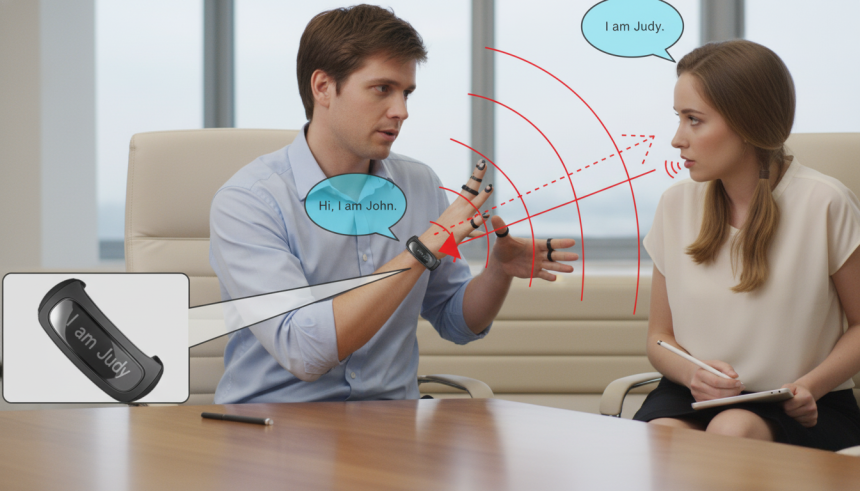
Some research projects explore wearable technology, such as smart gloves or wristbands, equipped with motion sensors that capture finger and hand movements. These devices translate the wearer’s gestures into text or audio output.
4. AI and 3D AvatarsRecent innovations use 3D avatars or digital humans that perform sign language in real time. These avatars can translate text or audio into sign language visually, helping websites and video content become accessible for deaf audiences.
AI-powered sign language translators typically follow a multi-step process:
- Input Capture:
- The system records the signer’s movements using a camera or sensor.
- Preprocessing:
- Background noise, lighting variations, and irrelevant movements are filtered out to improve accuracy.
- Feature Extraction:
- Key features such as hand shape, position, and motion trajectory are identified.
- Recognition and Classification:
- The system uses machine learning models (often convolutional neural networks—CNNs or recurrent neural networks—RNNs) to classify gestures as specific words or signs.
- Language Modeling:
- The system applies grammar rules to construct meaningful sentences, since sign language syntax differs from spoken languages.
- Output Generation:
- The translation is displayed as text or spoken using text-to-speech (TTS) technology.
This pipeline makes it possible to translate signs in real time, though accuracy depends on the quality of training data and the diversity of sign language datasets.
Despite remarkable progress, automatic sign language translation faces several challenges:
- Linguistic Complexity:
- Sign languages have unique grammar and syntax that differ greatly from spoken languages. Translating them accurately requires understanding context, not just gestures.
- Lack of Standardization:
- Each country—and even region—has its own sign language. For instance, ASL (American Sign Language) and BSL (British Sign Language) are distinct and not mutually intelligible.
- Data Scarcity:
- AI systems require vast datasets of annotated videos to learn effectively, but such datasets are limited.
- Non-Manual Signals:
- Facial expressions and body movements play a critical role in sign language meaning. Many systems still struggle to interpret these accurately.
- Real-Time Performance:
- Translating signs instantly with high accuracy and natural flow remains a computational challenge.
- Cultural and Ethical Considerations:
- Machine translation should complement, not replace, human interpreters—especially in sensitive or nuanced contexts.
The growing presence of sign language translators—both human and digital—has brought significant benefits to society:
- Empowerment of Deaf Communities:
- Deaf individuals can engage more freely in education, work, and public services.
- Increased Awareness:
- Sign language visibility promotes inclusion and encourages hearing individuals to learn basic signs.
- Global Accessibility:
- Online translators like SLTranslator.com and mobile apps allow anyone with an internet connection to communicate more inclusively.
- Innovation in Accessibility Technologies:
- The development of sign language translators has advanced broader fields such as AI vision, gesture recognition, and assistive technology.
The future of sign language translation is promising, driven by rapid advancements in artificial intelligence, 3D animation, and wearable tech. Researchers are working toward fully automated, real-time translators that understand entire sign languages, including emotion and context.
Here are key trends shaping the next generation of translators:
- Multilingual Sign Translation:
- AI tools that can translate between multiple sign and spoken languages.
- Integration in AR/VR:
- Augmented reality glasses that display translations in real time during face-to-face conversations.
- Improved Data Sharing:
- Open-source sign language datasets will accelerate research and improve accuracy.
- Human-AI Collaboration:
- Hybrid systems where AI handles basic translation while human interpreters manage complex or emotional contexts.
- Mainstream Accessibility:
- Integration of sign language translation into social media, video platforms, and customer service systems.
Sign language translators—both human and technological—play an indispensable role in making our world more inclusive. They are the bridge that connects the deaf and hearing communities, breaking down communication barriers and promoting equality.
While human interpreters remain irreplaceable in many situations due to their cultural and emotional intelligence, AI-powered translators are expanding access where human services are limited. Platforms like SLTranslator.com and similar innovations are transforming accessibility from a specialized service into a universal convenience.
As technology evolves, the goal remains clear: to ensure that no one is left unheard or unseen, regardless of how they communicate. Sign language translators, in all their forms, bring us one step closer to a world where communication truly knows no barriers.


