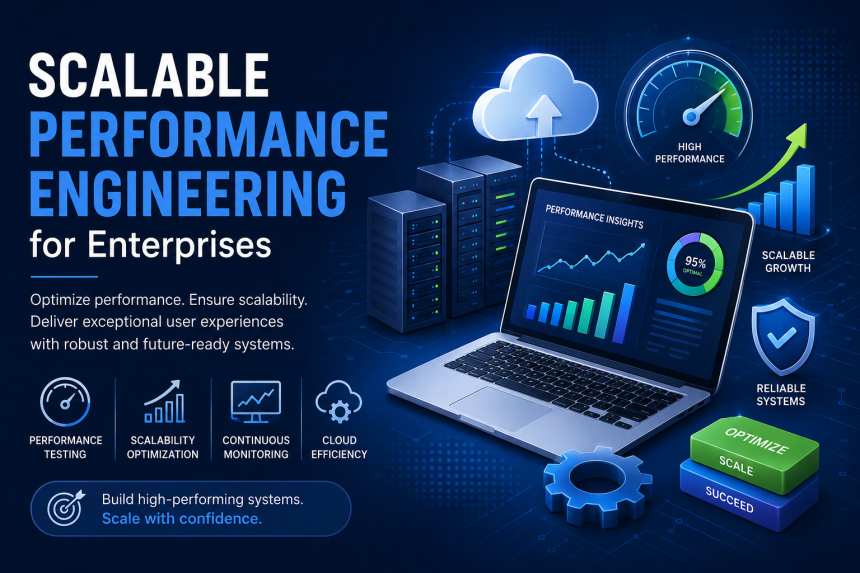

Scalable Performance Engineering for Enterprises
Optimize enterprise applications with scalable performance engineering solutions that improve speed, stability, and user experience. Enhance system efficiency, reduce downtime, and ensure reliable performance for growing business demands.
In today’s fast-moving digital environment, enterprises depend heavily on applications, cloud infrastructure, and online platforms to manage daily operations and customer interactions. Whether it is an e-commerce platform, banking application, healthcare system, or enterprise software solution, performance plays a critical role in delivering a smooth user experience. Slow-loading systems, application crashes, and poor response times can negatively impact customer satisfaction, operational efficiency, and business revenue.
As businesses continue to scale, maintaining system stability and speed becomes more challenging. This is where performance engineering becomes an essential part of modern IT strategies. Organizations now focus not only on developing software but also on ensuring that applications perform efficiently under varying workloads and complex operational environments.
Understanding Performance Engineering
Performance engineering is a systematic approach to designing, testing, monitoring, and optimizing software applications and IT systems to ensure consistent performance. Unlike traditional performance testing, performance engineering is integrated throughout the software development lifecycle.
The goal is to identify performance bottlenecks early, improve system reliability, and deliver seamless digital experiences for users. Enterprises use performance engineering practices to maintain application responsiveness, scalability, and stability even during high traffic conditions.
Performance engineering combines several important processes, including:
- Performance testing
- Capacity planning
- Load analysis
- System monitoring
- Application optimization
- Infrastructure tuning
- Automation and analytics
These practices help businesses build resilient systems capable of handling future growth.
Importance of Scalable Enterprise Systems
Modern enterprises operate in highly competitive industries where user expectations continue to rise. Customers expect websites and applications to load instantly and function smoothly across devices and platforms. Even a few seconds of delay can lead to customer frustration and revenue loss.
Scalable systems allow organizations to handle increasing traffic, larger databases, and growing operational demands without compromising performance. Enterprises that invest in scalable architecture gain several business advantages.
Improved User Experience
Fast and responsive applications create positive customer experiences, leading to better engagement and higher retention rates.
Enhanced Business Continuity
Reliable systems reduce downtime risks and help organizations maintain uninterrupted services during peak traffic periods.
Cost Optimization
Efficient infrastructure management prevents unnecessary resource consumption and reduces operational expenses.
Faster Digital Transformation
Businesses can adopt new technologies and expand services confidently when systems are built for scalability.
Competitive Advantage
Organizations with high-performing digital platforms can respond quickly to market demands and customer expectations.
Key Components of Performance Engineering
Performance engineering involves multiple technical and strategic elements that work together to optimize enterprise systems.
Performance Testing
Performance testing evaluates how applications behave under different workloads. It helps organizations identify bottlenecks, slow response times, and stability issues before deployment.
Common testing methods include:
- Load testing
- Stress testing
- Scalability testing
- Endurance testing
- Spike testing
These tests help IT teams understand how systems perform in real-world scenarios.
Monitoring and Observability
Continuous monitoring allows enterprises to track application health, server performance, database activity, and network behavior in real time.
Modern observability tools provide insights into:
- CPU and memory usage
- Response times
- Error rates
- Transaction performance
- Infrastructure utilization
This helps teams detect issues proactively and maintain system reliability.
Capacity Planning
Capacity planning ensures organizations have the necessary resources to support future growth. IT teams analyze expected traffic, user activity, and data usage to prepare scalable infrastructure.
Automation
Automation improves efficiency by reducing manual intervention in testing, deployment, and monitoring processes. Automated workflows help enterprises respond faster to performance issues.
In the middle of optimizing enterprise applications, organizations often rely onPerformance Engineeringstrategies to improve scalability, maintain system stability, and deliver consistent digital experiences for users across different platforms and workloads.
Role of Cloud Computing in Performance Optimization
Cloud technology has transformed the way enterprises manage scalability and system performance. Cloud platforms offer flexible infrastructure, advanced monitoring tools, and automated resource allocation.
Elastic Scalability
Cloud environments automatically adjust resources based on traffic demands, helping businesses maintain performance during high usage periods.
Global Accessibility
Cloud-based systems improve application speed and accessibility for users across multiple geographic regions.
High Availability
Cloud providers offer redundancy and failover systems to reduce downtime and improve reliability.
Cost Efficiency
Organizations can scale resources according to demand without investing heavily in physical infrastructure.
Performance Challenges Enterprises Face
Despite technological advancements, enterprises still encounter several performance-related challenges.
Increasing User Traffic
Growing customer bases and online activity can overload systems if infrastructure is not properly optimized.
Complex Application Architectures
Modern applications often use microservices, APIs, and distributed systems that require advanced monitoring and coordination.
Database Bottlenecks
Poor database performance can slow down entire applications and affect user experience.
Security and Compliance Requirements
Enterprises must balance performance optimization with cybersecurity and regulatory compliance standards.
Legacy Systems
Older infrastructure and outdated software can limit scalability and create integration issues.
Future Trends in Performance Engineering
Technology continues to evolve rapidly, introducing new approaches to performance optimization.
AI-Powered Monitoring
Artificial intelligence helps detect anomalies, predict failures, and automate performance analysis.
Edge Computing
Edge computing improves response times by processing data closer to users and reducing latency.
DevOps Integration
Performance engineering is increasingly integrated with DevOps workflows to enable faster deployments and continuous optimization.
Cloud-Native Architectures
Organizations are adopting cloud-native applications designed specifically for scalability and flexibility.
Predictive Analytics
Advanced analytics tools help enterprises forecast system demands and optimize resources proactively.
Conclusion
As digital transformation accelerates across industries, enterprises must prioritize system speed, scalability, and reliability to remain competitive. High-performing applications improve customer experiences, strengthen operational efficiency, and support long-term business growth.
Performance engineering provides organizations with the tools and strategies needed to build scalable systems capable of handling evolving market demands. From testing and monitoring to automation and cloud optimization, performance engineering helps businesses deliver stable and efficient digital experiences across all platforms.
By investing in scalable infrastructure and proactive optimization strategies, enterprises can reduce downtime, improve productivity, and prepare their systems for future expansion in an increasingly technology-driven world.
Best cancer care treatment Hospitals India
Best cancer care treatment Hospitals India



How Experienced Mechanics Ensure Vehicle Reliability and Safety
Experienced Miranda mechanics understand how these systems interact and can identify devel...

Hospital Curtain Track Suppliers in India & Operation Theatre Technici...
Golden Touch Fusion CBD: How They Work, Expected Results, and Where to...
Introduction Golden Touch Fusion CBD Gummies are marketed as a cannabidiol (CBD) suppleme...