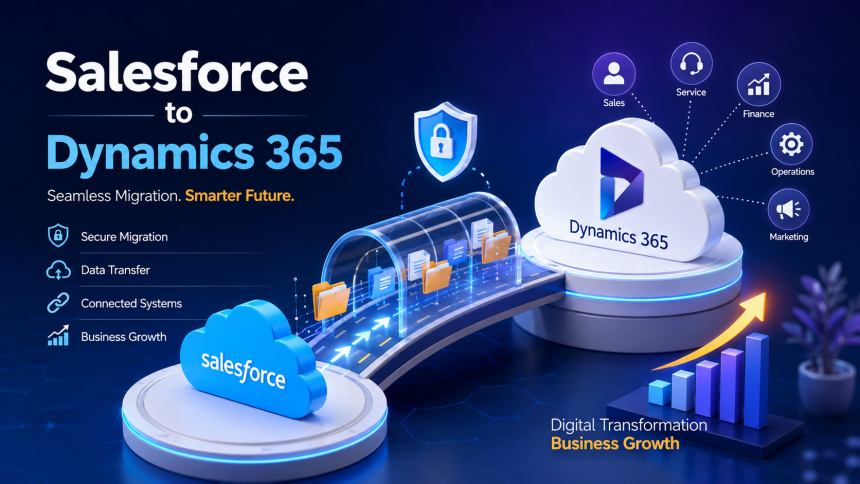

Salesforce to Dynamics 365: Modernizing CRM for Business Growth
Discover how Salesforce to Dynamics 365 migration can modernize CRM operations, improve data management, streamline integrations, strengthen security, and support scalable business growth.
Introduction
A CRM platform plays a central role in managing customer relationships, sales activities, service interactions, and valuable business information. As organizations grow, however, their CRM requirements can become more sophisticated. Companies may need better automation, stronger analytics, simpler integrations, improved scalability, or closer alignment with their broader technology environment. Microsoft Dynamics 365 can provide a flexible foundation for organizations seeking to modernize these capabilities. Moving between CRM platforms, however, requires much more than transferring records. A successful Salesforce to Dynamics 365 migration involves business analysis, data preparation, process redesign, integration planning, security, testing, and user adoption. When these areas are managed carefully, migration can become an opportunity to improve operations and establish a CRM environment that is prepared for future business demands.
Defining the Business Objectives
Every successful migration begins with a clear understanding of what the organization wants to accomplish. Businesses may decide to move because of changing operational requirements, complex customizations, integration challenges, reporting limitations, or the need to connect CRM more closely with other Microsoft technologies. Dynamics 365 can work with solutions across the Microsoft ecosystem, including Power Platform, Microsoft 365, Azure, and analytics tools. However, technology capabilities alone should not determine the migration strategy. Business leaders should identify existing problems and establish the improvements they expect from the new CRM. These objectives can guide decisions about data, workflows, integrations, and user experience. A clear business case also makes it easier to evaluate the migration's success after deployment.
Building a Detailed Migration Roadmap
A well-structured migration roadmap provides direction throughout the project. The initial discovery phase should examine the Salesforce environment, including objects, fields, customizations, workflows, automation, reports, dashboards, integrations, user roles, and historical records. This assessment helps identify technical dependencies and determine which components should be retained, redesigned, consolidated, or retired. The target Dynamics 365 architecture should then be designed around current business requirements rather than simply copying the existing configuration. Project teams should establish scope, responsibilities, timelines, validation methods, communication procedures, and deployment plans. For organizations with complex environments, phased migration can provide additional control by allowing teams to validate selected processes before wider deployment. Effective planning reduces uncertainty and helps prevent avoidable migration delays.
Reviewing Existing Business Processes
CRM migration creates an opportunity to improve workflows that may have become inefficient over time. Organizations should examine how employees manage leads, opportunities, accounts, customer requests, approvals, communication, and reporting. Processes that contain unnecessary manual steps can be redesigned using Dynamics 365 capabilities and automation tools. Likewise, unused fields, outdated workflows, and redundant customizations should not automatically be recreated. Business users should participate in process analysis because they understand practical challenges that may not be visible through technical documentation alone. Designing around real business needs can simplify daily work and improve user adoption. The goal is to create a CRM environment that supports employees more effectively while maintaining the processes that genuinely contribute to customer service and business performance.
Preparing Data for a Reliable Migration
Data quality is fundamental to the success of any CRM transformation. Long-running Salesforce environments may contain duplicate accounts, outdated contacts, incomplete records, inconsistent naming conventions, and historical information with limited current value. Moving this information without assessment can create reporting problems and make Dynamics 365 harder to manage. Data profiling should therefore begin before extraction. Teams should determine which records need cleansing, transformation, archiving, or removal. Field mapping should establish how Salesforce objects and attributes correspond with Dynamics 365 entities and fields. Relationships between accounts, contacts, opportunities, activities, cases, and other records should be preserved where required. Once migration is complete, validation should compare critical records with source data to confirm accuracy, completeness, and usability.
Planning Integration and Data Exchange
CRM platforms are often connected to many other applications, making integration planning essential. Salesforce may exchange information with finance systems, websites, marketing platforms, customer portals, communication applications, analytics solutions, or custom software. Each connection should be assessed before migration to determine its purpose, data dependencies, synchronization requirements, and future relevance. Some integrations may need to be rebuilt using APIs, Power Automate, Azure services, or custom development. Others may be replaced with native Dynamics 365 functionality or removed when they no longer provide meaningful value. During this phase, businesses can also identify opportunities to simplify data flows. A carefully designed integration architecture helps maintain continuity while reducing unnecessary dependencies and making the new CRM environment easier to manage.
Strengthening CRM Security
Security must be integrated into the migration strategy from the beginning. CRM platforms hold valuable customer, sales, service, and operational information that may require different levels of access. Organizations should design Dynamics 365 security roles based on current responsibilities, departments, teams, and data requirements. Existing Salesforce permissions should be reviewed rather than copied automatically because business roles and access requirements may have changed. Data protection should also cover extraction, transformation, transfer, testing, and storage. Governance policies should address administrative access, auditing, data ownership, retention, and configuration management. Organizations with industry or regulatory requirements should incorporate them into the target CRM architecture. Strong security controls protect sensitive information while ensuring authorized employees can access the data necessary for effective work.
Testing Before the CRM Goes Live
Testing is essential for identifying issues before the new CRM becomes part of daily operations. Teams should validate migrated records, relationships, workflows, automation, reports, dashboards, integrations, and permissions. Data reconciliation can reveal missing or incorrectly transformed information, while functional testing confirms that important processes operate as expected. User acceptance testing is especially important because business users can identify practical issues that technical teams may not notice. Multiple test migrations can also help refine data transformation rules, field mappings, integration configurations, and deployment procedures. Critical issues should be corrected and retested before production launch. A controlled cutover process can further reduce disruption by clearly defining when the old environment stops receiving changes and when Dynamics 365 becomes the primary CRM platform.
Managing Migration Challenges
CRM migrations can become complex when organizations have large datasets, extensive customizations, legacy workflows, multiple integrations, or years of historical information. Differences between Salesforce and Dynamics 365 can require certain functionality to be redesigned rather than directly transferred. Data cleansing may also take longer than expected when records contain inconsistencies or dependencies. User adoption presents another challenge because employees need to learn new interfaces and processes. These risks can be reduced through early discovery, realistic planning, pilot migrations, stakeholder involvement, and practical training. Communication is also important because users are more likely to support the transition when they understand how the new platform will improve their daily work. Proactive risk management helps protect both operational continuity and project quality.
Best Practices for a Smooth Transition
A successful CRM migration combines technical execution with business participation. Stakeholders from sales, service, management, IT, and other relevant departments should contribute to requirements gathering and user acceptance testing. Project documentation should clearly capture data mappings, integration decisions, security configurations, workflow changes, customizations, and testing results. Organizations should focus on valuable functionality rather than automatically reproducing every legacy feature. Employee training should begin before deployment and continue after launch as users become familiar with new processes. Monitoring should continue after go-live to identify data quality issues, adoption challenges, integration failures, and opportunities for optimization. This ongoing approach helps ensure that Dynamics 365 remains aligned with business requirements as the organization develops.
Benefits of Moving to Dynamics 365
A well-planned Salesforce to Dynamics 365 migration can deliver benefits across customer engagement, automation, analytics, collaboration, and data management. Organizations can connect CRM information more closely with productivity applications and other business systems, helping employees access relevant information more efficiently. Improved data quality can strengthen reporting and support more reliable decision-making, while redesigned workflows can reduce manual administration. Businesses can also use the migration to remove outdated processes and simplify their technology landscape. The Microsoft ecosystem provides opportunities for extending CRM functionality through automation, analytics, and connected applications as requirements change. By building the new environment around business objectives rather than legacy configurations, organizations can establish a scalable foundation for future digital initiatives.
Conclusion
Moving from Salesforce to Dynamics 365 is a significant transformation that requires careful attention to business objectives, data, integrations, security, testing, and user adoption. The most successful projects use migration as an opportunity to improve processes rather than simply transfer existing configurations. Thorough discovery, data cleansing, thoughtful solution design, strong governance, and comprehensive testing can reduce risks and create a smoother transition. Once implemented, Dynamics 365 can provide a connected foundation for customer management, automation, reporting, and business collaboration. Organizations that continue monitoring and optimizing their CRM can maintain its value as requirements evolve. Ultimately, a strategic Salesforce to Dynamics 365 migration can help businesses simplify operations, improve visibility, strengthen customer engagement, and create a flexible foundation for sustainable growth.
What European Manufacturers Need From an Indian Event Partner
European manufacturers expanding in India bring high standards with them. They expect prec...



NBSK Pulp Price Trend Q2 2026 | Global Price Trends, Forecast, Chart,...

BCTMP Price Trend Q2 2026 | Global Price Trends, Forecast, Chart, Pric...