
Resistance and Leverage: Iran's Diplomacy
The 81st session of the United Nations General Assembly (UNGA) served as a critical arena for the Islamic Republic of Iran to project power, counter Western narrative structures, and deploy its most formidable geopolitical lever: the transit of global energy. Foreign Minister Abbas Araghchi’s concluding address via the Islamic Republic of Iran Broadcasting (IRIB) offers a transparent window into Tehran’s dual-track strategy. This write up is an opinion about the Iran's diplomacy undertaken at UNO and USA during last week.
أَعُوذُ بِاللّٰهِ مِنَ الشَّيْطَانِ الرَّجِيمِ
بِسۡمِ ٱللهِ ٱلرَّحۡمَـٰنِ ٱلرَّحِيمِ
In the name of ALLAH, the Most Gracious, the Most Merciful
The Architecture of Resistance and Leverage:
Analyzing Iran’s Diplomatic Strategy at the 81st UN General Assembly
The 81st session of the United Nations General Assembly (UNGA) served as a critical arena for the Islamic Republic of Iran to project power, counter Western narrative structures, and deploy its most formidable geopolitical lever: the transit of global energy. Foreign Minister Abbas Araghchi’s concluding address via the Islamic Republic of Iran Broadcasting (IRIB) offers a transparent window into Tehran’s dual-track strategy. By framing its diplomatic engagements around the twin pillars of ideological "resistance" and a highly structured "seven-point plan" for the Strait of Hormuz, Iran sought to dismantle the Western paradigm of its isolation while simultaneously dictating the terms of regional de-escalation from a position of perceived strength.
1. The Counter-Isolation Narrative and the Prestige of Resistance
A primary domestic and international objective of the Iranian delegation was to aggressively refute the diplomatic containment strategies pursued by the United States and Israel. Araghchi’s emphasis that the majority of bilateral meetings occurred "at the request of the other side" serves as a direct rhetorical challenge to the notion of a sidelined Iran.
Within the text, this counter-isolation narrative is deeply intertwined with the concept of Muqawamah (resistance). Araghchi explicitly notes that foreign counterparts expressed appreciation for Iran’s stance against "the world's largest military power." By elevating resistance from a regional proxy doctrine to a source of universal "pride for many countries," the Iranian foreign policy apparatus successfully leveraged the global south's underlying anxieties regarding Western hegemony. In doing so, Tehran sought to transform its geopolitical friction with the West into a badge of sovereign honor and international respect.
2. The Seven-Day Framework: Accelerated Diplomacy from Collapsed Foundations
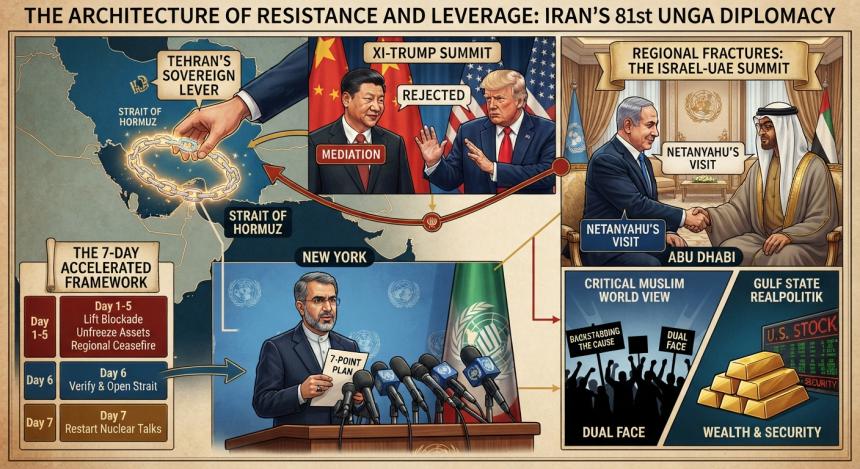
The operational heart of Iran's diplomatic offensive in New York was the formal introduction of a compressed, seven-day plan to end hostilities, reopen the Strait of Hormuz, and restart nuclear talks with the United States. This proposal does not emerge from a vacuum; rather, it directly mirrors a collapsed Memorandum of Understanding (MoU) signed in June 2026. The previous June framework—brokered by Pakistan and Qatar—had established a 60-day runway for nuclear negotiations and an immediate halt to multi-front military operations before unraveling in July amid renewed maritime confrontation.
By reintroducing this blueprint on a hyper-accelerated, one-week timeline, Tehran attempted to exploit immediate external pressures, such as the upcoming U.S. midterm elections, to force rapid American concessions. This accelerated structure operates as an intentional diplomatic gauntlet:
- Days 1–5: The United States must lift its naval blockade, waive sanctions on Iranian oil exports, and release roughly $12 billion in frozen assets. Concurrently, a comprehensive regional ceasefire covering Lebanon and Yemen must be observed.
- Day 6: Upon verification of U.S. compliance, Iran opens the Strait of Hormuz to global shipping traffic.
- Day 7: Formal, face-to-face negotiations resume between Washington and Tehran to finalize a permanent deal on mutually agreed subjects, centering on the nuclear file.
3. Great Power Complications: The Xi-Trump Summit and Washington's Rejection
The geopolitical gravity of Iran's proposal was further amplified by direct intervention from Beijing. During a high-profile state visit to Washington, Chinese President Xi Jinping delivered a direct, face-to-face message to U.S. President Donald Trump. Xi urged Washington to step away from continued military confrontation, return to the negotiating table, and respect the sovereign security of Gulf nations. By backing a return to the previous diplomatic framework, China attempted to act as a heavyweight guarantor of the de-escalation process.
However, this great power mediation faced an immediate firewall in Washington. The very next day, President Trump publicly and categorically rejected the Iranian proposal. Speaking to reporters, Trump stated that the deal "would not be acceptable," dismissing the framework as a desperate maneuver by Tehran because they are "losing so badly" under the weight of the U.S. naval blockade and secondary sanctions. This rapid rejection underscored Washington's refusal to allow external powers—even China—to dictate the terms of its maximum pressure campaign.
4. The Strait of Hormuz as Sovereign and Geopolitical Leverage
By tethering the freedom of navigation through one of the world's most vital maritime chokepoints to strict political prerequisites mandated by the Supreme Leader, Iran effectively transformed a regional military standoff into a global economic calculations game. Araghchi’s rhetoric deliberately reframes Iran's restriction of the Strait not as an act of aggression, but as a calculated, logical policy awaiting a "peaceful solution".
By declaring that Iran's conditions are entirely fair, the diplomatic team sought to shift the burden of regional stability onto Washington. This tactical framing presents Iran as a rational actor possessing a concrete blueprint for peace, thereby trapping the United States in a position where rejecting the proposal could be construed as choosing protracted conflict over maritime stability.
5. Intermediary Mechanics and Narrative Control
The reliance on Doha and Islamabad as primary interlocutors highlights the deeply institutionalized nature of indirect U.S.-Iran diplomacy. The fluid, ongoing nature of these talks—underscored by Araghchi’s eleventh-hour meeting with Qatari intermediaries before his departure to Tehran—reveals a highly coordinated negotiation loop.
The final segment of Araghchi’s statement functions as a rigorous exercise in risk mitigation. Amidst the fog of backchannel diplomacy, rumors of Iranian concessions often proliferate in international media. Araghchi’s categorical rejection of any "flexibility" or shift in Tehran's stance serves a dual purpose. It signals absolute alignment with domestic hardliners and the Supreme Leader's red lines, while simultaneously confining negotiations strictly to the Strait of Hormuz, refusing to let Western negotiators bundle it with ballistic missiles or regional alliances.
6. Regional Fractures: The Netanyahu UAE Visit and the "Unholy Alliance"
While Iran attempted to anchor regional security to its sovereign terms, a parallel diplomatic development highlighted the deep structural fractures within the Middle East. Israeli Prime Minister Benjamin Netanyahu’s unannounced visit to the United Arab Emirates on September 27, 2026, to meet with UAE President Sheikh Mohamed bin Zayed Al Nahyan, served as a stark juxtaposition to Tehran's anti-imperialist rhetoric.
Within large segments of the Muslim world and among pro-Palestinian factions, this high-level engagement has been bitterly denounced as the ultimate unmasking of an "unholy alliance" between Zionist leadership and Arab monarchs. Critics argue that such normalization efforts constitute a direct backstabbing of the Palestinian cause and the wider Muslim struggle.
From this critical perspective, the diplomatic maneuvering exposes a dual-faced policy of the Gulf sheikhs: publicly paying lip service to regional solidarity while privately prioritizing the security of their regimes and the preservation of vast wealth stored in Western banks and U.S. stock markets. Conversely, the participating governments defend the alignment as a necessary, pragmatic strategy to insulate their economies from regional chaos and establish intelligence-sharing frameworks against mutual adversaries. This deep ideological rift underscores a region caught between the transactional realpolitik of wealthy Gulf capitals and the popular pan-Islamic sentiment that views such transactions as a betrayal of core principles.
Conclusion
Abbas Araghchi’s reflections on the New York mission illustrate a sophisticated diplomatic doctrine designed to convert geopolitical friction into systemic leverage. By utilizing the UNGA platform to broadcast an accelerated version of the June framework, and finding diplomatic alignment in President Xi’s face-to-face messaging to the White House, Iran successfully projected the image of a confident, unisolated power. However, Trump’s immediate next-day rejection of the plan, coupled with the deepening, controversial integration of Israel and the Gulf states, demonstrates the immense friction facing backchannel diplomacy. Whether the indirect negotiations through Qatar yield a future breakthrough or dissolve into continued deadlock, Tehran has made its doctrine clear: regional peace and open waters remain entirely contingent upon the West acceding to the sovereign parameters set by the Islamic Republic.


How Can Childcare Centres Maintain Cleaner Playrooms and Rest Areas?

Polyester Industrial Yarn Price Trend Q2 2026 | Price Trends, Forecast...



Academic Excellence in AI and Data Science Engineering | HOD's Desk at...
