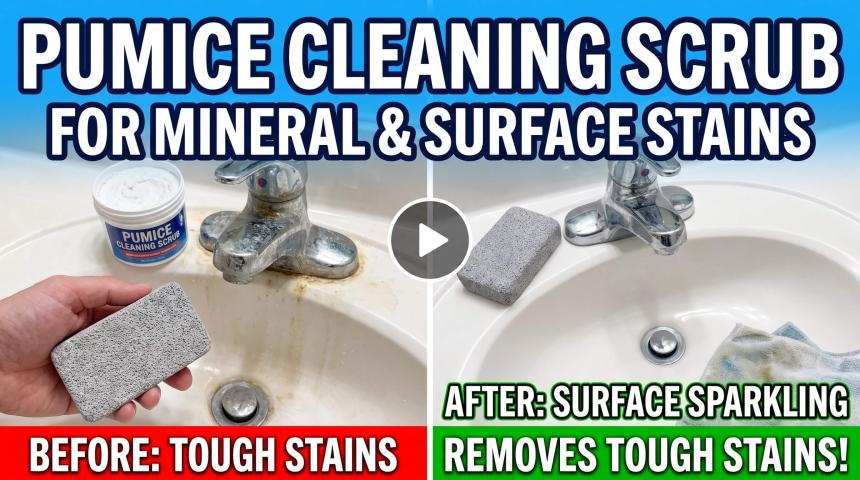

Pumice Cleaning Scrub for Tough Mineral and Surface Stains
Discover how a pumice cleaning scrub can help tackle stubborn mineral buildup, hard water stains, and residue on suitable hard surfaces. Learn how pumice works, where it can be useful, and important tips for safe and effective cleaning.
How Pumice Cleaning Scrub Helps Remove Stubborn Buildup
Some household stains are easy to wipe away, while others become increasingly difficult after mineral deposits and residue build up over time. Bathrooms, sinks, toilets, and other hard surfaces can develop marks that ordinary brushes and household cleaners struggle to remove. A properly selected pumice cleaning scrub can provide a practical solution by using the natural abrasive properties of pumice to work against stubborn buildup.
When choosing a cleaning approach, it is useful to understand how different methods work. For example, this guide on pumice cleaning scrub explains the difference between pumice-based cleaning and vinegar when dealing with stubborn toilet stains. Understanding the type of buildup you are dealing with can help you choose a more suitable cleaning method.
What Is a Pumice Cleaning Scrub?Pumice is a lightweight volcanic material with a naturally porous structure. Because of its abrasive characteristics, pumice has been used for various cleaning applications where physical removal of hardened residue is needed.
A pumice cleaning scrub can be especially useful for mineral deposits and buildup on appropriate hard, non-porous surfaces. Instead of depending entirely on a chemical cleaner to dissolve a stain, pumice works through controlled physical abrasion.
This makes it an interesting option for cleaning jobs where a conventional sponge or brush may not provide enough scrubbing power.
Common Cleaning Problems Pumice Can AddressMineral buildup can appear in many areas around a home or commercial property. Depending on the surface and product being used, pumice may be useful for tackling:
- Hard water rings
- Mineral deposits
- Limescale buildup
- Rust-colored residue
- Stubborn bathroom stains
- Hardened residue around plumbing fixtures
- Certain marks on ceramic and porcelain surfaces
The effectiveness of pumice depends heavily on the surface material. It should not be treated as a universal cleaning product for every type of finish.
Why Mineral Deposits Can Be Difficult to RemoveHard water contains naturally occurring minerals. When water repeatedly evaporates from a surface, those minerals can remain behind. Over time, layers of residue may accumulate and become hard.
A standard cloth may remove surface dirt, but it may not be able to break through firmly attached mineral deposits. A regular bathroom brush can also struggle when the buildup has become thick and hardened.
This is where an abrasive cleaning approach can be helpful. Rather than simply wiping over the deposit, pumice can gradually work against the hardened material.
Pumice Cleaning Versus Ordinary ScrubbingThere is a major difference between ordinary scrubbing and abrasive cleaning.
A soft sponge is designed to clean without significantly affecting the underlying surface. It is excellent for everyday dirt, soap residue, and light grime.
A pumice-based scrubber, by comparison, provides a much stronger physical cleaning action. This makes it potentially useful when ordinary cleaning tools have reached their limits.
However, stronger does not automatically mean better. Abrasive products must always be matched to an appropriate surface, and they should be used carefully.
Suitable Surfaces MatterBefore using a pumice cleaning product, identify the material you intend to clean.
Pumice can be suitable for certain hard, non-porous surfaces, including some porcelain and ceramic fixtures. These surfaces can tolerate carefully controlled abrasion better than softer or more delicate materials.
Pumice should generally be avoided on surfaces such as:
- Plastic
- Fiberglass
- Painted finishes
- Finished wood
- Marble
- Delicate coatings
- Surfaces that can easily scratch
When in doubt, check the manufacturer's instructions and test compatibility in a discreet area before treating a visible section.
How to Use Pumice for CleaningUsing the right technique is just as important as selecting the right product.
1. Identify the StainFirst, determine what you are trying to remove. Mineral deposits, rust-colored buildup, soap residue, and ordinary dirt may require different approaches.
2. Confirm Surface CompatibilityMake sure the surface is hard and suitable for an abrasive pumice product. Never assume that every bathroom or kitchen surface can safely be treated with pumice.
3. Keep the Surface WetMoisten the cleaning area and the pumice product according to the product instructions. Working with adequate moisture helps the pumice move more smoothly over a suitable surface.
4. Use Controlled PressureApply gentle pressure and work gradually. There is rarely a reason to aggressively grind a surface.
Focus on the affected area rather than scrubbing unnecessarily across the entire fixture.
5. Rinse and InspectAfter working on the buildup, rinse the area and inspect the result. If residue remains, repeat the process carefully rather than immediately increasing pressure.
Pumice and Vinegar: Different Cleaning ApproachesPumice and vinegar are sometimes discussed together because both can be used in approaches to mineral-stain removal, but they work differently.
Vinegar is acidic and may help loosen certain mineral deposits. Pumice relies on mechanical abrasion to physically remove suitable buildup.
For light deposits, a household cleaning solution may be enough. For stubborn, hardened deposits on a compatible surface, mechanical cleaning can offer another approach.
The best method depends on the severity of the stain, the material being cleaned, and the manufacturer's recommendations.
Benefits of a Pumice-Based Cleaning ApproachA pumice cleaning scrub can offer several practical advantages when used appropriately.
Physical RemovalInstead of relying exclusively on chemical action, pumice physically works against hardened deposits.
Useful for Stubborn BuildupCertain mineral rings and deposits can become difficult for ordinary cleaning tools to handle. An abrasive pumice product can provide additional cleaning power.
Versatile ApplicationsPumice has applications beyond household cleaning. Different grades and forms can be used for cleaning, personal care, soil improvement, industrial applications, and other specialized purposes.
Natural Mineral MaterialPumice is a naturally occurring volcanic material, making it an interesting alternative for applications where a mineral abrasive is appropriate.
Avoid Excessive PressureOne of the most important principles of abrasive cleaning is that more pressure is not necessarily better.
If a deposit is not coming away easily, stop and reassess the situation. The surface may not be suitable, or a different cleaning method may be more appropriate.
Applying excessive force can create unnecessary wear and may damage a surface that is not designed to withstand abrasion.
Combine Cleaning Methods CarefullyDifferent cleaning methods can sometimes complement one another.
For example, a suitable cleaning solution may help loosen certain deposits before gentle mechanical cleaning is attempted. However, cleaning chemicals should never be mixed casually.
Always follow product instructions and avoid combining chemicals that could create hazardous fumes or reactions.
Keeping Mineral Buildup Under ControlPreventing heavy buildup is often easier than removing it after years of accumulation.
Regular cleaning can help prevent mineral deposits from becoming deeply established. Wiping moisture from frequently affected areas and maintaining bathroom fixtures can also reduce the opportunity for residue to accumulate.
For areas exposed to hard water, consistent maintenance can make future cleaning considerably easier.
Choosing the Right Pumice ProductNot every pumice product is identical. Pumice can be processed into different forms and grades depending on its intended application.
When selecting a cleaning product, consider:
- The type of surface you plan to clean
- The type of buildup you need to remove
- The abrasiveness of the product
- Product instructions
- Recommended applications
- Whether the product is designed specifically for cleaning
Choosing a product intended for the job is better than using an abrasive material without understanding its properties.
Final ThoughtsA pumice cleaning scrub can be a useful option for stubborn mineral deposits and hardened residue when applied to appropriate hard surfaces. Its main advantage is its ability to provide controlled mechanical abrasion rather than relying solely on chemical cleaning.
The key is to use the right pumice product, confirm surface compatibility, keep the area appropriately wet, and work gently. With the right technique, pumice can become a practical addition to a broader cleaning routine.
For anyone dealing with persistent hard water buildup, understanding the difference between chemical and mechanical cleaning methods can make it easier to choose an effective approach for each situation.
Reliable and Convenient Taxi Services for Every Journey in Connecticut
U4gm Hero Siege Guide to Surviving Dense Enemy Groups
Fast clearing is not just about the damage shown on a character screen. Time spent escapin...