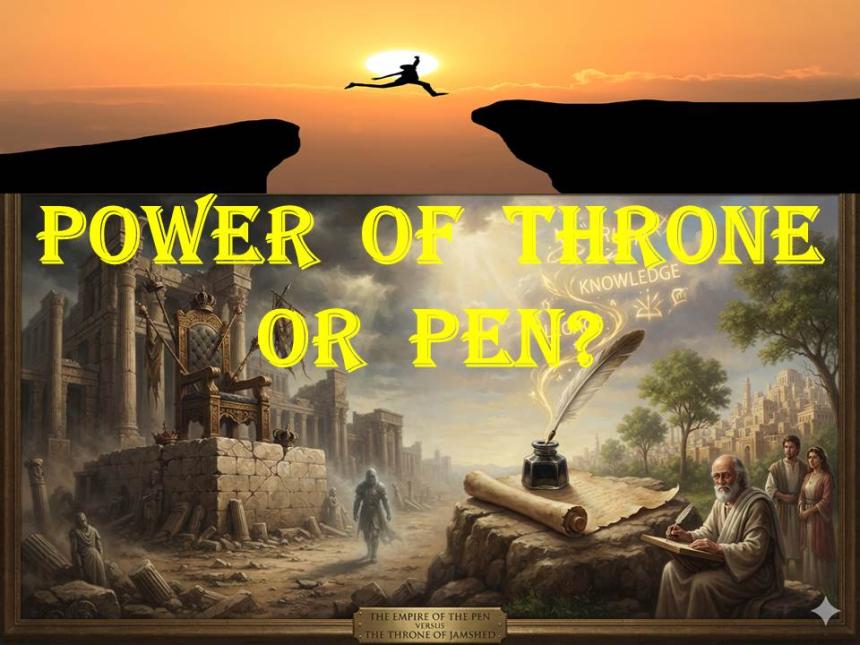

Power of Throne or Pen?
Storytelling is an important tool because it builds emotional connections, helps people remember information, and fosters empathy. The Throne of Jamshid symbolizes worldly power, grandeur, and material empire—things that fade away with time. In contrast, the legacy of the pen represents knowledge, wisdom, ideas, and indelible marks that endure for centuries. This story "Power of Throne or Pen?" is about the the power of pen and struggle of men of letters.
أَعُوذُ بِاللّٰهِ مِنَ الشَّيْطَانِ الرَّجِيمِ
بِسۡمِ ٱللهِ ٱلرَّحۡمَـٰنِ ٱلرَّحِيمِ
In the name of ALLAH, the Most Gracious, the Most Merciful
Power of Throne or Pen?
It was the era of the British Raj, when the entire subcontinent was chained to slavery. In that period of history, there were some madmen who had neither lands nor swords, but they had a weapon that made even the rulers of that time tremble. One of their leaders was Babu Karam Bakhsh Mina. He was a true journalist and poet whose blood of freedom was running in his veins. When he saw that the rulers were trampling on the rights of the people, he, along with Maulana Zafar Ali Khan, made the daily newspaper 'Zamindar' his front. His only fault was that he used to show the Britishers a mirror with his pen and asked questions whose answers were to be given by the British Empire.
When the dictators of the time were bothered by those questions, they said that Babu Karam should be locked up in the dark cells of the prison along with Maulana Zafar Ali Khan. Babu Karam Bakhsh said that they would endure the hardships of prison but they would never give up. He said that even after being imprisoned, he gave the currency of his emotions to Punjabi poetry and his book "Udekaan" (Waiting) became a beacon for the freedom lovers.
Then came the time when Quaid-e-Azam Muhammad Ali Jinnah launched the Pakistan Movement and achieved freedom from the British Raj and Hindu majority by partition of India. People sacrificed their lives so that a country where the people rule was to be established. But alas, Pakistan became independent, but the ruling elites remained slaves of the western masters. The Britishers went away from India, but left such a system which had its successor placed on powerful positions in the dominion state. The country has never been able to truly be a democratic country. The oppression, coercion and the rule of the stick were established in the name of democracy.
The transition to a government founded on agreements like the "Charter of Democracy" initially sparked profound public hope for a new era of constitutional supremacy and human rights. Citizens anticipated the permanent end of authoritarian rule, believing that democratic dispensation would finally prioritize the common man over heavy-handed governance. However, these idealistic expectations quickly dissolved into political expediency, revealing that the transition merely shifted power among entrenched political elite without altering the underlying structures of governance. Instead of achieving universal accountability, the new leadership adopted the oppressive tactics of the past, using state power to silence dissent and crush those who questioned the ruling nobility. For the marginalized populace, the promise of freedom was replaced by the familiar reality of sticks and subjugation, proving that while the faces of authority had changed, the colonial-style exploitation remained firmly in place. This stark contrast between democratic rhetoric and the persistent subjugation of ordinary citizens highlights the enduring struggle for genuine systemic reform in developing nations.
Following in the footsteps of Babu Karam Bakhsh, his son carried forward a profound legacy of defiance, choosing the arduous path of principle over the easy allure of political expediency. This intergenerational battle against oppression adapted to changing times but never wavered in its core mission. For Rehman Chaudhry, the values of resistance, courage, and an unyielding commitment to the right to information were not mere concepts, but a sacred trust woven directly into his bloodline. Passed down meticulously from grandfather to father, and onward through the lineage, this inheritance served as a moral compass in the face of systemic injustice. Even as the methods of state control and elite oppression evolved, each generation stood firm as a bulwark against tyranny, refusing to compromise the truth for personal safety or comfort. By treating these ethical duties as an inviolable family honor, they ensured that the flame of accountability remained lit, standing as a testament to the enduring power of familial legacy in the collective struggle against authoritarianism.
Though the colonial British rulers and brutal dictators of the past have long been buried in the mausoleum of history—leaving behind no trace of their names or symbols—the machinery of oppression did not die with them. Today, the battleground has shifted to the courtroom, where Babu Karam Bakhsh’s grandson, Rehmat Chaudhry, faces the very same truncheon rule for his work as a dedicated journalist. Armed with his writings, Rehmat sought to awaken the public consciousness and dismantle the enduring slavery imposed by the modern elite. His crime remains the same as that of his ancestors: speaking absolute truth to power. When brought before the judges of the era and questioned for his defiance, he proudly declared, ""I promote awareness, that's my extremism!" In response, the court handed him over to the police on a two-day physical remand, proving that while dictators change, the system's fear of truth and intellect remains entirely unchanged.
When Rehmat Chaudhry was finally brought out of the courtroom, there was not a single trace of fear, defeat, or remorse on his face, nor on the faces of his gathered supporters. Instead, an atmosphere of quiet dignity surrounded his inner circle as a close companion approached the shackled journalist. Surveying the chaotic and troubled conditions of the heavily guarded courthouse premises, Rehmat remained entirely unbowed by the heavy-handed display of state power. Looking calmly at the anxious crowd of onlookers, he uttered a few quiet but profound words that carried the weight of his entire family lineage: "This is a difficult time, it will pass." This simple statement did not reflect surrender, but rather the deep-seated historical consciousness of a man who knew that while tyrants are temporary, the endurance of truth is permanent.
In that profound moment of defiance, the onlookers were reminded of an inescapable law of nature that governs all of human history. Though cruelty, oppression, and the brutal rule of the stick may dominate the present, they carry the seeds of their own destruction and are destined to be erased. Dictators and oppressors routinely flaunt their absolute power, only to eventually crumble and meet their end in the dust of oblivion. In stark contrast, those who suffer imprisonment for the sake of truth, standing firmly alongside the oppressed, permanently engrave their names into history in golden letters. Rehmat Chaudhry’s towering courage served as living proof that the righteous pen of his grandfather is still very much alive today, serving as a powerful reminder that while flesh may perish, an honorable legacy of resistance can never die.
Ultimately, the grand tapestry of human history bears witness to an immutable truth: when mega-capitalists, despotic rulers, and oppressive Pharaoh-like systems—the elite Saghar-e-Jam—finally fracture under the weight of their own arrogance, they are relegated to the forgotten shrines of the past. Conversely, the common people who remain deeply rooted to the soil, the Jam-e-Safal, stand as the true, steadfast guardians of truth across every era. No matter how fragile or insignificant the ordinary citizen may feel in the shadow of imposing state machinery, they must never underestimate their collective strength. Empires crumble and political nobility fades, but the raw, authentic sovereignty of the public endures, serving as a powerful reminder that the real, ultimate power has always belonged, and will always belong, to the people.
In the battle between the "Empire of the Pen Versus the Throne of Jamshed"; it is written in the grand design of destiny: "The Lord gives thee the Pen; the one who does not write injustice." While the legendary Throne of Jamshed represents the pinnacle of worldly power, material glory, and territorial empire, it remains a fleeting illusion that inevitably fades with time. History leaves no room for ambiguity; the grand, imposing palaces of Persepolis lie in silent ruins today, and the monarchs who once commanded them have been reduced to mere cautionary tales. Material might can never grant eternal life to a tyrant, nor can it preserve an unjust status quo. In stark contrast, the legacy of the pen—anchored in knowledge, wisdom, and indelible ideas—remains eternally steadfast, continuing to guide the world long after the swords of oppressors have rusted away. This fragile "prophet of clay"—mankind—is given a profound choice: to blindly chase transient earthly dominion, or to ignore the hollow laws of power and instead leave a permanent, shining imprint on human history through the immortal strength of truth.
This shall always be remembered that the "Eternal Triumph of Truth" is constant. When the final ledger of human struggle is settled, history always declares figures like Babu Karam Bakhsh Mina as the true victors. The fleeting triumphs of corrupt systems and oppressive rulers are nothing more than temporary illusions, easily swept away by the sands of time. A righteous legacy does not perish with the individual; it flows forward, gathering strength across generations, just as Rehmat Chaudhry proved through his unyielding courage in the face of modern tyranny. By refusing to bow before the truncheon rule of the elite, the grandson validated the sacrifices of the grandfather, proving that the empire of the pen is indestructible. Ultimately, the thrones of oppressors turn to dust, but the legacy of those who stand firmly with the truth remains etched in golden letters forever, lighting the path of freedom for generations to come.
Convenient Ways to Buy Wine Online Ontario
Exploring options to buy wine online Ontario helps wine enthusiasts discover selections fr...