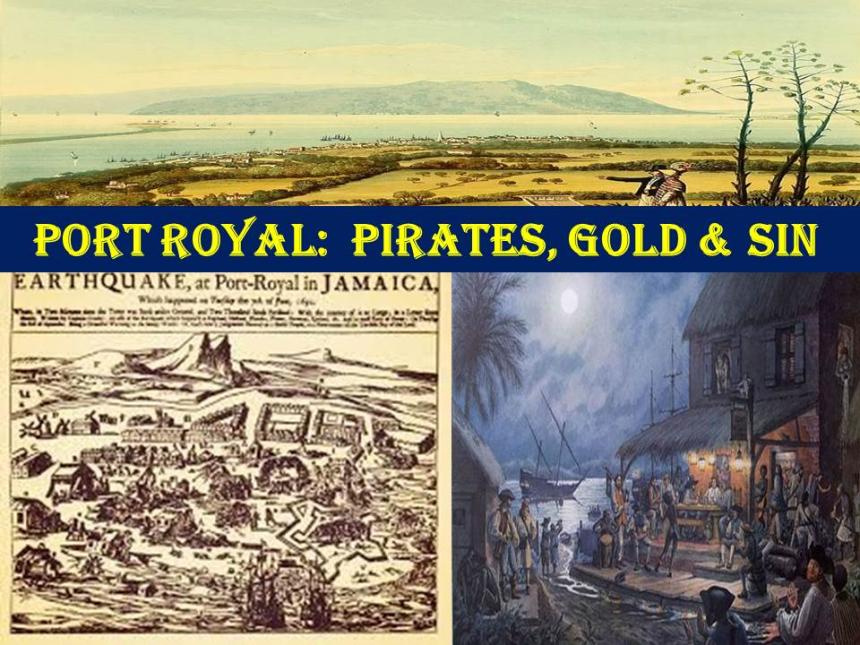

PORT ROYAL: PIRATES, GOLD & SIN
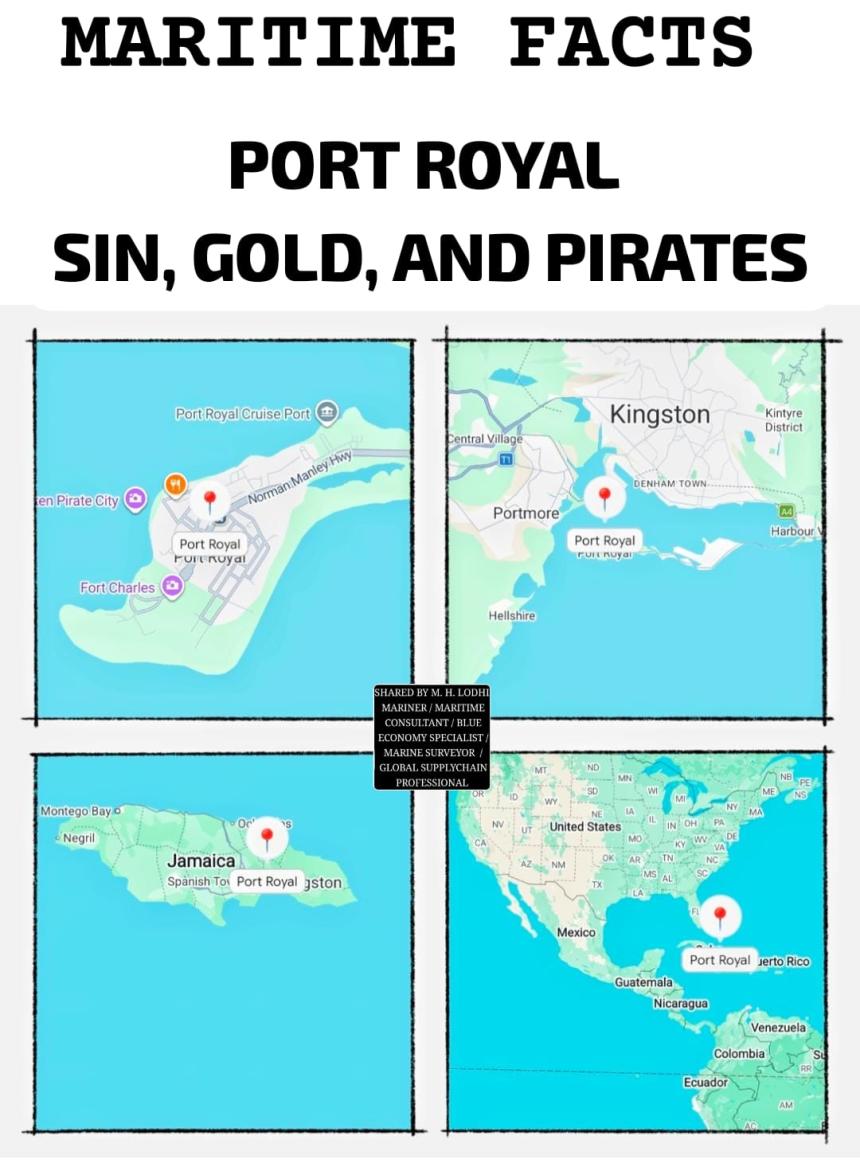
Port Royal, Jamaica, was once a booming 17th-century English (England today) hub. Famously dubbed "the wickedest city on earth," it thrived as a haven for pirates and privateers who plundered Spanish gold. Today, it is largely a submerged archaeological site following a catastrophic 1692 earthquake and tsunami. This write up is about "PORT ROYAL: PIRATES, GOLD & SIN" and explains the rise and fall of once a "Maga City".
أَعُوذُ بِاللّٰهِ مِنَ الشَّيْطَانِ الرَّجِيمِ
بِسۡمِ ٱللهِ ٱلرَّحۡمَـٰنِ ٱلرَّحِيمِ
اللہ کے نام سے شروع جو بڑا مہربان نہایت رحم کرنے والا ہے
In the name of ALLAH, the Most Gracious, the Most Merciful
PORT ROYAL: PIRATES, GOLD & SIN
Port Royal, Jamaica, was once a booming 17th-century English (England today) hub. Famously dubbed "the wickedest city on earth," it thrived as a haven for pirates and privateers who plundered Spanish gold. The English actively encouraged buccaneers and privateers to operate out of Port Royal. These privateers plundered Spanish ships and territories while enriching the local British government officials and merchants. Flushed with vast amounts of pirate-looted treasure, it became one of the richest and most important English towns in the New World, functioning as a hub for the trade of slaves, sugar, and logwood. Its reputation for rampant debauchery, pirates, and loose morals earned it the nickname "the Sodom of the New World". Today, it is largely a submerged archaeological site following a catastrophic 1692 earthquake and tsunami.
The City of Gold and Sin
Port Royal, Jamaica, was a legendary 17th-century boomtown and pirate haven famously dubbed "the wickedest city on earth". Fueled by privateering wealth, the city was infamous for its lavish lifestyle, taverns, and brothels. Its sudden destruction by a catastrophic earthquake and tsunami in 1692 swallowed half the city into the sea.
Port Royal’s infamous outlaw economy was a calculated, state-sponsored system where English privateers laundered looted Spanish wealth into respectable merchant capital. Driven by piracy and an explosive demand for services, the city transformed from a peripheral outpost into the financial center of the English Atlantic. In the late 1600s, Port Royal was one of the largest and most lucrative European's towns in the New World. Plundered Spanish gold and silver flowed freely, turning the port into a booming epicenter for merchants, taverns, and brothels catering to wealthy buccaneers.
Unlike traditional colonies, Port Royal's early economy was intentionally designed to support buccaneering. The engine of this system relied on several key dynamics as shown below:-
State-Sanctioned Plunder: Through "Letters of Marque," the English government essentially licensed piracy, giving buccaneers legal cover to raid Spanish shipping lanes.
The "Laundering" Process: Port Royal acted as a massive clearinghouse where plundered gold and silver were rapidly spent on everyday goods, supplies, and real estate, allowing ill-gotten gains to enter the legitimate economy.
Hyper-Inflation and Spending: Wealth poured into the town faster than anywhere else in the Americas. Plunderers frequently paid exorbitant prices—such as an entire year's working-class salary for a single barrel of wine—creating a booming local market for taverns, gambling dens, and outfitters.
The Transition to Legitimate Commerce: As the town's strategic importance grew, the economy shifted from pirate-dependent plunder to institutionalized trading, with the profitable exchange of sugar and enslaved laborers taking center stage.
Alcohol Flowed Like Water (Literally): Wealthy pirates bought entire wine barrels, forced passersby to drink at gunpoint, and drank rum because it was cheaper than fresh water.
A Pocket Watch Froze the Moment of Destruction: The Artifact: Archaeologists recovered an encrusted brass watch with silver hands permanently stopped at 11:43 AM the exact minute the disaster struck.
Pristine "Catastrophe Capsule": The Preservation: The harbor's oxygen-depleted silt sealed the sunken town in an airtight tomb, perfectly preserving delicate 17th-century organic materials like leather and wood.
Horatio Nelson Once Commanded Its Fort: The Naval Shift: Post-piracy, Britain turned the port into a disciplined Royal Navy station where a 20-year-old Horatio Nelson commanded Fort Charles in 1779.
1907 Earthquake Solidified Its Downfall: The End: After surviving fires and hurricanes, a final massive earthquake in 1907 permanently shattered Port Royal’s commercial hopes, shifting all major trade to Kingston.
The Pirate Capital
In the latter half of the 17th century, Port Royal served as the most important home base for buccaneers ravaging the Caribbean. Sponsoring criminals legally through letters of marque, the British Empire encouraged pirates to plunder Spanish merchant ships, making it an unimaginably wealthy trading hub. With nearly as many taverns as homes, it operated as the "Las Vegas of the 17th century," awash in stolen Spanish gold, "Kill Devil" rum, and unchecked debauchery.
In the 17th century, Port Royal was the headquarters of the numerous swashbuckling scoundrels that plundered the high seas and to defend Jamaica from Spanish recapture, English authorities welcomed privateers. Figures like Captain Henry Morgan used Port Royal as their headquarters before being knighted and later appointed as governor of Jamaica. Few more famous pirates to be associated with Port Royal are Calico Jack Rackham and Edward Blackbeard Teach.
Divine Retribution: The Day the Earth Swallowed Port Royal
On June 7, 1692, the party abruptly ended. At 11:43 a.m., a massive 7.5 magnitude earthquake struck Jamaica. Because the city was built on an unstable, sandy spit, the tremors caused intense soil liquefaction. Entire streets, taverns, and homes sank into the sea within minutes, followed immediately by devastating tsunami waves. Entire city blocks—along with their thousands of inhabitants, warehouses, and taverns—slid straight into the Kingston Harbor. The disaster killed roughly 2,000 people instantly, and survivors suffered through a disease outbreak shortly after. Many contemporaries and clergy members hailed the cataclysm as direct divine retribution for the city's rampant wickedness.
Sunken History Today
Today, about 60 percent of the original 17th-century town lies submerged up to 40 feet beneath the harbor's surface. The site is often referred to as an "underwater Pompeii" because the rapid sinking preserved "everyday artifacts", streets, foundations, pipes, and intact artifacts. For visitors and history buffs, the surviving terrestrial portion of Port Royal offers several historical attractions; such as "Fort Charles"; the primary English fortress that defended the harbor and "The Giddy House"; originally the Royal Artillery storehouse, this 1888 brick building was famously tilted at a severe angle by an earthquake in 1907.
Visitors walking inside experience a disorienting sensation of swaying due to the optical illusion of the slanted walls. Underwater archaeologists, notably in expeditions with Texas A&M University, have recovered intact pipes, pottery, and coins. One of the most famous discoveries is an antique pocket watch stopped at exactly 11:43, the moment the quake struck. While diving the restricted sunken ruins requires special governmental permission, salvaged artifacts can be viewed at the Museums of History and Ethnography at the Institute of Jamaica in Kingston.
The Concluding Remarks
The above details about Port Royal mention "Spain’s dominance"; and Spain in the 1700s was defined by its massive global empire. While dominance peaked earlier, the 1700s saw Spain’s transition from Habsburg to Bourbon rule, modernizing its administration, and fighting global conflicts to maintain vast territories in the Americas and Asia. One must recall that Spain is the same country that was ruled by Muslims and was made a center of civilization in European Continent, symbolizing Islamic influence of Hijaz (Makkah and Medina Centric). Spain attracted wealth (knowledge, gold and silver) through trade from land and sea by Muslims and Non Muslim Caravans towards it shores from China, India and Africa. The Fall of Granada in 1492 marked the end of centuries of Islamic rule in Spain at the hands of the Catholic Monarchs, Ferdinand and Isabella and concluded the Reconquista. This resulted in forced conversions, persecutions, and the eventual expulsion of Muslims and attracted the European Pirates to reach for Spain and carry out loot and plunder the riches created by Muslims through all possible illegal means.
In the 17th century, Port Royal was under the control of the England; after capturing from the Spanish in 1655. It served as a highly prosperous, albeit notorious, British colonial hub before being largely destroyed by a catastrophic earthquake in 1692. English (UK), then was not a rich empire. The UK's economy in the 1700s was defined by a critical transition from an agrarian, rural-based society into the world's first industrialized nation. At the start of the century, it relied heavily on agriculture and the cottage textile industry, and Port Royal and Piracy was a source for gathering wealth (gold and silver). The colonial conquest of Africa and Asia was first mastered in Atlantic Ocean and Port Royal was a flag post, albeit Pirate Capital.
Ultimately, Port Royal’s legacy is defined by its dramatic transition from supreme maritime wealth (symbolized by pirates, gambling dens, brothels; flowing wines, debauchery and loose morals) to an overnight archaeological treasure. Once a strategic naval stronghold and a lawless sanctuary for history's most notorious pirates, the city’s destiny was completely rewritten by the cataclysmic 1692 earthquake. By instantly swallowing two-thirds of the bustling brick metropolis into Kingston Harbour, the disaster created an unparalleled, airtight underwater time capsule. Today, Port Royal stands as a monumental site for marine archaeology, offering the world an immaculate, undisturbed glimpse directly into the daily life, commerce, and chaotic reality of the 17th-century Caribbean.
The Conclusion
The colonial powers, be it Britishers, French or Portuguese, were initially pirates and Port Royal symbolizes their actual past and inherent attributes. The state-sponsored violence, economic ambition, and illicit plunder heavily defined the initial expansion of all the colonial powers. In the early days of colonization, the acquisition of wealth was precarious and European Empires were poor and weak; and they wanted to attain the wealth available in distant lands of India and China.
Spain had an established dominance (due Muslim Rule) and European crowns frequently issued "letters of marque" to wrest control from Spain and other rival countries. These licenses officially authorized private ships (privateers) to attack, loot, and confiscate cargo (to possess gold and silver) from rival nations' ships and coastal settlements. Those governments lacking the naval resources for colonial control, turned a blind eye or actively encouraged this legalized piracy to build their empires on the cheap. Port Royal, Jamaica, serves as a prime, tangible symbol of this historical reality.
The Port Royal also symbolizes the maritime trade, undertaken with moral codes, turned into piracy. The Muslims traders were sailing through all the seas and conducting marine trade with religious alacrity and after the fall of Muslim Grenada into the hands of the Catholic Monarchs, the Spanish dominance soon became a game of piracy for illicit trade for loot and plunder.
The Modular Business: Building a Company by Combining Virtual Offices,...

Best cancer care treatment Hospitals India
Best cancer care treatment Hospitals India