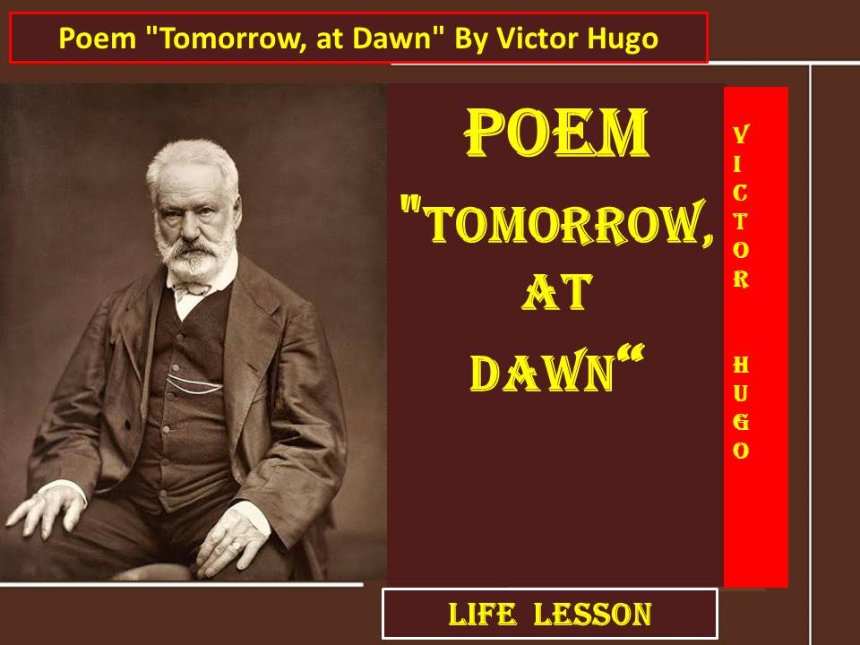

Poem "Tomorrow, at Dawn" By Victor Hugo
Victor Hugo (1802–1885) was a towering figure of 19th-century French literature and the leading voice of the Romantic movement. Celebrated worldwide for his monumental novels Les Misérables and The Hunchback of Notre-Dame, he was equally revered in France as a prolific poet, playwright, and essayist. Today, he remains an enduring symbol of French cultural heritage and intellectual freedom. Poem "Tomorrow, at Dawn" is the profound, inescapable weight of grief and the enduring bond of love that transcends death. This write up is about the poem and has been arranged for educational purposes from material available freely on Web Net.
أَعُوذُ بِاللّٰهِ مِنَ الشَّيْطَانِ الرَّجِيمِ
بِسۡمِ ٱللهِ ٱلرَّحۡمَـٰنِ ٱلرَّحِيمِ
اللہ کے نام سے شروع جو بڑا مہربان نہایت رحم کرنے والا ہے
In the name of ALLAH, the Most Gracious, the Most Merciful
Poem "Tomorrow, at Dawn" By Victor Hugo
Victor Hugo (1802–1885) was a towering figure of 19th-century French literature and the leading voice of the Romantic movement. Celebrated worldwide for his monumental novels Les Misérables and The Hunchback of Notre-Dame, he was equally revered in France as a prolific poet, playwright, and essayist. His personal life was marked by immense tragedy. Beyond literature, Hugo was a passionate political activist and statesman who staunchly defended democracy and campaigned against social injustice and the death penalty. Today, he remains an enduring symbol of French cultural heritage and intellectual freedom.
"Tomorrow, at Dawn" is one of the most striking poems in French literature, written by the great Victor Hugo. "Tomorrow, at Dawn" (Demain, dès l'aube) is a deeply moving 1847 poem by Victor Hugo, published in his 1856 collection Les Contemplations. Written on the fourth anniversary of his eldest daughter Léopoldine's tragic drowning, the poem describes a solitary journey through the countryside. While the opening stanzas misdirect the reader into thinking the speaker is visiting a lover, the final lines reveal a heartbreaking pilgrimage to her grave, where he places a bouquet of holly and heather in eternal remembrance.
The central idea of "Tomorrow, at Dawn" is the profound, inescapable weight of grief and the enduring bond of love that transcends death. Through the description of his solitary journey, Hugo explores several key concepts:-
• Grief as an Isolation Chamber: The speaker is completely detached from the beauty of the world around him. He walks with his eyes fixed on his thoughts, seeing neither the gold of the sunset nor the sails of distant ships, illustrating how intense mourning cuts a person off from reality.
• Love Beyond the Grave: The exhausting physical journey represents a relentless, unavoidable pilgrimage. Death cannot break the connection between the father and his daughter; his entire focus is simply to reach her.
• The Contrast of Nature vs. Sorrow: Nature continues its beautiful, objective cycles—the dawn breaks, the sun sets—completely indifferent to human suffering. The speaker contrasts this by carrying his own internal darkness.
Ultimately, the poem captures the bittersweet reality of mourning: a painful journey fueled by a love that refuses to forget.
Poem "Tomorrow, at Dawn" By Victor Hugo- Summary
The poem is a beautifully structured monologue where a speaker describes a solitary journey that begins at daybreak.
• The Journey Begins: The speaker declares that tomorrow at dawn, he will leave for the countryside. He describes the path he will take through the woods and over the mountains, driven by an urgent need to reach someone who is waiting for him.
• The Walk in Solitude: As he walks, he is entirely consumed by his own thoughts. He walks with his back bent, his hands crossed, and his eyes fixed on the ground. He is completely blind and deaf to the world around him, feeling lonely and sad. He notes that for him, day looks exactly like night.
• Indifference to Nature: He passes by beautiful sights without noticing them. He cares nothing for the gold of the evening sky, nor the ships sailing down toward Harfleur.
• The Reveal: In the final lines, the true destination is revealed. The speaker arrives not at a lover's home, but at a cemetery. The poem concludes with him placing a humble tribute—a bouquet of green holly and flowering heather—upon a grave.
Poem "Tomorrow, at Dawn" By Victor Hugo
Tomorrow, at dawn, at the hour when the countryside whitens,
I will set out. You see, I know that you wait for me.
I will go by the forest, I will go by the mountain.
I can no longer remain far from you.
I will walk with my eyes fixed on my thoughts,
Seeing nothing of outdoors, hearing no noise
Alone, unknown, my back curved, my hands crossed,
Sorrowed, and the day for me will be as the night.
I will not look at the gold of evening which falls,
Nor the distant sails going down towards Harfleur,
And when I arrive, I will place on your tomb
A bouquet of green holly and of flowering heather.
Poem "Tomorrow, at Dawn" By Victor Hugo - Lessons Learnt
Several profound life lessons and insights into the human condition can be drawn from Victor Hugo's poem:
• Love persists beyond death: The poem teaches that death does not end a relationship. The speaker’s grueling, dedicated trek shows that loving someone means continuing to honor and visit their memory, even when they are no longer physically present.
• Grief fundamentally alters our perception: Hugo illustrates how deep sorrow creates an internal world that completely shuts out external reality. When experiencing profound loss, a person can become blind and deaf to the beauty around them, showing that healing from grief takes time and deep emotional isolation is a natural part of mourning.
• Nature is indifferent to human suffering: The sun still rises, dawn still breaks, and ships continue to sail regardless of the speaker's broken heart. The poem highlights the contrast between a universe that moves on and a human heart that stands still in grief, reminding us that the world does not pause for our personal tragedies.
• Devotion requires action and effort: The act of physically walking across mountains and through woods serves as a metaphor for the effort required to maintain bonds. True devotion is active; it is a journey we choose to make for those we love, requiring sacrifice and endurance.
• True tribute lies in simplicity: At the end of his long, exhausting journey, the speaker does not offer a grand, expensive monument. Instead, he places a simple bouquet of wild holly and heather. This teaches that the most meaningful tributes to those we have lost are humble, quiet, and deeply personal.
The Conclusion
The ultimate conclusion of "Tomorrow, at Dawn" is that grief is an exhausting, isolating journey, but love ultimately triumphs over death through the act of remembrance. By analyzing how the poem builds to its final lines, we can draw a few definitive conclusions:-
• Love is stronger than the grave: The poem concludes that death cannot truly separate people who love each other. The speaker’s relentless march proves that the bond between a father and daughter remains active, powerful, and central to his life, even years after her passing.
• Mourning changes how we experience existence: Hugo forces us to conclude that profound loss completely rewrites a person's relationship with the world. The speaker becomes a ghost passing through life—blind to beauty, deaf to the world, and trapped in an internal landscape where day and night look exactly the same.
• Peace is found in quiet tribute: The final action of the poem—placing a humble bouquet of holly and heather on the grave—concludes the journey not with dramatic despair, but with a quiet, solemn acceptance. It suggests that while the pain of loss never truly leaves us, we find purpose and peace by honoring and tending to the memories of those we love.
Tandem Press Brakes: Powerful Forming for Long and Large Workpieces
<p>A tandem press brake combines two synchronized press brakes to create a forming solutio...



Unlock 99 OVR Cam Schlittler in MLB The Show 26 With U4GM
MLB The Show 26's 99 OVR Cam Schlittler is a strong addition to the 2026 Finest 1 Program,...

Meowdoku: use the fixed cat before making a guess
A practical introduction to cat-placement logic, region candidates and notes in an indepen...
