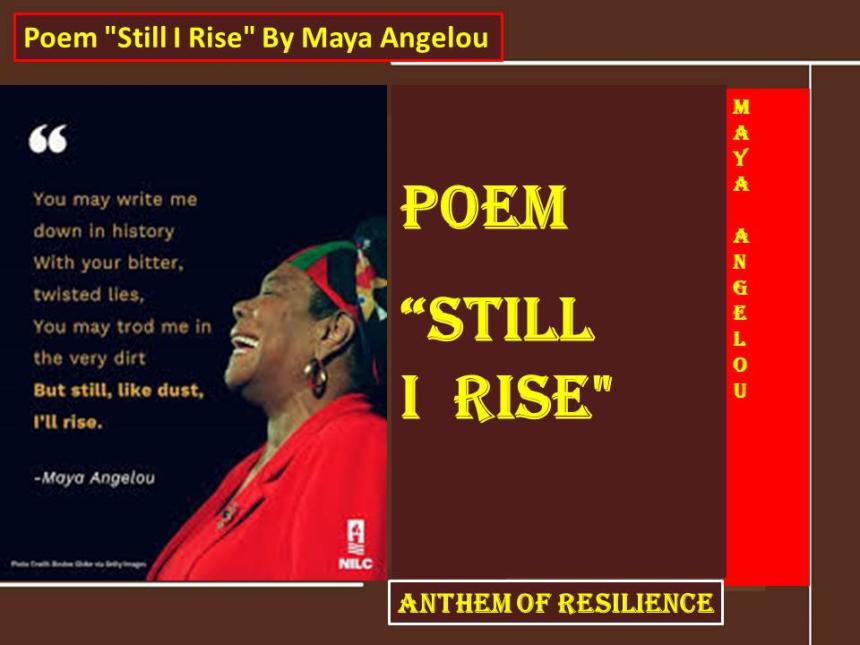

Poem "Still I Rise" By Maya Angelou
Maya Angelou (1928 – 2014) was an American memoirist, essayist, poet, and civil rights activist. She published seven autobiographies, three books of essays, and several books of poetry spanning over 50 years. Maya Angelou’s "Still I Rise" is a resounding anthem of resilience, self-love, and empowerment. This write up has been arranged for educational purpose.
أَعُوذُ بِاللّٰهِ مِنَ الشَّيْطَانِ الرَّجِيمِ
بِسۡمِ ٱللهِ ٱلرَّحۡمَـٰنِ ٱلرَّحِيمِ
In the name of ALLAH, the Most Gracious, the Most Merciful
Poem "Still I Rise" By Maya Angelou
Maya Angelou (April 4, 1928, St. Louis, Missouri, United States - May 28, 2014, Winston-Salem, North Carolina, United States) was an American memoirist, essayist, poet, and civil rights activist. She published seven autobiographies, three books of essays, several books of poetry, and is credited with a list of plays, movies, and television shows spanning over 50 years. Maya Angelou's real name was Marguerite Annie Johnson. She adopted the professional name "Maya Angelou" in the 1950s. "Maya" was a childhood nickname given to her by her brother, and "Angelou" is a variation of her first husband's surname, Tosh Angelos.
Maya Angelou's "Still I Rise" is a powerful poem that draws on a range of influences, including her personal background and the African American experience in the United States. Its message of liberation and survival was a consistent theme in Angelou's work. Maya Angelou’s "Still I Rise" is a resounding anthem of resilience, self-love, and empowerment. It asserts that despite histories of oppression, racism, and bitter hatred, marginalized individuals will continuously and triumphantly rise above their circumstances with dignity and unshakable confidence.
The poem can be broken down into these core meanings:-
1. Unstoppable Resilience
Defiance of nature: Angelou compares her ability to rise to unstoppable natural phenomena like dust and air. Just as dust cannot be permanently pressed down, her spirit and the spirit of her community cannot be crushed.
Reclaiming history: The opening lines address oppressors who attempt to rewrite history with "bitter, twisted lies" and drag her in the "very dirt". She dismisses these attempts, treating them as temporary obstacles she will inevitably overcome.
2. Radical Self-Worth and Pride
Refusing the victim narrative: The speaker outright refuses to show physical or emotional defeat—such as walking with lowered eyes, bowed shoulders, or crying. Instead, she walks with the confidence of someone who has "gold" in her backyard.
Body positivity: In the latter half, Angelou celebrates her physical form, particularly the full, proud curves of her body—a direct challenge to Eurocentric beauty standards and historical fetishization of Black women.
3. Empowerment and Triumph
The "I Rise" mantra: The repetition of "I rise" acts as a rhythmic mantra, building a tone of amused, cool confidence. She knows her oppressors want to see her broken, but she chooses to treat her pain as fuel for her success.
A collective voice: While the poem is highly personal, the "I" transforms into a universal voice for all historically oppressed people, symbolizing a collective journey from darkness into light.
"You may kill me with your hatefulness, But still, like air, I'll rise"
Still I Rise” is primarily about self-respect and confidence. In the poem, Angelou reveals how she will overcome anything through her self-esteem. She shows how nothing can get her down. She will rise to any occasion and nothing, not even her skin color, will hold her back. The message of Maya Angelou's "Still I Rise" is a triumphant declaration of resilience, self-empowerment, and unyielding dignity. It conveys that marginalized people will inevitably overcome oppression, hatred, and systemic attempts to break them, rising above adversity with unwavering confidence and strength.
Central Theme of Poem "Still I Rise" by Maya Angelou
The central theme of Maya Angelou's "Still I Rise" is defiant resilience in the face of oppression, racism, and sexism. The poem celebrates personal empowerment, self-worth, and the strength to overcome systemic injustice and historical trauma. The speaker addresses an oppressive, often racist, dominant society ("you") that attempts to suppress, demean, and break her. Despite constant efforts to tear her down with "bitter, twisted lies" or hateful actions, she responds with bold defiance. The repetition of the phrase "I rise" underscores her refusal to submit to prejudice.
Angelou draws a direct line from the historical trauma of her ancestors—referencing slavery as "huts of history's shame"—to the present day. The theme of resilience bridges individual struggle to a broader legacy of survival. By rising like "dust" and the "ocean," the speaker proves that the endurance of marginalized people is as inevitable as natural forces.
The poem is also a fierce celebration of Black womanhood and unapologetic self-love. The speaker's confidence, "sassiness," and joy directly challenge societal expectations that marginalized people should appear downtrodden or submissive. Her proud, upright posture is a powerful rejection of shame.
Poem "Still I Rise" By Maya Angelou
You may write me down in history
With your bitter, twisted lies,
You may trod me in the very dirt
But still, like dust, I’ll rise.
Does my sassiness upset you?
Why are you beset with gloom?
’Cause I walk like I’ve got oil wells
Pumping in my living room.
Just like moons and like suns,
With the certainty of tides,
Just like hopes springing high,
Still I’ll rise.
Did you want to see me broken?
Bowed head and lowered eyes?
Shoulders falling down like teardrops,
Weakened by my soulful cries?
Does my haughtiness offend you?
Don’t you take it awful hard
’Cause I laugh like I’ve got gold mines
Diggin’ in my own backyard.
You may shoot me with your words,
You may cut me with your eyes,
You may kill me with your hatefulness,
But still, like air, I’ll rise.
Does my sexiness upset you?
Does it come as a surprise
That I dance like I’ve got diamonds
At the meeting of my thighs?
Out of the huts of history’s shame
I rise
Up from a past that’s rooted in pain
I rise
I’m a black ocean, leaping and wide,
Welling and swelling I bear in the tide.
Leaving behind nights of terror and fear
I rise
Into a daybreak that’s wondrously clear
I rise
Bringing the gifts that my ancestors gave,
I am the dream and the hope of the slave.
I rise
I rise
I rise.
Summary of Poem "Still I Rise" By Maya Angelou
You have the ability to shape how history remembers me with your hurtful, warped lies. You have the power to walk all over me, crushing me into the dirt itself. But even so, I will rise up from the ground just as dust rises from the earth.
Does my bold and cheeky attitude offend you? Why are you so miserable? Maybe it's because of the confident way I walk, as if I had oil wells right in my living room.
I am like the moon and the sun, the rises of which are as inevitable as the rise of ocean tides. Just like high hopes, I will keep rising.
Were you hoping to see me looking sad and defeated? Did you want to see me in a submissive posture, with my head bent and eyes looking down rather than up at you? Did you want to see my shoulders slouching down in the same way that tears fall down, my body having been weakened by all my intense sobbing?
Is my pride making you mad? Are you so upset because I am so happy and joyful that it seems as though I must have gold mines in my own backyard?
You have the ability to shoot at me with your words, which are like bullets. You have the ability to cut me with your sharp glare. You may even kill me with your hatred. Nevertheless, just as the air keeps rising, I will keep rising.
Does my sex appeal make you upset? Are you taken aback by the fact that I dance as though I have precious gems between my legs?
I rise up out of history's shameful act of slavery. I rise up from this deeply painful past. I am as vast and full of power as a dark ocean that rises and swells and carries in the tide.
I rise up, and in doing so leave behind all the darkness of terror and fear. I rise up, and in doing so enter a bright morning that is full of joyful wonder. With the personal qualities and grace I inherited from my ancestors, I embody the dreams and hopes of past enslaved peoples. I will rise, and rise, and rise.
Stanza Wise Explanation of Poem "Still I Rise" By Maya Angelou
Stanza 1. In this stanza, Maya Angelou gives her heart and soul to declare that nothing and no one could oppress her or keep her down. She doesn’t care what the history books saw, for she knows they are full of “twisted lies.” She will not let it bother her that others “trod” her “in the very dirt.” She proclaims that if she is trodden in the dirt, she will rise like dust.
Stanza 2. In the second stanza, she asks a question. This is an interesting question, as she refers to her own tone as “sassiness” and asks the hearer if her sassy tone is upsetting. The poet notices that the people around her in her society are “beset with gloom” when she succeeds. She questions this. She knows that she is succeeded in life, in her writing, and as a woman. The “oil wells pumping in [her] living room” symbolize her success.
Stanza 3. In this stanza, she compares herself to the moon and the sun as they are affected by the tides. This gives the reader the understanding that the speaker has no other choice but to rise out of her affliction. Try as a society might keep her oppressed, it is in her nature to rise and stand against oppression just as it is the nature of the tides to respond to the moon.
Stanza 4. The speaker’s questions in this stanza are direct, pertinent, and appropriately accusing. She knows that her own success is received with bitterness by the racist people in her society. So she directs these questions at a society that has long tried to keep her oppressed. She asks them if they want to see her broken, oppressed, depressed, and bitter.
She asks these questions know that this indeed is what many in society wanted. They did not want to see a black woman rise out of the oppression of her society and succeed. The speaker knows this and she draws attention to it with these revealing, yet cutting questions.
Stanza 5. She continues with the questions directed at a racist society when she asks whether her “haughtiness” is offensive. She knows that society resents seeing a black woman full of pride. This question has an air of sarcasm which serves to point out the hypocrisy of society as it is embittered by the success of one that it has tried to oppress. The speaker continues in a sarcastic tone as she pretends to comfort the hearer.
The poet says, “don’t you take it awful hard.” This is her sarcastic way of pretending to care for those who resent her success. She continues, however, to in a sense “flaunt” her success before the society that has always oppressed her. She claims that she has “gold mines” and that she laughs at the success she has found.
Stanza 6. In this stanza, she lets society know that no matter what it does to oppress her, it will not succeed. The poet lets society know that it cannot prevail against her with words or looks. She proclaims that society cannot prevail against her even if it managed to have her killed because of its hatefulness. She claims that she will still “like air” rise.
Stanza 7. The speaker continues her questioning of society. By this time in the poem, it becomes apparent that the speaker has placed society on trial and is now in the process of cross-examination. She knows the answers to these questions, but to ask them is to incriminate the offender. While she asks incriminating questions, she simultaneously reveals incredible self-confidence despite the oppression of society.
Stanza 8. In this stanza, the speaker finally refers to the past- the reason that she is oppressed and resented to this day. She calls slavery “history’s shame” and she proclaims that she will not be held down by the past, even if it is “rooted in pain.”
Stanza 9. In the final stanza, the speaker reveals that she intends to leave behind all the effects of slavery and the history of oppression with the intent to rise above it. She claims that she will leave behind the “terror and fear” and that she will rise above the pain and the oppression “Into a daybreak that’s wondrously clear.”
The speaker does not intend to allow the hatefulness of society or the pain of the past to stop her from becoming all that she ever dreamed of being. For this reason, she repeats three times, “I rise.”
The Conclusion
The moral of Maya Angelou's poem "Still I Rise" is that resilience, unshakeable self-worth, and self-love are the ultimate triumphs over oppression and hate. It teaches that marginalized voices cannot be permanently broken by adversity. In an interview in 1997, Angelou stated that she used the poem to sustain herself in hard times. Therefore, every one may get inspiration for the same reasons.
The poem "Still I Rise" by Maya Angelou teaches us that true human dignity and honour comes from self empowerment; which then propels an individual facing oppression, hatred, and adversity. The poem demonstrates that one can triumph over all kinds of adversity by maintaining unyielding confidence, dignity, and unapologetic pride.
NOTE: This write up has been compiled with the help of material available freely on web net from various sources for educational purposes.
How Can Software Development Companies in Kuwait Automate Business Wor...
Discover how a software development company in Kuwait can automate manual workflows, reduc...


Do Window Graphics Block Sunlight? A Guide to Light, Privacy, and Visi...



¿Qué debe saber antes de comprar Kamagra en línea?
No debes confundir la popularidad de un producto con su seguridad. Antes de utilizarlo, co...