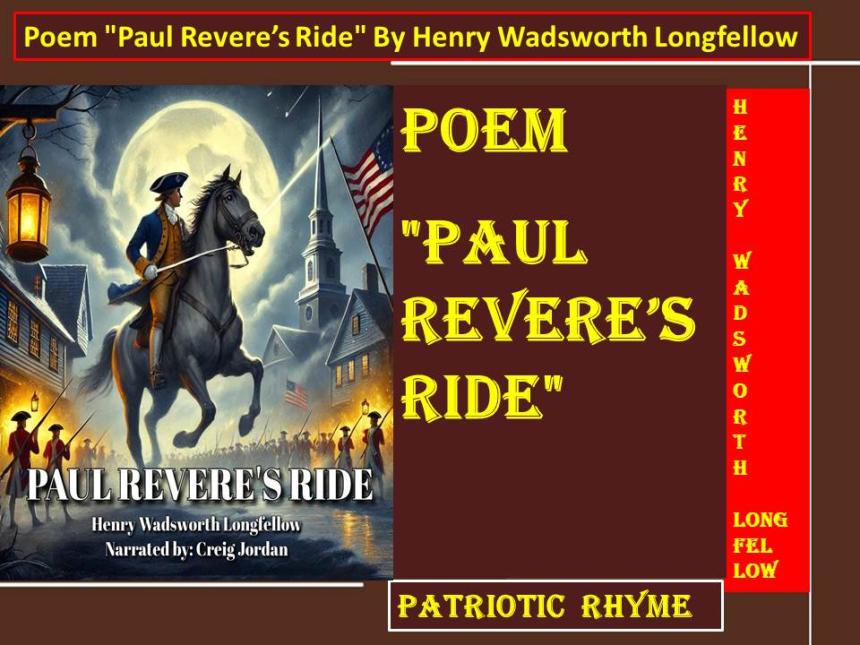

Poem "Paul Revere’s Ride" By Henry Wadsworth Longfellow
Henry Wadsworth Longfellow (1807- 1882) was an American poet and educator. Henry Wadsworth Longfellow wrote several celebrated poems, but his most famous and enduringly popular work is "Paul Revere's Ride". Poem "Paul Revere's Ride" is about patriotism and defending freedom. The poem was written to inspire unity. This write up has been arranged for educational purposes.
أَعُوذُ بِاللّٰهِ مِنَ الشَّيْطَانِ الرَّجِيمِ
بِسۡمِ ٱللهِ ٱلرَّحۡمَـٰنِ ٱلرَّحِيمِ
In the name of ALLAH, the Most Gracious, the Most Merciful
Poem "Paul Revere’s Ride" By Henry Wadsworth Longfellow
Henry Wadsworth Longfellow (February 27, 1807, Portland, Maine, United States - March 24, 1882, Cambridge, Massachusetts, United States) was an American poet and educator. Henry Wadsworth Longfellow wrote several celebrated poems, but his most famous and enduringly popular work is "Paul Revere's Ride". The poem written in 1860, is spoken by the landlord of the Wayside Inn and tells a partially fictionalized story of Paul Revere. In the poem, Revere tells a friend to prepare signal lanterns in the Old North Church to inform him whether British forces will come by land or sea.
The primary theme of Henry Wadsworth Longfellow’s poem "Paul Revere's Ride" is patriotism and the power of individual action in defending freedom. The poem was written when the US nation was fracturing on the brink of the Civil War, it sought to inspire unity and remind Americans of their shared, heroic revolutionary history.
The Poem "Paul Revere’s Ride" By Henry Wadsworth Longfellow centers on how one person's courage and urgency can spark a massive movement and shape the destiny of a nation. It emphasizes the moment when waiting ends and decisive action is required to stand up for one's beliefs. Revere's ride symbolizes resistance against oppressive rule, showcasing bravery in the face of daunting odds.
The central theme of "Paul Revere's Ride" by Henry Wadsworth Longfellow is the monumental impact of individual courage and action on history. It highlights how one person's bravery can inspire a nation, ignite a movement for freedom, and preserve liberty during times of darkness.
The poem "Paul Revere’s Ride" By Henry Wadsworth Longfellow champions the revolutionary spirit and collective determination of American colonists fighting against oppression. Longfellow uses the imagery of a horse’s spark on the cobblestone to illustrate how a single, seemingly small action can “kindled the land into flame” and launch a revolution.
The poem "Paul Revere’s Ride" By Henry Wadsworth Longfellow, framed as a tale told to future generations, emphasizes that the courage of the past should continue to inspire and unite people. Longfellow wrote this in 1860 as the United States approached the Civil War, using it as a deliberate call to action to remind his 19th-century audience of the foundational values of American freedom.
Summary of Poem "Paul Revere’s Ride" By Henry Wadsworth Longfellow
Henry Wadsworth Longfellow’s "Paul Revere’s Ride" is a narrative poem that recounts the famous American Revolution event. It follows patriot Paul Revere as he embarks on a frantic midnight ride on April 18, 1775, to warn colonists of advancing British troops prior to the battles of Lexington and Concord. The poem’s narrative structure breaks down into four main beats:-
The Signal Setup: Before leaving Boston, Paul Revere instructs an unnamed friend to hang lanterns in the steeple of the Old North Church as a warning system. The signal is a famous rule: "One if by land, and two if by sea".
The Gleam of Light: Revere waits anxiously on the Charlestown shore while his friend climbs the church tower. When his friend spots the British crossing the river, he lights two lanterns—signaling they are coming by sea.
The Ride: Upon seeing the signal, Revere mounts his horse and gallops at breakneck speed through the night. He rides through Medford, Lexington, and Concord, warning farmers and villagers to arm themselves and prepare for battle.
Historical Legacy: Published in 1861 on the eve of the American Civil War, the poem serves as a patriotic call to action. The final lines suggest that in times of peril, Revere’s message of defiance and liberty will always awaken the people to defend their freedom.
Poem "Paul Revere’s Ride" By Henry Wadsworth Longfellow
Listen, my children, and you shall hear
Of the midnight ride of Paul Revere,
On the eighteenth of April, in Seventy-Five:
Hardly a man is now alive
Who remembers that famous day and year.
He said to his friend, “If the British march
By land or sea from the town to-night,
Hang a lantern aloft in the belfry-arch
Of the North-Church-tower, as a signal-light,—
One if by land, and two if by sea;
And I on the opposite shore will be,
Ready to ride and spread the alarm
Through every Middlesex village and farm,
For the country-folk to be up and to arm.”
Then he said “Good night!” and with muffled oar
Silently rowed to the Charlestown shore,
Just as the moon rose over the bay,
Where swinging wide at her moorings lay
The Somerset, British man-of-war:
A phantom ship, with each mast and spar
Across the moon, like a prison-bar,
And a huge black hulk, that was magnified
By its own reflection in the tide.
Meanwhile, his friend, through alley and street
Wanders and watches with eager ears,
Till in the silence around him he hears
The muster of men at the barrack door,
The sound of arms, and the tramp of feet,
And the measured tread of the grenadiers
Marching down to their boats on the shore.
Then he climbed to the tower of the church,
Up the wooden stairs, with stealthy tread,
To the belfry-chamber overhead,
And startled the pigeons from their perch
On the sombre rafters, that round him made
Masses and moving shapes of shade,—
By the trembling ladder, steep and tall,
To the highest window in the wall,
Where he paused to listen and look down
A moment on the roofs of the town,
And the moonlight flowing over all.
Beneath, in the churchyard, lay the dead,
In their night-encampment on the hill,
Wrapped in silence so deep and still
That he could hear, like a sentinel’s tread,
The watchful night-wind, as it went
Creeping along from tent to tent,
And seeming to whisper, “All is well!”
A moment only he feels the spell
Of the place and the hour, and the secret dread
Of the lonely belfry and the dead;
For suddenly all his thoughts are bent
On a shadowy something far away,
Where the river widens to meet the bay,—
A line of black, that bends and floats
On the rising tide, like a bridge of boats.
Meanwhile, impatient to mount and ride,
Booted and spurred, with a heavy stride,
On the opposite shore walked Paul Revere.
Now he patted his horse’s side,
Now gazed on the landscape far and near,
Then impetuous stamped the earth,
And turned and tightened his saddle-girth;
But mostly he watched with eager search
The belfry-tower of the old North Church,
As it rose above the graves on the hill,
Lonely and spectral and sombre and still.
And lo! as he looks, on the belfry’s height,
A glimmer, and then a gleam of light!
He springs to the saddle, the bridle he turns,
But lingers and gazes, till full on his sight
A second lamp in the belfry burns!
A hurry of hoofs in a village-street,
A shape in the moonlight, a bulk in the dark,
And beneath from the pebbles, in passing, a spark
Struck out by a steed that flies fearless and fleet:
That was all! And yet, through the gloom and the light,
The fate of a nation was riding that night;
And the spark struck out by that steed, in his flight,
Kindled the land into flame with its heat.
He has left the village and mounted the steep,
And beneath him, tranquil and broad and deep,
Is the Mystic, meeting the ocean tides;
And under the alders, that skirt its edge,
Now soft on the sand, now loud on the ledge,
Is heard the tramp of his steed as he rides.
It was twelve by the village clock
When he crossed the bridge into Medford town.
He heard the crowing of the cock,
And the barking of the farmer’s dog,
And felt the damp of the river-fog,
That rises when the sun goes down.
It was one by the village clock,
When he galloped into Lexington.
He saw the gilded weathercock
Swim in the moonlight as he passed,
And the meeting-house windows, blank and bare,
Gaze at him with a spectral glare,
As if they already stood aghast
At the bloody work they would look upon.
It was two by the village clock,
When he came to the bridge in Concord town.
He heard the bleating of the flock,
And the twitter of birds among the trees,
And felt the breath of the morning breeze
Blowing over the meadows brown.
And one was safe and asleep in his bed
Who at the bridge would be first to fall,
Who that day would be lying dead,
Pierced by a British musket-ball.
You know the rest. In the books you have read,
How the British Regulars fired and fled,—
How the farmers gave them ball for ball,
From behind each fence and farmyard-wall,
Chasing the red-coats down the lane,
Then crossing the fields to emerge again
Under the trees at the turn of the road,
And only pausing to fire and load.
So through the night rode Paul Revere;
And so through the night went his cry of alarm
To every Middlesex village and farm,—
A cry of defiance, and not of fear,
A voice in the darkness, a knock at the door,
And a word that shall echo forevermore!
For, borne on the night-wind of the Past,
Through all our history, to the last,
In the hour of darkness and peril and need,
The people will waken and listen to hear
The hurrying hoof-beats of that steed,
And the midnight message of Paul Revere.
The Story of Poem About
On the night of April 18, 1775, Patriot leader Joseph Warren dispatched silversmith Paul Revere and courier William Dawes from Boston to warn revolutionary leaders John Hancock and Samuel Adams that British soldiers (or "Regulars") were marching to arrest them and destroy the colonial militia's weapons stockpile in Concord.
The Lanterns: A prearranged signal system using the steeple of the Old North Church in Boston—immortalized as "one if by land, two if by sea"—informed Patriot scouts in Charlestown that the British were rowing across the Charles River rather than marching out over land.
The Midnight Ride: Revere successfully slipped out of Boston, was rowed across the harbor, and borrowed a horse in Charlestown. He rode through the towns of Somerville, Medford, and Arlington, loudly warning the countryside that the "Regulars are coming out".
The Interception: Revere and Dawes met up in Lexington, successfully tipped off Hancock and Adams, and decided to continue on to Concord. Along the way, they were stopped by a British patrol. While Dawes and a third rider, Dr. Samuel Prescott, escaped, Revere was captured and briefly held.
Historical Myth vs. Reality: Henry Wadsworth Longfellow’s 1860 poem, "Paul Revere's Ride," made Revere a solo folk hero, but in reality, the alarm was sounded by a large network of riders. It was actually Dr. Prescott who managed to reach Concord and warn the militia.
Stanza Wise Explanation of Poem
Published in 1861, Henry Wadsworth Longfellow’s "Paul Revere's Ride" is an iconic narrative poem that mythologizes the famous April 18, 1775, event. Using 14 varied stanzas, the poem details a single rider’s historic mission to warn colonial militias about advancing British troops, ultimately sparking the American Revolution. A stanza-by-stanza breakdown of the poem's narrative and meaning illustrates the sequence of events:-
Stanzas 1–2: The Plan
Stanza 1: The speaker addresses children (and the reader), instructing them to listen to the story of Paul Revere's ride on April 18, 1775.
Stanza 2: Revere devises a covert signaling plan with a friend. They agree that if the British march by land, one lantern will be hung in the Old North Church belfry; if by sea, two. Revere will wait on the Charlestown shore to ride and warn the countryside.
Stanzas 3–4: Infiltration
Stanza 3: Revere bids his friend goodnight and quietly crosses the Charles River by rowboat in the dark.
Stanza 4: The British warship Somerset is described as an ominous, dark shadow in the water.
Stanzas 5–7: The Signals
Stanza 5: Revere's friend waits anxiously on the shore, hearing the boots and weapons of British soldiers marching to their boats.
Stanza 6: The friend stealthily climbs the Old North Church tower. As he looks over the quiet graveyard, he experiences a moment of lonely dread before focusing on the sea.
Stanza 7: The friend spots the first lantern, then a second one gleams. The signal confirms the British are crossing the water.
Stanzas 8–11: The Midnight Warning
Stanza 8: Revere, waiting on his horse, sees the two lights. He mounts his steed, and the spark struck by its hooves ignites a metaphorical fire for the impending revolution.
Stanza 9: Revere races into the night. His ride through Middlesex country is described, establishing the urgency of his mission.
Stanza 10: He gallops through Medford, waking residents with the news of the approaching British troops.
Stanza 11: He reaches Lexington, warning the sleeping town of the impending danger.
Stanzas 12–14: Revolution and Legacy
Stanza 12: Revere reaches Concord, passing the famous bridge.
Stanza 13: The speaker transitions to the following day's events, highlighting the clash between the British regulars and the local farmers who successfully defended their towns.
Stanza 14: The poem ends by cementing Revere as a symbol of American independence. The speaker looks to the future, noting that Revere’s message of defiance will waken and inspire Americans whenever the nation faces an "hour of darkness and peril and need".
NOTE: This write up has been compiled with the help of material available freely on web net from various sources for educational purposes.
Lesson Learnt From Poem
Henry Wadsworth Longfellow’s "Paul Revere's Ride" teaches that one person can significantly alter the course of history. Written just before the American Civil War, the poem serves as a call to action, emphasizing that average citizens can make a profound difference when they take a stand for freedom and country. "The Impact of an Individual's Action" can be profound as Revere as a lone relatable hero, in the poem, illustrates how the courage and initiative of a single individual can inspire a nation and spark a revolution.
The poem "Paul Revere's Ride" By Henry Wadsworth Longfellow underscores the necessity of being alert to danger and having systems in place to quickly communicate warnings (e.g., the signal lanterns in the Old North Church). Longfellow specifically includes the date (April 18, 1775) to remind his audience that they must learn and preserve the heroic deeds of the past so that the spirit of freedom echoes forever. Revere’s ride shows that spreading a crucial message brings a community together, turning everyday farmers and villagers into a unified force for a common cause.
The Conclusion
Henry Wadsworth Longfellow’s "Paul Revere's Ride" remains relevant today as a timeless cultural symbol of civic duty and individual courage. It reminds us that ordinary citizens can influence history and acts as an enduring beacon of defiance against oppression and cruelty. Just as it was written during the fractured period leading up to the Civil War to remind citizens of their shared foundational values, the poem is a symbolic call for civic conscience.
The poem reflects a ringing cry of "a voice in the darkness, a knock at the door" as an enduring motif for communities mobilizing to protect their fundamental liberties in the face of daunting odds. The narrative framework—speaking to the youth of the nation—highlights the importance of passing historical memory from one generation to the next. The Henry Wadsworth Longfellow’s poem "Paul Revere's Ride" is vital for today’s youth because it serves as an enduring symbol of civic courage.
The poem's climax—where a single spark from a horse's hoof "kindled the land into flame"—empowers youth, showing that personal responsibility and speaking up can spark significant change in their communities. By exploring Revere's willingness to abandon the safety of his home to protect his neighbors, youth are encouraged to examine the ideals of duty, vigilance, and standing up against injustice.
The poem evokes patriotic courage to shape the destiny of a nation. The primary theme is patriotism and the power of individual action in defending freedom of self and nation. The poem aims to inspire unity for shared heroic revolutionary history.
FundedFirm vs Summit Strike: Which Prop Trading Firm Reigns Supreme in...
In the world of forex and prop trading, two names have recently grabbed traders’ attention...

Migliori Casino Online: Guida Completa per Scegliere la Piattaforma Gi...
Migliori Casino Online: Guida Completa per Scegliere la Piattaforma Giusta


انٹونی سی سوٹن کی کتاب "امریکہ سیکرٹ اسٹیبلشمنٹ" 'آرڈر آف سکل اینڈ بون...
Migliori Casino Online: Guida Completa per Scegliere la Piattaforma Id...
Migliori Casino Online: Guida Completa per Scegliere la Piattaforma Ideale
Personal Watercraft Market Industry Outlook Points to USD 3.6 Billion...
A forecast value of USD 3.6 billion by 2027 places the Personal Watercraft Market on a mea...