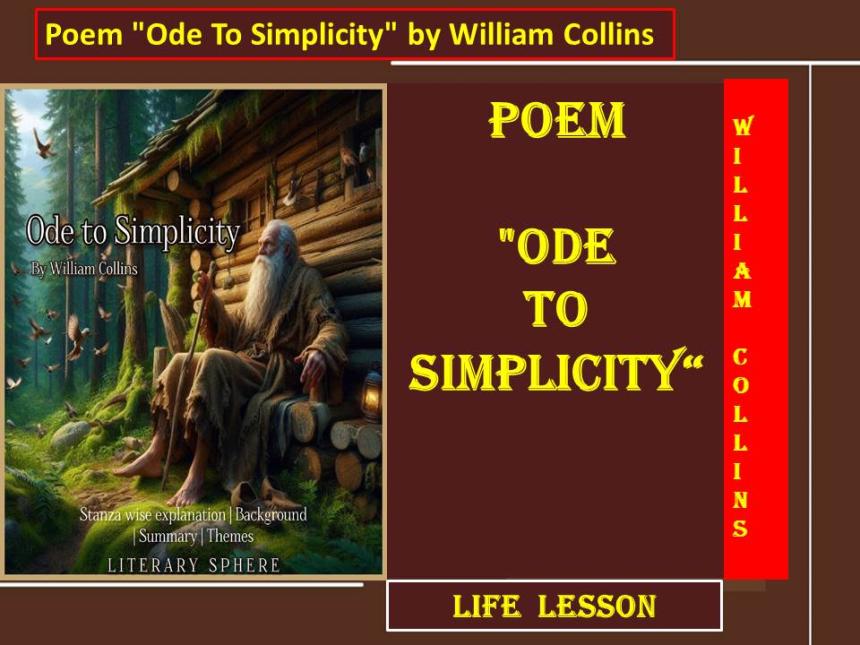

Poem "Ode To Simplicity" by William Collins
William Collins (1721 - 1759) was an English poet and was an important poet of the middle decades of the 18th century. He is considered second in influence only to Thomas Gray. Poem "Ode to Simplicity" by William Collins is an 18th-century lyric poem that personifies simplicity as a modest, natural maiden and critiques artificiality and excess. This write up has been arranged from material available on Free Webnet for educational purpose.
أَعُوذُ بِاللّٰهِ مِنَ الشَّيْطَانِ الرَّجِيمِ
بِسۡمِ ٱللهِ ٱلرَّحۡمَـٰنِ ٱلرَّحِيمِ
In the name of ALLAH, the Most Gracious, the Most Merciful
Poem "Ode To Simplicity" by William Collins
William Collins (December 25, 1721, Chichester, UK - June 12, 1759, Chichester, UK) was an English poet. He was an important poet of the middle decades of the 18th century and is considered second in influence only to Thomas Gray. His lyrical odes mark a progression from the Augustan poetry of Alexander Pope's generation and towards the imaginative ideal of the Romantic era.
Poem "Ode to Simplicity" by William Collins is an 18th-century lyric poem that personifies simplicity as a modest, natural maiden and critiques artificiality and excess. Collins portrays Simplicity as a pure, unadorned nymph dressed in simple Attic robes rather than flashy, artificial garments. The poem argues that true poetic inspiration and genuine emotion come from the wild mountains and nature, not from ornate human artifice. It laments how modern society and corrupt institutions have abandoned true virtue and simple beauty in favor of materialism and pride.
Poem "Ode to Simplicity" by William Collins is the celebration of a pure, natural, and unadorned life over the artificiality, materialism, and false ornamentation of contemporary society. Collins personifies "Simplicity" as a chaste, unboastful nymph and a child of Nature, contrasting her modest "Attic robe" with the flashy wealth and pageant weeds of artificial art. Writing as a transitional (Pre-Romantic) poet, Collins rejects the overly formal, rigid, and ornate style of the Augustan / Neoclassical age.
Poem "Ode To Simplicity" by William Collins - Summary
"Ode to Simplicity" by William Collins is an 18th-century transitional poem that praises natural grace and emotional honesty while criticizing the fake and overly decorated style of contemporary society and literature. The poem presents nature and wild mountains as the true birthplace of genuine song and inspiration. Collins uses references like Hybla’s honey, the river Cephisus, and Sophocles' Electra to link true simplicity to ancient, timeless traditions.
Poet William Collins treats Simplicity as a pure, modest nymph ("a decent maid, in Attic robe array'd") who rejects material wealth, gaudy decorations, and artificial art. He laments that true virtue and simplicity faded away in Rome and modern lands as people turned toward false ornaments and shallow passions. The poet speaker asks Simplicity to guide his youth and infuse his poetry with natural charms, wishing his work to remain simple enough to reach humble people.
Poem "Ode To Simplicity" by William Collins
O thou, by Nature taught
To breathe her genuine thought
In numbers warmly pure, and sweetly strong;
Who first on mountains wild,
In Fancy, loveliest child,
Thy babe, or Pleasure's, nurs'd the pow'rs of song!
Thou, who with hermit heart,
Disdain'st the wealth of art,
And gauds, and pageant weeds, and trailing pall,
But com'st a decent maid,
In Attic robe array'd,
O chaste, unboastful nymph, to thee I call!
By all the honey'd store
On Hybla's thymy shore;
By all her blooms, and mingled murmurs dear;
By her whose lovelorn woe
In ev'ning musings slow
Sooth'd sweetly sad Electra's poet's ear:
By old Cephisus deep,
Who spread his wavy sweep
In warbled wand'rings round thy green retreat;
On whose enamell'd side,
When holy Freedom died,
No equal haunt allur'd thy future feet.
O sister meek of Truth,
To my admiring youth,
Thy sober aid and native charms infuse!
The flow'rs that sweetest breathe,
Tho' Beauty cull'd the wreath,
Still ask thy hand to range their order'd hues.
While Rome could none esteem
But virtue's patriot theme,
You lov'd her hills, and led her laureate band;
But stay'd to sing alone
To one distinguish'd throne,
And turn'd thy face, and fled her alter'd land.
No more, in hall or bow'r,
The passions own thy pow'r;
Love, only love her forceless numbers mean;
For thou hast left her shrine,
Nor olive more, nor vine,
Shall gain thy feet to bless the servile scene.
Tho' taste, tho' genius bless
To some divine excess,
Faints the cold work till thou inspire the whole;
What each, what all supply,
May court, may charm our eye;
Thou, only thou canst raise the meeting soul!
Of these let others ask,
To aid some mighty task,
I only seek to find thy temp'rate vale;
Where oft my reed might sound
To maids and shepherds round,
And all thy sons, O Nature, learn my tale.
Poem "Ode To Simplicity" by William Collins - Explanation
Poem "Ode to Simplicity" was written during the Augustan Age of English literature, also known as the Age of Reason . This period gave great importance to reason, logic, balance, and order. Writers believed that literature should be clear, well-controlled, and useful for society. Poetry was expected to each moral values and correct human behavior.
The genius of William Collins was capable of every degree of excellence in lyric poetry, and perfectly qualified for that high province of the muse. Possessed of a native ear for all the varieties of harmony and modulation, susceptible of the finest feelings of tenderness and humanity, but, above all, carried away by that high enthusiasm which gives to imagination its strongest colouring, he was at once capable of soothing the ear with the melody of his numbers, of influencing the passions by the force of his pathos, and of gratifying the fancy by the luxury of description.
Stanza 1: Invocation of Simplicity as a Muse
Key Idea: The speaker calls upon Simplicity as a divine teacher and source of true art.
Explanation: The speaker addresses Simplicity, stating that she is taught by Nature to express pure, genuine thoughts. Unlike loud or flashy poetry, her voice is warm, pure, and sweetly strong. She was born wild in the mountains alongside Fancy (imagination) or Pleasure, representing the raw, uncorrupted origins of real song.
Stanza 2: Rejecting Artificiality for Natural Grace
Key Idea: Simplicity avoids worldly luxury and dresses in modest, classic attire.
Explanation: Simplicity has a quiet, hermit-like heart. She rejects the false "wealth of art," gaudy decorations, dramatic stage costumes, and heavy funeral robes (pageant weeds and trailing pall). Instead, she arrives as a modest, honest young maiden dressed in a simple, elegant ancient Greek (Attic) robe. The speaker calls out to this pure, unboastful nymph for inspiration.
Stanza 3: Association with Nature and Ancient Freedom
Key Idea: Simplicity is tied to sacred, natural landscapes and the memory of liberty.
Explanation: The speaker invokes classic, beautiful settings—like the honey-rich shores of Hybla and the deep river Cephisus. These pastoral, green retreats are where holy Freedom once lived and died. No other artificial place could ever tempt Simplicity away from these natural, sacred ground-marks of liberty.
Stanza 4: A Plea for Personal Guidance
Key Idea: The speaker asks Simplicity to guide his youth and balance his creative work.
Explanation: Simplicity is described as the gentle sister of Truth. The young speaker begs her to infuse his mind with her sober aid and natural charms. Even when Beauty creates a wreath of sweet flowers, it still needs the hand of Simplicity to arrange their colors in proper, harmonious order.
Stanza 5: Simplicity in Classical Rome
Key Idea: Rome lost Simplicity when it abandoned virtue for narrow flattery.
Explanation: When Rome valued true virtue and patriotism, Simplicity loved its hills and inspired its great writers. However, when Rome started singing praise only to a single powerful ruler (one distinguished throne) and lost its collective liberty, Simplicity turned her face away and fled from that changed land.
Stanza 6: The Decay of Passion and Modern Loss
Key Idea: Modern poetry and society have lost the true power of profound emotion.
Explanation: In the final reflection, Simplicity is no longer found in grand halls or romantic bowers. Poetry has weakened, and love has become the only shallow theme left in meaningless (forceless) verses, because Simplicity has abandoned her shrine in modern culture.
Poem "Ode To Simplicity" by William Collins - Lessons Learnt
The lesson to be learnt from William Collins's "Ode to Simplicity" is that true beauty, emotional depth, and artistic purity stem from a humble, natural life rather than artificiality and material wealth. The poem criticizes the heavy decorations, wealth, and fake pageantry of modern society, teaching us to value inner substance over outward show. Simplicity is portrayed as a child of nature and fancy, showing that genuine thoughts and pure inspiration come from connecting with the natural world.
The poet William Collins connects simplicity with a "hermit heart" that stays chaste, unboastful, and true to real human feelings instead of forced or pretentious expressions. The poem teaches for art and writing that plain, sincere language communicates deep passion and reaches ordinary people far better than high-flown, complicated diction.
The Conclusion
In the digital age, concluding the message of Poem "Ode to Simplicity" by William Collins shifts our focus from the physical traps of 18th-century luxury to the overwhelming noise, algorithms, and artificiality of our modern online lives. The poem becomes a vital framework for maintaining our mental well-being and finding authenticity in a hyper-connected world.
The poem by William Collins criticizes the "wealth of art" and "pageant weeds"—the fake, showy decorations of high society. This symbol in digital age represents the highly curated lifestyles, engagement bait, and filtered aesthetics we see on social media. However, true personal identity and genuine human value cannot be found in chasing online vanity or superficial viral metrics.
The poet praises the "hermit heart" that rejects constant noise in favor of quiet, deliberate reflection. In this age, the relentless stream of notifications, algorithmic feeds, and endless scrolling that fractures our attention spans. Therefore, we must actively practice digital minimalism and unplug to reclaim our focus, mental clarity, and peace of mind.
Poet William Collins argues that art "faints" and stays cold without the pure, natural spirit of simplicity. In this age, the rise of generative AI, deep-fakes, and automated content that can easily mimic human creativity.Therefore, while technology can produce flawless output, it lacks a true human soul. Raw, unfiltered human vulnerability and lived experiences hold the highest creative value.
Poem "Ode To Simplicity" by William Collins reminds us that real wisdom is "by Nature taught," urging a return to natural environments. In this digital age spending hours staring at screens and living completely virtual lives is fatal.Therefore, it is recommend to stay grounded, so that we must balance our screen time by stepping outside, disconnecting from devices, and re-engaging with the real, physical world. Ultimately, the simple conclusion of poem "Ode to Simplicity" is that less is more. In a world trying to sell us constant connection and complex tech, choosing a simple, mindful, and intentional life is the ultimate form of self-care and rebellion.

What European Manufacturers Need From an Indian Event Partner
European manufacturers expanding in India bring high standards with them. They expect prec...



NBSK Pulp Price Trend Q2 2026 | Global Price Trends, Forecast, Chart,...

BCTMP Price Trend Q2 2026 | Global Price Trends, Forecast, Chart, Pric...