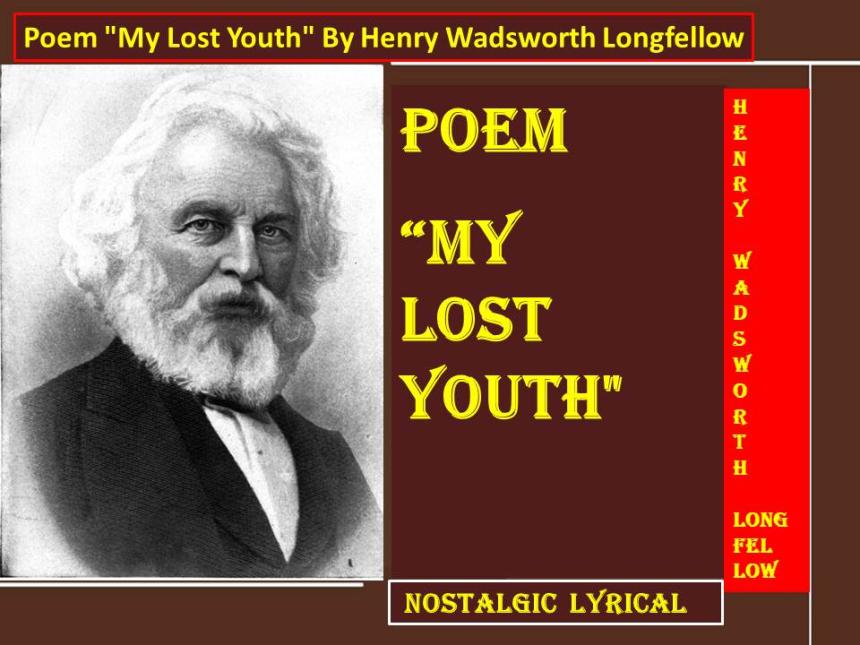

Poem "My Lost Youth" By Henry Wadsworth Longfellow
Henry Wadsworth Longfellow (1807- 1882) was an American poet and educator. Henry Wadsworth Longfellow wrote several celebrated poems, but his most famous and enduringly popular work is "Paul Revere's Ride". Poem "My Lost Youth" is a nostalgic 1855 lyrical poem reflecting on his childhood in Portland, Maine. It explores the contrast between the freedom and ambitious dreams of youth and the bittersweet reality of adulthood. This write up has been arranged for educational purposes.
أَعُوذُ بِاللّٰهِ مِنَ الشَّيْطَانِ الرَّجِيمِ
بِسۡمِ ٱللهِ ٱلرَّحۡمَـٰنِ ٱلرَّحِيمِ
In the name of ALLAH, the Most Gracious, the Most Merciful
Poem "My Lost Youth" By Henry Wadsworth Longfellow
Henry Wadsworth Longfellow (February 27, 1807, Portland, Maine, United States - March 24, 1882, Cambridge, Massachusetts, United States) was an American poet and educator. Henry Wadsworth Longfellow wrote several celebrated poems, but his most famous and enduringly popular work is "Paul Revere's Ride". "My Lost Youth" is a famous, nostalgic poem by Henry Wadsworth Longfellow published in 1855.
The Poem, “My Lost Youth,” a lyrical autobiography of the poet's early life, is Henry Wadsworth Longfellow's tribute both to his native city of Portland, Maine, and to the boy who climbed its hilly streets and gazed out over its harbor dreaming faraway dreams.
Poem "My Lost Youth" By Henry Wadsworth Longfellow explores his undiminished memories of growing up in his birthplace, the seaside city of Portland, Maine. The poem is famous for its haunting refrain connecting the unpredictable dreams of childhood to the passage of time.
Core Themes of Poem "My Lost Youth" By Henry Wadsworth Longfellow
"My Lost Youth" by Henry Wadsworth Longfellow is a nostalgic 1855 lyrical poem reflecting on his childhood in Portland, Maine. It explores the contrast between the freedom and ambitious dreams of youth and the bittersweet reality of adulthood. The poem contrasts the poet's aging present with his vivid, imaginative childhood. When he visits his "dear old town" in his thoughts, his youthful spirit returns. The recurring couplet, "A boy's will is the wind's will, / And the thoughts of youth are long, long thoughts," highlights how young minds are restless, ambitious, and filled with grand, lingering dreams. Longfellow beautifully recalls the sights of his youth—the black wharves, the sailing ships, the Spanish sailors, and the natural beauty of the surrounding waters that fed his boyish imagination.
The poem consists of ten stanzas, with the final two lines of each serving as a repeating refrain from a "Lapland song" that continuously haunts his memory. Readers often praise the poem for its lyrical autobiography and the bittersweet realization that while innocence is lost, the dreams of youth endure in one's memory.
The main message of "My Lost Youth" by Henry Wadsworth Longfellow is that the spirit of childhood, along with its dreams and passions, remains alive within an aging self. Rather than merely lamenting the passage of time, the poem celebrates the enduring connection between past memories and present identity. " is the bittersweet nature of nostalgia and the enduring power of childhood memories. It explores how youthful dreams and the spirit of the past remain alive and well within an aging self.
The poet of "My Lost Youth" reflects on his childhood in Portland, Maine, realizing that his youthful aspirations and feelings remain vivid and continue to shape who he is today. Returning to the physical or mental landscape of his youth allows Longfellow to re-experience the joy and wonder of his past. The recurring lines "A boy's will is the wind's will, / And the thoughts of youth are long, long thoughts" capture the unpredictable nature and expansive, uninhibited dreaming of youth. While the memories of youth are beautiful and comforting, they are also tinged with the melancholic pain of time passing.
Poem "My Lost Youth" By Henry Wadsworth Longfellow
Often I think of the beautiful town
That is seated by the sea;
Often in thought go up and down
The pleasant streets of that dear old town,
And my youth comes back to me.
And a verse of a Lapland song
Is haunting my memory still
‘A boy’s will is the wind’s will,
And the thoughts of youth are long, long thoughts.’
I can see the shadowy lines of its trees,
And catch, in sudden gleams,
The sheen of the far-surrounding seas,
And islands that were the Hesperides
Of all my boyish dreams.
And the burden of that old song,
It murmurs and whispers still:
‘A boy’s will is the wind’s will,
And the thoughts of youth are long, long thoughts.’
I remember the black wharves and the slips,
And the sea-tides tossing free;
And the Spanish sailors with bearded lips,
And the beauty and mystery of the ships,
And the magic of the sea.
And the voice of that wayward song
Is singing and saying still:
‘A boy’s will is the wind’s will,
And the thoughts of youth are long, long thoughts.’
I remember the bulwarks by the shore,
And the fort upon the hill;
The sunrise gun, with its hollow roar,
The drum-beat repeated o’er and o’er,
And the bugle wild and shrill.
And the music of that old song
Throbs in my memory still:
‘A boy’s will is the wind’s will,
And the thoughts of youth are long, long thoughts.'
I remember the sea-fight far away,
How it thundered o'er the tide!
And the dead captains, as they lay
In their graves, o'erlooking the tranquil bay
Where they in battle died.
And the sound of that mournful song
Goes through me with a thrill:
‘A boy’s will is the wind’s will,
And the thoughts of youth are long, long thoughts.’
I can see the breezy dome of groves,
The shadows of Deering’s Woods;
And the friendship old and the early loves
Come back with a Sabbath sound, as of doves
In quiet neighborhoods.
And the verse of that sweet old song,
It flutters and murmurs still:
'A boy's will is the wind's will,
And the thoughts of youth are long, long thoughts.'
I remember the gleams and glooms that dart
Across the school-boy's brain;
The song and the silence in the heart,
That in part are prophecies, and in part
Are longings wild and vain.
And the voice of that fitful song
Sings on, and is never still:
‘A boy’s will is the wind’s will,
And the thoughts of youth are long, long thoughts.’
There are things of which I may not speak;
There are dreams that cannot die;
There are thoughts that make the strong heart weak,
And bring a pallor into the cheek,
And a mist before the eye.
And the words of that fatal song
Come over me like a chill:
‘A boy’s will is the wind’s will,
And the thoughts of youth are long, long thoughts.’
Strange to me now are the forms I meet
When I visit the dear old town;
But the native air is pure and sweet,
And the trees that o'ershadow each well-known street,
As they balance up and down,
Are singing the beautiful song,
Are sighing and whispering still:
‘A boy’s will is the wind’s will,
And the thoughts of youth are long, long thoughts.’
And Deering’s Woods are fresh and fair,
And with joy that is almost pain
My heart goes back to wander there,
And among the dreams of the days that were,
I find my lost youth again.
And the strange and beautiful song,
The groves are repeating it still:
‘A boy’s will is the wind’s will,
And the thoughts of youth are long, long thoughts.’
Summary of Poem "My Lost Youth" By Henry Wadsworth Longfellow
Henry Wadsworth Longfellow's poem "My Lost Youth" serves as a lyrical homage to both his birthplace of Portland, Maine, and his own youthful spirit. He intertwines memories of the coastal landscape with his youthful imagination, ultimately discovering that while time passes, the dreams and spirit of his boyhood remain eternally alive within him. The refrain "A boy’s will is the wind’s will,/ And the thoughts of youth are long, long thoughts" echoes throughout the piece, anchoring the poet’s reflections and emphasizing the enduring nature of youthful dreams.
Henry Longfellow visualizes his hometown, recalling the ships, old wharves, Deering’s Woods, and historical sights. The sensory details bring his past to life. The poem is unified by a recurring refrain from an old "Lapland Song": "A boy's will is the wind's will, / And the thoughts of youth are long, long thoughts". This highlights the boundless, unpredictable, and deep nature of youthful dreams. Longfellow mentions unfulfilled desires and painful memories that "make the strong heart weak," yet refuses to let them overshadow the beauty of his youth.
The poem "My Lost Youth" maps that distance not as grief but as a kind of double vision: ten stanzas that walk the streets of the old town while measuring what the walk costs. Each stanza closes with a borrowed couplet from a Sami love poem, "A boy's will is the wind's will, / And the thoughts of youth are long, long thoughts," and the effect is less refrain than incantation, a phrase the mind cannot stop turning.
Stanza Wise Explanation of Poem "My Lost Youth" By Henry Wadsworth Longfellow
Henry Wadsworth Longfellow’s My Lost Youth is a nostalgic, autobiographical reflection on the poet's childhood in Portland, Maine. Throughout the ten stanzas, Longfellow contrasts the vibrant, dreamy perspectives of his youth with the somber realities of adulthood, anchored by a repeating, wistful Lapland refrain.
Stanza 1. The speaker recalls his beautiful hometown of Portland, Maine, sitting by the sea. As he walks the streets in his memory, he feels his youth returning. "A boy's will is the wind's will, / And the thoughts of youth are long, long thoughts." This famous repeating refrain emphasizes the unpredictable, shifting nature of a young boy's desires and the vast, imaginative, and enduring dreams that occupy a young mind.
Stanza 2. He visualizes the landscape of the city, recalling the "shadowy lines of its trees" and the shining seas and islands. He compares these islands to the mythological Hesperides, representing the golden, magical dreams of his boyhood imagination. Youth inherently perceives ordinary things with a sense of magic, wonder, and boundless possibility.
Stanza 3. The speaker reminisces about specific ships anchored in the harbor—the Spanish sailors with "beards that were black" and the robust "Viking" ships. These maritime images evoke the spirit of adventure, exoticism, and courage that fascinated him as a young boy.
Stanza 4. He remembers the coastal fortifications (the bulwarks), the fort on the hill, the sunrise gun, the beating drums, and the shrill bugles. The auditory and visual imagery of the military fort highlights a boy's deep connection to nature, local history, and the thrilling pulse of the town.
Stanza 5. He lists specific geographical spots in his memory: the Deering's Woods, the quiet cove, the salt meadows, and the ancient block-house. Nature and historical landmarks act as physical anchors for his nostalgic memories, rooting his childhood identity in specific, real-world places.
Stanza 6. The speaker reflects on a specific historical event that occurred near the coast—the famous naval battle between the American ship Enterprise and the British ship Boxer (1813). He recalls the deaths of the captains. This memory represents his first real encounter with death and heroism, shaping his understanding of bravery and history as a youth.
Stanza 7. He describes how the song of these fallen naval heroes echoes in his ears, merging with the sights and sounds of the bustling port town. Portland’s maritime history heavily influenced the poet’s early imagination, embedding a sense of romance and tragedy into his childhood.
Stanza 8. The speaker shifts to the present day, noting how the physical town has grown and changed. Despite this, his inner feelings and the memories of his youth remain unchanged. There is a bittersweet contrast between the passage of external time (the evolving city) and the timelessness of internal human memory.
Stanza 9. He references "strangeness" and the busy, bustling world of the modern harbor. Yet, the ocean tides continuously wash in, symbolizing the cyclical and enduring nature of time and memory. The sea becomes a metaphor for both the passage of time and the constant, rhythmic flow of youthful thoughts.
Stanza 10. In the final stanza, the speaker concludes that whoever sings the song of the city of Portland or praises the sea is truly singing about the poet's own soul. He acknowledges that despite the changes, the boy who dreamed in those hilly streets lives on within him. The poet reconciles his present and past, realizing that his adult self is forever shaped by the endless, "long, long thoughts" of his youthful dreams.
Lesson Learnt From Poem "My Lost Youth" By Henry Wadsworth Longfellow
Henry Wadsworth Longfellow’s "My Lost Youth" teaches that while time inevitably passes and childhood fades, our youthful dreams and memories endure. The poem’s core lesson is that nostalgia is a powerful, grounding force; by holding onto the hopeful, wandering spirit of our youth, we remain deeply connected to who we are, even as adults.
The poem reflects that time constantly marches forward, but the memories of our past provide a comforting anchor to our roots and identity. Reflecting on the past brings joy, but it can also be painful because we can never physically return to those simpler days. The famous refrain, "A boy's will is the wind's will, / And the thoughts of youth are long, long thoughts," illustrates that youthful imagination is free, directionless, and filled with boundless, long-term dreams. Longfellow discovers he finds his "lost youth again" not by traveling back in time, but by returning to the landscape of his youth—both physically and in his mind—proving that the passions of our youth still live within us.
Pourquoi les Joueurs Préfèrent Aujourd’hui le Casino en Ligne
Pourquoi les Joueurs Préfèrent Aujourd’hui le Casino en Ligne