
Poem "Life Doesn't Frighten Me" By Maya Angelou
Maya Angelou (1928 – 2014) was an American memoirist, essayist, poet, and civil rights activist. She published seven autobiographies, three books of essays, and several books of poetry spanning over 50 years. Maya Angelou's "Life Doesn't Frighten Me" is a bold, rhythmic poem about a child who defiantly faces both real and imagined fears. This write up "Poem "Life Doesn't Frighten Me" By Maya Angelou" has been arranged for educational purpose from material from free web net.
أَعُوذُ بِاللّٰهِ مِنَ الشَّيْطَانِ الرَّجِيمِ
بِسۡمِ ٱللهِ ٱلرَّحۡمَـٰنِ ٱلرَّحِيمِ
In the name of ALLAH, the Most Gracious, the Most Merciful
Poem "Life Doesn't Frighten Me" By Maya Angelou
Maya Angelou (April 4, 1928, St. Louis, Missouri, United States - May 28, 2014, Winston-Salem, North Carolina, United States) was an American memoirist, essayist, poet, and civil rights activist. She published seven autobiographies, three books of essays, several books of poetry, and is credited with a list of plays, movies, and television shows spanning over 50 years. Maya Angelou's real name was Marguerite Annie Johnson. She adopted the professional name "Maya Angelou" in the 1950s. "Maya" was a childhood nickname given to her by her brother, and "Angelou" is a variation of her first husband's surname, Tosh Angelos.
The poem "Life Doesn't Frighten Me" was published in 1978 in Maya Angelou's poetry collection "And Still I Rise"; this poem presents a defiant, childlike speaker who mocks everyday fears and threats. The poem's repeated refrain asserts courage and self-possession, turning mundane and imagined dangers into objects of ridicule. Its playful, accessible tone and imagery make resilience feel immediate and teachable. Placed in Angelou's late-1970s work, it reflects her lifelong concerns with overcoming adversity and encouraging confidence, often read as reassurance for young readers and a statement of personal strength.
The central theme of Maya Angelou's poem "Life Doesn't Frighten Me" is courage and resilience in the face of fear. Through the voice of a bold child, the poem explores how self-belief, playful imagination, and a defiant attitude can overcome both imaginary childhood fears and real-world threats. Poem “Life Doesn’t Frighten Me” reflects that relationship with language as armor. The poem belongs to a tradition of bravado poetry, verse that asserts strength, sometimes defiantly, in the face of real or imagined danger. The poetic theme of the poem may be explained in following three references:-
Courage vs. The Absence of Fear
The poet does not claim that scary things do not exist. Instead of denying fear, the poem shows that true bravery is an active choice to face and dismiss those anxieties. The repeated refrain, "Life doesn't frighten me at all," acts as a powerful mantra of resilience.
Childlike Innocence vs. Real-World Threats
The poet casually brushes off terrifying imagery—ranging from shadows, dragons, and ghosts to "tough guys" fighting in the dark. By blending imagined childhood terrors with more serious, adult-like anxieties (like bullies or societal dangers), Angelou highlights how the power of a positive mindset can shield us from all types of adversity.
The Power of the Mind and Imagination
To conquer her fears, the poet relies on imagination and an inner "magic charm". By making fun of her fears, going "boo," and smiling, she demonstrates that approaching terrifying situations with confidence and playfulness strips them of their power.
Poem "Life Doesn't Frighten Me" By Maya Angelou
Shadows on the wall
Noises down the hall
Life doesn't frighten me at all
Bad dogs barking loud
Big ghosts in a cloud
Life doesn't frighten me at all
Mean old Mother Goose
Lions on the loose
They don't frighten me at all
Dragons breathing flame
On my counterpane
That doesn't frighten me at all.
I go boo
Make them shoo
I make fun
Way they run
I won't cry
So they fly
I just smile
They go wild
Life doesn't frighten me at all.
Tough guys fight
All alone at night
Life doesn't frighten me at all.
Panthers in the park
Strangers in the dark
No, they don't frighten me at all.
That new classroom where
Boys all pull my hair
(Kissy little girls
With their hair in curls)
They don't frighten me at all.
Don't show me frogs and snakes
And listen for my scream,
If I'm afraid at all
It's only in my dreams.
I've got a magic charm
That I keep up my sleeve
I can walk the ocean floor
And never have to breathe.
Life doesn't frighten me at all
Not at all
Not at all.
Life doesn't frighten me at all.
Summary of Poem "Life Doesn't Frighten Me" By Maya Angelou
Maya Angelou's "Life Doesn't Frighten Me" is a bold, rhythmic poem about a child who defiantly faces both real and imagined fears. By repeating the empowering mantra, "Life doesn't frighten me at all," the poet practices courage, transforming fear into strength through imagination and self-belief. Angelou fills the poem with concrete, vivid images of things that might scare a child:-
“Shadows on the wall”
“Bad dogs barking loud”
“Mean old Mother Goose”
“Boys all pulling girls’ hair”
“Panthers in the park”
“Strangers in the dark”
“Lions on the loose”
“Dragons breathing flame”
The poem juxtaposes whimsical childhood terrors (ghosts, dragons, Mother Goose) with real-world, everyday anxieties (school bullies, tough guys, strangers). Bravery isn't the absence of fear, but the conscious, repeated decision to face it. The poet uses her voice and imagination to talk down her anxieties. When faced with daunting scenarios, the poet relies on a metaphorical "magic charm" kept "up my sleeve," which symbolizes inner resilience, cultural heritage, and self-belief. The recurring line "Life doesn't frighten me at all" acts as a protective chant to steady the speaker's nerves.
Poem "Life Doesn't Frighten Me" By Maya Angelou Explains
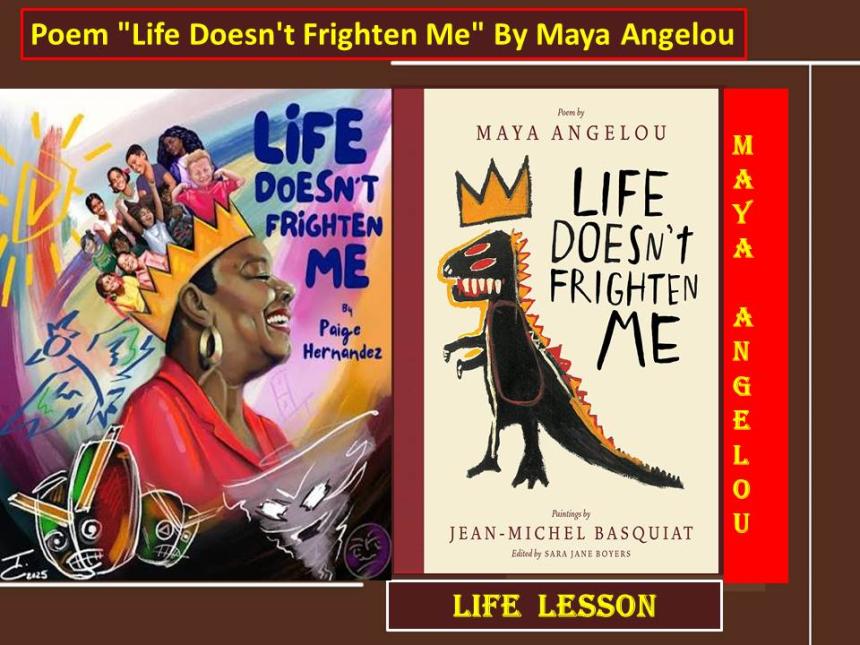
The American poet Maya Angelou's "Life Doesn't Frighten Me" was first published as a picture book (illustrated by the painter Jean-Michel Basquiat) in 1993. In this poem, a little girl claims that she's not the least bit frightened of—well, anything, from "panthers" to "tough guys." While her list of the things she's not frightened of might hint she's actually a little more scared than she's letting on, her bravado makes it clear that she has the courage to face her fears. This poem suggests that it takes real and admirable bravery to be a kid.
The poet Maya Angelou and painter Jean-Michel Basquiat were known for bold, defiant self-expression. That combination matters. Basquiat, a Brooklyn-born artist who rose from homelessness to international fame before his death at 27, brought a visual language of crowns, figures, and raw energy that perfectly complements Angelou’s verbal bravado. His jagged, expressive images mirror the poem’s bold declarations. Together, they create something that feels both childlike and fierce, which is exactly the point.
Children’s fears are often vivid and imaginative, built from ghosts, fairytale villains, and the dark. By putting bravery in a child’s mouth, Angelou suggests that courage isn’t reserved for adults. It’s a human quality we grow into by practicing it. The child voice also allows for playful language, rhyme, and repetition that feel like a chant or playground rhyme, making the poem both accessible to young readers and structurally deliberate.
Angelou’s tone also shifts subtly across the stanzas. Early on, the fears are external and even whimsical: “shadows on the wall” and “noises down the hall.” By the later stanzas, the fears become more existential: “dragons breathing flame” and “tough guys in a fight.” In "Life Doesn't Frighten Me," Maya Angelou uses a defiant, chant-like rhythm to explore childhood resilience. Through the persona of a bold child, she contrasts imaginary and societal terrors with self-assurance, showing that true courage is a mindset we actively choose.
The poem "Life Doesn't Frighten Me" By Maya Angelou opens by addressing classic childhood fears. The speaker acknowledges the creeping shadows and mysterious sounds in a dark house, but instantly dismisses them with the repeating refrain, establishing a tone of immediate fearlessness. Even when fears infiltrate the subconscious during nightmares, the speaker refuses to be intimidated. The sound might be "quite right" (perhaps just a normal creak), and the speaker asserts authority over the dream.
Angelou introduces surreal, fairy-tale elements like fire-breathing dragons and aggressive animals. Despite the vivid, terrifying imagery of these beasts invading a safe space (the bedspread), the speaker brushes them off as harmless or manageable.
The poem "Life Doesn't Frighten Me" By Maya Angelou pivots from fairy-tale monsters to real-world threats. From street brawlers to nighttime prowlers, the speaker refuses to let urban dangers evoke terror. The poet draws a playful line—warning against creepy-crawlies. She also mentions schoolyard taunts (boys pulling hair), a relatable social anxiety, but again claims power over the situation.
The poet Maya Angelou explains the source of her courage: a metaphorical "magic charm". This represents self-belief, imagination, and inner resilience. With it, the poet feels capable of doing the impossible, like breathing underwater. The final stanzas repeat the refrain with increasing intensity. The repetition serves as a protective mantra or chant. By stating it repeatedly, the poet convinces not only the reader but also herself that fear has no power over her.
The Conclusion
In "Life Doesn't Frighten Me" by Maya Angelou, the central lesson is that courage is a choice. Through a child's perspective, Angelou teaches that repeating positive affirmations and relying on inner strength can help you face both imaginary threats and real-life bullies without fear. The repeated refrain, "Life doesn't frighten me at all," acts as a rhythmic charm. It teaches that speaking confidence into existence can shield you from anxiety. The speaker mentions a metaphorical "magic charm" and superpowers. This symbolizes self-belief and imagination as a defense against real-world adversity.
My Dear Readers; If one believes in "One" God (ALLAH in Islam); then the source of the "magic charm" is so simple; and the emergence and culturing of "self belief" is not metaphorical but a natural outcome that arises from one "Kalma" (La ilaha illallah Muhammadur Rasulullah; Arabic لَا إِلَٰهَ إِلَّا ٱللَّٰهُ مُحَمَّدٌ رَسُولُ ٱللَّٰهِ "There is no deity but ALLAH; Muhammad (PBUH) is the messenger of Allah.") This Kalma is the real defense against all real world fears, demons and adversity. The five time "Salat" (Prayers) is a repeated affirmation of faith and strengthening of courage and resilience to face challenge of life.
This poem "Life Doesn't Frighten Me" by Maya Angelou is a refreshing reminder that we humans will always have to face our imaginary and real fears of life and the best way to deal with those frightening demons, devils and fearsome entities lies in our childish innocence and strengthening belief. The strength of a Man's Character actually stems from his childish memories and our foundational memories shape how we process emotions, handle adversity, and build resilience later in life. The real force behind a "Giant of a Man" actually is a "Child's" innocence, courage and resilience.
Online Entertainment Platform: A Modern Destination For Digital Gaming...
Online Entertainment Platform: A Modern Destination For Digital Gaming Experience



Plan the Ultimate Branson Vacation with the Best Table Rock Lake Condo...


Terna Trust’s Nursing and Allied Health Sciences Courses for Successfu...