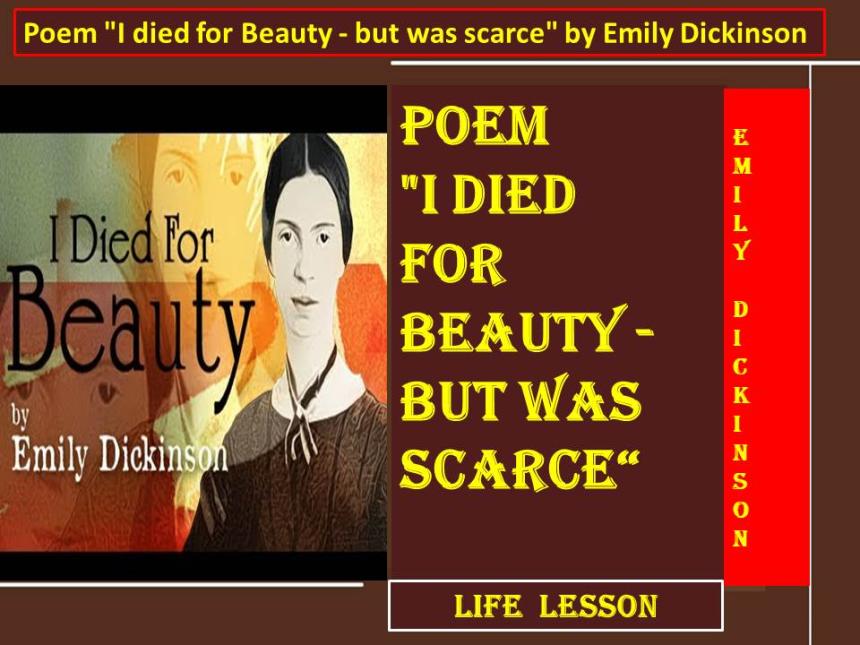

Poem "I died for Beauty - but was scarce" by Emily Dickinson
Emily Elizabeth Dickinson (1830 - 886) was an American poet. She largely remained unpublished and unknown during her lifetime, but her work is now widely regarded for her bold original verse, haunting personal voice, and enigmatic brilliance. Emily Dickinson’s poem "I died for Beauty—but was scarce" is about the interconnectedness of beauty and truth and the ultimate futility and oblivion of death. This write up has been arranged for educational purpose.
أَعُوذُ بِاللّٰهِ مِنَ الشَّيْطَانِ الرَّجِيمِ
بِسۡمِ ٱللهِ ٱلرَّحۡمَـٰنِ ٱلرَّحِيمِ
In the name of ALLAH, the Most Gracious, the Most Merciful
Poem "I died for Beauty - but was scarce" by Emily Dickinson
Emily Elizabeth Dickinson (December 10, 1830, Amherst, Massachusetts, United States - May 15, 1886, Amherst, Massachusetts, United States) was an American poet. She largely remained unpublished and unknown during her lifetime, but her work is now widely regarded as canonical. Emily Dickinson is considered one of the leading 19th-century American poets, known for her bold original verse, which stands out for its epigrammatic compression, haunting personal voice, and enigmatic brilliance.
Emily Dickinson's poem “I Died for Beauty” is an allegorical work that depicts someone who died for beauty interacting briefly with someone who died for truth. An allegory is a metaphorical work in which the characters and actions represent larger ideas or themes. 'I died for beauty but was scarce' deals with the themes of beauty and truth. Dickinson portrays them as parallel in various ways in the poem. The themes of death, beauty, and truth are frequent in Dickinson's poem.
The main themes of Emily Dickinson’s poem "I died for Beauty—but was scarce" are the interconnectedness of beauty and truth and the ultimate futility and oblivion of death. The central idea of Emily Dickinson's "I died for Beauty—but was scarce" is that Beauty and Truth are interconnected, kindred ideals that provide purpose, but ultimately, they are both powerless against the inevitable, equalizing force of death and the passage of time. The poem explores this theme through a few key concepts:-
The Unity of Truth and Beauty: The two deceased speakers—one who died for Beauty and one who died for Truth—recognize that their noble causes are fundamentally the same. This echoes John Keats's famous philosophy that "Beauty is truth, truth beauty".
Connection in Isolation: Despite the bleak setting of the tomb, the two martyrs form a deep companionship in the afterlife, finding comfort and kinship in their shared devotion to higher ideals.
The Obliteration of Time: As "moss" slowly creeps up their graves, it covers their lips (silencing their conversation) and their names (erasing their identities). This haunting imagery reveals that no matter how noble or significant our earthly pursuits are, mortality and time eventually erase all human achievements.
Poem "I died for Beauty - but was scarce" by Emily Dickinson
I died for Beauty - but was scarce
Adjusted in the Tomb
When One who died for Truth, was lain
In an adjoining Room -
He questioned softly "Why I failed"?
"For Beauty", I replied -
"And I - for Truth - Themself are One -
We Brethren are", He said -
And so, as Kinsmen, met a Night —
We talked between the Rooms -
Until the Moss had reached our lips -
And covered up - Our names -
Summary of Poem "I died for Beauty - but was scarce" by Emily Dickinson
"I died for Beauty — but was scarce" by Emily Dickinson is an allegorical poem about the pursuit of ideals. It describes two deceased speakers—one who died for Beauty and one for Truth—who converse from adjacent tombs before time and nature ultimately erase their identities. The speaker, having just died for Beauty, is barely settled in the grave when another figure is buried in the adjoining room.
The neighbor explains that he died for Truth. They agree that Beauty and Truth are fundamentally the same and become "kinsmen" (kindred spirits). They talk to each other in the darkness until moss grows over their graves, covering their lips and eventually obliterating the names on their tombstones.
Dickinson references the Romantic idea (famously expressed by John Keats) that Beauty and Truth are interconnected and interchangeable concepts. While dying for noble ideals like Truth and Beauty is profound, the poem emphasizes that time (symbolized by the creeping moss) eventually destroys all memory, speech, and human identity. Rather than a romanticized afterlife, the poem offers a slightly bleak but resigned view that death makes all human achievements and pursuits fade away into silence.
Stanza wise Explanation: Poem "I died for Beauty - but was scarce" by Emily Dickinson
"I died for Beauty—but was scarce" by Emily Dickinson explores the relationship between two great ideals: art (Beauty) and knowledge (Truth). The poem suggests that while people may die for these noble causes, time and death ultimately erase all earthly identities.The poem can be broken down stanza by stanza as follows:-
Stanza 1.
The speaker has just died for the sake of "Beauty" and is barely settled into her grave when she gets a companion. The person in the neighboring tomb died for "Truth". Dickinson sets the scene in a quiet, shadowy tomb, positioning the two concepts as close neighbors.
Stanza 2.
The neighbor speaks through the wall of the tomb, asking the speaker why she "failed" (implying that pursuing high ideals in life ultimately leads to death). When she answers that she died for Beauty, he reveals that he died for Truth. He declares that Truth and Beauty are essentially the same thing. Because their ideals are linked, they become "brethren" (kindred spirits) in death.
Stanza 3.
The two souls converse in the dark like family. However, their companionship is cut short by the relentless passage of time and death. The growing "moss" symbolizes nature and time. It eventually covers their mouths (stopping their speech) and their tombstones (erasing their identities). The poem ends with a haunting reminder that, despite the nobility of their earthly pursuits, death renders all human achievements silent and forgotten.
The ultimate moral of "I died for Beauty—but was scarce" by Emily Dickinson is that abstract human ideals—like Truth and Beauty—are the most profound and unifying forces in life. However, while these pursuits connect us as kindred spirits, they are powerless to stop the ultimate equalizer: death and oblivion.
The poem conveys a timeless message through a haunting and philosophical allegory. When the speaker (who died for Beauty) meets a neighbor in the afterlife (who died for Truth), they realize their causes are identical. They are "brethren" and "kinsmen" sharing a universal human journey. The ending—where graveyard moss grows over their lips and covers their names—is a stark reminder of human mortality. Regardless of how beautiful or true our lives were, time and death will eventually erase our individual identities and memories.
The Conclusion
The overarching lesson from Emily Dickinson's "I died for Beauty—but was scarce" is that while high ideals like beauty and truth are noble, they are ultimately fragile and temporary. In the face of mortality, human ambitions, sacrifices, and even our very identities are inevitably erased by time. What poem doesn't say is that this world is mortal and time and nature will erase all identities.
The Poem "I died for Beauty - but was scarce" by Emily Dickinson is stark reminder that glorified nobility or worldly beauty are not eternal in nature and immortality is not possible; the poem serves as a meditation on the shared mortality of humanity and how the relentless march of nature eventually erases even the most profound human ideals. The only thing constant in this world is decadence and mortality and nature sweeps everything leaving no marks behind.


Rooftop Solar Panels for Home for Sustainable Living
As electricity costs continue to rise, homeowners are looking for cleaner and more afforda...

Kaspersky Next XDR Expert Deployment India
Deploying an extended detection and response platform requires more planning than installi...

Kamagra Fiyatını Araştırırken Güvenilir Satıcı Nasıl Seçilir?
Ayrıca ürünün ruhsat durumunu, üretici bilgilerini ve satış için geçerli yasal gereklilikl...
