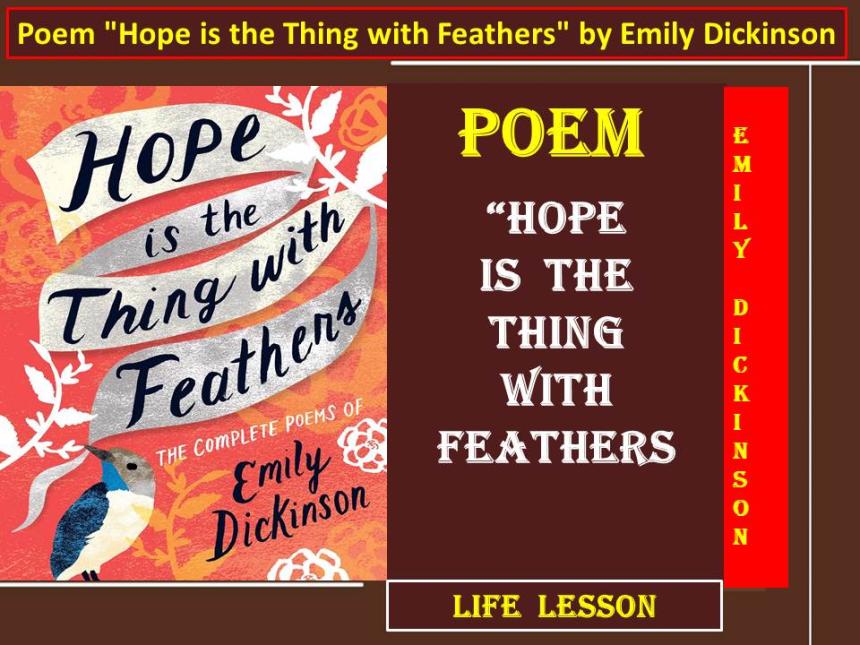

Poem "Hope is the Thing with Feathers" by Emily Dickinson
Emily Dickinson (1830–1886) was a reclusive American poet who wrote nearly 1,800 poems, but fewer than a dozen were published during her lifetime. Her sister discovered her extensive collection of hand-bound booklets, and now she is widely celebrated as one of the most important and influential figures in American literature. "Hope is the thing with feathers" is one of Emily Dickinson’s most famous poems, uses an extended metaphor, transforming the abstract concept of hope into a resilient bird that lives inside the human soul. This write up is about the poem and has been arranged for educational purposes from material available freely on Web Net.
أَعُوذُ بِاللّٰهِ مِنَ الشَّيْطَانِ الرَّجِيمِ
بِسۡمِ ٱللهِ ٱلرَّحۡمَـٰنِ ٱلرَّحِيمِ
In the name of ALLAH, the Most Gracious, the Most Merciful
Poem "Hope is the Thing with Feathers" by Emily Dickinson
Emily Dickinson (1830–1886) was a reclusive American poet who spent most of her life in her family home in Amherst, Massachusetts. Her poetry is highly distinct, characterized by short lines, unorthodox punctuation, and a frequent use of slant rhyme. She wrote nearly 1,800 poems, but fewer than a dozen were published during her lifetime, usually heavily edited to fit the traditional style of the era. After her death, her sister discovered her extensive collection of hand-bound booklets, leading to the posthumous publication of her work. Today, she is widely celebrated as one of the most important and influential figures in American literature.
"Hope is the thing with feathers" is one of Emily Dickinson’s most famous poems, written around 1861 and published posthumously in 1891. The poem uses an extended metaphor, transforming the abstract concept of hope into a resilient bird that lives inside the human soul. This "bird" sings continuously through hardships and demanding times without ever asking for anything in return. Through this imagery, Dickinson honors the enduring and selfless nature of human resilience. It remains celebrated globally as a powerful anthem of comfort and inner strength.
The central idea of "Hope is the thing with feathers" is that hope is an eternal, resilient, and selfless force within the human spirit.
By comparing hope to a bird perched inside the soul, the poem illustrates several key concepts:-
Endless Resilience: Hope sings its comforting tune continuously, never fading even during life’s most difficult trials and "storms."
Universal Comfort: It offers warmth and strength to anyone experiencing dark, cold, or unfamiliar times ("the chillest land" and "strangest Sea").
Pure Selflessness: Hope operates entirely free of cost, demanding absolutely nothing ("not a crumb") from the person it sustains.
Ultimately, Dickinson shows that while hardships are inevitable, the human capacity for hope is indestructible and universally accessible.
Poem "Hope is the Thing with Feathers" by Emily Dickinson-Summary
"Hope is the thing with feathers" is a lyrical poem that celebrates the indestructible nature of human optimism.
The poem unfolds through a few main narrative points:-
The Metaphor: The poem defines hope as a resilient bird that lives permanently inside the human soul, singing a wordless, everlasting song of comfort.
Strength in Adversity: This inner voice of hope grows strongest and sweetest during life's most chaotic and difficult "storms," refusing to be silenced by hardship.
Universal & Free: Hope accompanies people through their loneliest, coldest, and most unfamiliar emotional trials without ever demanding anything in return.
Ultimately, the poem summarizes hope as a universal, unconditional gift that endlessly sustains the human spirit entirely for free.
Poem "Hope is the Thing with Feathers" by Emily Dickinson
"Hope" is the thing with feathers -
That perches in the soul -
And sings the tune without the words -
And never stops - at all -
And sweetest - in the Gale - is heard -
And sore must be the storm -
That could abash the little Bird
That kept so many warm -
I’ve heard it in the chillest land -
And on the strangest Sea -
Yet - never - in Extremity,
It asked a crumb - of me.
Stanza Wise Explanation of Poem "Hope is the Thing with Feathers" by Emily Dickinson
Stanza 1: The Metaphor of the Bird"
The Metaphor: Dickinson introduces hope as a bird ("the thing with feathers").
The Location: This bird lives inside the human spirit ("perches in the soul"). This means hope is an innate, permanent part of being human.
The Song: The bird sings a "tune without the words," meaning hope is a deep, emotional feeling that transcends language. You do not need to explain hope; you just feel it.
Constancy: The song "never stops - at all -." Hope is continuous and always available, even when we are not actively thinking about it.
Stanza 2: Facing the Storms of Life
The Gale (The Storm): The bird’s song sounds "sweetest" during a "Gale" (a powerful windstorm). This symbolizes that hope becomes most valuable and powerful when life gets difficult.
Resilience: The "storm" must be incredibly severe ("sore") to ever silence or confuse ("abash") this "little Bird."
The Impact: The bird has "kept so many warm," meaning hope has historically provided comfort, survival, and emotional warmth to countless people during their darkest times.
Stanza 3: Universal and Selfless Comfort
Universal Presence: The speaker notes they have heard the bird in the "chillest land" and on the "strangest Sea." These places represent the absolute worst scenarios—loneliness, isolation, grief, and unfamiliar hardships. Hope exists everywhere, no matter how bad things get.
Extreme Circumstances: Even in moments of absolute crisis ("Extremity"), hope remains active.
Selflessness: Despite saving the speaker time and time again, the bird "never... asked a crumb - of me." Hope is entirely unconditional. It requires no payment, sacrifice, or effort to keep it alive; it simply gives.
Core Lessons: Poem "Hope is the Thing with Feathers" by Emily Dickinson
Emily Dickinson’s poem offers timeless wisdom about the human condition:-
Resilience is Innate: The "bird" perches inside the soul naturally. The poem teaches that inner strength and optimism are not qualities we must constantly manufacture; they are already built into our spirit.
Adversity Amplifies Hope: The song sounds "sweetest in the Gale." The poem reminds us that hope shines brightest not when life is easy, but when we are facing our hardest challenges.
Hope is Unconditional and Selfless: Because the bird never asks for a "crumb," the poem teaches that hope is an unconditional internal resource. It does not require wealth, status, or external validation to sustain us.
Relevance in the Digital Age
While written in the 19th century, the poem is incredibly relevant to our lives in the 20th-century digital landscape:-
An Antidote to "Doom scrolling": In an era of 24/7 news cycles, social media algorithms often feed us anxiety, division, and climate dread. The permanent, quiet song of the bird serves as a mental sanctuary, helping us tune out digital noise and connect with quiet inner peace.
Combating Digital Isolation: The "chillest land" and "strangest Sea" perfectly describe the modern feelings of digital isolation and cyberbullying. Even when the internet makes us feel lonely or disconnected from reality, the poem reminds us that our true source of comfort is internal and always accessible.
A Counter to Transactional Culture: Today’s digital world is highly transactional—driven by likes, views, monetization, and data tracking. The bird demanding "not a crumb" stands as a powerful reminder that the most valuable things in life—like hope, empathy, and resilience—cannot be bought, sold, or digitized.
The Conclusion
In conclusion, Emily Dickinson’s "Hope is the thing with feathers" stands as a masterful exploration of human resilience. By transforming an abstract emotion into a tangible, singing bird, Dickinson captures the indestructible nature of optimism. Dickinson reminds us that hope does not demand a price, nor does it require a complex vocabulary; it simply exists within us as a quiet, steady presence. In a world that often feels chaotic and overwhelming, the poem leaves us with the comforting certainty that our inner capacity to endure and heal is always within reach.
"Hope is the thing with feathers" remains profoundly relevant today as an anchor against modern anxiety. In an era dominated by digital noise, isolation, and transactional relationships, Dickinson's "little Bird" represents a free, un-digitized sanctuary of the soul. The poem ultimately teaches us that true resilience is not found on a screen or measured in metrics, but is an eternal, selfless melody playing quietly inside each of us. Ultimately, the poem serves as a timeless reminder that no matter how severe the storms of life may be, the human spirit possesses an innate, unconditional sanctuary of hope that can never be truly silenced.


Convenient Ways to Buy Wine Online Ontario
Exploring options to buy wine online Ontario helps wine enthusiasts discover selections fr...
