
أَعُوذُ بِاللّٰهِ مِنَ الشَّيْطَانِ الرَّجِيمِ
بِسۡمِ ٱللهِ ٱلرَّحۡمَـٰنِ ٱلرَّحِيمِ
In the name of ALLAH, the Most Gracious, the Most Merciful
Play: Gordon College & Student Politics!
(The Shadows of Jubilee Hall and the Mirage of Being "Apolitical")
Characters:
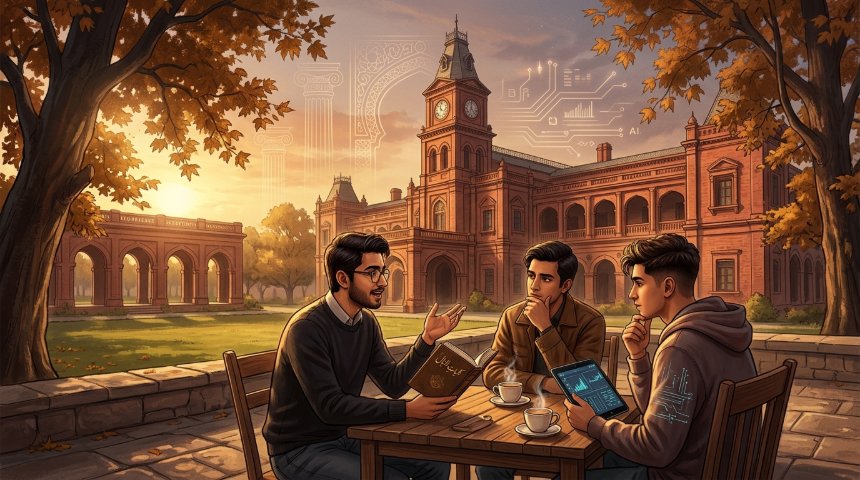
- Zaid: (Approx. 21 years old) A student of History and Iqbal Studies. Simple yet dignified attire, carrying a register of books, speaking with poise and depth.
- Kashif: (Approx. 21 years old) A student of Psychology. Wearing glasses, quick-witted, skilled at unraveling the knots of human psychology.
- Rafe: (Approx. 20 years old) A student of Computer Science / AI (Artificial Intelligence). Modern jacket, holding an iPad, a vocal representative of Generation Z.
- Moderator: Secretary of the college’s Dramatic and Debating Society.
- Audience (Students): College students seated in Jubilee Hall (four of whom—Hamza, Ahmad, Sara, and Bilal—step up to the microphones to ask questions).
Set Design:
The historic Jubilee Hall of Government Gordon College, Rawalpindi. The stage backdrop features an artistic illustration of Gordon College’s iconic red-brick building and dense Chinar trees. Center stage holds an old wooden table and three chairs, with teacups and books resting on top. Microphone stands are positioned on the left and right sides of the stage so students from the audience can step up to ask questions.
Opening (Scene One)
(The hall is dimly lit; the sound of Gordon College’s bell rings in the background. As the curtain rises, bright stage lights illuminate the platform. The Moderator steps up to the front microphone.)
Moderator:
Respected faculty members and dear fellows! Established in 1893, Government Gordon College Rawalpindi—and this historic Jubilee Hall—has for decades stood as a custodian of knowledge, resistance, and political consciousness. Today, we gather for a dialogue on a question that has become the greatest dilemma in the minds of our generation: "Why should there be student politics? And how can a citizen or a Muslim fall for the illusion of being 'apolitical'?" Let us begin this dialogue with an afternoon gathering of three college friends!
(The Moderator steps aside. Rafe, Kashif, and Zaid walk onto the stage and sit around the table. Rafe is engrossed in his iPad; Kashif picks up a teacup and teases Rafe.)
Kashif: (Smiling, in a lighthearted, humorous tone)
Hey Rafe, I’ve been watching since morning—your iPad is charged to a hundred percent, but when is your political consciousness going to charge?
(A ripple of laughter echoes through the hall. Rafe locks his iPad and looks up with a touch of weariness.)
Rafe:
Honestly, Zaid and Kashif, in today’s world, staying away from politics is the smartest thing students can do. Everywhere you look, there’s chaos, noise, blame games, and moral decay. Look at the tech industry, look at the AI revolution! Instead of getting tangled in pointless political debates, we should focus solely on our degrees and careers—build startups, become doctors and engineers. Personally, I keep myself completely "apolitical," and I consider that entirely right.
Kashif: (Adjusting his glasses, shifting to a serious yet incisive tone)
Rafe, what you’re calling "apolitical" is what modern psychology calls a 'defense mechanism' or 'privileged detachment.' When young people feel helpless before a system, or when their own comforts aren't immediately threatened, their subconscious comforts them with the illusion: "I am above this mess." Yet living within a society and an educational institution while remaining neutral is impossible. Silence simply serves as passive endorsement of the powerful and the status quo.
Zaid: (Rising from his chair and stepping downstage toward the front, speaking in a solemn, dignified voice)
Kashif, you’ve untangled the psychological knot accurately—but Rafe, look toward history and the foundations of our faith. In ancient Greece, Plato warned in The Republic that the penalty for refusing to participate in politics is that you end up being governed by your inferiors. In ancient Athens, a citizen who detached from public affairs to focus solely on personal matters was called an 'idiotes'—the very root of the modern English word "idiot." Under monarchies and dictatorships, rulers wanted the youth and the public to remain "apolitical" so their monopoly on power would go unchallenged.
Rafe: (Interjecting immediately)
Alright, granted—but Islam is a religion of spirituality and worship. Where does this intense political imperative come from, and why should it be accepted?
Zaid: (Turning toward Rafe passionately)
That is the greatest misconception of all, Rafe! Islam did not come into this world merely for a few isolated rituals of worship; it came to establish a complete way of life—to implement the supreme sovereignty of Almighty God under the mantle of earthly vicegerency (Khilafat) in accordance with the Quran. Like John Milton’s Paradise Lost, an Islamic state is the dreamland of the Muslim Ummah, and it is incumbent upon every member of the Ummah to strive to live proudly as a citizen of that dreamland—and a true home within that dreamland can only exist when citizens play an active role in its politics! Tell me, can any sensible person remain indifferent to the affairs, security, and management of their own home?
Kashif: (Standing up and looking out toward the hall)
Precisely! If a house is on fire or thieves have broken in, and a resident sits inside their room saying, "I am apolitical, I only want to focus on my career," one can only lament their lack of reason. That is why Allama Iqbal bound the destiny of the individual and the nation together:
In the hands of individuals lies the destiny of nations,
Every person is a star of the community’s fate.
Zaid: (Addressing the audience directly)
And Rafe, the very silence you view as 'dignity,' our Prophet (peace be upon him) described as self-abasement. Abu Sa'id al-Khudri (may Allah be pleased with him) narrated that the Messenger of Allah (peace be upon him) said: "Let none of you ever belittle himself." The Companions asked: "O Messenger of Allah, how does a person belittle himself?" He (peace be upon him) replied: "When he sees a matter concerning which he ought to speak out for the sake of Allah, yet he remains silent and does not speak. Then, on the Day of Judgment, Allah will ask: What prevented you from speaking the truth? He will say: Fear of the people. Then Allah will say: I had more right that you should fear Me." And then Abu Sa'id al-Khudri himself added: "Then trials kept afflicting us continuously until we fell short in our duties, and we reached a state of hardship and decline."

Scene Two: Questions from the Audience (The Case for Student Politics)
(A deep silence falls over the hall. Zaid and Kashif return toward the table. Meanwhile, the Moderator steps up to the microphone.)
Moderator:
The dialogue on stage is now open to the audience of Jubilee Hall. Any student who wishes to question these characters may step up to the microphones.
(From the middle of the hall, a student named Hamza rises and walks up to the microphone on the right.)
Hamza (From the Audience):
My question is for all three of you! Our core topic is: "Why should there be student politics?" We come here to study, and in the past, strikes, unrest, and clashes were witnessed on campuses in the name of student politics, which led to the ban on student unions. So why should students be in politics? Isn't it detrimental to our education?
Zaid: (Stepping forward confidently)
Hamza, you have raised the most fundamental question. The direct answer is that student politics is a "nursery of leadership," and Gordon College itself is living proof of it! From the Pakistan Movement to democratic struggles, students have shaped history at every critical juncture. If colleges and universities do not have healthy politics and student unions, where will the country find conscious leaders rising from the grassroots? Politics will then remain monopolized solely by hereditary feudal lords, capitalists, and entrenched power circles! Yes, however, it is essential that students have no affiliation with becoming pawns of mainstream political parties.
Kashif: (Clarifying the psychological and social dimension of Hamza’s question)
And Hamza, student politics never means disrupting education or resorting to violence—violence actually erupts when avenues for dialogue and democratic expression are shut down! The true purpose of student politics is to organize students for their rights—against arbitrary fee hikes, hostel issues, curriculum reforms, and freedom of expression—and to cultivate critical thinking. A student who cannot question injustice on their own campus—how will they ever stand up against a larger unjust system in practical life tomorrow?
(Now, from the front row of the hall, another student named Ahmad steps up to the microphone.)
Ahmad (From the Audience):
Zaid bhai! You spoke of an Islamic state and Caliphate, yet critics argue that Islamic governments were established merely through military conquest and force, leaving no room for public opinion or rights. Where did political consciousness come from in that?
Zaid: (Smiling)
An excellent question, Ahmad! The Western assumption that Islam spread by the sword is the product of a superficial reading of history. The documented records of the renowned Muslim historian Al-Baladhuri refute this. When Muslims conquered Syria, Iraq, Persia, and Egypt, they did not forcibly dismantle the social and religious institutions of local populations; instead, they negotiated treaties. And listen to the incident of the Syrian city of Homs! When the Muslim army realized they could no longer guarantee the protection of the citizens of Homs in the face of a massive Byzantine offensive, the Muslim commander returned every single coin of the jizyah tax they had collected!
Rafe: (Startled with genuine surprise)
Did a victorious army really return the taxes it had already collected?
Zaid: (Nodding affirmatively)
Yes, indeed, Rafe! Think about it: if a Muslim is part of an army, how can they ever be negligent? They are accountable at every moment before God and the Caliph of the time. The principle of Islam is unequivocal: If you cannot protect the nation, you have no right to collect taxes from them or claim the legitimacy to govern. And the Quran affirms this very ethos: “Wa amruhum shura baynahum”—the affairs of Muslims are conducted through mutual consultation. Bay'ah (pledge of allegiance), which today takes the form of the vote, has always been mandatory.
(Loud applause erupts across the hall. Now, a female student named Sara steps up to the microphone on the left.)
Sara (From the Audience):
My question is for both Rafe and Kashif. In a country like Pakistan where political disillusionment is everywhere, even our parents and teachers tell us to stay away from politics and focus solely on our degrees and technology. How can a student balance politics and technology together?
Rafe: (Holding his iPad and pacing across the stage passionately)
Sara! Honestly, until just a few minutes ago, I thought the exact same way. But now I realize that separating technology and politics is the biggest mistake. If educated youth like us withdraw into silence and abandon politics, then tomorrow the laws governing AI, data privacy, and our freedom of speech will be written by people who don't even know the ABCs of technology! In this technological age, the threat of unchecked tyranny is greater than ever before.
Kashif: (Looking toward Sara)
And Sara, our parents' concern is valid, though their prescribed solution is flawed. Politics is the most honorable human endeavor—it encompasses data, philosophy, history, science, psychology, and negotiation. Even a flawed democracy with messy politics is a thousand times better than a military dictatorship or the rule of a usurping martial law, because dictatorship is inherently anti-politics and anti-culture, whereas a democracy possesses a self-correcting mechanism.
(From the hall, another student named Bilal walks briskly to the microphone.)
Bilal (From the Audience):
My question is for all three of you! If we become good Muslims in our personal lives—offer our prayers, fast, and do our work honestly—isn't that enough? Won't God judge us solely on our individual deeds?
Zaid: (Shaking his head solemnly)
Bilal, that is the exact misconception the entire Ummah is trapped in. Individual righteousness is an obligation in its own right, yet the punishment for collective sins is borne by the entire nation. When we remain silent in the face of oppression and injustice, we prove ourselves weak. Iqbal warned against the fate of such weakness:
The Judge of Destiny has decreed from eternity:
The punishment for the crime of weakness is sudden death.
Kashif: (Building on Zaid’s point)
And Bilal, it is the immutable law of the Quran and Sunnah that God does not change the condition of a people who do not strive to change it themselves. Iqbal expressed this truth in verse:
God has never changed the condition of that nation,
Which has no thought of changing its own condition.
Closing Scene
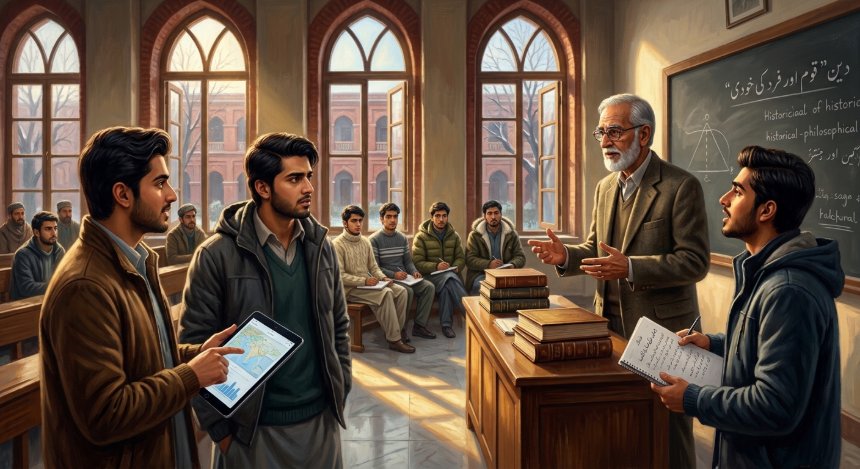
(A profound silence settles over the hall. The stage lighting shifts to a warm amber glow, evoking dusk. Rafe rises from his seat and steps to center stage.)
Rafe: (In a resolute voice)
Today’s gathering in Jubilee Hall has opened my eyes. Student participation in politics is not a hobby—it is the greatest duty of our time, pursued with independent consciousness rather than subservience to any political party. Running away from politics and remaining silent before oppression is truly belittling oneself—and surrendering our home, our future, and our freedom. I will become an engineer and build a tech company, too—but I will never become an ancient Greek "idiotes," or sit silently out of fear as a mere spectator!
Zaid: (Looking out at the audience, in a loud, resonant voice)
Remember, my friends! Allama Iqbal’s verdict is final and unyielding:
Nature may overlook the sins of individuals,
Yet it never forgives the sins of a nation.
(The three friends stand side by side at center stage.)
Kashif:
Undoubtedly, our home is not yet part of that ideal "dreamland"...
Zaid:
Yet we can certainly strive to shape it into that dreamland...
Rafe:
And today’s dialogue—is the very first milestone on that journey!
(Thunderous applause erupts across the hall. Gordon College’s anthem or an uplifting musical score swells in the background as the stage curtain slowly falls.)


