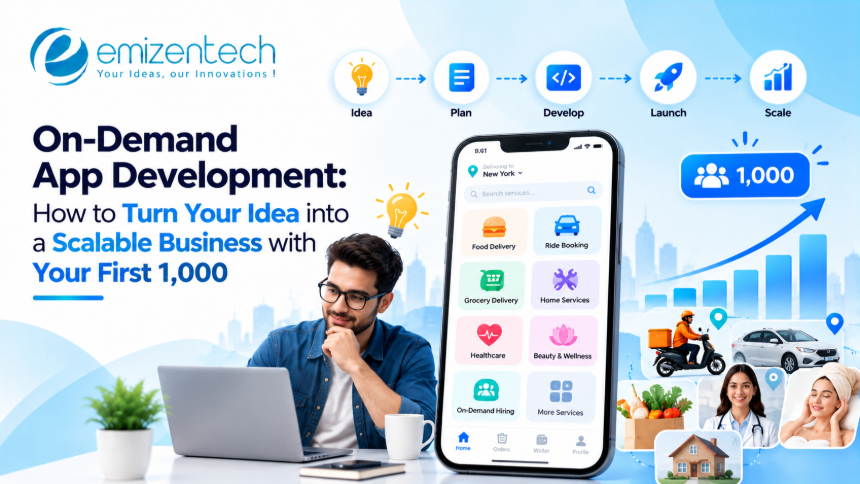

On-Demand App Development: How to Turn Your Idea into a Scalable Business with Your First 1,000
Learn how on-demand app development helps startups validate ideas, build an MVP, acquire their first 1,000 users, and scale a successful business.
Launching an on-demand app requires more than a promising idea. Businesses need to understand customer needs, build a reliable service, and attract users who are willing to return. A structured approach to on demand app development helps startups validate their ideas, control development costs, and prepare for sustainable growth.
From selecting the right business model to acquiring the first 1,000 users, every stage should support a clear business objective.
How to Validate Your On-Demand App Idea Before DevelopmentBefore investing in development, businesses should determine whether their app solves a genuine customer problem. Market validation reduces the risk of building a product that lacks demand and helps establish a clear direction for the project.
Identify a Specific Customer ProblemStart by identifying the problem your app will solve. For example, a home services app might help customers find verified professionals without making multiple phone calls.
Define your target audience, their existing challenges, and the value your app will provide. Customer interviews, surveys, and competitor reviews can help validate these assumptions before investing in on demand app development.
Research Competitors and Market DemandAnalyze competing applications to understand their features, pricing, customer feedback, and service limitations.
Look for opportunities to improve the existing experience. Faster bookings, transparent pricing, better customer support, or more reliable service providers can help differentiate your app.
An experienced on demand app development company can also help businesses assess technical feasibility, identify essential features, and plan an MVP that aligns with validated market demand.
How to Plan Your On-Demand App Development StrategyA clear development strategy helps businesses prioritize essential features, manage resources, and prepare for future expansion.
Choose the Right Business ModelThe business model determines how the application generates revenue.
- Commission-based: Earn a percentage of each completed transaction.
- Subscription-based: Charge customers or service providers a recurring fee.
- Service fee: Apply a fixed fee to each booking or transaction.
- Hybrid model: Combine multiple revenue streams to support different customer segments.
Choose a model that aligns with customer expectations and the economics of your service.
Define Your Target Market and Launch AreaInstead of launching across multiple locations, start with a specific geographic area or customer segment.
A focused launch helps businesses manage service availability, maintain quality, and understand local demand before expanding.
Set Measurable Business GoalsEstablish clear targets for user acquisition, completed bookings, repeat purchases, and customer retention.
These metrics help businesses evaluate whether the app is delivering value and identify areas that need improvement.
What Features Should Your On-Demand App MVP Include?A minimum viable product (MVP) should include the essential functionality needed to deliver the core service. Developing unnecessary features at the beginning can increase costs and delay the launch.
Customer App FeaturesThe customer application should make it easy to discover services and complete transactions.
Essential features include:
- User registration and profile management
- Service search and discovery
- Booking or order placement
- Secure payment integration
- Real-time tracking and notifications
- Ratings and reviews
Service providers need tools to manage their availability, accept bookings, and track earnings.
Important features include provider registration, verification, booking management, availability controls, and payment tracking.
Admin Panel FeaturesAn administrative dashboard helps businesses manage daily operations.
It should support user management, service provider verification, booking monitoring, pricing controls, reporting, and customer support.
The MVP should focus on functionality that directly supports the primary customer journey.
How Does On-Demand App Development Support Business Scalability?Scalability should be considered during development rather than added only after the application starts attracting users.
Choose a Scalable Technology StackThe technology stack should support the app's functionality, expected traffic, and future growth.
Frontend frameworks, backend technologies, databases, and cloud infrastructure should be selected based on performance requirements, development resources, and long-term maintenance needs.
Build a Flexible Application ArchitectureA modular architecture allows businesses to introduce new features without rebuilding the entire application.
Well-designed APIs and efficient database structures also support integrations with payment gateways, analytics tools, inventory systems, and other business applications.
Prepare for Growing User DemandPerformance testing, monitoring, cloud infrastructure, and security controls help maintain application reliability as the user base increases.
Businesses should also plan for higher transaction volumes and increased service provider activity.
How to Acquire Your First 1,000 Users for an On-Demand AppAcquiring the first 1,000 users requires a focused marketing strategy and a service experience that encourages customers to return.
Launch in a Focused MarketStart with a limited service area where customer demand and service provider availability can be managed effectively.
For example, a food delivery startup could begin in a specific neighborhood before expanding into additional locations.
Use Pre-Launch Marketing to Build AwarenessCreate a landing page that explains the app's value and allows interested customers to register for early access.
Social media campaigns, local partnerships, and relevant online communities can help generate awareness before the launch.
Introduce Referral and Incentive ProgramsReferral rewards and introductory discounts can encourage customers to try the application.
However, incentives should support profitable customer acquisition. Discounts that attract users who never return can increase marketing costs without building a sustainable business.
Improve Retention Through Customer FeedbackTrack customer reviews, booking completion rates, repeat usage, and support requests.
Use this information to identify friction points and improve the experience. Retaining existing customers is often more cost-effective than continuously acquiring new ones.
How Much Does It Cost to Develop an On-Demand App?The cost of developing an on-demand application depends on its features, complexity, technology stack, integrations, and development team.
Development componentCost considerationsUI/UX designUser research, wireframes, and interface designFrontend developmentCustomer and service provider applicationsBackend developmentBusiness logic, databases, and APIsThird-party integrationsPayments, maps, notifications, and analyticsTesting and deploymentPerformance, security, and compatibility testingMaintenanceBug fixes, infrastructure, and feature updatesA basic MVP generally requires less investment than a complex application with real-time tracking, multiple user roles, and advanced automation.
Businesses should also allocate a separate budget for marketing, customer acquisition, and post-launch improvements.
Common Mistakes to Avoid When Building an On-Demand AppSeveral mistakes can prevent an application from gaining traction or scaling successfully.
- Building too many features: Unnecessary functionality increases development costs and delays the launch.
- Targeting too many markets: Expanding before establishing reliable operations can affect service quality.
- Ignoring provider onboarding: A shortage of service providers can lead to poor customer experiences.
- Underestimating marketing costs: A functional app will not automatically attract users.
- Neglecting performance and security: Technical issues can reduce customer trust and retention.
- Expanding too early: Growth should be based on consistent demand, operational readiness, and measurable performance.
Building a successful on-demand business requires continuous improvement beyond the initial launch.
Once the app reaches its first 1,000 users, businesses should evaluate customer retention, service quality, transaction volume, and acquisition costs.
The next stage may involve expanding service areas, introducing additional features, onboarding more providers, or improving operational efficiency. Each decision should be based on customer behavior and business performance.
EmizenTech offers on-demand app development services to help businesses build custom applications with essential features, reliable integrations, and scalable architecture. With 12+ years of experience and a 4.9 Clutch review, EmizenTech supports businesses in developing applications designed for their operational requirements and long-term growth.
Frequently Asked QuestionsHow long does it take to develop an on-demand app?A basic MVP may take around 2–4 months, while more complex applications can require 6 months or longer, depending on features, integrations, and testing requirements.
How much does it cost to build an on-demand app MVP?The cost depends on the application's complexity, design, technology stack, and development team. A basic MVP generally costs less than a fully featured application with multiple integrations.
What is the best business model for an on-demand app?Commission-based, subscription-based, and service-fee models are common options. The best choice depends on the target market, service type, and customer payment preferences.
How can startups acquire their first 1,000 app users?Startups can combine focused market launches, referral programs, local partnerships, targeted marketing, and customer feedback to attract and retain early users.
How can an on-demand app scale after its initial launch?Businesses can scale by improving customer retention, expanding service coverage, onboarding more providers, optimizing infrastructure, and introducing features based on user demand.

How Omnichannel Pharma Engagement Connects to Pharma Supply Chain Stra...


Engine Oil Manufacturing Plant Setup 2026: Cost, Machinery, Raw Materi...

Flower Delivery in East of Kailash: Fresh South Delhi Guide
Delivering premium farm-fresh flowers to South Delhi requires a rigorous commitment to col...


Nickel Sulfate Manufacturing Plant Setup 2026: Cost, Machinery, Invest...