
أَعُوذُ بِاللّٰهِ مِنَ الشَّيْطَانِ الرَّجِيمِ
بِسۡمِ ٱللهِ ٱلرَّحۡمَـٰنِ ٱلرَّحِيمِ
In the name of ALLAH, the Most Gracious, the Most Merciful
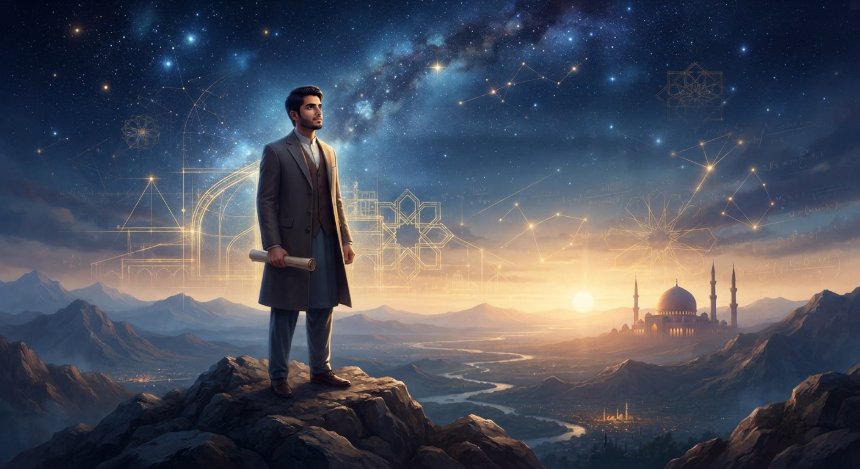
O Muslim! Rise & Rebuild the World
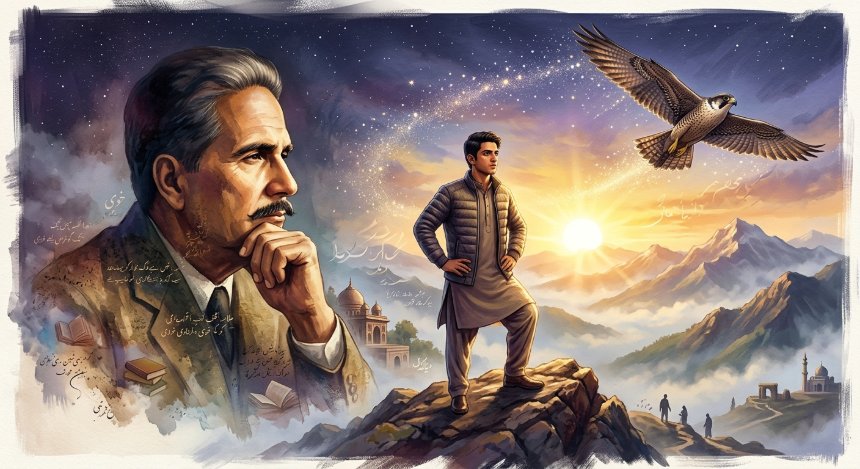
Throughout human history, whenever humanity fell victim to stagnation, despair, and material subjugation, thinkers and poets raised their voices to remind humankind of its true reality and greatness. Rather than viewing a human being as a mere puppet of clay or a slave to circumstances, the Poet of the East, Allama Muhammad Iqbal, declared man to be the true architect of the universe.
Historical Context and the Awakening of the Ummah
The era in which Iqbal lived was a time of severe trial and tribulation for the entire Islamic world, including the Indian subcontinent. On one hand, India was bound in the chains of British imperialism, while on the other, most of the Muslim world suffered under Western colonial dominance and intellectual and political subjugation. Yet, amidst the darkness of this despair, a new consciousness of awakening and struggle was taking birth. Whether through Jamal al-Din al-Afghani’s calls for pan-Islamic unity or the movement-based struggles of reformers like Hassan al-Banna, efforts were underway everywhere to rouse the Ummah from its slumber of heedlessness. Through his poetry and philosophy, Iqbal gave momentum to this very intellectual revolution. He yearned to see Muslims not as a lifeless crowd, but as a "living nation" possessing the courage to write its own destiny. Driven by this passion, he jolts the Ummah awake with the call:--
Memaar-e-Haram! Baaz ba Tameer-e-Jahan Khaiz
(O Architect of the Sanctuary! Rise once more to rebuild the world)
This verse calls humanity back to its true station—reminding us that our duty is not merely to settle for the old structures of the world or accept subjugation, but to construct a new and better world through the power of faith, action, and Divine Love (Ishq).
The Misconception of Life and Its True Essence
The ordinary person views life as nothing more than eating, breathing, and accumulating material comforts. Entangled in the distractions of this transient world, they forget the true purpose of their creation. Yet, the real essence of life lies in self-recognition and the perfection of one’s inner self. Iqbal captures this relationship between life and Khudi (selfhood) in a profound metaphor:
Zindagani hai sadaf, qatra-e-Naisan hai Khudi
Woh sadaf kya ke jo qatre ko guhar kar na sake
(Life is an oyster shell, and Selfhood is the spring raindrop within it;
What worth is that shell which cannot turn the drop into a pearl?)۔
That is, this worldly life is merely a shell (sadaf), and human selfhood is that rare raindrop destined to become a priceless pearl (guhar). A human’s true purpose is not to remain a passive spectator of the world, but to bring brilliance and refinement to this universe through character and action.
Embedded within this verse is a grand message for the Muslim youth: O young soul! Recognize your Khudi, elevate your worth and dignity, and strive relentlessly in this world. By embracing the path of knowledge and action, refine your character until you become a unique pearl (Guhar-e-Yagana), so that through your vitality, the Muslim Ummah may reclaim its lost glory and honor. Reflect upon the monumental mission for which you were created and the heights of the Pleiades (Auj-e-Surayya) you are commanded to reach! Understand your true purpose: you are not an ordinary individual, but the standard-bearer of the Sanctuary's glory. Through purposeful and relentless struggle in this life, you must forge your selfhood into a pearl, and with the radiance of that rare gem, build a world anchored in the supreme sovereignty of Almighty Allah—in other words:--
Memaar-e-Haram! Baaz ba Tameer-e-Jahan Khaiz
(O Architect of the Sanctuary! Rise once more to rebuild the world)۔۔
The Illusion of Material Vastness and the Power of Love for the Prophet ﷺ
When a person views this world through physical eyes and limited intellect (Khird), the earth and skies appear insurmountable and boundless. One feels helpless before this vast universe and opposing forces. However, in Iqbal’s philosophy, Ishq (Divine Love) is that supreme spiritual force and unshakable conviction whose single leap (jast) collapses all material distances and barriers:
Ishq ki ik jast ne tay kar diya qissa tamam
Is zameen o aasman ko be-karaan samjha tha main
(A single leap of Love settled the entire matter;
I had once thought this earth and sky to be boundless.)۔۔
Through Ishq, the truth dawns upon the human soul that true infinity does not reside in the physical cosmos, but within one's own inner self and spiritual ascension. This Ishq is, in essence, true servitude and obedience to Allah; yet no Muslim can even reach the foundation of this love—let alone its heights—without becoming a devoted servant and lover of the Noble Master, Prophet Muhammad ﷺ. Love for the Holy Prophet ﷺ provides that boundless strength which empowers a believer to take that spiritual "leap," propelling them to become a traveler of realms far beyond even the heights of the Pleiades. Devotion and obedience to the Messenger of Allah ﷺ is the master key that lifts humanity from lowliness to the pinnacles of creation, as Iqbal declares:-
Quwwat-e-Ishq se har past ko bala kar de
Dahr mein ism-e-Muhammad ﷺ se ujala kar de
(Through the power of Love, elevate every lowly state;
Illuminate the world with the name of Muhammad ﷺ.)
Rebuilding the World: The Revolution of Khudi and the Testimony of History
The question then arises: how does one discover the path to this inner ascension and world-building? Iqbal locates the answer in awakening Khudi, cleansing it of dust (self-purification and reform), and elevating one's standard of life. When a person brushes away the dust of heedlessness settled upon their selfhood, illuminates their inner being with the light of Divine Gnosis (Marifat-e-Ilahi) to fulfill their duty as God’s vicegerent on earth (Niyabat-e-Arzi), and adopts national reform and the welfare of humanity as their guiding principles, they become free even from the fear of death and subjugation:--
Ho agar khud-nigar o khud-gar o khud-geer Khudi
Yeh bhi mumkin hai ke tu maut se bhi mar na sake
(If Selfhood is self-observing, self-building, and self-mastering,
It is even possible that death itself cannot make you die.)۔۔
This inner awakening makes humanity the true axis of the universe. To transform the world, one must first spark a revolution within oneself; for when a person's inner world changes, the external world naturally bends to their will:۔۔
Teri Khudi mein agar inqilab ho paida
Ajab nahi hai ke yeh chaar su badal jaye
(If a revolution is born within your Selfhood,
It is no wonder that all four corners of the world will change.)۔۔
Many dismiss this philosophy as mere bookish idealism or poetic imagination, questioning its practical value in today's materialistic age. Yet history bears witness that whenever this revolution of Khudi ignited within individuals, the map of the world was redrawn. Was it not in this very world that an ordinary barrister, Muhammad Ali Jinnah, through his selfhood and iron resolve, became Quaid-e-Azam and altered the course of history? Did not Sheikh Muhammad Iqbal himself, through his intellectual awakening, rise as the Poet of the East and Sage of the Ummah to rouse a sleeping nation? Similarly, in the modern era, Iran’s revolutionary leadership—first Ayatollah Ruhollah Khomeini and subsequently Ali Khamenei—embraced this philosophy of self-reliance and resistance, setting an example of standing firm before major global powers, particularly the United States, and playing a defining role in regional politics. These examples prove that the revolution of Khudi is no myth, but a living reality.
Demands of the Modern Era and Our Intellectual Heritage
In today’s age, "rebuilding the world" demands that the youth of the Ummah do not merely rest on tales of past glory, but step forward to lead in modern sciences, scientific research, and technology. For Iqbal, there is no contradiction between faith and science; rather, conquering the forces of nature is the believer's rightful duty. Nor would this be an unprecedented feat! Though the Muslim nation appears intellectually and materially subdued today, it was not always so; for centuries, Muslims led the world in science, arts, and civilization. It may come as a surprise that the earliest pioneers of modern science fiction and speculative literature were Muslim scholars and writers, who produced works exploring scientific imagination and cosmic mysteries for centuries. This proves beyond doubt that the Muslim soil has never been barren—the tragedy is simply that, in our ignorance, we grew content with intellectual servitude. All that is needed now is for today’s youth to unite the wisdom of the Holy Quran, the prophetic character of Muhammad ﷺ, and mastery over modern sciences to awaken their Khudi and conquer the world anew through knowledge and action:--
Nahin hai na-umeed Iqbal apni kisht-e-weeran se
Zara nam ho to yeh mitti bohat zarkhaiz hai saqi
(Iqbal is not despondent over his barren field;
Given a little moisture, this soil is remarkably fertile, O cupbearer.)

Liberation from Self-Serving Materialism and the Journey to Conquer the Universe Liberation from Self-Serving Materialism and the Journey to Conquer the Universe
In today’s materialistic age, humanity’s greatest tragedy is its devotion to the idols of self-interest and worldly comforts. People remember God merely out of necessity and desperation; so long as false worldly supports and material idols satisfy their desires, they remain steeped in heedlessness, turning to God only when those idols fail them. Striking at this self-serving mindset, Allama Iqbal declares:
Is dair-e-kuhan mein hain gharaz-mand pujari
Ranjida buton se hon to karte hain Khuda yaad
(In this ancient temple, the worshippers are driven by self-interest;
Only when displeased with their idols do they remember God.)--
Only by breaking free from this self-serving worship does a human become truly worthy of Divine servitude and cosmic mastery. O Muslim youth of the modern era! Master science and technology and conquer the world through knowledge and research—for "beyond the stars there are more worlds yet, and more trials of Love still await!" From among your own ranks can rise the Newtons and Einstein's of a new age. Remember that modern science has only just learned to stand on its own feet; the deepest mysteries of the cosmos remain to be unlocked. Who is destined to journey across the stars and conquer the vast expanses of space? You must accomplish this by mastering the horizons of East and West like Dhul-Qarnayn; by shattering the barriers of time and distance like Prophet Sulayman (peace be upon him)—for whom the winds were subjugated so that a morning’s journey covered a month’s distance and an evening’s journey another month’s; and by unlocking the secrets of transporting matter across hundreds of miles in the blink of an eye through the power of scriptural knowledge, like Asif ibn Barkhiya. Yet always remember one foundational truth: You must conquer the world, not ruin yourselves by getting lost in its fleeting pleasures and glamour—for the true means of conquering the universe will emerge from the boundless depths of Khudi, not merely from laboratories!۔
Conclusion
In essence, "Memaar-e-Haram! Baaz ba Tameer-e-Jahan Khaiz" is not merely a poetic line, but a living manifesto and a call to action. It shakes humanity out of its slumber of heedlessness, reminding us that we are not slaves to this universe, but its architects. When the warmth of Divine Love and devotion to the Prophet ﷺ, the light of modern knowledge, and the lamp of Khudi ignite within the youth, not only do their own souls attain eternal life, but dormant nations are breathed into with a brand-new spirit:
Khudi ke saaz mein hai umr-e-jawidan ka suragh
Khudi ke soz se roshan hain ummaton ke chiragh
(In the melody of Selfhood lies the secret of eternal life;
By the flame of Selfhood are the lamps of nations lit.)۔۔