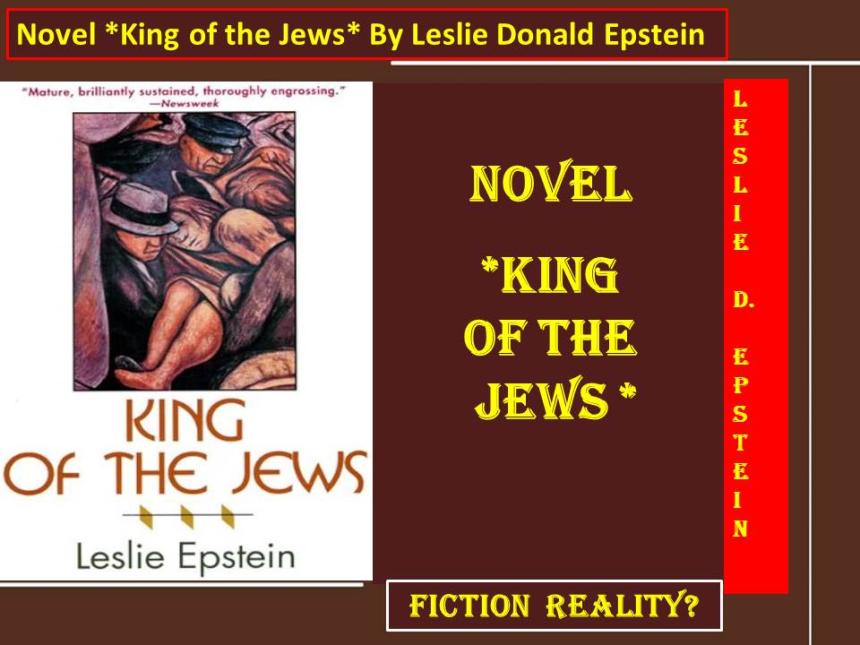

Novel ‘King of the Jews’ By Leslie Donald Epstein
Leslie Donald Epstein (1938-2025) was an American educator, essayist and novelist. He is the author of seven novels and three short story collections. His most controversial work was the novel, "King of the Jews", in which he examines European Jews who betrayed their own people to the Nazis. This write up is an introduction of the Novel ‘King of the Jews’ By Leslie Donald Epstein and arranged for educational purposes from material available freely on Web Net.
أَعُوذُ بِاللّٰهِ مِنَ الشَّيْطَانِ الرَّجِيمِ
بِسۡمِ ٱللهِ ٱلرَّحۡمَـٰنِ ٱلرَّحِيمِ
In the name of ALLAH, the Most Gracious, the Most Merciful
Novel ‘King of the Jews’ By Leslie Donald Epstein
Leslie Donald Epstein (May 4, 1938, Los Angeles, California, US - May 18, 2025, Boston, Massachusetts, US) was an American educator, essayist and novelist. Leslie Epstein was born to a Jewish family in Los Angeles and grew up in Hollywood and his illustrious writing career includes a dozen novels, led Boston University's Creative Writing Program for more than 30 years. His ancestry shall never be neglected to understand the whole narrative made in the novel written in 1979 and unfolding now in 2020s.
Leslie Epstein spent his childhood in the 1940s and 1950s in Pacific Palisades in Los Angeles, California. He was part of a Hollywood screenwriting family. His father and uncle, Philip and Julius, wrote classics like Arsenic and Old Lace and won an Academy Award for Casablanca. He is the author of seven novels and three short story collections. His most controversial work was the novel, King of the Jews, in which he examines European Jews who betrayed their own people to the Nazis.
Novel ‘King of the Jews’ By Leslie Donald Epstein; a 1979 classic tells the darkly humorous story of I.C. Trumpelman, a man whose fancy determines the fate of others. Chosen as the head of a Judenrat, Trumpelman thrives on the power granted him and creates an authoritarian regime of his own within the ghetto. By turns a con man, charismatic leader and merciless dictator, Trumpelman reveals himself as an extraordinarily complex protagonist.
The Jacket of the book says "In what has become a classic novel of the Holocaust, Leslie Epstein dares to explore the excruciating moral dilemma of the Judenrat, the group of Jewish officials who in each ghetto of Europe were forced to collaborate in the destruction of their own people, to choose who was to live and who was to die. It is especially the tale of one such leader, Isaiah Chaim Trumpleman, who strides across these pages, as he does across the lives of his subject, with terrifying force. Part con man, part charismatic hero, both savior and executioner, he is, finally, a tragic character - a figure of inexhaustible vitality who rules over a kingdom of death. But not only death: for this is also the story of the ghetto itself, a community which, while filled with dirt, disease, and despair, is no less marked by courage, irrepressible laughter, and a fierce grip upon life."
With King of the Jews, Epstein dared to do something for which too many remain unprepared to forgive him: portray Jews dying in the Holocaust as ordinary sinners—and therefore bristling with all the flawed humanity the Nazis tried to deny, rather than martyred saints (a humanity-denying perspective of its own). As the Judenrat chairman I. C. Trumpelman haggles for Jewish lives with the gusto of a grandmother at market (“With ten [sacrificed] Jews, I save a hundred. … If your hands are clean, it’s because mine are dirty!”), Epstein resurrects Isaac Babel’s old teaching: Saints are boring, not to mention a lie.
Novel ‘King of the Jews’ By Leslie Donald Epstein Explains
Leslie Epstein has adapted his 1979 novel for the stage performance in October 2023. The work, which Epstein adapted for the stage, follows a group of Jewish people in a café forced by German occupiers to establish a self-governing group that will decide who lives and dies in the ghetto surrounding them. Epstein's stage adaptation premiered in Boston in 2007.
Leslie Donald Epstein when asked about the stage play, and he said "When I adapted my novel King of the Jews for the stage, I aimed to capture the essence of humanity’s most challenging moments," shared Epstein in an earlier statement. "This small café becomes a microcosm of the larger world and its most profound moral dilemmas. The struggle of the Judenrat echoes in stark form many of the choices, including that between good and evil, democratic instincts, and the ruthlessness of fascism, that stands before us now. We, too, must discover what these ordinary men and women do on their stage: cowardice, of course, and foolish pride and egoism, but also resilience, the ability to laugh, the strength to resist, and in the end, a degree of hidden wisdom that cries out to those with power over others: there are moral limits beyond which no human beings can be asked to go. Their past is very much with us in our own present."
This moment comes early on in "King of the Jews", by Leslie Epstein’s stage adaptation of his polarizing 1979 novel, which Ruth Wisse, more than a bit unfairly, savaged for its resemblance to farce set amid the Shoah.
In a Lodz nightclub in 1939, a group of Jewish waiters, musicians and rabbis must assemble a frightful minyan, deciding on 10 people to oversee their coreligionists and form a ghetto on the orders of the Third Reich. In the midst of this nightmare, there’s a moment of classic slapstick.
A waiter enters with a tray of poppy seed rolls, and as a crowd dashes for the exit, having witnessed a grotesque humiliation in the street, they collide and the rolls go flying. Seconds later, gunshots sound in the alley outside.
In Commentary, Wisse tore into the book’s “stylized theatrical staging”; it’s curious that, in an actual staged production, much of this style, and the gallows humor of the ghetto, has been diluted or, at the very least, does not land its comedic punches.
Divided into two acts that play out in real time, Epstein’s narrative, inspired by the figure of Mordechai Chaim Rumkowski, the Lodz Ghetto elder who fancied himself the patron protector of his city’s Jews but was in fact a power-mad functionary of Nazi genocide, is more contained than in his novel. Set in the Astoria Cafe, where the audience is treated to a pre-show jazz combo and has the option of sitting at cabaret tables on Lauren Halpern’s impressive, wall-to-wall period set, the show owes something of a debt to Casablanca, a film penned by Epstein’s father, Phillip, and uncle Julius. In plot, it resembles Jean Genet’s The Balcony, in which a cast of misfit brothel patrons rise to wear the new clothes of emperors and generals in an ersatz government.
When F.X. Wohltat (Daniel Ohreskes, finding fresh, menacing mannerisms in the stock role of Nazi collaborator), orders the customers and staff of the cafe to command the fates of their fellow Jews, there is a lively debate over the ethical implications.
Two raggedy rabbis, played by Allan Lewis Rickman and Robert Zuckerman, offer Godot-esque, gin gimlet-eyed Talmud. Schpitallnik (Jonathan Spivery, also the show’s musical director), a stammering refugee from Budapest, offers excuses. Finally, a Lithuanian doctor, Gotterman (Richard Topol, magnetic as he is repugnant), insists that they must get their hands dirty to save a child hiding among them.
“If we make the choices, we can divert the river of their wrath — away from this boy and from all our little ones,” Gotterman says, a haunting reversal of Rumkowski’s infamous plea for Jewish parents to “give me your children” so that they might be sent to Chelmno.
Gotterman, who in the book is called Trumpelman, a name wisely nixed for a post-Trump world, should be and ultimately becomes the show’s focus as head of the Judenrat, but the constant presence of the ensemble, all excellent in accented English, make his arc and its tortured contortions difficult to track. Beginning the action with a messiah complex, and immediately claiming another man’s wife (torch singer Phelia Lubliver, played by Rachel Botchan), he is hard to accept either as anti-hero or tragic figure.
When we arrive in Act II, with the Judenrat convened in white tie and tails by costume designer Oana Botez, we miss Gotterman’s slow transition from reluctant Nazi accomplice to moral monster. During intermission he has become irredeemable in his office as elder, and it is only the others, notably the young cellist turned minister of security, Dorka Kleinweiss (Erica Spyres), who negotiate to save as many Jews as they can.
As in his novel, Epstein peppers the drama with authentic jokes from the ghetto, and under Alexandra Aron’s direction, the cast is diligent in injecting some physical comedy into this devil’s bargain. For all the show’s problems — and some, like the exclusively euphemistic references to Nazis as “the Blond Ones” were in the original text — it affords audiences sitting amid the action an intimacy that invites post-show discussion if not quite a sense of complicity.
Novel ‘King of the Jews’ By Leslie Donald Epstein- The Story
Lodz was the last remaining ghetto in Poland when it was destroyed in the spring of 1944. This was no accident: the ghetto was an industrial powerhouse for the Nazis, containing, at its height, nearly 100 factories dealing in textiles and manufactured goods — all made by the hands of forced Jewish labor.
Mordechai Chaim Rumkowski, the chairman of the Lodz ghetto’s Jewish council, or Judenrat, was largely responsible for this productivity. A quixotic opportunist, Rumkowski made a morally dubious call: to work with the Nazis to make the ghetto as productive as possible, prove the ghetto’s indispensability, and perhaps thereby lessen the severity of the Jews’ inevitable fate.
Rumkowski is a fascinating figure and proves equally fascinating in the fictional guise of I.C. Trumpelman, the protagonist of Leslie Epstein’s polarizing 1979 debut King of the Jews.
Like his real-life inspiration, Trumpelman is an unknowable, often merciless character who willingly facilitates the deportation of Jewish children to the camps only to broker improvements for those who remain. He believes that sacrificing Jews in order to save Jews is a worthy calculus. We can’t tell if he’s a martyr or a murderous lunatic. He is probably both.
Leslie Epstein’s novel, King of the Jews, is loosely based on events in the ghetto of Lodz under the German occupation of World War II. The Lodz ghetto was liquidated in August 1944, with the same thoroughness as all the other Jewish ghettos of Poland, but its almost five-year duration was exceptional in many ways. The Jewish worker population of Lodz, center of Polish industry, became the nucleus of the largest “labor ghetto” under Nazi rule. The great productivity of the ghetto, especially as a source of textiles and manufactured goods for the German Wehrmacht, encouraged the belief that its economic usefulness would guarantee its survival. This belief was systematically cultivated by the Germans through the man they appointed as leader of the Jewish Council, Mordechai Chaim Rumkowski, who justified his autocratic rule by claiming that his pitiless efficiency would avert a much harsher fate.
The last of all the ghettos to be destroyed, in a city that remained otherwise intact, Lodz ghetto preserved the largest collection of material about its wartime history, including buried caches of photographs, diaries, documents, and eyewitness accounts. This archive has been supplemented in the ensuing decades by dozens of memoirs and autobiographical novels, leaving the researcher and historian with a greater well of information than any other destroyed Jewish community was able to bequeath.1 Epstein’s novel makes selective use of this material.
Although its central character, I. C. Trumpelman, is based on the actual chairman of the Lodz Judenrat, and though the book’s descriptions of the local conditions derive from documented ghetto history, King of the Jews does not attempt a historical interpretation of either the ghetto Elder or of the ghetto itself. The book bears the same relation to the Holocaust as M*A*S*H does to the Korean war. Its flat caricatures, cabaret style of narration, and stylized theatrical staging for all the main events of the plot belong to the category of farce. Like other American war farces, Epstein’s book isolates the moral angst of the situation from the historical conditions in which it originated: from the aggression of totalitarian regimes or, in this case, from the articulated program of genocide. True evil seems not to be a suitable subject for this genre. Thus the Germans, under euphemistic designations, remain outside the “problem” of this book, which concentrates on the destruction of the Jews as an internal Jewish matter. To use the kind of fairytale analogy in which Epstein delights, this is like the story of Red Riding Hood, but without the wolf. The wolf’s lurking presence is admitted as part of the atmosphere, but the real subject is the credulity of Red Riding Hood, and the nature of her guilt in directing the wolf to granny’s door.
The book’s main thematic concern is with what the jacket copy calls the “excrutiating moral dilemmas” of those charged with executing German orders, and of those not so charged whose initiatives had still to be weighed against the threat of collective reprisal. To dramatize this moral plight of the Jews, the book is studded with relevant debates: on Judenrat membership as a privilege or right; on the strategy of appeasement versus rebellion; on the right to sacrifice a minority to save the majority; on the relative merits of labor and sabotage; on the relative morality of murder and suicide. There is even a debate (whose literary antecedent is in André Schwartz-Bart’s The Last of the Just) on whether children being deported to their death should be lulled with bright dreams or told that “Oswiecim is the homeland of the Jews.” Hannah Arendt’s thesis of the banal inflexibility of the totalitarian mind during the Holocaust seems to have found its corollary in this presentation of the hyperactive Jewish moral imagination. But the debates, which include many classical ghetto arguments culled from various Holocaust anthologies, are phrased in snappy one-liners that make the “excruciating moral dilemmas” of the Jews sound like entries on a multiple-choice exam.
Novel ‘King of the Jews’ By Leslie Donald Epstein- The Conspiracy
The above clip is making waves on social media and people are searching this Novel ‘King of the Jews’ By Leslie Donald Epstein. Back in July 10th 2023, Trump was given the Torah Crown, honouring him as the ‘King of the Jews’…
In 1979 a man by the name of Leslie Donald Epstein, published a book titled ‘King of the Jews’. It is a novel set in a Jewish ghetto in Nazi occupied Poland during the Holocaust. The book’s first chapter is titled “The Golden Age.”
At the centre of the story is I.C. Trumpelman, a charismatic con man who is appointed head of the ghetto’s Jewish Council, the Judenrat. Granted authority over his fellow Jews, Trumpelman gradually builds his own authoritarian regime, placing his image on money and stamps and deciding who will be sacrificed to the Nazis in the belief that doing so might save others.
Among the other characters is Mosk, a wealthy mill owner and influential businessman within the ghetto.
As his power grows, the line between survival, collaboration and tyranny becomes increasingly difficult to distinguish.
So, here’s a novel written nearly half a century ago by a man named Epstein, featuring characters named Trumpel man and Mosk, and beginning with a chapter called “The Golden Age.”
We live in a very strange matrix…
The Conclusion
The Holocaust (as described by Jewish Sources) was the systematic, state-sponsored murder of six million European Jews by Nazi Germany and its collaborators between 1933 and 1945. Also known as the Shoah, the genocide wiped out roughly two-thirds of Europe's Jewish population alongside millions of other victims targeted by the Nazi regime. "Nazi Germany and its collaborators" refers to the totalitarian regime led by Adolf Hitler and the network of foreign governments, military forces, and local citizens that assisted them during World War II and the Holocaust.
The Holocaust was conducted across the entire European continent, spanning thousands of locations in Germany and territories occupied by or allied with the Nazi regime.Core Concentration and Extermination Camps. The most deadly, industrialized killings took place in Nazi-occupied Poland, where Germany built specialized death camps near rail lines.
Leslie Donald Epstein belonged to "Epstein" Family which is one of the oldest Ashkenazi Jewish family names, originating from the town of Eppstein in Hesse, Germany. "Epstein" is derived from the town and castle name Eppstein in western Germany. Before World War II, approximately 92% of the world’s Jewish population was Ashkenazi, with the vast majority living in Central and Eastern Europe. The overwhelming majority of Jews killed in the Holocaust were also the "Ashkenazi" Jews.
"Churchill, Hitler, FDR, Stalin and the Bankers" is a historical and political book by Dr. Mujahid Kamran, former Vice Chancellor of the University of the Punjab. The text explores the thesis that a hidden network of international financial elites and central bankers manipulated global events, engineered major economic policies, and helped instigate the 20th century's devastating world wars. In his book Churchill, Hitler, FDR, Stalin and the Bankers, Dr. Mujahid Kamran draws heavily on the research of revisionist historians like Antony C. Sutton to argue that Adolf Hitler’s rise to power and his subsequent decision-making were tightly directed by a network of international financiers and corporate handlers.
The book frames Hitler's most influential figures not as his political cabinet, but as agents of Wall Street and international banking entities who acted as conduits to fund and direct the Nazi regime. The book specifically identifies the following banking families as the "Core Banking Dynasties":-
1. The Rothschild Family (London and Paris branches): Identified as the ultimate architects of the modern central banking system. The book asserts they used their immense wealth to influence the Bank of England and European monetary policies to manipulate global geopolitical shifts.
2. The Warburg Family (M.M. Warburg & Co. / Kuhn, Loeb & Co.): Specifically highlights Paul Warburg (the architectural mastermind behind the creation of the U.S. Federal Reserve) and Max Warburg (a prominent German banker), framing them as structural bridges between American and German financial systems.
3. The Morgan Family (J.P. Morgan & Co.): Identified as a key financial pipeline linking Wall Street to British intelligence and European financing before and during both World Wars.
4. The Rockefeller Family (Chase National Bank / Standard Oil): Identified as the primary American economic force that bankrolled geopolitical strategies. Kamran details how their corporate entities, like Standard Oil, maintained financial and industrial partnerships with Nazi Germany's chemical monopolies even during World War II.
The Rothschild Family is the uncrowned chief of "the Bankers" documented as an Ashkenazi Jewish banking family originating from the Jewish ghetto of Frankfurt, Germany. The whole drama or fiasco created since the publishing of "Protocol of Zions" is attributed to this family as "Masterminds". The others in supporting role under the guidance of Rothschild are the "Warburg Family" another prominent Ashkenazi Jewish banking dynasty established by German Jews in Hamburg.
The Leslie Donald Epstein Family and the Bankers are from the "Ashkenazi Jewish" background from Germany (Somehow Germany linkage comes up). The world now have discovered about "Jeffrey Epstein" Files (Jeffrey Epstein family had Polish Jewish descent but surprisingly adopted a German linkage). Novel ‘King of the Jews’ By Leslie Donald Epstein shall not be a "surprise" controversial fiction story. There are always some family secrets and Leslie Donald Epstein actually spilled the beans in public by writing a novel based on those closely kept secrets. Now read the Novel again and the story will make a great sense as a true story and the conspiracy may not necessary be one far fetched idea.
How Can Scalable Web Applications Support Long-Term Business Growth?

dead animal removal Melbourne
Protect your home or business with professional pest control South East Melbourne services...