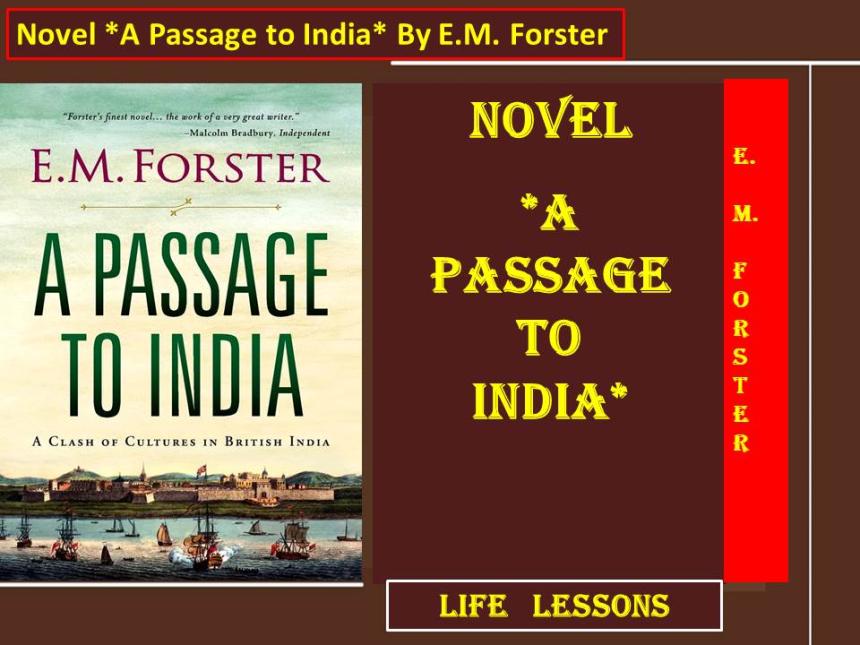

Novel *A Passage to India* By E.M. Forster
Edward Morgan Forster (1879-1970) was an English author. He wrote numerous short stories, essays, speeches and broadcasts. He is celebrated for his ironic and insightful novels examining class, society, and personal connection. Novel "A Passage to India" by E. M. Forster explores the political and personal tensions between the British colonizers and the Indian people during the British Raj.This write up is an introduction of the Novel *A Passage to India* By E.M. Forster and arranged for educational purposes from material available freely on Web Net.
أَعُوذُ بِاللّٰهِ مِنَ الشَّيْطَانِ الرَّجِيمِ
بِسۡمِ ٱللهِ ٱلرَّحۡمَـٰنِ ٱلرَّحِيمِ
In the name of ALLAH, the Most Gracious, the Most Merciful
Novel *A Passage to India* By E.M. Forster
Edward Morgan Forster (January 1, 1879, Marylebone, London, United Kingdom-June 7, 1970, Coventry, United Kingdom) was an English author. He wrote numerous short stories, essays, speeches and broadcasts, as well as biographies and pageant plays and is celebrated for his ironic and insightful novels examining class, society, and personal connection.. He is best known for his novels, particularly "A Room with a View", "Howards End" and "A Passage to India".
Novel "A Passage to India" by E. M. Forster, published in 1924 explores the political and personal tensions between the British colonizers and the Indian people during the British Raj. The story centers on a young Indian doctor, Dr. Aziz, and his troubled relationships with English visitors after a controversial incident at the Marabar Caves.
The central idea of A Passage to India by E.M. Forster is the profound difficulty of human connection across vast racial, cultural, and political divides. Set during the British Raj, the novel investigates whether true friendship is possible between the British colonizers and the Indian colonized, ultimately concluding that political inequality and prejudice make genuine unity nearly impossible.
Forster uses the central relationship between Dr. Aziz and Cyril Fielding to test if personal goodwill can overcome imperial division. Political dominance poisons private interactions, turning mutual respect into suspicion and resentment. The famous final lines of the book—where the horses and earth cry out, "No, not yet" and "No, not there"—reinforce that India and England cannot unite under current conditions.
The British ruling class is portrayed as trapped by rigid racial codes, arrogance, and a lack of empathy. Imperialism damages the colonizers just as much as the colonized by stripping them of authentic human feeling and moral clarity. Institutional bias surfaces instantly during the crisis at the Marabar Caves, where the English community rushes to judgment against Aziz without evidence.
India itself is depicted as a vast, chaotic, and indifferent presence that resists Western logic and comprehension. The echo in the Marabar Caves symbolizes absolute emptiness and meaninglessness—a spiritual void that shatters Mrs. Moore's comforting worldview and overwhelms Adela Quested's sanity. This cosmic "muddle" suggests that human beings are fundamentally isolated in a confusing universe.
Novel *A Passage to India* By E.M. Forster- Detailed Explanation
"I do not think it is the duty of a minor official to educate the natives." This line, spoken casually by a British administrator in India, contains everything E.M. Forster understood about the British Empire: the casual cruelty of people who believe certain humans are beneath their concern, the way power justifies indifference, the fundamental refusal to see colonized people as fully human.
*A Passage to India* was published in 1924, as British rule in India was beginning its slow collapse. Forster had visited India twice, lived there, observed the machinery of empire from the inside. The novel is his indictment of colonialism, but more specifically, it's his exploration of whether genuine connection between colonizer and colonized is even possible.
The story centers on Adela Quested, a young British woman arriving in India to see if she wants to marry Ronny Heaslop, a British magistrate. She's curious about India, wants to see the real country rather than the filtered version British colonists inhabit. She meets Dr. Aziz, an Indian Muslim doctor, and Cyril Fielding, a British educator who genuinely respects Indian culture.
While Ronny and the other English bureaucrats feel quite at ease sequestered in their enclaves, which are off-limits to Indians, Mrs. Moore and Adela feel deprived by their isolation. They want to see the "real" India. One evening Mrs. Moore wanders away from a dreadfully boring play at the British club and goes to see a nearby mosque. Her presence startles Dr. Aziz (Victor Banerjee), a Moslem doctor, who has stopped there to rest after being snubbed by his British superior. The initial surprise turns to instant rapport between them when Mrs. Moore explains that she has respectfully taken off her shoes and that she believes "God is here." Mrs. Moore is like no other Englishwoman Dr. Aziz has ever met.
Forster builds something almost friendly between these three. Aziz takes Adela and her elderly friend Mrs. Moore on an expedition to the Marabar Caves, the only real landscape feature in the region that predates British arrival. The caves are ancient, mysterious, and utterly indifferent to human meaning. Sound echoes strangely. Time feels suspended.
Something happens in the caves. Forster never quite says what. Adela emerges claiming Aziz assaulted her. Aziz is arrested. A trial is arranged, and the novel becomes an examination of how the machinery of colonial justice works, how race determines guilt and innocence before evidence is even presented.
But the central question is whether anything actually happened. Adela's story changes as she recounts it. She seems uncertain about her own memory. The reader is deliberately left unsure. Forster uses this ambiguity brilliantly. It doesn't matter whether Aziz assaulted her. What matters is that colonial society instantly believed the accusation, instantly took the British woman's word over the Indian man's, instantly mobilized to punish him.
Mrs. Moore, the older woman, recognizes the injustice immediately. She refuses to participate in the trial against Aziz despite enormous pressure from the British community. For this act of conscience, she's treated as a traitor to her own race. The British exile her from their society, and she dies on the passage back to England. Adela, meanwhile, must learn the truth of Mrs. Moore's observation that "India forces one to come face to face with oneself."
Forster shows how empire corrupts everyone within it. The British characters are not villains. They're ordinary people who've absorbed the assumptions of colonialism so completely they can't see their own cruelty. They believe they're civilizing India, bringing order and justice. They're genuinely shocked when Indians resent them or fail to be grateful.
Aziz becomes the lens through which we see this corruption. He's intelligent, educated, capable, but none of that matters to the colonial system. He can be a good doctor, a loyal friend, the kind of person Fielding genuinely likes, but when accused by a British woman, his individual qualities become irrelevant. He's reduced to his race and his category: an Indian man, therefore suspect.
The trial is rigged before it begins. The judge is British, the magistrate is British, the entire system is designed to protect British interests and validate British judgment. Aziz's lawyer is Indian but operating within a system that doesn't value Indian testimony. Everyone knows what the verdict will be before evidence is presented.
Yet something unexpected happens. During the trial, Adela recants. She admits uncertainty about what happened in the caves. She refuses to maintain the lie. This act of honesty destroys her socially. The British community turns on her for betraying the race. The Indians are cautious in their gratitude because her honesty came too late to prevent the arrest, the humiliation, the machinery of justice turning against Aziz.
Even when she tells the truth, justice doesn't come. Aziz is released, but vindication is hollow. The trial itself was the punishment. The accusation itself was the crime. Whether he's officially acquitted matters less than that he was arrested and tried in the first place.
Forster explores whether friendship is possible across the divide of empire. Fielding and Aziz genuinely like each other, but the system they inhabit constantly undermines their connection. Ronny Heaslop, the magistrate, is Fielding's friend too, yet he's completely absorbed into colonial ideology. He can't see Indians as equals. He can't imagine that an Indian might be as educated, as intelligent, as worthy of respect as a British official.
The final section, set years after the trial, shows Aziz and Fielding attempting to renew their friendship after the trauma. They meet in the forest, try to recapture what they had, but something has been destroyed that cannot be rebuilt. The institutional violence of colonialism has poisoned their connection. Even though Fielding tried to support Aziz during the trial, the fundamental power imbalance remains. Fielding is English in an English colony. Aziz is Indian in a country ruled by his colonizers.
The title *A Passage to India* refers to the journey, but also to the question of whether any passage is truly possible between the British and Indian worlds. The novel's answer is devastating: not in the context of empire. Not when one group has power over the other. Not when the entire legal, social, and political system privileges one race.
Forster was writing during the height of empire, when such critiques were genuinely radical. He showed how colonialism corrupts the colonizers while destroying the colonized. He showed how systems of power create injustice that no individual conscience can overcome. He showed how good intentions matter less than structural realities.
The caves themselves become the novel's central symbol. They're ancient, indifferent to human drama, and they produce an echo that terrifies Mrs. Moore. The echo reduces all sound to the same meaningless reverberation. In the caves, human distinctions collapse. Yet this collapse, which should be liberating, is instead terrifying to the British characters. They need hierarchy, need to believe in British superiority. The caves suggest that none of it matters, that India existed before Britain arrived and will continue after Britain leaves.
What makes *A Passage to India* endure is Forster's refusal to simplify. He doesn't make the British characters purely evil or the Indian characters purely noble. He shows how systems corrupt individuals, how power structures determine outcomes independent of personal morality, how empire creates a situation where genuine friendship becomes almost impossible.
Adela is sympathetic but not vindicated by telling the truth. Aziz is wronged but not fully redeemed by being acquitted. Fielding tries to do right but remains implicated in the system he critiques. Mrs. Moore becomes a saint-like figure through her refusal to participate in injustice, but her refusal changes nothing. She dies in exile, her conscience intact but ineffectual.
In an essay on Forster's novel, Peter Burra describes it as "one of the most aesthetically compact books ever written, whose thought, like music's cannot be fixed, nor its meaning defined." The film convincingly depicts the "strangeness" of India and the cross-cultural misunderstandings that ensue from the incident at the Marabar Caves.
Read *A Passage to India* when you want to understand how empire operates, how good intentions fail against systemic injustice, how institutions determine outcomes more than individuals do. Forster wrote a novel about British India that remains urgently relevant to any situation where power operates across lines of race, class, or nationality.
The passage between worlds remains impossible. The novel's genius is in showing us why, clearly and without false hope.
https://www.facebook.com/groups/1310508596300250/permalink/1970558483628588/
Novel *A Passage to India* By E.M. Forster- A Highly Acclaimed Film
The Novel *A Passage to India* By E.M. Forster was adapted into a highly acclaimed epic adventure / drama Film "A Passage to India"; Directed by David Lean, which premiered on December 14, 1984. A literary riddle that each person is challenged to decipher in light of his or her own perception of human passion and prejudice and the film was a master act to help comprehend the subject.
Key Movie Details
Director: The film was directed, written, and edited by legendary filmmaker David Lean, known for other sweeping classics like Lawrence of Arabia and Doctor Zhivago. This was the final film of his career.
Main Cast: Judy Davis as Adela Quested; Victor Banerjee as Dr. Aziz; Peggy Ashcroft as Mrs. Moore; James Fox as Richard Fielding; Sir Alec Guinness as Professor Godbole
Reception and Awards
The film was a major critical success and received 11 Academy Award nominations, including Best Picture and Best Director. It won two Oscars:
Best Supporting Actress: Won by Peggy Ashcroft (who, at age 77, became the oldest actress to win the award at the time).
Best Original Score: Won by composer Maurice Jarre.
The film is widely praised for its beautiful cinematography of the Indian countryside and its faithful exploration of the book's themes of cultural misunderstanding and racism during the British Raj.
Novel *A Passage to India* By E.M. Forster- Lessons to be Learnt
Novel "A Passage to India" by E.M. Forster is a famous novel about British rule in India. It shows how prejudice, cultural gaps, and the desire for power ruin human connections. The Novel teaches us about the deep harm of prejudice, the limits of human understanding across cultures, and the reality that true friendship struggles to survive in a society built on unfair power and imperial rule. The core message is that true friendship between different cultures is very hard under an unequal political system.
Cultural and Social Lessons
Bridge the Gap: Forster shows that personal goodwill is not enough to fix a wide social divide. Political equality must exist first.
Beware of Prejudice: Both the British rulers and the local Indians fall into the trap of broad stereotypes. They judge whole groups instead of seeing individuals.
The Cost of Imperialism: Ruling over others distorts human nature. It makes the rulers arrogant and suspicious, and it forces the ruled to wear a mask of submission.
Psychological and Personal Lessons
Misunderstandings Happen Easily: The Marabar Caves episode shows how fear and a strange environment can distort the truth. People project their own inner chaos onto confusing events.
Open-Mindedness is Rare: Characters like Adela Quested try to see the real India, but they often fail because they bring their own hidden biases and fears.
True Friendship is Fragile: The bond between Fielding and Dr. Aziz fades because outside social pressures and doubts pull them apart.
The Conclusion
Novel "A Passage to India" by E.M. Forster shows that the British rulers and Indian locals lived in separate worlds. They didn't see each other as true equals because of pride and fear. Ruling over others makes people cruel, arrogant, and blind to their own faults. Good intentions are not enough. Two humans from different cultures may try to be friends, but social pressures and hidden biases tear them apart. An unfair system stops people from loving or trusting one another. Small social mistakes easily turn into massive hatred due to tension in the air. Peace under foreign or dictator's rule is fake. It hides deep anger that can explode at any time. The empty echo strips away meaning from life. It shows that human beings are fundamentally alone in a confusing universe.
Novel "A Passage to India" by E.M. Forster remains deeply relevant today because our digital tools mirror the colonial divides of the novel, showing how echo chambers, online miscommunication, and superficial connections prevent true human empathy. The caves reduce all sounds to a single, meaningless "boum." This resembles modern internet algorithms that flatten complex human ideas into loud, repetitive outrage. Just as the echo drove Adela into confusion and panic, digital spaces often distort facts and push people toward extreme emotional responses.
Today, video calls and social media feeds offer a fake sense of closeness while actually increasing feelings of isolation. A small, misunderstood gesture in Chandrapore quickly turns into a massive legal and racial crisis. This perfectly mirrors modern internet "cancel culture," where context is lost and public judgment is instant. Today, despite being globally connected via the internet, tribalism, political polarization, and digital borders keep people deeply divided. At the end of the novel, the earth and sky say Aziz and Fielding cannot be true friends until they are equals. In the digital age, true connection is still impossible if one side holds all the power, or if the friendship only exists through a screen.