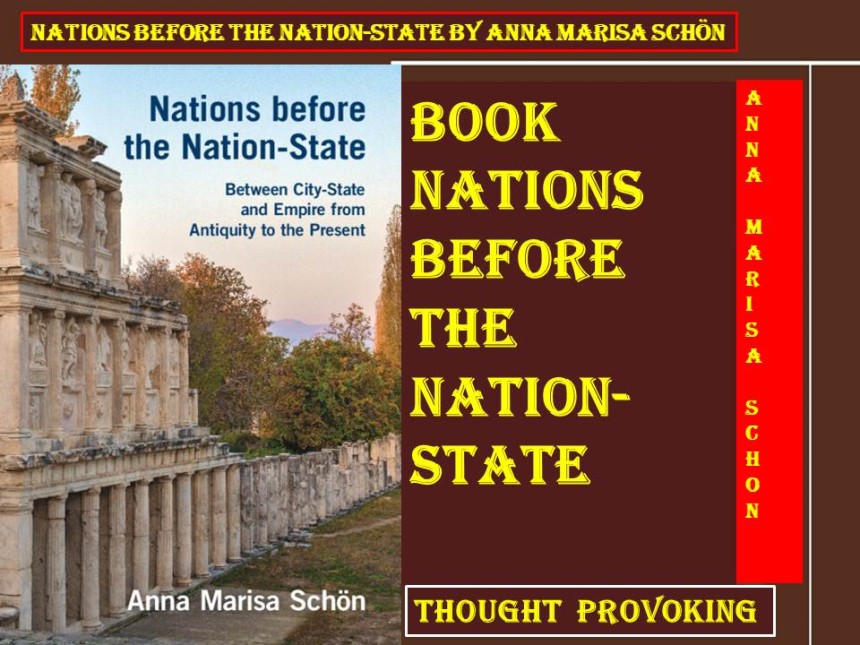

Nations before the Nation-State By Anna Marisa Schön
Nation states are modern concept established a century ago; however, human history is quite longer and is witness to certain ideas like "nations are borne before state". "Nations before the Nation-State" (2024), by Anna Marisa Schön, challenges the modern assumption that nations only exist alongside state structures. This write up also challenges the modern assumptions in a different perspective.; which is based on religion, Islam and proposes Muslims' Nation State.
بِسۡمِ ٱللهِ ٱلرَّحۡمَـٰنِ ٱلرَّحِيمِ
In the name of ALLAH, the Most Gracious, the Most Merciful
Nations before the Nation-State By Anna Marisa Schön
Anna Marisa Schön is a Postdoctoral Associate at the Department of Political Science at Duke University. Her research focuses on medieval political thought, and questions surrounding nationalism, national pluralism, and empire. She has co-translated J. G. Fichte's work on the French Revolution (2021) and her work has appeared in History of Political Thought, British Journal of the History of Philosophy, and Democratic Theory.
The Book "Nations before the Nation-State," by Anna Marisa Schön, argues that the concept of the nation existed long before the modern era as a cultural-linguistic identity rather than a political entity tied to a state. By examining ancient and medieval thought, the book challenges the modern nation-state paradigm and suggests alternative ways to understand national identity.
Throughout Antiquity and the Middle Ages, thinkers understood nations as communities defined by common language, culture, and descent, and sharing strong bonds of belonging and solidarity. Even so, they did not assume that nations would also be appropriate units of government. The recovery of this historical understanding, in turn, yields valuable insights for contemporary political dilemmas. A nation-State is basically a state, where all the people living in it, share elements of their society, things like a shared history, a shared language, shared customs and laws, and those sorts of things. Therefore, a Nation-State's populace has a shared identity.
In 1787-99, after the french revolution, France was considered the first nation-state. However, some experts believe that the English Commonwealth established in the year 1649 should be cited as the first nation-state. Thereafter the definition of "a nation-state" has been made to be an independent political entity formed by a group of people who share common cultural traits such as language, religion, and ethnicity. Although not all citizens may possess every characteristic of the dominant group, they typically share similar backgrounds and traditions. Today, after the World War -I & II an order was established and UNO was formatted to recognize the existence of a nation-state having four characteristics as a nation-state are sovereignty, land, population, and government.
The Book "Nations Before the Nation-State" offers the first extended study of the idea of the nation in ancient and medieval political thought. It recovers a pre-modern conception of the nation as a cultural and linguistic community, rather than a political association, and examines better means for thinking about nationhood. The book Offers a historic perspective from which to address challenges of nationalism; this book engages with debates on multiculturalism, liberal nationalism, and constitutional patriotism and argues that contemporary political dilemmas can be resolved more organically by recovering modes of thinking that have resolved similar tensions for centuries.
"Nations before the Nation-State" by Anna Marisa Schön discusses the concept of nation between City-State and Empire from Antiquity to the Present and provides significant insights and lessons for nation-building, primarily by challenging the modern assumption that every nation must have its own state. Schön argues that for much of history, "nation" was understood as a cultural, linguistic, or, in some contexts, a familial / descent-based community, rather than a political unit defined by territorial sovereignty.
Here are the key lessons for nation-building derived from her work:-
Disentangling Nation from State: The core lesson is that nationhood and statehood do not need to be inherently linked. Schön demonstrates that national communities can exist, thrive, and share bonds of solidarity without needing to control a state.
Accommodating Pluralism: By looking back at ancient and medieval political thought, the book argues for "recovering modes of thinking" that allowed multiple cultural or national communities to coexist within larger political structures, such as empires or cities. This suggests that nation-building does not require ethnically homogeneous populations.
A "Pre-Modern" Model for Modern Problems: The work proposes that this pre-modern, non-political understanding of the nation offers a way to address the challenges of modern nationalism, ethnic conflicts, and the limitations of liberal multiculturalism.
Alternative Political Organization: Rather than forcing a one-to-one mapping of nation-to-state (which often leads to exclusion), the book suggests that nation-building can be organized through looser, less restrictive political arrangements.
In essence, Schön argues that modern political dilemmas can be resolved more organically by decoupling the concept of the nation from the rigid framework of the modern nation-state.
The Nation Before the State: Lessons from History for Reviving the National Movement.
Now, in the following a write up by Dr. Abdullah Al-Nafisi penned with a different perspective is being shared:-
For over fourteen centuries, Islam has remained alive despite the fall and decline of its Muslim states. This resilience was not due to the sultan or the army, but rather to the living nation... It was the nation that preserved Islam and maintained its structure. When the state deviated or retreated, the religion remained present in values, education, markets, customs, and the consciousness of the people.
Every historical experience proves a universal law and a principle of human society: that the natural state is a branch, and the nation is the root. The state comes to serve, not to invent; it comes to complement, not to create. When the survival of religion is tied to power, or the survival of an organization to governance, Islam becomes hostage to politics, and the vibrant current of the nation becomes hostage to division, targeting, or deviation.
Some contemporary Islamic movements, such as the experience of Hizb ut-Tahrir as formulated by Al-Nabhani, attempted to build a civilizational project on the foundation of community building, and to achieve “communication with society,” as stated in its pamphlets (Party Bloc, Concepts of Hizb ut-Tahrir, and Community Entrance)..... But what actually happened was that the organization monopolized thought and the means of implementation, while the nation itself was not utilized. Consequently, the party itself became a target, and the idea of preserving society became a lost or almost neglected idea.
The lesson learned from this is that no civilizational project can succeed if it separates the organization from the nation, or if it prioritizes the state over building the nation itself. Those who understand this will know that the starting point is not controlling the state, nor raising slogans, but rather reviving the current of the nation, and restoring the nation itself to the center of action and life.
Why “the current of the nation”?
Because it represents the collective consciousness and social conscience that has historically preserved Islam.
Because it is a network of values, ethics, and social relations that transcends any organization or party.
Because it is the foundation upon which the state is built, not the other way around.
Because it is the only way to overcome political targeting and external exploitation, as it is present in society before it is imposed upon the authorities.
What does this mean practically for Islamists?
Overcoming the illusion of exclusive representation, for no one represents the nation alone, and no organization possesses its entire share of history or society.
Work must be within society, not above it, through education, social activism, civic initiatives, unions, media, and charitable work, for these are all genuine tools for the revival of the nation.
Patience and cumulative progress are the paths to civilizational change, as they require more time than any political struggle or election.
Redefining the relationship with the state: the state is a tool, not an end. The nation creates the state, not the other way around.
In light of this understanding, any discussions about party names, slogans, or measures of power become mere formalities. The essence lies in restoring the nation to the center of action and reviving its civilizational current, so that it becomes the true power within society, and any subsequent political rule becomes simply a reflection of what the nation embraces.
Reviving the nation's current today is not merely an organizational or political choice, but a historical and practical necessity to keep Islam alive and active, and to rebuild society upon its authentic values, far removed from political deviation and external targeting. The nation's current is the collective consciousness, civilizational values, and moral and social capacity that preserved Islam throughout the centuries and protected society when states deviated and regimes changed. It is this current that ultimately shapes the state, not the other way around.
Organizations, movements, and parties are not ends in themselves, but rather means to activate the nation's current. They have two main tasks:
First, to elevate the nation to revive its current, revitalize society, and build its awareness and readiness for civilizational progress.
The second is to be an incubator for preparing professional political leaders who possess the ability to plan, make decisions, and manage the state and its resources, so that the civilizational project becomes a tangible reality when the appropriate conditions are met.
The story of Saddam Hussein when he was a university student practically embodies this lesson. While his classmates were busy studying for the next day's exam, Saddam was gazing at the ceiling, lost in thought, not studying. When asked what was distracting him from his studies, he replied that he was thinking about how to govern Iraq. He was thinking with the mindset of a ruler, not with that of the poor or the oppressed. This is what Islamists today must learn. True leadership begins with adopting a mindset of project and governance, while adhering to values and principles, not merely with a feeling of oppression or lamenting the past.
We should not forget in this context the observation of Ghannouchi—may God have mercy on him—which reveals another aspect of the problem. He mentions that the Islamists gained the trust of the vast masses, which may reach 80%, but they failed to gain the trust of the hard power. In the country, which does not exceed 20%, this critical balance demonstrates that popularity alone is insufficient if it is not accompanied by the ability to manage state institutions and protect the political project.*
Any party that relies solely on religious and spiritual discourse, neglecting a political program and practical skills, transforms into a school for preachers, not politicians, as we witnessed in the experiences of the Muslim Brotherhood in Egypt, Sudan, and Tunisia, where they failed miserably when they tried to govern.
In short, reviving the nation's movement means restoring the nation itself to the center of civilizational action, utilizing organizations as tools, building qualified political leaders, and activating society, so that any subsequent political influence becomes a product of the nation's will, not merely a dream or slogans, and ensures the continued vitality and effectiveness of Islam across generations.
Concluding Additional Comments
In Islamic historical perspective, the "ummah" (a community of people united by the ideology of religion) is a fundamental pillar, which is born before the existence and value-based harmony of any political framework (state and government). This concept of "Ummah" as a community of nation; the evolution of the country, empire and state; its survival and restoration after collapse; becomes a civilizational necessity for its effectiveness in regaining its ascendancy. History teaches us that despite the ups and downs of time, the decline of Muslim nations should be regarded as temporary political misfortune; and therefore, the construction of a "Muslim Nation" from the body of "Ummah" based on Islamic values shall be preferred as the most desired goal for all politiical purposes.
Lessons from History to Revive the Soul of the Muslim Nation:
The nation is the real reality and soul, and the state is a branch: History, especially the Prophetic era, shows that the nation was first established on faith and values (i.e. a nation based on an ideology was created first) and then the state emerged as a framework to organize the objectives of that ideology. The state did not create the nation; ideology formed a nation and that nation created a country or state.
Understanding global (social and economic) laws: History should not be studied merely for entertainment, but to understand the laws of Allah that govern the decline of nations (through luxury and injustice) and their triumph (through values and unity), as pointed out by Ibn Khaldun.
Building collective consciousness: To revive the ideology and its spirit in the nation, the educational system of the nation should be used to create hope for brighter future and establishment of Muslims' Islamic state.
Upholding fundamental values: Historically, nations have collapsed when they have lost their values and denied their history. Therefore, before focusing on the "state", one should focus on the cohesion of the "Muslim nation" as a concrete entity.
The family system is the foundation: We should never forget that the foundation of the Muslim Ummah is the Muslim's family system. The Holy Quran gives us clear instructions and guidelines in this regard. A strong Islamic family, tribe and nation are the need of the hour.
To be equipped with good education: One of the main reasons for the decline of the Muslim Ummah is the lack of education. Therefore, an educational system should be established that focusses morality and result oriented actions and is equipped with Islamic laws and modern education that is based on science and sociology for social welfare, politics and governance.
Strengthening Identity: Connecting generations to the history and values of the Muslim nation, not just geographical borders.
Overcoming Incompetence: Understanding the causes of past wounds and pain and examining the causes of weakness to revitalize the nation’s Muslim character and implement a system of government that prioritizes wisdom and competence.
A combined, unified and congruent "Muslim Nation State," with different autonomous economic sub regions, may be established; because, the Muslim Ummah shared a common ideology in the shape of One Qiblah and and ALLAH as the Supreme Sustainer and Guide with Quran and Sunnah of Holy Prophet Muhammad (PBUH) as the ultimate source of law making and governance model. The "Muslim Ummah" nurtures the commonality based on the rituals, customs and traditions emerging from the original state of Medina under the Prophet Muhammad (PBUH) and his four "Rightly Guided" Caliphs. The Book "Nations before the Nation-State," by Anna Marisa Schön provides a convincing argument to Muslim Ummah to establish a "Muslim Nation State."

Online Slot Game: A total Guidebook for you to Capabilities, Game play...
Online Slot Game: A total Guidebook for you to Capabilities, Game play, along with Tricks...

How to Choose the Right Plastic Surgeon in Chicago, IL
Choosing to undergo plastic surgery is a personal decision that deserves careful thought,...

From Environmental Audits to Remediation: How Best environmental engin...
This guide explains how Best Environmental Engineering Consultants help organizations mana...