
"My Child! Hold the Pen with Care"
Storytelling is an important tool because it builds emotional connections, helps people remember information, and fosters empathy. Fiction is defined as any creative literary or narrative work that portrays imaginary characters, settings, and events. This story "My Child! Hold the Pen with Care" argues that while humanity has long weaponized arbitrary hierarchies—such as artificial linguistic battles that judge minds by their dialects—the emergence of instant AI translation is quietly dismantling these divisions. Ultimately, "My Child! Hold the Pen with Care" frames the history of the Blue Planet not as a collection of isolated cultures, but as a singular, unfolding story of mankind striving for shared empathy, resilience, and unyielding truth in the face of the storm. This has been arranged for educational infotainment purposes.
أَعُوذُ بِاللّٰهِ مِنَ الشَّيْطَانِ الرَّجِيمِ
بِسۡمِ ٱللهِ ٱلرَّحۡمَـٰنِ ٱلرَّحِيمِ
In the name of ALLAH, the Most Gracious, the Most Merciful
Story: "My Child! Hold the Pen with Care"
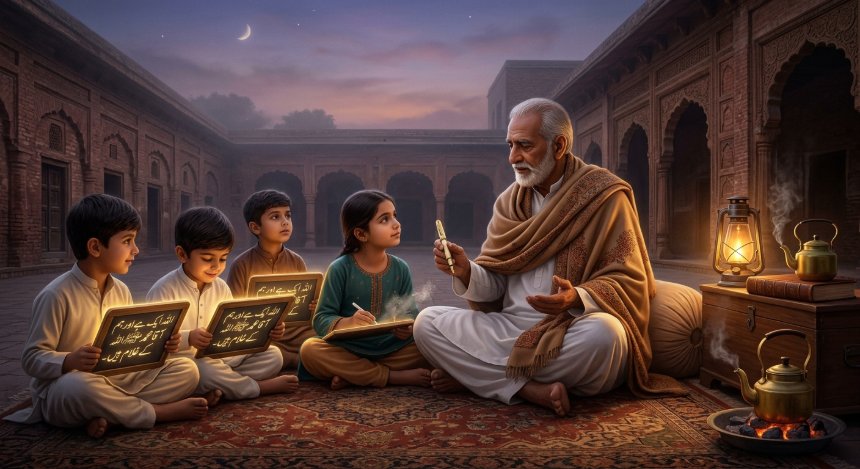
A hazy November evening was descending upon the courtyard of the grand, historic Khwab Mahal (The Palace of Dreams) in Phool Nagar. The air was thick with the earthy scent of dry leaves and a deep, mystical tranquility, while in the corner of the courtyard, steam gently rose from a brass kettle of green tea brewing over hot coals. In the center of the courtyard, sitting on an antique carpet, was seventy-year-old Rana Muhammad Bachsh. Clad in a white, embroidered linen tunic and draped in a warm Pashmina shawl, he leaned back against a large bolster. His face gleamed with the light of countless life experiences and profound wisdom. Rana Muhammad Bachsh was holding onto the precious heritage of Khwab Mahal, determined to pass on to the next generation the very traditions his grandfather had envisioned while laying the palace's foundations—a dream to transform Khwab Nagar into a society mirroring the Prophet Muhammad's ﷺ State of Madinah, under the supreme sovereignty of Allah Almighty.
Seated around him were his grandchildren, their ages ranging between five and ten years. Eight-year-old Nawal and the mischievous five-year-old Sarfaraz held wooden slates and pieces of chalk in their hands. In the courtyard, the steady ticking of the clock blended with the faint, rhythmic scratching of chalk against the wooden slates.
Rana Muhammad Bachsh leaned forward to look at Nawal’s tiny fingers, which were gripping the chalk so tightly that it was tracing crooked, jagged lines across the wood. Gently stroking her head with deep affection, he smiled softly and said:
"No, my child... My child! Hold this chalk with the same care as you would a pen. A pen in your hand is a sacred trust (Amanat), to be held with absolute love and confidence. You must never grip the pen with such force; you must grant it a degree of dignity and space between your fingers. Hold it as you would hold a delicate bird in your hand—firm enough so it cannot fly away, yet gentle enough so it does not suffocate."
Showing his slate covered in chaotic, uneven lines, and wiping the white chalk dust off the hem of his shirt, little Sarfaraz asked with pure innocence: "Grandfather! Why do we practice these letters Alif and Ba day after day? Nowadays on a mobile phone, you just touch the screen once and the entire word appears by itself! Why put so much effort into this pen and chalk?"
Rana Muhammad Bachsh took a deep breath, his mind wandering back through the corridors of centuries-old history. He picked up his own slate, drew a vintage, ivory-bodied fountain pen with a golden nib from his waistcoat pocket—which gleamed under the lantern's glow—and used a piece of chalk to write upon the slate in exquisite, calligraphic letters:
"Allah is One, and we are the slaves of the Holy Prophet Muhammad (peace and blessings of Allah be upon him)."
The children gazed in reverence at the luminous words written by their grandfather, the contours of the letters carrying an awe-inspiring majesty. Adjusting his shawl over his shoulders, Rana Muhammad Bachsh began to speak with a voice wrapped in deep affection:
"My dear ones! When the Creator of the universe chose His final Prophet and our Master—may my life be sacrificed for his honor!—and descended the very first revelation upon him in the Cave of Hira, the first cosmic command was not about kingdoms, material wealth, or weapons. Rather, that command was 'Iqra', meaning Read! And in the very next verses, Allah bore witness: 'He Who taught by the pen.' This was an eternal proclamation to the world until the end of time that the one who holds fast to knowledge and the pen will always remain superior. The words you touch on a screen, Sarfaraz, are soulless words generated by a machine. But when you write by hand, binding characters to form 'Abba' (Father) or 'Amma' (Mother), at that precise cosmic moment, nature is busy weaving new neural pathways within your brain. Forcing our children away from the pen and turning them into slaves of screens over the last few decades has severely scarred the awakened hearts of our new generation."
Nawal asked curiously, "Grandfather! Did people in the olden days write everything with just this pen?" She pointed toward the shining nib of the vintage fountain pen held in his hand, which he was using to duplicate the children's slate inscriptions into a notebook.
Rana Muhammad Bachsh looked toward the heavy, classic books resting upon the antique wooden chest in the courtyard. Coughing slightly, he turned up the flame of the lantern and replied:
"As long as Muslims honored the sacred sanctity of the pen, the world lay at their feet. Whether it was the Bayt al-Hikma (House of Wisdom) in Baghdad or the magnificent libraries of Andalusia, the rustle of the pen echoed all through the nights. Look at the thousand-year history of our own subcontinent; Islam did not spread here by the force of any sword. Instead, Sufi saints like Hazrat Data Ganj Bakhshؒ and Khwaja Gharib Nawazؒ sowed the seeds of sublime character and deep love for the Prophet ﷺ, completely transforming human hearts."
"But Grandfather! People say that Artificial Intelligence (AI) will soon write everything by itself, so why will humans be needed?" asked ten-year-old Ahmad, who was sitting closest to his grandfather.
An intense wave of majesty and resolve swept across Rana Muhammad Bachsh's face. Pausing his pen over the notebook, he looked at all the children with piercing eyes:
"That, my child, is the absolute grandest delusion of this century! A computer can aggregate all the information in the world, but it can never replicate the profound pain of a human heart, the tear in a human eye, or that divine sweetness of the love for the Prophet ﷺ which can only pour onto paper from a yearning human soul through a pen held in a human hand. Whatever history has been written on this earth is solely 'the story of mankind,' and no artificial intelligence can ever replace it. This is precisely why Allama Iqbal proclaimed:
'Amarat kya, shikoh-e-khusravi kya, kuch nahin uski
Agar hasil na ho insan ko ilm-e-lawh-o-sultani!'
(What is wealth? What is royal majesty? It is nothing—
If man does not possess the knowledge of the Divine Tablet and Sovereignty!)
My children, pick up your own pens right now and write this sentence: 'Allah is One, and we are the slaves of the Holy Prophet Muhammad (peace and blessings of Allah be upon him).' And as you write it, feel in your hearts that Allah is watching you, and that this is reaching the Holy Prophet ﷺ in the form of a beautiful salutation (Darood). Come, write it now."
With immense enthusiasm and devotion, the children gripped their chalks and began to write across their slates.
Ahmad spoke up, "Grandfather... I felt something incredibly strange... something entirely new... as if my heart was vibrating deep within."
Nawal chimed in, showcasing her slate with a joyful beam: "Grandfather, I felt as if an invisible, divine strength was present with me, beautifully crafting these letters and guiding my hand effortlessly across the board!"
A celestial smile bloomed across Rana Muhammad Bachsh's face. Drops of profound love and pride welled up in his eyes. Drawing Ahmad and Nawal closer, he placed his hands of blessing upon their heads and spoke in a low, resonant, and majestic voice:
"Subhan Allah! My children, this is the very living miracle that the material world cannot see with its physical eyes. Ahmad, what you felt as 'something new' was the very first awakening of your Khudi (Selfhood). And Nawal, my daughter! That strength you felt accompanying you is the timeless continuity of that same divine light from Hira, which sustains the heart of every true believer who holds the pen. When a human being rises above all worldly attachments to adorn the tablet of their heart with the sacred name of the Prophet ﷺ and spells it out with a pen, the very soul of the cosmos becomes the guardian of their pen."
He cast his gaze across all the children sitting in the courtyard, their faces reflecting a strange sense of dignity and understanding under the golden glow of the lantern. At that moment, Ahmad asked again:
"Grandfather! If we possess such a magnificent, divine strength, then how did we Muslims become enslaved by the world? And why has this bondage remained so unyielding?"
Rana Muhammad Bachsh let out a deep, sorrowful sigh, set his cup of tea aside, and spoke:
"My children! Trapped by the glittering illusions of the material world, we abandoned our soul, our unique civilization, and our language, adopting English as our absolute way of life. Tell me, how can a human being express the true depth of their soul’s desires in a foreign tongue? When a nation loses its mother tongue, its heart no longer beats while speaking, and its soul feels no ecstasy while writing. We adopted the Western educational system, but the tragedy is that we merely loaded books onto ourselves like donkeys, and instead of attaining the light of true wisdom, we spent our lives braying aimlessly! The consequence was devastating—material, intellectual, psychological, and ideological slavery seeped deep into our very bones. We acquired degrees, but it was an education that only taught us to mimic others, stripping away our true identity."
He paused for a brief moment, his eyes fixing upon the dancing flame of the lantern in the courtyard, before continuing with deep conviction:
"When the Muslims of the subcontinent lay deeply enslaved by British material power and Hindu social dominance, Allah Almighty chose Hakim al-Ummat Allama Muhammad Iqbal for their intellectual awakening. Iqbal was no ordinary poet; he was a sublime philosopher, visionary thinker, and forward-looking leader who gave a true dream of freedom to the enslaved Muslims of India. He discovered the remedy for our decline within his 'Philosophy of Khudi'—which means the recognition of one's inner self, Islamic honor, and the unwavering resolve never to bow before anyone except Allah! He shook the Ummah awake, warning them that an education which only traps you in the anxiety of securing a livelihood while rendering your soul dead is not knowledge, but a sophisticated form of slavery. Iqbal cried out:
'Asr-e-hazir malik-ul-maut hai tera jis ne
Qabz ki rooh teri de ke tujhe fikr-e-maash!
Dil-e-bendar farigh hai maadi afkar se
Ke yeh woh tadap hai jo insan ko karti hain tarash!'
(The modern age is your angel of death, which—
Has seized your soul by trapping you solely in the worry of livelihood!
The awakened heart is detached from purely material thoughts—
For this is the spiritual yearning that carves and sculpts a true human being!)
When Allama Iqbal wrote his famous poem 'Shikwa' (The Complaint) regarding the decline of Muslims, it caused a great storm, but when he delivered 'Jawab-e-Shikwa' (The Response), he gave the Ummah the absolute map for its resurrection. He taught us that worldly pomp, majesty, and royal grandeur hold absolutely no value if a human being is devoid of that esoteric, cosmic knowledge which unlocks the hidden secrets of the universe:
'Amarat kya, shikoh-e-khusravi kya, kuch nahin uski
Agar hasil na ho insan ko ilm-e-lawh-o-sultani!'
In his masterpiece Masjid-e-Qartaba, he wept over the structural decay of the Ummah, lamenting that the educators in our schools had become blind-sighted and dry-spirited, and those in the hermitages were lacking in spiritual ambition:
'Jalwateyan-e-madrasa koor nigah-o-murdah-zauq
Khalwateyan-e-maikhada kam talab-o-tihi kadoo
Main ke meri ghazal mein hai aatish-e-rafta ka suragh
Meri tamam sarguzasht khoye huon ki justaju!'
But my children! Iqbal was never hopeless. To reinfuse life into this dry-spirited Ummah, he used his bleeding pen in the final stanza of Jawab-e-Shikwa to present an absolute truth before the court of the Holy Prophet ﷺ—proclaiming that the Prophet’s blessed existence is itself the living destiny of the cosmos and the physical manifestation of the Ultimate Book:
'Lawh bhi tu, Qalam bhi tu, tera wajood Al-Kitab
Gunbad-e-aabgeena rang tere muheet mein hubab!'
When a human being remains faithful to that sacred being who is himself both the Tablet and the Pen, every force in the universe surrenders before him."
Gently using his thumb to wipe away a stray smudge of white chalk from Nawal's cheek, he continued:
"Today, Muslim countries appear independent on the global map, but a shackle of Western intellectual slavery hangs tightly around their necks—worn not out of compulsion, but carried with immense pride. If we are to break free from this mental bondage and ascend once more to the highest heights of Surayya, we must reintroduce our children to the sacred Seerah of the Prophet ﷺ. The story of the Seerah rejuvenates the mind, heart, and soul, and awakens that Khudi which harbors an intense yearning for true freedom. According to Allama Iqbal, the survival and strengthening of Khudi lies solely in obedience to the Prophet ﷺ and the emulation of his beautiful character (Uswah-e-Hasanah). He explicitly declared:
'Tarh-e-nau afgan ke ma jidat pasand uftada ain
Ein che hairat khana-e-imroz-o-farda sakhta!
Ba Mustafa rasan khoesh ra ke deen hamma ost
Agar ba o na raseedi, tamam Bu Lahabi ast!'"
The night had now grown completely deep, and the golden light of the ancient lantern illuminated the words written across the slates: "Allah is One, and we are the slaves of the Holy Prophet Muhammad (peace and blessings of Allah be upon him)." In a moment of playful mischief, little Sarfaraz tilted his slate and gently brushed it against his grandfather's white tunic, leaving a tiny streak of white chalk across the fine linen. Rana Muhammad Bachsh burst into a warm, ringing laughter.
Looking at the tiny hands of the children, which were now holding the chalk with immense focus, dignity, and respect, he looked at Sarfaraz and Nawal with deep affection and said:
"My children! These individual letters you are practicing—when bound together, they form words. Those words frame sentences, and those sentences give birth to an entire living story. Come, let us all write a single sentence across your slates today."
The children smiled and looked at one another, exchanging a silent, secret signal with their eyes. With absolute focus and devotion, they began to slide their chalks across their boards. Once finished, they held up their slates simultaneously before their grandfather.
Rana Muhammad Bachsh looked at the boards and found the exact same sentence beautifully calligraphed across every single slate:
"My Grandfather is the absolute best!"
Tears of immense love and deep emotion welled up in Rana Muhammad Bachsh's eyes. Drawing all the children tightly into his embrace one by one, he spoke with a voice trembling with deep feeling:
"Subhan Allah! My beloved children; our Allah is infinitely Great, He is the most Gracious and Merciful, and our Master Muhammad Mustafa ﷺ—may millions of our souls be sacrificed for his honor!—is the absolute best and most majestic being in existence. And a true slave and lover of that very Prophet ﷺ was our Allama Muhammad Iqbal, who showed us the path of Khudi and true freedom."
He brought the story to its beautiful climax, invoking Allama Iqbal’s eternal philosophy which seemed to weave a spell of absolute magic through the stillness of the courtyard:
"Remember well, my precious children! When you reconnect yourselves with this educational and spiritual light brought by the Master of Creation ﷺ, the Master of the cosmos will unfold the reality of the material world before you. The Tablet will be yours, and the Pen will be yours. You will then be empowered to write your own destiny with your very own pen, for the Divine Quill of Truth (Khama-e-Haq) has left your forehead blank—not for the slavery of others, but to write your own epic story of Khudi, just as Iqbal declared:
'Tu apni sarnowisht khud apne qalam se likh
Khali rakhi hai khama-e-haq ne teri jabeen!'
And the pathway to this ultimate ascension is completely clear, direct, and beautifully simple:
'Ki Muhammad se wafa tu ne to hum tere hain
Yeh jahan cheez hai kya, lawh-o-qalam tere hain!'
Go forth, my children! Pick up your slates, walk toward the great libraries, hold fast to your pens, and learn to write your own story to illuminate this universe with the sacred Name of Muhammad ﷺ; and whenever you encounter difficulty, read the profound poetry of Allama Muhammad Iqbal, and make the Holy Hadith and the Majestic Qur'an your ultimate guides."
Ahmad, Nawal, and Sarfaraz looked at their grandfather with a gaze of profound spiritual comprehension. The ancient courtyard of Khwab Mahal was no longer just a room; it had transformed into the open gateway of a magnificent new civilization, through which the timeless legacy of human intellect, reason, and faithful honor was being beautifully woven.
What a Grain Is, and Why 50, 55, 62, 130 and 168 Keep Showing Up on th...
A grain is 1/7000 of a pound. Choosing a bullet weight is mostly a matter of what your bar...

Furadeira de Impacto: Como Escolher, Utilizar e Aproveitar Seus Benefí...
Furadeira de Impacto: Como Escolher, Utilizar e Aproveitar Seus Benefícios