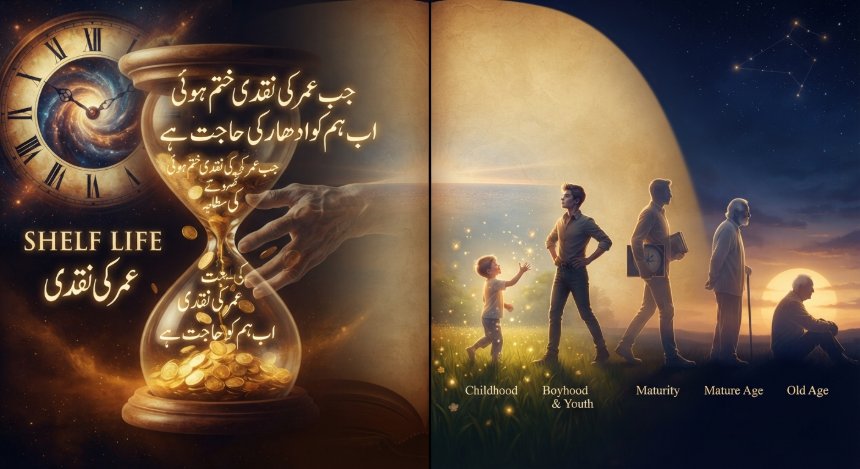

Man's Shelf Life
"Man's Shelf Life" is a deeply philosophical exploration of time, transience, and the human condition, weaving together the industrial concept of shelf life with the natural progression of human existence. By contrasting the melancholic Urdu verses of Ibn-e-Insha with the celebratory Western poetry of Mary Oliver and Lord Tennyson, the essay captures the bitter sweetness of life’s finite milestones. Ultimately, it reflects on personal loss and grief, transforming the inevitability of death into a profound, graceful acceptance and a celebration of a life lived with wonder.
أَعُوذُ بِاللّٰهِ مِنَ الشَّيْطَانِ الرَّجِيمِ
بِسۡمِ ٱللهِ ٱلرَّحۡمَـٰنِ ٱلرَّحِيمِ
In the name of ALLAH, the Most Gracious, the Most Merciful
Man's Shelf Life
In the marketplace of the universe, man is the sole merchant who is endowed not with money or wealth as capital, but with 'time.' This time, these breaths, these months and years are, in reality, "the cash of time" that is quietly slipping from our pockets every single moment. Every other loss in the world can be recouped, lost wealth can be regained, and sinking businesses can recover, but a single second spent in the market of time cannot be bought back even if the entire wealth of the cosmos were offered. When the eminent Urdu poet Ibn-e-Insha wrote, "When the cash of time expired, now we find ourselves in need of a loan," he was capturing this very human helplessness, where a person stands at the final threshold of life, looking back at the past with bittersweet longing.
If we look at this cash of time through a material and scientific lens, it represents man's true "Shelf Life" in this universe. In industrial terms, shelf life refers to the period during which a product (especially food and medicine) can remain stored without becoming unfit for use or consumption, or the maximum time a packaged material can be kept under specified conditions and still meet its required performance criteria. Man, too, is a biological creation whose quality of life and survival depend on a specific timeframe. Maintaining this biological shelf life requires "specified conditions"—namely health, a nurturing environment, and a balanced lifestyle.
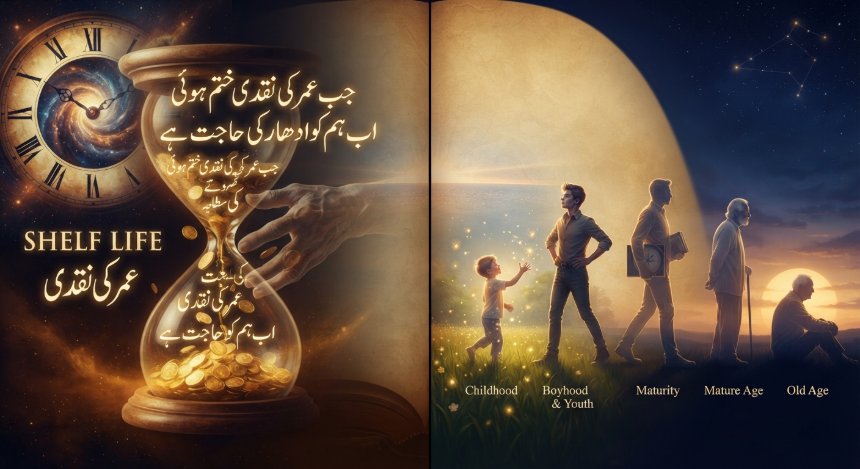
While the shelf life of material objects is merely the duration of their structural soundness, human life showcases a fascinating, living, and far deeper manifestation of this concept. Here, each stage of life is not just the passing of hours; it is a package of distinct emotions, traits, and unique opportunities with its own expiration date. If that specific cash of time is not spent in accordance with its innate demands, a person is left with an irreparable sense of loss and regret for the rest of their days. Nature has woven the stages of human shelf life in a precise chronological sequence, where each milestone holds its own unique price and value:--
- Childhood: This is the initial and most innocent phase of life's duration, directly succeeding infancy. This stage also marks the beginning of stepping out of a mother's embrace to discover the wider world. This "cash of time" is defined by playfulness, carefreeness, innocence, and simplicity. If a child cannot spend this currency according to its natural demands—if their innocence is stolen or they are deprived of carefreeness—that purity can never be reclaimed at any price.
- Boyhood: As the borders of childhood fade, boyhood begins. The cash of this age carries its own unique worth, determined by the harmless follies, dreams, and emotional truths of these years. These are invaluable days. Once they pass, life never again retains that same worth, charm, or raw conviction for "that first foolishness of love" which belongs exclusively to this age. The companionships, circles, gatherings, and attachments of later years inevitably become dependent on logic, convenience, and calculated give-and-take. This is the very childhood that elders mockingly throw back at you in later years, saying, "Why are you talking like a child? Grow up now."
Boyhood unfolds like a fable, reaching its climax as adolescence and maturity set in. This is the age where a fraction of this currency is colloquially termed a "crush." While intellectuals attribute it to the onset of puberty, almost every human inevitably probes this currency through love's first foolish mistake. By the time boyhood ends, it leaves the individual with an identity within society. As the proverb goes, "Coming events cast their shadows before"—and boyhood begins to busy the youth outside the home, engaging them with the neighborhood and the surrounding community.
- Youth: Emerging from the naivety of boyhood, as a person steps into youth, innate talents awaken and energy climbs toward its zenith. This is the era where dreams set out in search of fulfillment, and a person strives to recognize their existence and purpose. There is a school of thought that man looks his most beautiful during this specific age. If the finest value of youth's currency is to look one's "most beautiful," then this is the hour—whether for a boy or a girl. A credible reason for this is the lingering hue of childhood’s departing innocence mixed with the raw vigor of youth, for strength in itself is not inherently a creator of grace.A subset of youth is also the expansion of love's first foolishness, but it must conclude within this very era. Carrying such folly beyond youth proves incredibly costly; it is akin to using a medicine past its shelf life, after it has turned into poison. In our Pakistani society, a vast majority of girls get married during this age, and a well-regarded opinion holds that this is indeed the optimal age for them to embark on this vital milestone of life.
- Prime of Life (Adulthood): This is the era of man’s peak performance. If a human were viewed as a product, this is the phase where the item passes through its most effective, durable, and reliable shelf life. Physical strength, mental acumen, and resolve are at their strongest. Society and life demand the highest productivity from a person during this period. In the modern era, most men tie the knot during these years. It must always be remembered that marriage is a profound and serious turning point in human civilization; it is the strongest anchor for the preservation of the human race and the cultural continuity of any nation, which is perhaps why it is celebrated with such grandeur across all societies. It is during this prime that elders wish to see their young ones shoulder the weight of life. This is the stage where the maxim "Children are the future of the nation" transforms from a sapling into a robust tree, revealing its true form. What a nation can achieve in the race of life can be gauged entirely by the struggle, competence, and capability of its adults.
- Mature Age (Middle Age): This is the turning point where the limits of one's shelf life gradually become visible. A sober stillness settles over the graph of performance. Now, intellect, capability, and experience begin to define a person's identity. Here, to keep oneself from faltering, one requires greater care, wisdom, and a balanced lifestyle. It serves as a delicate, solemn bridge between the tempestuous zeal of youth and the frailty of old age. The currency of this age manifests in the spirit of Iqbal’s verse: "If one is worthy, We bestow the glory of kings." This age presents a person as a seasoned expert across all fields and walks of life. Though people are no longer as hasty or fiercely sharp as they were in their youth, they acquire a venerable grace by becoming deeply experienced, carrying the weight of vital responsibilities. The "cash of this age" is the crown of leadership, where individuals possessing wisdom, intellect, and profound insight become the "captains" of their respective spheres, leaving their distinct mark. The pages of history are filled with the monumental achievements born of this age's currency.
- Old Age: This is the final edge of the human shelf life, where the expiration date draws incredibly close. The physical limbs and mental faculties begin to fall short of their required performance criteria. Memory fades, bones weaken, and man becomes exactly like a medicine or food whose material efficacy has been exhausted. The only difference is that products on a store shelf have their manufacturing and expiration dates clearly printed on their labels, but Nature has kept the expiration date hidden on the packaging of man. We simply do not know how many coins of time remain in our pockets.
It is at this juncture that one must recall Ibn-e-Insha's poem, “Now the cash of time is spent,” which laments:
"When the cash of time expired,
now we find ourselves in need of a loan.
Is there a banker who will step forward?
Is there a lender who will bestow?
When we look back at the past along this journey of life, we realize that the heaviest price paid in spending this cash of time is saying goodbye to our loved ones. Whether it is a loyal pet or our own kin—their departure feels like nothing short of a personal apocalypse. Accepting the stark reality that they will never return is the most agonizing threshold for the human soul. Until this trauma robs us of someone who was an inseparable part of our daily existence, it feels as though loss is something that only happens to others, while we remain immune.
Yet, as our own allotted span—our shelf life on this planet—diminishes, a beautiful transformation takes place. Man learns to accept every kind of ending with a sense of peace and stillness that was absent before. There is no guarantee that we will walk this earth tomorrow, or that the currency of our breaths will last. This is an unvarnished truth from which there is no escape. Watching our loved ones depart one by one is the greatest lesson life imparts.
In a sense, one becomes deeply grateful to those departed souls for teaching us how to live out our remaining days. Though they left behind a profound grief, they also bequeathed a radiant beacon that illuminates our inner darkness. The passing of a beloved brother or a dear one teaches a person to value the healing, gentleness, and empathy they left behind within us. This experience deepens our awareness of life’s fragile nature; one begins to love and celebrate the presence of every person encountered along the way, recognizing the splendid virtues that may have gracefully transitioned into our own being through the blessing of their company.
Here, the philosophy of life transcends fear and arrives at the sanctuary described by the American poet Mary Oliver in her poem "When Death Comes," where she writes:--
"I was a bride married to amazement..."
This line teaches us that when death arrives, if a person looks back, they should feel that their life was spent in a holy matrimony with a world of wonder, where their dignity and sanctity were fully upheld—just as a bride is cherished. It means a person leaves this earth having spent a beautiful, meaningful era rather than merely killing idle time. They face death not like a frightened traveler, but like a bride who established a deep, lifelong, and active relationship with wonder, curiosity, and passionate love. She did not come to this world merely to make a "brief visit" as a passive observer; rather, she was the groom who took the universe into her arms.
An almost identical message is found in the famous poem "Crossing the Bar" by Alfred, Lord Tennyson. Upon the arrival of death, instead of fear or mourning, he desires a peaceful voyage across the waters, where there is no turbulent foam or the sad crying of farewells for those left behind. He hopes that when he crosses the boundary of this world (the sandbar) into the ocean of eternity, his ship will glide smoothly because he expects to see his "Pilot" face to face.
When the cash of time is near its end, a person should be filled not with lamentation and regret, but with the profound satisfaction of having lived every moment and every stage of life with its full beauty, its priceless follies, and its unique demands. For those who invest this capital in love, knowledge, and service to humanity, their physical shelf life may one day expire, but the legacy of their deeds will never grow old. They depart having celebrated their "wild and precious" life, fully accepting the reality of death—and that, truly, is the ultimate and most beautiful expenditure of the cash of time.
NOTE: This post is inspired from a thread on X.com from Anuradha🇮🇳 @ako660 as follows:-
Small Business CFO in Calgary: Finance Leadership Sized for Owner-Run...
Small Business CFO in Calgary: Finance Leadership Sized for Owner-Run Companies

Como Escolher as Melhores Consultoria de Compliance para Sua Empresa
Como Escolher as Melhores Consultoria de Compliance para Sua Empresa