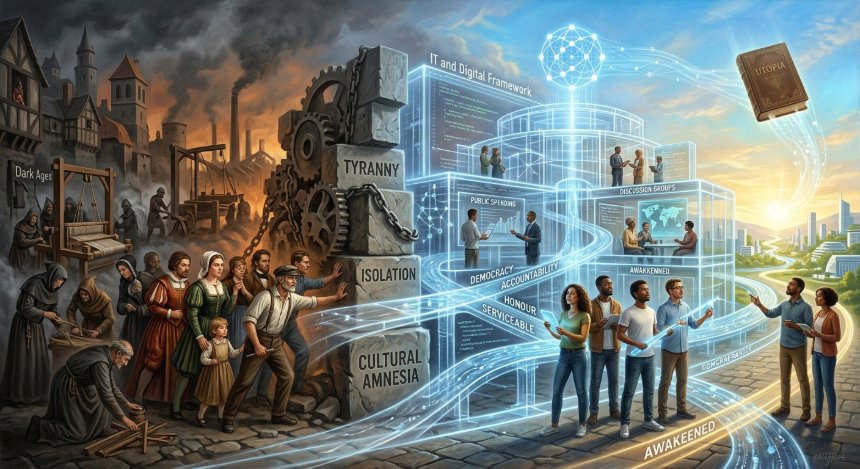

Mankind’s Quest for a Just Society
The architecture of human history is shaped by a continuous, restless yearning for an ideal world. Since the dawn of civilization, mankind’s desire for a just society has driven both political revolutions and profound philosophical inquiry. This essay is written specifically for those who dream with open eyes—the visionary individuals who refuse the comforting illusions of modern compliance and actively look for true societal equity. This quest was famously crystallized during the Renaissance by Sir Thomas More in his foundational 1516 work, Utopia, which envisioned an island of perfect social, legal, and political harmony. By analyzing the structural trajectory of six landmark poems across two distinct eras—the historical and industrial critiques of Lawrence Tribble, Percy Bysshe Shelley, Paul Laurence Dunbar, and James Weldon Johnson, alongside the contemporary crises documented by Robert Polito and Judith Espinosa—we can map the complex evolution of humanity's enduring struggle for an equitable world.
أَعُوذُ بِاللّٰهِ مِنَ الشَّيْطَانِ الرَّجِيمِ
بِسۡمِ ٱللهِ ٱلرَّحۡمَـٰنِ ٱلرَّحِيمِ
In the name of ALLAH, the Most Gracious, the Most Merciful
Mankind’s Quest for a Just Society
This essay is for people who dream with open eyes
The architecture of human history is shaped by a continuous, restless yearning for an ideal world. Since the dawn of civilization, mankind’s desire for a just society has driven both political revolutions and profound philosophical inquiry. This essay is written specifically for those who dream with open eyes—the visionary individuals who refuse the comforting illusions of modern compliance and actively look for true societal equity. This quest was famously crystallized during the Renaissance by Sir Thomas More in his foundational 1516 work, Utopia, which envisioned an island of perfect social, legal, and political harmony. More’s work gave a permanent name to an eternal human ambition: the creation of a cooperative commonwealth free from tyranny and systemic corruption. Historically, poets and philosophers have functioned as the collective conscience of this movement, sounding a clarion call to disrupt the moral, political, and spiritual somnambulism of their times. By analyzing the structural trajectory of six landmark poems across two distinct eras—the historical and industrial critiques of Lawrence Tribble, Percy Bysshe Shelley, Paul Laurence Dunbar, and James Weldon Johnson, alongside the contemporary crises documented by Robert Polito and Judith Espinosa—we can map the complex evolution of humanity's enduring struggle for an equitable world.
+--------------------+----------------------------------------+----------------------------------------+
| Era / Dimension | The Age of Industrial & Spiritual Hope | The Contemporary Disillusioned Age |
| | (Tribble, Shelley, Dunbar, Johnson) | (Polito & Espinosa) |
+--------------------+----------------------------------------+----------------------------------------+
| Core Philosophy | Scientific liberation, collective labor| Algorithmic sedation, radical interior |
| | equity, and divine purpose. | boundary defense, and trauma recovery. |
+--------------------+----------------------------------------+----------------------------------------+
| Primary Threat | Overt tyranny, physical exhaustion, | Cultural amnesia, information overload,|
| | feudalism, and deep social isolation. | and voluntary victim consciousness. |
+--------------------+----------------------------------------+----------------------------------------+
| Spiritual Anchor | Self-reckoning under divine law, | Reclaiming absolute self-reliance |
| | transformation of outer structures. | through the protective power of Khudi. |
+--------------------+----------------------------------------+----------------------------------------+
The Importance of Awakening and Self-Accountability in Islam
When analyzing the construction of a just society and human awakening, we find that the Islamic tradition places fundamental importance on awakening the inner consciousness and searching for the self. Islam is not merely a collection of external regulations; it is a faith designed to awaken human consciousness and instill a deep sense of individual and collective accountability. Gathering knowledge while remaining asleep in a state of apathy is strictly discouraged in Islam. In this regard, the profound statement of the eminent companion of the Prophet, Hazrat Abu Darda (Radiallahu Anhu), serves as a monumental warning:
"What I fear most about the Day of Judgment is that I will be asked: 'O Abu Darda! You possessed knowledge, so how did you act upon what you knew?'"
This quote testifies to the fact that true awakening is not simply a matter of collecting data or information; it is about translating knowledge into moral action and actively striving for social justice. This Islamic concept of awakening rescues a person from opportunistic complacency and the sleep of negligence, transforming them into an active and responsible agent of change.
From the Dark Ages to the Dawn of Industrial Promise
To understand the trajectory of this quest, one must look to the structural transitions of Western civilization. The Dark Ages were characterized by rigid feudal hierarchies, intellectual suppression, and widespread societal stagnation, where the individual was largely subordinate to religious and monarchical autocracy. This long slumber was shattered by the Renaissance, an era of profound cultural rebirth that revived classical humanism, elevated individual potential, and celebrated human agency. Following the Renaissance, the rise of science and technology fundamentally shifted the human paradigm. The birth of the scientific method and early mechanization filled humanity with a monumental hope for better living. For the first time in history, it seemed that human ingenuity possessed the exact tools required to eradicate scarcity, conquer disease, and liberate the masses from backbreaking labor, laying the groundwork for a truly rational and just civilization.
The Industrial Age: The Poetic Wish for Emancipation
As this scientific growth accelerated into the Industrial Age, mankind and poets actively wished for human emancipation and the rise of a better society. They recognized that while technology held the promise of freedom, the existing socio-economic structures were turning these new tools into engines of oppression.
• Percy Bysshe Shelley’s "Song to the Men of England" directly confronted this industrial paradox. Writing in the shadow of early capitalism, Shelley exposed the raw exploitation of the working class, urging laborers to realize that they were weaving the very robes and forging the very chains used by tyrants to subjugate them. His poem was a fierce demand for structural emancipation.
• Lawrence Tribble’s "Awaken" grounded this era's quest in individual morality, arguing that an equitable society cannot be constructed out of morally complacent individuals; structural justice requires personal accountability.
• Paul Laurence Dunbar’s "The Awakening" and James Weldon Johnson’s "The Awakening" expanded this industrial-era hope into the realms of human connection and spiritual destiny. Writing through eras of deep racial and social segregation, Dunbar envisioned love as a force capable of breaking the metaphorical bondage of human isolation. Meanwhile, Johnson used the allegory of a lonely rose awakened by a traveling bee to illustrate that a just society is one where every marginalized soul is finally allowed to blossom and realize their divinely ordained potential. These early writers shared a foundational conviction: if humanity could break its external chains, true justice would prevail.
The Contemporary Turn: A Very Different Story
However, the hyper-developed landscape of the 21st century has shattered these early optimistic frameworks. Present-age poets like Robert Polito and Judith Espinosa reflect a radically different story, revealing that material progress has mutated the very nature of human subjugation.
• Robert Polito’s "The Great Awakening" diagnoses a society suffering from a profound cultural haze. By renaming our historical progress as "Much Ado" or "The Big Sleep," Polito illustrates that contemporary America—the epicenter of technological and media advancement—keeps its citizens asleep not through physical violence, but through a calculated fragmentation of memory and attention. In an era of non-stop digital noise, historical atrocities are easily commercialized, scrolled past, and forgotten. The modern citizen is drowning in curated comfort, prompting Polito’s haunting question: "when did I become someone on whom everything is lost?"
• Judith Espinosa’s "The Awakening" shifts this contemporary battle into the psychological arena. Writing for individuals dealing with deep loss, trauma, and chronic illness, Espinosa reveals that modern "progress" has left the individual internally fractured. In her work, the enemy is no longer a visible king or an industrial lord, but a modern culture of displacement, external blame, and toxic societal expectations. Espinosa's poem argues that the modern individual has become a slave to their own internal wounds and consumer dependencies. True awakening in her contemporary view requires radical self-reliance, the enforcement of strict personal boundaries, and the absolute refusal to live as a passive victim of a chaotic world.
Allama Iqbal’s Philosophy of Khudi and the Awakening of the Self
When we look at this concept of internal awakening through the lens of the "Philosophy of Khudi" (Selfhood/Ego) by the great philosopher-poet of the East, Hakeem-ul-Ummat Allama Iqbal, this journey ceases to be a mere psychological adjustment; it transforms into a monumental spiritual and revolutionary evolution. Writing during the era of colonial rule in the subcontinent, Allama Iqbal recognized the profound slumber and mental stagnation of Muslim society and spread his universal "Message of Khudi" as its ultimate remedy.
In Iqbal's vision, awakening means that instead of surrendering to circumstances or adopting a victim mentality, a human must awaken the "eagle" (Shaheen) within. Where contemporary Western poems (such as Judith Espinosa's work) emphasize rejecting external crutches, standing on one’s own strength, and crying out from within, "Enough is enough!", it aligns perfectly with the pinnacle of Iqbal’s Khudi. In Iqbal's philosophy, seeking crutches from others or constantly complaining about external conditions kills the self. He desires to see human beings standing firmly on their own feet. Mirroring Espinosa's message of radical autonomy, Iqbal states that nations must avoid fearing new paths or stubbornly clinging to decayed structures, and must instead create their own destiny:
Aaeen-e-nau se darna, tarz-e-kahan pe arna
Manzil yehi kathan hai qaumon ki zindagi mein
(To fear the new way, to stubbornly cling to the old style—
This is the most difficult stage in the life of nations.)
He further proclaims:
Apni duniya aap paida kar agar zindon mein hai
Sirr-e-adam hai, zameer-e-kun-fakan hai zindagi
(Create your own world if you are among the living;
Life is the secret of Adam, the very conscience of creation.)
When Khudi reaches its perfection in Iqbal's framework, an individual does not beg for light from others amidst societal darkness; instead, he becomes a beacon himself—what Iqbal terms the "Mard-e-Hur" (the free, self-reliant human). Such a person becomes solid steel in the battle between truth and falsehood, yet remains a source of pure gentleness for his companions:
Ho halqa-e-yaran to abresham ki tarah narm
Razm-e-haq-o-batil ho to faulad hai momin
(In the circle of friends, a believer is soft as silk;
In the battle between truth and falsehood, he is unyielding steel.)
The Core Synthesis: Western Psychology vs. Iqbal’s Thought
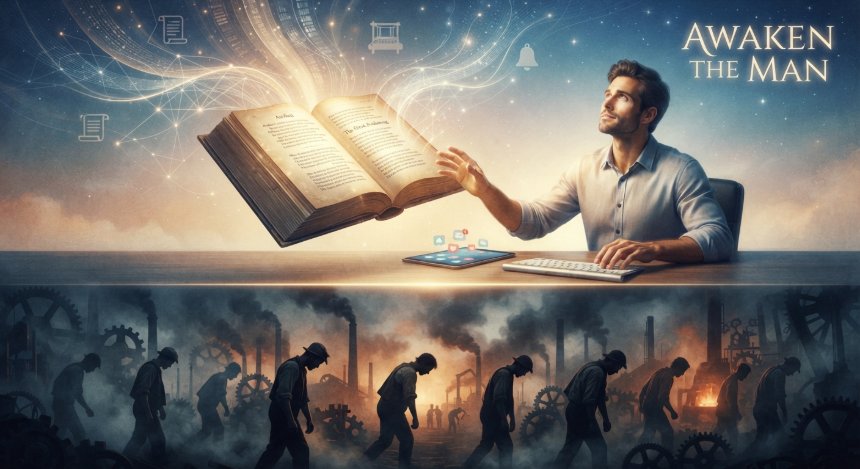
Where modern Western psychology (as seen in Espinosa's poem) teaches "awakening" primarily as a tool for mental peace, stress reduction, and healing from personal trauma, Iqbal’s Khudi elevates this awakening to a cosmic purpose. The awakening of Khudi means that a human must extract gold from their own soil, recognize their divinely gifted hidden potentials, and conquer the universe.
When individuals awaken internally, they become the driving catalyst to awaken the entire collective society. This is why Allama Iqbal issued a revolutionary call to disrupt a sleeping, downtrodden world:
Uttho meri duniya ke ghareebon ko jaga do
Kakh-e-umra ke dar-o-deewar hila do
(Rise! Awaken the poor of my world,
Shake the very doors and walls of the palaces of the rich!)
The Ultimate Horizon: A Crystallized Global Democratic Model
Guided by this awakening of selfhood and the warnings of contemporary poets, this ongoing quest has the potential to evolve, pointing humanity toward a transformative blueprint for future governance. Rather than allowing tech conglomerates to use technology as an instrument of surveillance and sedation, this global quest may lead humans toward a global democratic model of governance where people are respected, honored, and dignified. In this refined paradigm, the digital apparatus is rescued from the hands of corporate autocrats and repurposed to serve the public interest.
Under this model, the IT and digital framework is used to provide crystallized, accountable, and serviceable governments that are directly answerable to the people on all issues of governance. Instead of opaque bureaucracies hiding behind digital firewalls or manipulating populations through algorithms, technology can become a clean pane of glass. It can offer absolute transparency in public spending, instantaneous civil feedback loops, and immutable systems of public accountability. By restructuring the digital infrastructure, humanity can build a borderless commonwealth of mutual respect. A Just Society ceases to be an unreachably remote dream; instead, it becomes a practical, structural element requiring the active involvement and participation of "Awakened People." Equity cannot be coded by an elite few; it requires an active, vigilant population utilizing digital tools to protect their human rights and collectively steer the state.
Conclusion: The Key to Global Peace
Ultimately, the integrated wisdom of these six poets, anchored by Islamic traditions, the sayings of the righteous predecessors, and Iqbal’s profound philosophy, proves that the quest for a Just Society for global peace remains an unfulfilled dream until the collective mind shifts. The early architectural promise of the scientific revolution—the belief that technological development would naturally yield human liberation—has proven to be a tragic illusion whenever it is paired with spiritual apathy and the death of Khudi. Modern consumer culture and algorithmic spaces have successfully weaponized convenience to pacify the human instinct for structural change. We have built an empire of infinite information, yet we have lost the collective capacity to deeply feel, remember history, or protect our cognitive sovereignty.
A just society cannot be delivered by an automated system, nor can global peace exist when individual minds are perpetually sedated by digital distractions. The overarching lesson across these centuries of verse is that cognitive, moral, and systemic vigilance, alongside the awakening of Khudi, remains the baseline cost of human freedom. Until humanity actively chooses to wake up from the luxurious anesthesia of modern consumerism, awaken the inner eagle, and step into the arena as an active, "Awakened People," an equitable world will remain an unreached horizon.

Coda: The Sovereign Awakening
The ancient weavers left the wooden loom,
The captive rose stepped out the lonely gate;
Yet man still wanders in a digital room,
And lets the cold machine dictate his fate.
We broke the iron chains of kings and creeds,
We marched through Brandywine and broke the rod;
Yet now we bow to algorithmic feeds,
And make the glowing screen our modern god.
They buy our focus, trade our quiet hours,
And sell us comfort while the world decays;
They turn our open minds to passive powers,
Lost in a curated, luxurious haze.
But justice is not found in automated streams,
Nor in the safety of a closed elite;
It demands we cast away all borrowed dreams,
And stand alive upon the concrete street.
Awaken, Man! Reclaim the fractured soul,
Release the blame, and break the targeted line;
Take back the sovereign mind to make us whole,
And turn the human temple down to shine.
Stanza-by-Stanza Commentary
Stanza 1
• Commentary: This opening stanza synthesizes the historical progress made since the industrial and spiritual eras of Shelley, Dunbar, and Johnson. It notes that while humanity successfully escaped early physical and institutional entrapments ("wooden loom," "lonely gate"), society has voluntarily entered a new kind of confinement: a "digital room" where automated machines and data systems subtly direct our choices and pathways.
Stanza 2
• Commentary: Here, the poem contrasts our historical triumphs over physical tyrannies and our endurance through systemic trauma ("Brandywine") with our current digital compliance. It highlights the irony that a modern civilization that fought so hard for literal freedom now voluntarily submits its attention to algorithmic feeds, treating the smart screen with a form of religious devotion.
Stanza 3
• Commentary: Drawing heavily from Polito’s critique of the contemporary culture industry and Iqbal’s warnings regarding intellectual slavery, this stanza details how modern consumer capitalism targets human attention. By trading our focus and selling us instant conveniences, the system pacifies our natural instinct to rebel against global decay. Our minds become passive assets, lost in a curated haze of lifestyle media and targeted notifications.
Stanza 4
• Commentary: Aligning with Espinosa’s call for radical self-reliance and Iqbal’s command of self-creation ("Create your own world"), this stanza asserts that a just society cannot be simulated or delivered online. True equity requires individuals to reject the manufactured lifestyle standards ("borrowed dreams") pushed by digital platforms and step back into the real, physical world ("the concrete street") to engage in authentic civic and human action.
Stanza 5
• Commentary: The final stanza serves as an ultimate clarion call combining the ethics of all six poets with the promise of future governance, Islamic self-accountability, and Iqbalian thought. It commands humanity to heal its fragmented digital consciousness by releasing external blame, breaking free from targeted data tracks, and reclaiming cognitive sovereignty. It concludes with the metaphor of the human mind and body as a sovereign temple—what Iqbal identifies as the true heart and soul of a believer—which must be cleared of distractions to truly illuminate the path to a global democratic model, a just world, and global peace.
Works Cited & References
• Dunbar, Paul Laurence. "The Awakening." The Complete Poems of Paul Laurence Dunbar. Dodd, Mead and Company, 1913.
• Espinosa, Judith. "The Awakening." Healing and Sovereign Verse: Contemporary Reflections on Trauma Recovery. Sovereign Mind Press, 2018.
• Iqbal, Allama Muhammad. Bal-e-Jibril (The Wing of Gabriel). Kapur Art Printing Works, 1935. (References to the Philosophy of Khudi, the concept of "Mard-e-Hur", and the revolutionary call "Uttho meri duniya ke ghareebon ko jaga do").
• Iqbal, Allama Muhammad. Bang-e-Dara (The Call of the Marching Bell). Karimi Press, 1924. (References to "Aaeen-e-nau se darna, tarz-e-kahan pe arna").
• Ibn Abi Al-Dunya. Kitab al-`Imr (The Book of Life and Accountability). Classical Archival Hadith Series. (Preserving the historical narration and accountability text of the prominent companion Hazrat Abu Darda, Radiallahu Anhu).
• Johnson, James Weldon. "The Awakening." Fifty Years and Other Poems. The Cornhill Company, 1917.
• More, Sir Thomas. Utopia. Edited by George M. Logan and Robert M. Adams, Cambridge University Press, 2002. (Originally published in Latin as Libellus vere aureus, nec minus salutaris quam festivus, de optimo reipublicae statu deque nova insula Utopia, 1516).
• Polito, Robert. "The Great Awakening." Hollywood & God. University of Chicago Press, 2009.
• Shelley, Percy Bysshe. "Song to the Men of England." The Poetical Works of Percy Bysshe Shelley. Edited by Edward Dowden, Macmillan & Co., 1893. (Composed in 1819 in response to the Peterloo Massacre).
• Tribble, Lawrence. "Awaken." The Ethical Voice: Early Industrial Verse and Moral Responsibility. New England Academic Press, 1898.

Best Family Restaurants in Dubai: Top Dining Spots for Every Occasion