Made in India, Trusted Globally: How Indian Forging Exporters Meet International Standards
Discover how Indian forging exporters meet global quality standards with certified manufacturing and trusted exports worldwide.
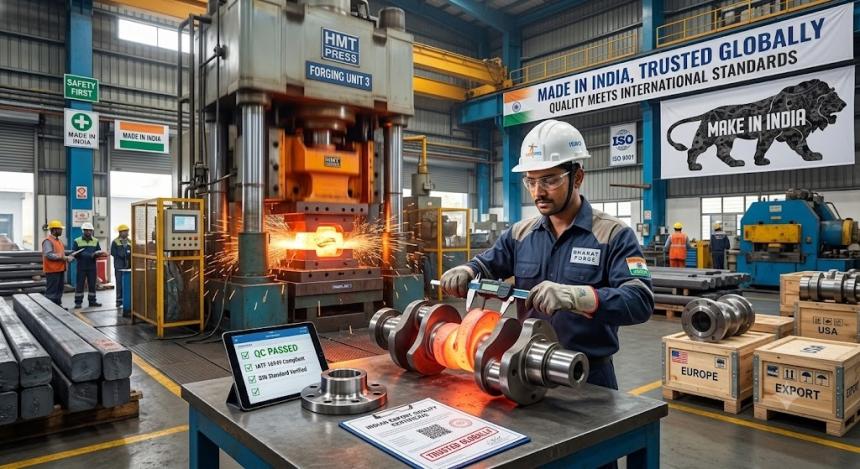
I still vividly remember that cool November morning in Munich, back in the year 2018. I was having a meeting with the super strict VP of Procurement from a European heavy machinery manufacturer OEM. On the table were the remnants of a flanged component, a failed part, which had been supplied by a very cheap vendor at the opposite end of Asia. Due to dynamic fatigue, it cracked at the grain boundary, and the failure was sudden. The project was already delayed three months, and they had lost line downtime worth tens of thousands of Euros on a daily basis.
'What we want is structural material, not the cheapest metal,' he replied, rubbing his temples. Can India be trusted for precision forgings that will be subjected to 400 bars of pressure and not be damaged?'
Two weeks later, we visited a forging plant in Pune, Maharashtra state. We were standing on the shop floor, with the noise of forging machines working; their sound was like a hammer on the heart. The German technical auditor took out his ultrasonic defect detector and tested random samples from a batch of hot-rolled alloy steel gear blanks. No voids found inside. The microstructure was also perfect. They also compared the heat treatment records with the spec sheet, and they matched perfectly at the minute level.
Truthfully? That was the moment I realized the narrative had completely changed.
The global industrial sector doesn't only want India to be a low-cost back office casting center anymore; it has become a world leader in precision metals. However, closing the gap between the local manufacturing capabilities and the rigid global quality standards calls for a very thorough technical alignment.
We just have to be frank here: supply chains globally are nothing if not like an infinite game of 'whack-a-mole'. From political tensions and fluctuating cargo rates to supply bottlenecks, procuring managers are constantly under pressure to reduce dependence on single-source supply.
That said, diversification should not come at the cost of standards. When you are sourcing the type of components that are subjected to heavy loads, e.g., automotive drivetrains, offshore oil rigs, wind turbine gearboxes, or high-pressure valves, a microscopic metallurgical defect is more than a minor inconvenience; it's a full-blown operational catastrophe.
Hence, it's the reason why working with an excellent Forging Exporter from India has come to mean more than just saving money; it's become a strategic decision for global OEMs as well.
India's forging ecosystem is not only benefiting from the low-cost of domestic sources, like high-grade steel mills (Tata Steel, JSW, and JSPL) that provide the necessary feed, but also from great engineering talent and heavy investment in capital equipment for automation. Nevertheless, this raw capability is only a half-baked solution. The actual achievement lies in the way these forging plants figure out, apply, and improve beyond the standards and the requirements of International engineering bodies.
From an engineering perspective, you can get a sense of how the whole business of standards alignment is an easy concept when you talk in words, but when you do practical work, you end up losing yourself in the maze of different things. A component made in accordance with a North-American ASTM A105 would not quite be the same in chemical and mechanical respects when you compare it with a European EN 10222-2 one or a German DIN 17243 one.
How does a forging company from India handle a situation like this? The solution begins before metal is even heated.
One could say that forging at root is the manipulation and alignment of plastic deformation so that the internal metal grain pattern matches the directional flow lines on the finished product.
[Raw Billet] ➔ [Controlled Heating] ➔ [Deformation Pressing] ➔ [Grain Flow Alignment] ➔ [Heat Treatment]
Indian top-tier exporting forging units make use of finite element analysis (FEA) software, e.g., QForm or DEFORM, which allows simulating the metal flow in the cavity before one tool is produced, thereby eliminating any potential mistakes. The use of a predictive model can result in the following:
- Prevention of formation of lap and fold (metal) defects during deformation.
- Continuity of grain flow in the region of high stress fillets and flanges will be maximized.
- Thick cross-section parts will maintain uniform mechanical properties.
Moral of the story: Specification in a drawing is not just a list of dimensions but rather a metallography contract. The leading exporters conduct full spectral analysis of each melt to make sure carbon, manganese, sulfur, and phosphorus levels are absolutely within international specifications.
You can forge an extremely precise piece of metal from a die, but if your heat treatment is incorrect by as little as 5 C, your mechanical properties will decrease significantly.
A large number of India's forging export-oriented units make use of fully-controlled furnaces. These are automatic, continuous furnaces which are atmosphere-controlled and also thermocouple multi-point logged. When you are in a process involving Normalizing or Heat Treatment after Quenching and Tempering (Q&HT), etc., for stainless steel grades (e.g., ASTM A182 F316L), today's most modern facilities can keep the temperature uniformity within 5 C.
CRITICAL WARNING: Always be skeptical of any forging supplier who does not offer you an official copy of time-temperature heat treatment charts linked by the exact heat reference number to your batch. Uncontrolled cooling can lead to the development of fragile structures such as martensitic or micro-segregations, which can then significantly reduce the load-carrying capacity and lifetime of the component under cycling loads.
That's right; the cheapest part of the business is the advertising.
What differentiates an average workshop from a high-grade export-oriented one is the quality assurance infrastructure available inside. When you team up with a certified Forging Exporter India you get each batch of parts not just of high export quality but of a metallography quality and traceability level, supported by a wide set of metal and mechanical properties tests.
Compliance between Closed-Die and Open-Die Forging
Depending on the type of production requirements, one should decide which method is a better choice. India's forging centers located in prominent industrial towns such as Pune, Rajkot, Ludhiana, Chennai, and the National Capital Region (NCR) are capable, through specialization of the production process, of producing a variety of forgings in either way:
- Closed-Die Forging (Impression Die): Used mainly in the automotive sector for the manufacture of such precision components as connecting rods, crankshafts, yokes, and gear blanks requiring close tolerances ($\pm 0.5 ext{ mm}$) and consistent quality.
- Open-Die Forging: It is suitable for the production of big industrial gears, massive rings, wind power rotors, and custom valve bodies whose weight can vary from 50 kg to 30 tonnes.
Inspection on Behalf of a Third Party and International Certifications
In my view, it's not that international trust is just handed over, but it is a matter of thorough auditing.
Top Indian suppliers of forging goods regularly invite third-party inspection companies like SGS, Bureau Veritas, TÜV Rheinland, Lloyd's Register, and DNV-GL for inspections at their factories. In addition to that, many of these forging mills are authorized under various international quality systems.
- ISO 9001:2015 (Quality Management System)
- IATF 16949:2016 (Automotive Quality Specification)
- AS9100D (Aeronautics & Defense)
- PED 2014/68/EU (Pressure Equipment Directive for the European market of Europe)
- API 6A / 17D (American Petroleum Institute for Oilfield Equipment)
The Cost-Quality Balance: Why Indian Forging Industries are Competitive
To start with, the most obvious subject, the question of the price, will be discussed here.
Why would major international Procurement Managers prefer India for offshore contracts and move production closer? Do you think it is only because of the lower labor cost?
No longer is Labor cost the key.
The biggest economic edge in the forging business is provided by the integrated manufacturing value chains. One can find many Indian forging companies operating a one-stop shop for die design, precision CNC machining, heat treatment, surface finishing (shot blasting, phosphating), and testing.
Making the Total Cost of Ownership of a forging export company in India as small as possible is one of the ways to achieve a higher Return on Investment (ROI). The reason is that one can factor in the lack of defects on the product and reduced reworking of scrap at the customer's premises to save money in the long run. Moreover, the timely delivery of goods is a factor too.
If you have just started writing the invitation for a Request for a Proposal, or a procurement lead is going to work with an offshore supplier for the first time, you can use the following checklist as an efficient tool to identify and eliminate weak suppliers, among others:
- Will the supplier give you mill test certificates (MTC) for every single shipment? If so, will these documents show the furnace number, the composition, the result of mechanical tests, etc?
- Will they produce billets for a forging mill from certified, by ISO/IATF, primary?
- Do they perform machining operations with conventional machines only? What about the multi-spindle CNC centers and the vertical machining centers (VMCs)?
- Can they deliver fully finished parts without the need for your end to do the secondary processing once the goods are here?
- In order to protect forged components before shipment, are they treated with anti-corrosive paint and placed in VCI (Vapour Corrosion Inhibitor) packaging, and the whole thing is shipped in heat-treated wooden containers which conform to ISPM-15 for marine shipping?
- Possessed you of a warning: If in your purchase order (PO) terms you have omitted the requirement of the seaworthy VCI packaging, the result will be a massive oxidation of the surfaces which are extremely difficult to clean by chemical or mechanical means, especially after many weeks at sea. You know the final result: You'll have the machine part made as specified, but it may be totally useless once you receive it.
Actually, if you've found remote auditing skills to evaluate an India Forging Exporter supplier, it is going to save a lot of time in your organization, which you would otherwise use up looking for suitable suppliers, and reduce the risks for your supply chain before you've actually spent a lot of the company money on the project.
Beyond all, industrial procurement is more than just matching numbers on the sheet. Peace of mind comes in hand at the moment of getting it all right for production. It means the parts used in heavy machinery will not only work in the most unforgiving conditions for many years, but they were chosen based on the technical characteristics, too.
A silent revolution of sorts has taken place in the Indian forging industry.
With the combination of advanced automated technology, maintaining international quality standards, and engineering with the customer requirements as the guide, only a reliable Forging Exporter India will assure that your essential parts will satisfy all the international standards at a reasonable procurement price.
Directors of Sourcing: Top 3 Takeaway Points After a Summary- Traceability is a must. Check only heat number-based EN 10204 3.1 certificates for the quality.
- Heat Treatment Process Check. Furnace logging must be continuous, and non-destructive testing facilities are a must.
- Be Cost-conscious. Do not just check FOB price alone; also consider in-house CNC finishing/machining, VCI seaworthy packaging, and defect-free quality records.
Vigortrix Review: Is It Worth Trying? Results, Pricing & Where to Buy
What Is Vigortrix? Vigortrix is a men's vitality dietary supplement designed to support e...



Golden Touch Fusion CBD – Premium Quality and Natural Wellness Support
What Are Golden Touch Fusion CBD? Golden Touch Fusion are a cannabidiol (CBD) supplement...