
Love Rendered Usefulness
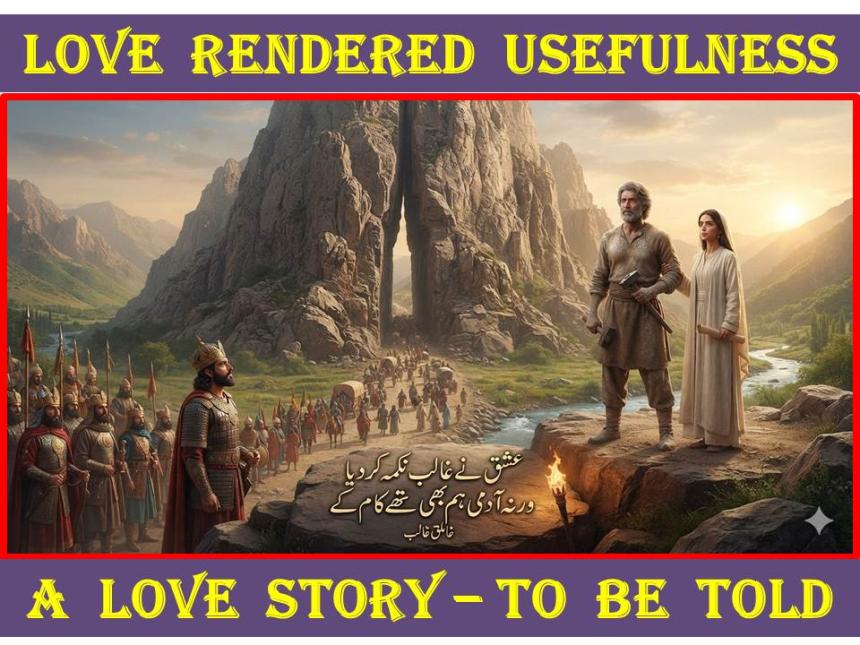
Storytelling is an important tool because it builds emotional connections, helps people remember information, and fosters empathy. There is a famous love story about Shirin and Farhad and like all other such love stories e.g Romeo and Juliet ends up to be a tragic romance story. Ghalib is a famous fundamental Urdu poet and Shirin Farhad love story "Love Rendered Usefulness" is being retold, in light of his verse with a fresh approach.
أَعُوذُ بِاللّٰهِ مِنَ الشَّيْطَانِ الرَّجِيمِ
بِسۡمِ ٱللهِ ٱلرَّحۡمَـٰنِ ٱلرَّحِيمِ
In the name of ALLAH, the Most Gracious, the Most Merciful
Love Rendered Usefulness
"Love Rendered Usefulness" is a beautifully poetic phrase that speaks to the idea of love finding its ultimate expression through action, service, and practical care. When love is rendered useful, it moves past feelings and words to become something tangible that lifts burdens, builds up others, and solves real-world problems. Let’s read in the following a story on the same theme:-
The Circle of Desires
Once upon a time, at the foot of a towering, majestic mountain, lived a stonecutter named Farhad. He lived in a breathtakingly beautiful valley where emerald fields stretched across the lowlands and crystal-clear streams cascaded down from snow-capped peaks. Yet, despite the natural beauty surrounding him, Farhad’s life was defined by a restless, burning ambition. He did not merely break rocks out of necessity; he loved playing with his hammer and chisel, viewing them as stepping stones to something greater.
Farhad’s resolve was rooted in the saying: "Whoever conquers the mountain peak shall discover the secret of an ideal life." These words took deep root in his heart, and he resolved to conquer that towering summit; wielding his hammer and chisel, he would carve a staircase to reach a height where no human had ever set foot. People called him a madman—a madman... Why those in love are always deemed insane?
One day, while delivering stones to the mansion of a wealthy merchant, he witnessed a life of pure luxury. Looking at his own dust-laden hands, he thought to himself, "My tools are making a path to the top far too slowly. How powerful a rich man must be! He could easily fund an expedition to reach any peak." A deep desire awoke in his heart: "I wish I were rich."
Instantly, his wish was granted. Farhad found himself dressed in fine silks, surrounded by immense wealth. For a brief moment, he was content. However, shortly after, a prince passed through the valley with immense royal grandeur. Soldiers marched ahead of him, an army of servants followed, and even the wealthiest merchants bowed low in respect. Farhad fell into deep thought. "A rich man is not truly powerful after all. A prince holds the ultimate authority to command an army to reach the top. A prince is the one who is truly powerful." His heart yearned once more: "I wish I were a prince."
The wish was granted. Now Farhad possessed palanquins, soldiers, and servants. Wherever he went, people bowed. He commanded his armies to march toward the peak, confident that his ideal life was finally within his grasp. But as they climbed, the blazing sun in the sky scorched his men. Royal status could not govern the fierce heat. His soldiers collapsed, and they were unable to move any further. "The sun is more powerful than I am," Farhad realized. "It sits effortlessly above the peak." His heart cried out: "I wish I were the sun."
That wish, too, was instantly fulfilled, and Farhad became the sun. But his fire scorched the fields of the beautiful valley, dried up the rivers, and forced the people into hiding. He felt immensely powerful, shining down from the heavens onto the mountaintop. But after some time, a thick, dark storm cloud completely blanketed the valley. Not a single beam of his light could pierce through it. "The cloud is more powerful than the sun," he realized. He wished to become a cloud, and so it happened. As a cloud, he poured heavy rains until the rivers overflowed and the fields vanished underwater. He swirled around the mountaintop, unleashed his fury, and tried to wash it away in a flood. But he could not move the mountain. The mountain stood, tall and resolute, completely unmoved by storms manufactured by him.
"The mountain itself is more powerful than the cloud," Farhad thought. He wished he must become the mountain itself. His wish was granted, and he became the mountain—unaltered by sunshine, rain, or wind. Standing high and mighty, Farhad felt that he was now the ultimate monument that everyone else tried to conquer. He possessed the summit.
"At last," he thought, "I am at the top of the world. I am the most powerful. I have achieved ideal life."
But just as this thought arose, he heard a sound: Tuck... Tuck... Tuck... A hammer and chisel were striking his rock. A sharp pain vibrated deep within his stone bones.
"Who could possibly be powerful enough to break a mountain?" he wondered in disbelief. He looked down toward the base of the mountain in the beautiful valley. There, at the foot of the mountain, stood a lone stonecutter—a laborer holding a hammer and chisel, steadily carving away stone from his very foundation.

The Awakening and the Princess
The moment Farhad realized that the ultimate power in the universe was neither a king, nor the sun, nor a cloud, nor a mountain, but the unyielding will and labor of a human being, his final wish was granted. He found himself back in his dust-covered clothes, holding his hammer and chisel at the foot of the mountain. But inside him, there was a profound, serene peace. He had uncovered the greatest secret of existence.
Some time later, the royal caravan of the Armenian Princess Shirin passed by that place. Upon seeing the rugged, rocky mountain, Shirin remarked wistfully, "If only there were a person of such resolve who could carve a path through this mountain to my kingdom—connecting two distant valleys—so that I might spend time amidst such beautiful landscapes!"
When Farhad saw Shirin, her innocent face and graceful voice instantly captivated his heart. But Farhad quickly reined in his emotions. He was no longer a naive dreamer. Having lived through the illusions of wealth and power, he knew the stark difference between hollow desires and reality. He recognized the vast social divide between a dusty stonecutter and a princess of the realm. He had no desire to possess or marry her. Instead, he wanted to teach the princess and her cynical court a profound lesson about reality: that it is easy to sit in palaces and harbor impossible desires, but bringing them to life requires sweat, blood, and unyielding resolve. He resolved to cut the mountain—not to win a bride, but to prove that human labor can transform a discarded dream into a living reality.
Love Rendered Me Useless
Farhad cast aside all worldly gains, status, and rational calculations, and raised his hammer. The world mocked him, calling him a fool for wasting his life on a rock. But Farhad had attained a state of spiritual liberation. Ordinary love ruins and breaks common people, making them useless to society. But this was Farhad—the master artisan. His love took a divine, selfless form. It liberated him from worldly greed and the desire for validation. With every strike of his chisel against the stone, the immortal verse of the poet Ghalib echoed through the valley:
Ishq ne Ghalib nikamma kar diya,
Warna aadmi hum bhi the kaam ke.
(Love rendered me useless, O Ghalib,
Else, I too was a man of great capability.)
Farhad was "useless" to the material world because he no longer cared for its rewards. He was carving this path for a higher purpose: to bridge the gap between divided communities, to bring prosperity to the poor, and to ensure that whenever humanity walked through this path, they would genuinely pray for his gentle princess.
The Softening of the King
History often remembers King Khosrow Parvez as a jealous and tyrannical ruler, but a hidden truth remains untold. When Khosrow initially arrived with chests of gold and jewels to break Farhad’s spirit, offering to make him the wealthiest merchant or the prime minister if he abandoned his chisel, Farhad merely smiled and tossed a handful of dirt over the gold.
"Your Majesty," Farhad said calmly, "I have already been a merchant, a prince, and the sun itself. It is all fleeting. This love has made me 'useless' to your world of greed, but it has granted me a freedom your throne can never buy."
As days turned into months, Khosrow watched Farhad work. He saw how every strike shattered the unyielding rock, and how the sweat from Farhad's brow seemed to soften the very stone. Witnessing this absolute, selfless dedication and love for humanity, the stone-hard heart of King Khosrow finally melted. Recognizing that a man who has conquered his own ego cannot be broken, Khosrow surrendered his pride.
Instead of plotting against him, the King provided a massive force of royal laborers and engineers to work under Farhad’s command. The fusion of the King's resources and the stonecutter's absolute conviction achieved the impossible. The mountain was conquered, and a wide, beautiful highway was forged through the stone.
Eternity
When the highway opened, thousands of poor farmers, travelers, and caravans began flowing between the valleys. Prosperity bloomed, and heartfelt prayers for Princess Shirin and the master stonecutter filled the air. When Princess Shirin walked through the newly carved pass and realized that Farhad had not done this to claim her as a prize, but to honor her dream and save her people, her inner world shifted completely.
According to the laws of the world, she was destined to marry a prince and live as a queen. But she looked around and wondered where in this material world she would ever find a heart as vast and noble as Farhad's? How long would she truly live as a queen? A few decades in a gilded cage before being buried into the forgotten pages of history? Farhad’s sacrifice had shown her the true face of divine love (Ishq-e-Haqeeqi). She learned that true power and immortality do not lie in wearing a crown, but in erasing one's ego to serve others.
Shirin renounced her royal silks, her titles, and her palace forever. Refusing to become a mere decoration for a prince's court, she chose to live at the base of the highway, dedicating her entire life to serving humanity—tending to weary travelers, healing the sick, and feeding the poor. Without the traditional bonds of marriage, Farhad and Shirin became eternally unified in spirit and purpose. Farhad stood atop the peaks, continually shaping the landscape, while Shirin remained in the valley, nurturing the community that flourished because of his sacrifice. They were deemed "useless" by a world obsessed with material gain, but through their selfless love, they achieved true immortality.
Even today, when travelers pass through the majestic roads carved deep into the great mountains of the world, a whisper echoes through the wind with the sound of a distant chisel: Love rendered me useless, O Ghalib, Else, I too was a man of great capability.
Epilogue: The Hymn of the Chisel
I chased the crown, I chased the sun,
The phantom races wealth had run.
I wore the silk, I ruled the cloud,
And stood atop the mountain proud.
Yet in the heights, I found no rest,
A hollow king, an empty chest.
Until a striking truth awoke:
The universe is but a stroke
Of human will, of sweat and bone,
That shatters the unyielding stone.
The highest peak must bow its head
To where the dusty dreamers tread.
Then came her voice, a gentle sigh,
A dream cast up against the sky—
To build a path where valleys meet,
And lay the world at hidden feet.
I did not strike to win her hand,
Or rule across a conquered land;
I struck to show what love can do
When false desires fade from view.
Let rulers mock this useless state,
Let kings debate my foolish fate.
For I have left their court behind,
A higher, deeper truth to find.
No longer bound by greed or pride,
With every mountain pushed aside,
We live where broken paths are healed,
And love’s eternity revealed.




From Mine to Market: Tracking the Raw Materials Behind Fertilizer Pric...
Fertilizer prices in October were driven more by government decisions than by farm demand.