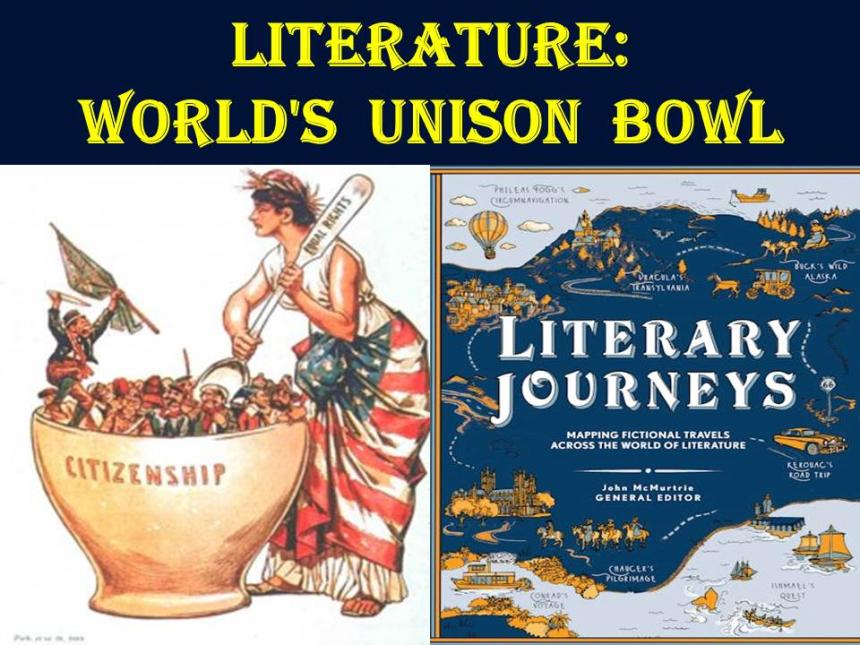

Literature: World's Unison Bowl
Literature is the artistic expression of human emotions, thoughts, and experiences. Literally, it refers to a collection of poetry and prose (such as novels, stories, and poems) that reflects 'the life' and affects the reader's or listener's heart is called literature. This write up " Literature: World's Unison Bowl" is discussing the literature and its universal appeal so as to act for unison of the world.
أَعُوذُ بِاللّٰهِ مِنَ الشَّيْطَانِ الرَّجِيمِ
بِسۡمِ ٱللهِ ٱلرَّحۡمَـٰنِ ٱلرَّحِيمِ
In the name of ALLAH, the Most Gracious, the Most Merciful
Literature: World's Unison Bowl
In its simplest definition literature is a body of written works. However, the name has traditionally been applied to those imaginative works of poetry and prose distinguished by the intentions of their authors and the perceived aesthetic excellence of their execution. Literature may be classified according to a variety of systems, including language, national origin, historical period, genre, and subject matter. The term is also used more narrowly for writings considered an art form, especially novels, plays, and poems. It includes both print and digital writing. In recent centuries, the definition has expanded to include oral literature, much of which has been transcribed.
Definitions of the word literature tend to be circular. The 11th edition of Merriam-Webster’s Collegiate Dictionary considers literature to be “writings having excellence of form or expression and expressing ideas of permanent or universal interest.” The 19th-century critic Walter Pater referred to “the matter of imaginative or artistic literature” as a “transcript, not of mere fact, but of fact in its infinitely varied forms.” But such definitions assume that the reader already knows what literature is. And indeed its central meaning, at least, is clear enough. Deriving from the Latin littera, “a letter of the alphabet,” literature is first and foremost humankind’s entire body of writing; after that it is the body of writing belonging to a given language or people; then it is individual pieces of writing.
(https://www.britannica.com/art/literature )
Literature is the artistic expression of human emotions, thoughts, and experiences. Literally, it refers to a collection of poetry and prose (such as novels, stories, and poems) that reflects 'the life' and affects the reader's or listener's heart is called literature. The terminological meaning of literature is to compose humans' life expressions, thoughts, and imagination in a beautiful written form.
Literature is a creative art form using written or spoken words in various genres and formats. It features beauty of language, deep expression, and artful storytelling; which creates a taste of literal beauty for the reader; and fulfills the admiration from his sense of articulation, expression and humor.
It is universally acknowledged that literature is a mirror of the society and records human conditions of its time. Professor Thomas Huxley, an English biologist and anthropologist once said "Literature is an expression of society." "Literature basically reflects the bad and good of the particular society and thus helps the people of the society to recognize what they are going through." Therefore, literature acts as a mirror to society, capturing both its virtues and its flaws. It helps people see their own reality, understand shared struggles, and find ways to fix what is broken.
"Literature symbolizes society or the world in all aspects. It has been creating a huge impact in development of society by changing the political system and a preview of humans who experience this in their life. Literature makes us to deeply analyse societal issues and sometimes it provides us a solution to solve the problem. The Poet, the dramatist, the novelist, the essayist all of them reflects society in their works. Literature reflects both good and bad values of the society. In reflecting the bad values it makes us to rectify and solve the issues. In reflection of good values in the society it makes us to emulate. Often as reflection, literature presents a picture of what people think, say and do in the society. Literature records the real life events from the society and converts these mundane activities into fiction and presents them to the society as a mirror in which people may look at their own images and make amends wherever necessary."
(https://www.technoarete.org/common_abstract/pdf/IJSEM/v5/i4/Ext_38179.pdf )
Famous English poet William Wordsworth described poetry as the "spontaneous overflow of powerful feelings" in his "Preface to Lyrical Ballads"; similarly literature is an effective expression of human emotions and feelings; and this is done through words that touch the heart; and awakens consciousness in the reader. And such a creative process is not just information, but also the personal and artistic experience of the writer.
"Literature is the art of expressing emotions, thoughts in a society. It is the reflection of opportunities and obstacles, pain and gain, and assets and liabilities prevailing in the society. Literature can be said as the mirror through which we can see the whole society. Society can be best understood by reading historical fiction or contemporary fictional books. Literature also revolves around the society as many authors try to depict the uplift and backlogs of society in their piece of art. In literature, we find stories designed to portray human life and action through some characters that, by their words, action and reaction convey certain messages for the purpose of education, information, and entertainment."
"We cannot separate society and literature as it is the part and parcel of life. Therefore, Literature and society can be accepted as the two faces of the same coin that cannot be separated. Literature is the way of expression towards society. Hence, Literature cannot sustain without society, and on the other hand, the society too cannot be unnoticed in literary piece in one way or another. Literature is created by human beings and human beings create a society."
(https://anubooks.com/uploads/session_pdf/166255093412.pdf )
A writer and poet write to convey his inner feelings, thoughts, and observations to others. His goals include describing beauty, expressing humanity, reforming society, and searching for truth. The reasons for expressions (spoken and written) by a writer and poet include registering emotions and feeling of the happiness or sadness that oozes in the heart of a writer and poet, and flow through his tongue or pen-an art he masters at. Moreover, a writer and poet reflect his observations and see the world and the conditions of people around him and mold them into a prose or poem. The writers and poets also find satisfaction in doing such expressions; because writing on a topic that flourishes in the heart and mind gives the writer and poet mental peace and happiness.
The use of literature to reform society was championed by key figures like Martin Luther (britannica.com), Charles Dickens, and Raja Ram Mohan Roy (brainly.in), who used written works to challenge corruption, poverty, and unjust traditions. Literature for the reformation of society includes influential works that challenge injustice, expose flaws, and inspire moral or political change. Key examples are Harriet Beecher Stowe’s Uncle Tom’s Cabin, Charles Dickens’s Oliver Twist, and the educational essays of the Sir Syed Ahmad Khan in India.
The writers and poets also keep the reformation of society in mind; therefore, they draw everyone's attention to the evils, injustices, and shortcomings of society through their submissions. The writers and poets teach people about love, peace, and goodness. And through this, they also protect history and culture. They preserve the conditions, lifestyle, and values of their time for future generations. And at a higher level, the writers and poets also carry out the function of awakening the consciousness of their nations. They force people to think through their writings and other literary forms as per the sense of responsibility within themselves.
Literature is always a mirror of the conditions, social atmosphere, and human emotions of its time. "The Romantic poets, often writing about beautiful rural landscapes as a source of joy, made nature poetry a popular poetic genre. When writing environmental poems today, contemporary poets tend to write about nature more broadly than their predecessors, focusing more on the negative effects of human activity on the planet. Critic Jay Parini explained in his introduction to Poems for a Small Planet: Contemporary American Nature Poetry, “Nature is no longer the rustic retreat of the Wordsworthian poet. … [it] is now a pressing political question, a question of survival.” Distinct from nature poetry, environmental poetry explores the complicated connections between people and nature, often written by poets who are concerned about our impact on the natural world. Poets today are serving as witnesses to climate change while bringing attention to important environmental issues and advocating for preservation and conservation."
(https://www.poetryfoundation.org/collections/146462/poetry-and-the-environment )
From the Ripple Foundation: "Your environment directly affects different aspects of your writing, from your style to the topics you write about. Through experience, your surroundings, such as location, atmosphere, and culture play a significant role in your writing. Writing is an artistic medium which can change based on the environment you are writing in… Writing at places, where you may have emotional and cultural ties, can help you easily communicate your feelings." (Ripple Foundation Wave Blog).
Writers and poets take influence from their environment and mold it into their art. Literature describes the problems, sorrows, and joys of their time. It becomes the voice of society and represents the emotions of the people. Literature does not only describe the conditions, but also gives us the idea of changing society. Literature always creates history, which allows us to follow the events of the era in which literature was written.
A research paper on "ResearchGate.net/Publication" with the title "Evolution of Local, National Or Regional Literature Into World Literature" says "David Damrosch, in his seminal book, What is World Literature?, reveals that Goethe brought forth his vision in a discussion with his disciple, Eckermann, in such a statement; “I am more and more convinced that poetry is the universal possession of mankind, revealing itself everywhere and at all times in hundreds and hundreds of men...I therefore like to look about me in foreign nations, and advise everyone to do the same. National literature is now a rather unmeaning term; the epoch of world literature is at hand, and everyone must strive to hasten its approach.” It further adds on "the world literature is literature that is massively read across cultural divides, either in its original language of production or translation to foreign languages."
It may be said that the literature may be both regional and international. Literature is born within its specific area and region, rooted deeply in local culture, unique geography, and distinct language patterns. This connection shapes how stories capture the true spirit and daily life of a homeland. It may said that literature is born within its own area and region soaked into its own soil and culture, so it has regional roots. But when it presents human emotions and truth in a moral, rational and human way, it wins the hearts of people all over the world and becomes international. Any literature which is connected to the language, customs and environment of its region and shows the problems and joys of a particular society in a true way; then it preserves the identity and culture of a nation. Any literature with true representation of a national spirit, free from jingoism and shallow approach, will seek universal appeal; because it will be story of the emotions and feelings of mankind.
There are many examples of literary works translated and filmed in other country becoming super hits. Famous international literary works translated and adapted into massive box-office hits abroad include Stieg Larsson’s The Girl with the Dragon Tattoo, Bong Joon-ho's adaptation of the French graphic novel Snowpiercer, and Akira Kurosawa’s cinematic translation of Shakespeare’s Macbeth into Throne of Blood.
The original Source of "The Girl with the Dragon Tattoo" is Swedish crime novel Män som hatar kvinnor by Stieg Larsson. The 2011 Hollywood version directed by David Fincher grossed over $232 million worldwide and earned critical acclaim, following the massive success of the 2009 Swedish-language film adaptation. The original Source of "Snowpiercer"; French post-apocalyptic graphic novel Le Transperceneige by Jacques Lob and Jean-Marc Rochette and directed by South Korean auteur Bong Joon-ho, this international co-production became a critical darling and global box office hit, grossing over $86 million. The original Source of "Throne of Blood"; is William Shakespeare's English play Macbeth. Transposed by Akira Kurosawa into feudal Japan, this adaptation became a monumental critical success in global cinema history and one of Japan's most revered artistic achievements. The 2005 Indian drama film Black (en.wikipedia.org) was inspired by the life and writings of Helen Keller (en.wikipedia.org), drawing specifically from her autobiography "The Story of My Life".
As the humans are constantly on the move and the men of letters and creators of literature also travel; so they also accept the influences of other regions and in today's modern era, the mixing and meeting of people from different regions is not a surprise; therefore, today it is not difficult to create literature that has an international flavor. Therefore, literature with an international flavor is being created through cross-cultural migration, professional literary translation, and the influence of digital connectivity. Authors draw from multiple traditions, and multinational publishing houses distribute these diverse works to worldwide audiences.
Authors living between two or more cultures infuse their stories with displaced identities, hybrid languages, and dual perspectives. Borderless digital platforms, international literary festivals, and multinational conglomerates actively seek and market diverse, cross-border narratives. Writers from formerly colonized spaces reshape traditional Western literary forms, injecting local folklore, historical realities, and alternative stylistic rhythms. Writers from formerly colonized spaces reshape traditional Western literary forms, injecting local folklore, historical realities, and alternative stylistic rhythms. Such literature may therefore be called international literature.
The characteristics of international literature must be a blend of global thinking. It talks about the shared human emotions such as love, sorrow, joy, fear, anger and peace and human feelings like surprise, disgust, shame, hope and gratitude. With the help of mutual translation of different languages, this literature reaches other languages and countries. This breaks the boundaries and affects readers all over the world. Literature is like a beautiful plant. Its roots are in the soil of its region, but its flower spreads its fragrance all over the world. The beauty of this type of literature is loved and appreciated all over the world.
Can literature be called the common asset of humanity? Yes, literature can be called the common asset of humans. Literature is not limited to any one region or language. It expresses the emotions, thoughts and experiences of humanity. And people all over the world have the same emotions and feelings. Therefore, all literature written about humanity is actually the common asset of all humans. This is because it describes the truth of human experiences. Literature written in any corner of the world, speaks of the emotions of love, sorrow, joy and fear of all humans, men, women, children and the elderly. These emotions are the same in all humans.
International literature leads to connecting hearts in large areas across continents. Such literature gives us, the people of one region, the opportunity to understand the lives and problems of the people of another region. It reduces the distance between different nations and cultures. International literature teaches love, peace and justice with a universal message. The stories and poems of great writers are free from the bondage of race and language. Their message is for the whole world.
Literature is the story of man and it is a lesson for mankind. Literature is actually the heart and soul of mankind.The voices of the poets and writers are like a picture of their past and present and a bright lamp for the future. Literature is a human story that describes the happiness, sorrows, love and hatred of human beings. Whatever literature is, it is always a mirror of the history of its time. It tells how man has traveled through time and what he has seen. Therefore, it reflects the society of the place of literature.
Literature always puts the good and bad of society in front of us. Literature gives humans the opportunity to learn lessons, which provides the moral training of humans. Literature shows us the path of truth and goodness; and teaches human compassion. Literature also teaches us to feel the pain of other humans. Literature gives humans the opportunity to recognize themselves and act with reason and understanding.
Literature has a universal appeal that unites the world by fostering shared human empathy, crossing cultural borders, and highlighting common moral values. It connects people everywhere through emotional truth and shared stories. Books invoke human emotions and touch the feelings like love, grief, and hope that all people feel. Stories dealing with the humans' fight for freedom, justice, and peace re-enforces belief in struggles for common causes. Tales teach kindness, fairness, and respect for others fostering core values. World literature is a global cultural asset defined by cross-border circulation, translation, and shared human values. It acts as an intellectual bridge connecting diverse national stories and with the latest spread of the digital technological spread, the global reach of literature and its appeal is beneficial for unison of mankind.
We will see in the next coming days; how the literatures of different civilizations, countries, languages and societies have conveyed similar messages? This will be an interesting and fascinating read; which the readers will definitely like. Please follow; thanks.






Aviloo teszt – Az elektromos autók akkumulátorának megbízható állapotf...
Aviloo teszt – Az elektromos autók akkumulátorának megbízható állapotfelmérése
