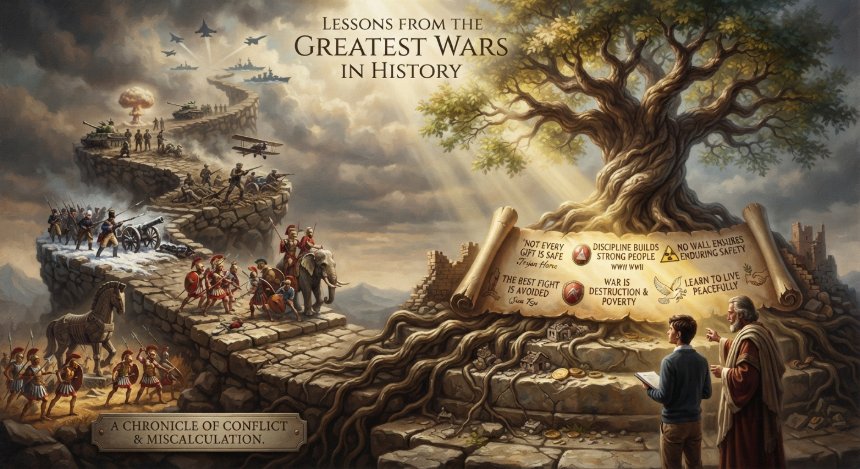

LESSONS FROM THE GREATEST WARS IN HISTORY
Throughout human history, warfare has served as a catastrophic yet powerful catalyst for global change, reshaping borders, toppling massive empires, and redefining civilizations. By examining these monumental conflicts in a strict chronological timeline, we can uncover profound, timeless lessons about statecraft, technological adaptation, strategic hubris, and the heavy socioeconomic toll of military ambition. Ultimately, this historical arc reveals that the true measure of a society's greatness is found not in its capacity to launch a brilliant military campaign, but in its structural resilience and enduring commitment to peaceful coexistence.
أَعُوذُ بِاللّٰهِ مِنَ الشَّيْطَانِ الرَّجِيمِ
بِسۡمِ ٱللهِ ٱلرَّحۡمَـٰنِ ٱلرَّحِيمِ
In the name of ALLAH, the Most Gracious, the Most Merciful
LESSONS FROM THE GREATEST WARS IN HISTORY
Throughout history, warfare has been one of the most powerful catalysts for human change, shaping borders, collapsing empires, and forcing societies to adapt. By examining these monumental conflicts in chronological order, we can uncover profound lessons about governance, technology, arrogance, and the heavy cost of human ambition.
1. The Trojan War (c. 12th Century BCE)
The Trojan War stands as one of antiquity’s most enduring legendary conflicts, sparked by the abduction of Helen of Troy and fought between the kingdoms of Greece and the walled city of Troy. For ten grueling years, conventional military strength failed to breach Troy's formidable defenses, driving the conflict into a bloody and exhausting stalemate. It was only when the Greeks feigned a total retreat, leaving behind a massive wooden horse as a deceptive peace offering, that they managed to bypass the city's walls from within. The Trojans celebrated their apparent victory, unaware that elite soldiers hidden inside the structure would emerge under the cover of night to open the gates to the returning Greek army.
• The Core Lesson: Not every gift is safe; blind acceptance of unexpected generosity from an adversary often masks a Trojan horse designed for your destruction.
2. The Battle of Marathon (490 BCE)
The Battle of Marathon marked a pivotal moment in the First Persian Invasion of Greece, where a heavily outnumbered citizen-army of Athenian hoplites stood alone against the vanguard of the mighty Persian Empire. Recognizing that a standard head-on clash would lead to a swift encirclement, the Athenian general Miltiades devised a brilliant, unconventional battlefield strategy. He deliberately weakened his center lines while packing heavy infantry onto his flanks, luring the overconfident Persian forces deep into a trap before closing the sides around them. This sudden, aggressive double-envelopment shattered the Persian lines and forced a chaotic retreat, proving that raw numbers could be overcome by superior tactical coordination.
• The Core Lesson: A smaller force with a clear, well-executed plan can decisively win against an overwhelming opponent.
3. Thermopylae (480 BCE)
The Battle of Thermopylae occurred during the Second Persian Invasion of Greece, when King Leonidas led a small vanguard of 300 elite Spartans and a few thousand Greek allies to block the path of Xerxes’ massive, hundred-thousand-strong imperial army. Knowing they could never defeat the Persian host in an open field, the Greeks chose a narrow coastal pass that severely bottlenecked the enemy's numbers, rendering their overwhelming cavalry and archery useless. For three days, the heavily armored Greek hoplites held the line with unbreakable discipline, inflicting massive casualties on the Persian forces until a local informant betrayed a mountain path that allowed the invaders to outflank them. Though the defenders were ultimately wiped out, their heroic stand delayed the Persian advance and bought precious time for the rest of Greece to unite and prepare a winning defense.
• The Core Lesson: A small team with a strong position and unbreakable resolve can hold the line against seemingly impossible odds.
4. Sparta & The Peloponnesian War (431–404 BCE)
The Peloponnesian War was a devastating, generation-spanning civil conflict that pitted the democratic naval empire of Athens against the austere military oligarchy of Sparta for total hegemony over the Greek world. For centuries, Sparta had proven that rigorous lifestyle discipline and continuous physical training built an incredibly strong, elite warrior class capable of dominating any land battle. However, as this protracted war dragged the entire region into decades of brutal siege warfare, internal political betrayals, and devastating plagues, both superpowers tore their shared civilization apart. By the time Sparta finally secured a costly victory with Persian funding, the entire Greek world was left deeply fractured, bankrupt, and highly vulnerable to foreign conquest.
• The Core Lesson: While discipline builds strong people, fighting each other ultimately weakens everyone and leaves the whole society exposed to collapse.
5. Sun Tzu & The Art of War (c. 5th Century BCE)
During China's chaotic and bloody Eastern Zhou period, military general and philosopher Sun Tzu compiled his foundational strategic insights into the text known as The Art of War. Having witnessed firsthand the immense economic drain, societal ruin, and unpredictable chaos of prolonged warfare, Sun Tzu argued that physical combat should always be a leader's absolute last resort. He revolutionized strategic thinking by asserting that true mastery lies in psychological warfare, espionage, and political deception rather than brute battlefield force. By understanding the enemy's weaknesses and manipulating their movements before a single weapon is drawn, a wise commander can break an opponent’s resolve without ever expending lives or resources.
• The Core Lesson: The best fight is the one you avoid, as winning without open combat preserves your resources and ensures true strategic supremacy.
6. The Punic Wars & Hannibal's Campaigns (264–146 BCE)
The Punic Wars were a series of three monumental conflicts fought between the naval superpower of Carthage and the rising Roman Republic for total dominance over the western Mediterranean. The Second Punic War was defined by the legendary Carthaginian general Hannibal Barca, who bypassed Rome's coastal defenses by marching war elephants across the treacherous, freezing Alps to strike the Italian peninsula from behind. Hannibal consistently used surprise, ambush tactics, and psychological manipulation to inflict catastrophic defeats on much larger Roman armies, famously encircling them at the Battle of Cannae. Yet, despite facing near-extinction, Rome refused to capitulate; they learned from their failures, copied Carthaginian naval designs, expanded their manpower, and eventually launched a counter-invasion that permanently erased Carthage.
• The Core Lesson: Use surprise, not just strength, to destabilize your opponent, but remember that one individual defeat is not the end if your society possesses the structural resilience to adapt and endure.
7. The Great Wall of China (c. 3rd Century BCE–17th Century CE)
For centuries, imperial Chinese dynasties faced a continuous, existential threat of sudden, highly mobile raids from nomadic northern tribes across the Eurasian Steppe. Rather than relying entirely on reactive, expensive military campaigns that drained the imperial treasury, successive rulers invested in building and connecting the vast fortifications of the Great Wall. This massive engineering project was not merely a passive stone barrier, but a highly sophisticated, active defensive network complete with troop garrisons, watchtowers, and a rapid smoke-and-fire signaling system. By proactively controlling high-altitude choke points and securing major trade routes, the wall allowed smaller border forces to effectively monitor, delay, and redirect massive invading armies before they could breach the heartland.
• The Core Lesson: Good defense is smart planning, relying on proactive preparation and robust structural engineering rather than panic-driven reactions.
8. The Hundred Years' War (1337–1453)
The Hundred Years' War was an intermittent, deeply exhausting series of hostilities fought between the royal House of Plantagenet of England and the House of Valois of France over the rightful succession to the French throne. Spanning across generations, this brutal conflict evolved from chivalric medieval skirmishes into an early theater of total war, introducing destructive technologies like the English longbow and early gunpowder artillery. Decades of continuous raiding, scorched-earth tactics, and heavy wartime taxation completely devastated the French countryside, while plunging the English crown into severe financial crises and political instability. By the time the fighting finally ceased, both kingdoms had spent astronomical fortunes only to end up roughly where they started geographically, forever altering their feudal structures in the process.
• The Core Lesson: Long, drawn-out fights inevitably drain both sides, consuming immense resources and human lives for diminishing strategic returns.
9. The Fall of Constantinople (1453)
For over a millennium, Constantinople, the capital of the Byzantine Empire, stood as an impregnable bastion of the Christian world, largely thanks to the legendary Theodosian Walls that had repelled dozens of heavy sieges. However, in 1453, the ambitious Ottoman Sultan Mehmed II arrived outside the city with a revolutionary military doctrine centered around massive, custom-forged gunpowder super-cannons. For several weeks, these unprecedented artillery pieces bombarded the ancient stone fortifications, systematically reducing the centuries-old walls to rubble and allowing Ottoman infantry to flood the gaps. The tragic fall of this historic metropolis sent shockwaves through Europe, signaling the definitive end of the Middle Ages and proving that static, traditional defensive structures were entirely obsolete.
• The Core Lesson: Old walls fail against new tools; relying strictly on past defensive triumphs without continuous technological adaptation leaves you completely defenseless.
10. The Wars of the Roses (1455–1487)
The Wars of the Roses were a series of bloody, intermittent civil conflicts fought between two rival branches of the royal House of Plantagenet—the Lancastrians and the Yorkists—for control of the English throne. What began as a localized political dispute among aristocratic cousins rapidly escalated into an all-consuming feud that fractured the nation's nobility and dragged local communities into factional violence. For over three decades, treacherous betrayals, sudden assassinations, and chaotic battlefield executions systematically wiped out the country's ancient ruling lineages and severely destabilized the monarchy. The exhausting cycle of domestic warfare only ended when a relatively obscure claimant, Henry Tudor, united the warring factions through marriage, building a completely new dynasty on the ruins of the old.
• The Core Lesson: Family fights can easily destroy the whole house, as internal betrayal and domestic division invite total self-destruction.
11. The Thirty Years' War (1618–1648)
The Thirty Years' War erupted within the Holy Roman Empire as a localized religious dispute between Protestant and Catholic states, but quickly spiraled into an all-consuming continental conflict involving Europe's major geopolitical powers. The war was characterized by the widespread use of unchecked mercenary armies who sustained themselves by systematically looting, burning, and terrorizing local civilian populations across Central Europe. Decades of continuous, uncontrolled military destruction triggered catastrophic famines, widespread outbreaks of typhus, and severe economic collapse, wiping out up to sixty percent of the population in some regions. When the exhausted nations finally signed the Peace of Westphalia, they were left to govern depopulated, structurally ruined landscapes that took generations to financially recover.
• The Core Lesson: War leaves everyone poorer, shattering local economies and inflicting civilian trauma that far outweighs any short-term political gain.
12. Napoleon's Invasion of Russia (1812)
At the absolute peak of his continental power, Emperor Napoleon Bonaparte marched his massive, half-million-strong Grande Armée into Russia, confident that a swift, decisive battlefield victory would force Tsar Alexander I to sue for peace. Instead of engaging in a direct fight, the Russian forces executed a masterful scorched-earth retreat, burning their own crops, villages, and even parts of Moscow to deny the invading army any local sustenance. Napoleon found himself sitting deep within a deserted, smoldering capital, dangerously overextended and completely isolated from his European supply lines. As the brutal, freezing Russian winter set in, the French army was forced into a catastrophic retreat, during which hundreds of thousands of elite soldiers perished from starvation, hypothermia, and relentless guerrilla ambushes.
• The Core Lesson: Know your limits before you march; unchecked hubris and ignoring the harsh realities of geography and logistics will break even the most powerful empire.
13. The Battle of Waterloo (1815)
Following his dramatic escape from exile on Elba, Napoleon Bonaparte quickly raised a new French army to challenge the allied European coalitions gathered in Belgium during the legendary Hundred Days. At the Battle of Waterloo, Napoleon faced a combined force led by the Duke of Wellington and eagerly anticipated the arrival of his own detached wing to crush the allied defensive lines. However, Napoleon delayed his initial morning assault due to wet ground conditions and made critical errors in communication, failing to prevent the Prussian army under Gebhard von Blücher from unexpectedly arriving on his right flank. This single, critical miscalculation turned a highly winnable tactical engagement into a chaotic French rout, permanently ending Napoleon's imperial reign and rewriting the political map of Europe for a century.
• The Core Lesson: One bad decision can instantly end a legendary legacy, undoing years of brilliant strategic success in a matter of hours.
14. World War I & The Gallipoli Campaign (1914–1918)
World War I was a catastrophic global inferno ignited by the assassination of Archduke Franz Ferdinand, a localized Balkan crisis that rapidly exploded because of a rigid network of secret European alliances. The war quickly devolved into a horrific, deadlocked trench stalemate, prompting Allied leaders to plan the Gallipoli Campaign to knock the Ottoman Empire out of the war and open a vital sea route to Russia. Thousands of incredibly brave British, French, and ANZAC troops were landed directly onto the heavily fortified beaches of the Gallipoli peninsula under intense enemy gunfire. However, the entire operation was doomed by atrocious intelligence, poor maps, fluid command confusion, and a total failure to account for the steep, easily defensible terrain held by the Ottoman defenders.
• The Core Lesson: Small conflicts can easily grow out of control if unchecked, and even the bravest human effort cannot fix a fundamentally poor operational plan.
15. World War II & The Battle of Stalingrad (1939–1945)
World War II stands as the deadliest conflict in human history, exploding onto the global stage because major world democracies consistently ignored or appeased the early, aggressive expansionist warnings of fascist dictatorships. Seeking a decisive blow against the Soviet Union, Nazi Germany launched a massive offensive into the industrial city of Stalingrad, dragging both nations into a brutal, house-to-house war of attrition. The German High Command, blinded by ideological arrogance, pushed their troops deep into the urban ruins while completely failing to secure their vulnerable flanks or prepare for the fast-approaching sub-zero winter. The Red Army capitalized on this oversight, launching a massive encirclement that trapped the elite German Sixth Army, cutting off their food, fuel, and ammunition supplies.
• The Core Lesson: Ignoring early warnings costs millions of lives, and once locked in combat, winter weather and reliable supply lines matter just as much as raw battlefield courage.
16. The Vietnam War (1955–1975)
The Vietnam War was a prolonged, asymmetrical Cold War conflict that pitted the overwhelming technological, economic, and conventional military power of the United States against the North Vietnamese Army and Viet Cong guerrillas. Operating with an immense arsenal of advanced aircraft, heavy artillery, and chemical defoliants, the conventional superpower struggled to achieve its political objectives against a highly resilient adversary. The communist forces utilized an intricate network of underground tunnels, hidden booby traps, and masterful jungle camouflage, blending seamlessly into the local population and using the dense terrain to launch devastating surprise ambushes. This intense guerrilla warfare eroded the political will of the intervening superpower over two decades, demonstrating that industrial dominance cannot easily subdue an indigenous population fighting on its own soil.
• The Core Lesson: Knowing the land and understanding local terrain beats having more raw industrial power and advanced technology.
17. The Cold War (1947–1991)
Following the destruction of World War II, the Cold War emerged as an intense, decade-spanning ideological and geopolitical standoff between the nuclear-armed superpowers of the United States and the Soviet Union. With both nations possessing enough atomic weaponry to trigger complete global annihilation through Mutually Assured Destruction (MAD), direct military conflict between them was far too dangerous to contemplate. Instead, the rivalry was fought through tense proxy wars, space races, and continuous espionage, occasionally escalating to the brink of nuclear catastrophe during events like the Cuban Missile Crisis. Throughout these dangerous flashpoints, back-channel diplomacy, strategic patience, and structured arms-control summits ultimately triumphed over rash military aggression, successfully preventing a third world war.
• The Core Lesson: Strategic patience, continuous dialogue, and open diplomatic talks can successfully prevent a global disaster.
18. The US-Israel-Iran War (2026)
The US-Israel-Iran War erupted as a highly volatile, modern conflict following massive, coordinated aerial campaigns launched by the United States and Israel against Iran's central command, nuclear sites, and energy infrastructures. Although the initial offensive achieved significant conventional milestones—including the death of Iran's Supreme Leader—it immediately triggered an expansive, asymmetrical retaliation across the entire Middle East. Utilizing its deeply entrenched regional proxy networks and mobile missile capabilities, Iran successfully disrupted global shipping and effectively closed the strategic Strait of Hormuz, sending severe economic shocks through international energy markets. The resulting multi-month stalemate highlighted the limits of conventional air power, demonstrating that long-term strategic success remains elusive when an adversary chooses to endure rather than engage head-on.
• The Core Lesson: Conventional military dominance cannot guarantee a swift or decisive victory in an interconnected world, as asymmetric forces only need to survive and disrupt global supply lines to force a costly stalemate.
Conclusion
When woven together, the long timeline of human conflict reveals that while weapons, strategies, and technologies continuously evolve, the fundamental nature of strategic miscalculation remains remarkably unchanged. From the ancient wooden horse outside the gates of Troy to the modern maritime gridlocks of the Persian Gulf, history consistently punishes hubris, unchecked overexpansion, and the failure to anticipate the compounding logistical or economic realities of total war.
Ultimately, this historical arc proves that there is no such thing as absolute security, and no wall can ensure enduring safety for any nation. Millennia of bloodshed demonstrate that war is not a solution, but only a tool mainly bringing destruction and poverty to both the victors and the vanquished. If our civilization is to survive the terrifying power of modern weaponry, humans must learn to live peacefully and adopt means for coexistence rather than conflicts. True long-term security, as demonstrated across millennia, rarely belongs to those who rush blindly into battle relying solely on raw power, but to those who possess the wisdom to preserve a lasting peace.


How Can Childcare Centres Maintain Cleaner Playrooms and Rest Areas?

Polyester Industrial Yarn Price Trend Q2 2026 | Price Trends, Forecast...




Academic Excellence in AI and Data Science Engineering | HOD's Desk at...
